COSMO-based models: fundamentals and tools, 3rd edition
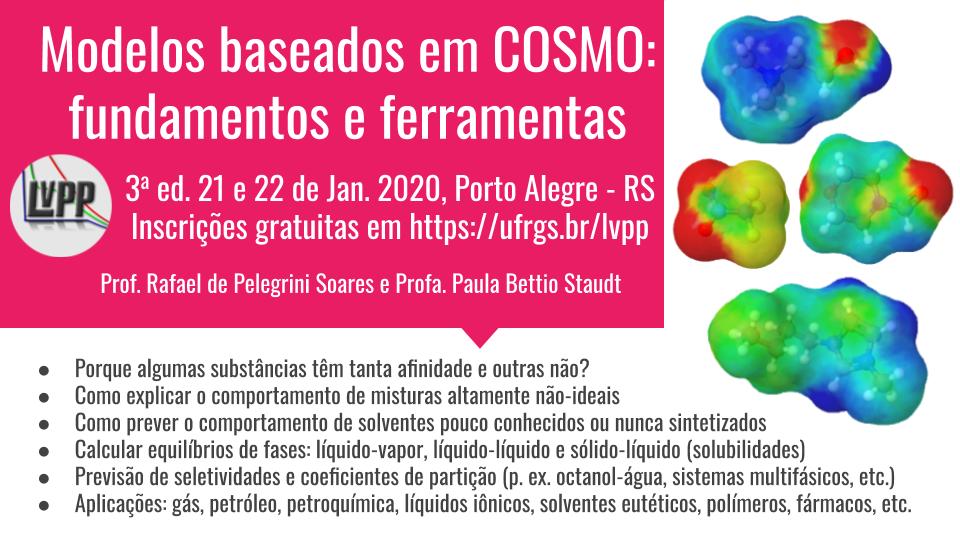
This will be the 3rd ed. January, 21 and 22, 2020, Porto Alegre – RS. Subscription before January 16th, using the form available here. This edition will be in Portuguese only.
The virtual laboratory for properties prediction

This will be the 3rd ed. January, 21 and 22, 2020, Porto Alegre – RS. Subscription before January 16th, using the form available here. This edition will be in Portuguese only.

COSMO-SAC-Phi is a new method for inclusion of pressure effects in COSMO-type activity coefficient models (like COSMO-RS, COSMO-SAC, or F-SAC). The extension consists in the direct combination of COSMO-SAC and lattice-fluid ideas by the inclusion of free volume in form of…
Read more

Although very successful, activity coefficient models based on the COSMO-RS theory, like COSMO-SAC and F-SAC, can represent incompressible liquids only. In this presentation the COSMO-SAC-Phi method is addressed, showing how pressure effects can be included in any of these models by the…
Read more

Here you will find a presentation covering the basics of COSMO-based models (COSMO-RS, COSMO-SAC, and F-SAC) sponsored by Texas A&M Qatar and Oryx GTL.
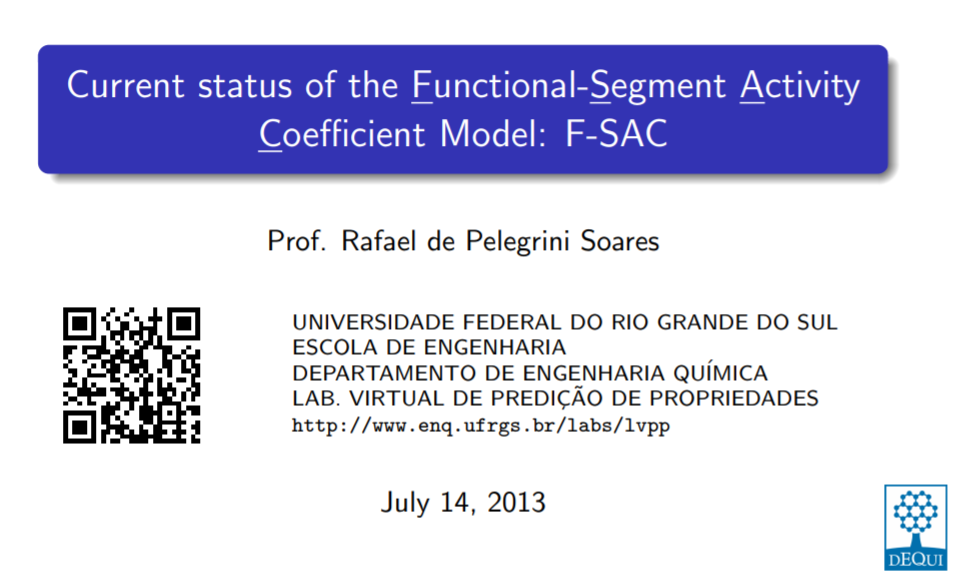
Here we have a 2013 presentation for the current status of the F-SAC model. A FORTRAN demonstration code, along with parameter tables, is also freely available here.

With the aim of predicting mixture behavior based on information of pure components only, COSMO-based models have emerged as a promising alternative. Several works in the literature are available attesting the good performance of COSMO-RS variants in several different applications….
Read more

COSMO‐based activity coefficient models have become an interesting alternative to the prediction of the behavior of substances in mixture. These models depend on the pure substance information known as sigma‐profile. The present work aims to create and freely distribute a…
Read more

Development of reliable models for estimating the solubilities of hydrocarbon–water systems is a challenging task, specially for ill-defined hydrocarbons, such as oil and petroleum fractions. In this work, the F-SAC (Functional-Segment Activity Coefficient) model was used to predict the water…
Read more

Here we have a word cloud for the titles of our recent published articles. This is a nice way to see what are the topics we are working on.

The PC-SAFT parameters are commonly estimated using pure components experimental data of vapor pressure and liquid density. Although widely used, this methodology often requires binary interaction parameters for its application to mixtures. In this recent work, not only pure component…
Read more