
Technology background
Hybrid organic-inorganic materials are of great interest in commercial applications due to their mechanical properties, optical and thermal, combining thermal and chemical stability of the ceramic materials, with the processability and flexibility of organic compounds and polymers. These materials exhibit the organic and inorganic components dispersed at the molecular level or nano, and due to this fact and show distinct properties superior to those obtained by the components, in their pure forms. Currently there is only one precursor compound capable of giving photoactive hybrid materials.
Technology description
This technology consists of new precursors with different photophysical properties, which can be used in the synthesis of hybrid organic-inorganic material type and can be obtained through the process via sol-gel or graphitization.
Problem Fixed
The present invention provides the possibility of obtaining hybrid materials from new photoactive precursors, which decrease the multiple synthesis steps.
Advantages
-simply obtaining methodology and more efficient;
-Use precursors with higher chemical stability;
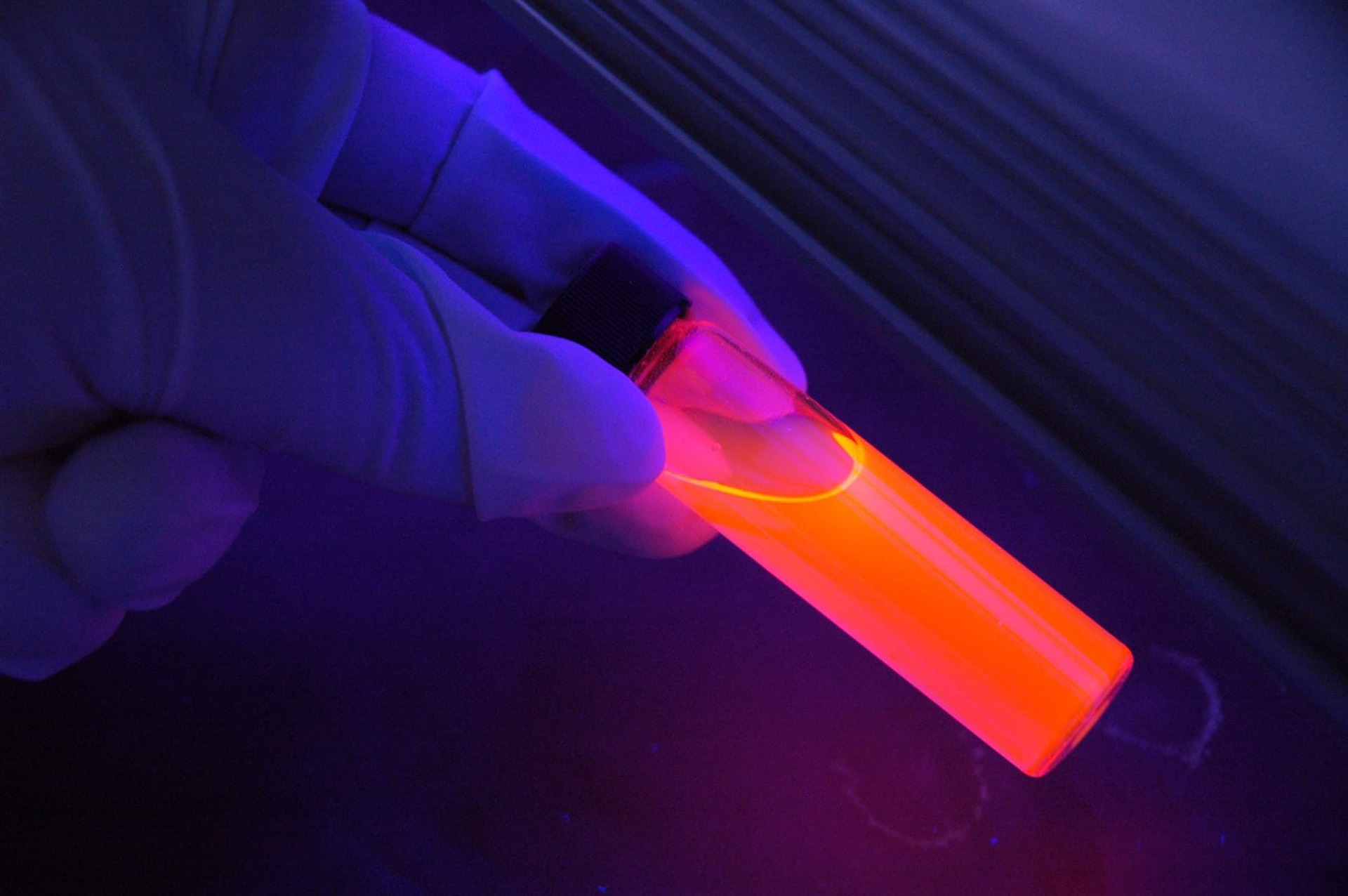
-synthesized compounds possess an intense fluorescence emission;
-Soluble in different solvent systems, both polar as apolar;
-Possibility of forming different photoactive hybrid materials with different properties than previously reported.
Applications
-Manufacture of organic solar cells;
-photosensitive materials for digital printing revelation;
-photoactive coatings on surfaces;
-optical sensors;
-Quimiodosímetro.
Nível de Maturidade da Tecnologia (TRL – Technology Readiness Level)

Status of the technology
Patent filled by INPI.
Inventors
Venturini Angelica Live
Fabiano Severo Rodembusch
Victoria Goulart Isoppo
Roger Braun Center
Visit our laboratory (click in the logo)

