
Visa
Brazil enforces the “international principle of reciprocity”. If your country requires a visitor’s visa from Brazilian citizens (e.g. USA, Japan, Canada, Mexico), it is likely that you will also need to apply for a Temporary (not Business) Visa to visit Brazil. You can check with your Brazilian consulate or embassy if you need a Visa to enter Brazil. Official invitation letters will be provided for those participants that need to apply for a Visa.
More information about Visa, please visit the page of the Brazilian Consulate in Washington.
Language
The official language in Brazil is Portuguese, a latin language somewhat similar to Spanish. All the activities in the conference will be in English. However it would be appropriate to learn basic sentences in portuguese to interact with non-English speakers in restaurants, shops, etc. In general, brazilians are very helpful with foreigners, they will make an effort to communicate with you, even if they do not understand your language.
Currency
The Brazilian currency is called Real (plural Reais) and is symbolized as R$ (code BRL). We have R$2, R$5, R$10, R$20, R$50, and R$100 bills. One can exchange money in most banks and currency exchanges, but less common currencies may be difficult to exchange. ATM’s are located all over the country and offer a reasonable exchange rate. ATM’s generally accept both Cirrus/MasterCard and the Plus/Visa cards. Foreign currencies are not commonly accepted in shops, but credit cards are widely used, mainly Visa and MasterCard (American Express and Diners Club are less accepted). It’s always good to keep small amounts of cash in Real for small expenses. The office hours for banks in Brazil is from 10am to 4pm.
Health
We ask you to please bring any special medication you might need during your stay in Brazil.
Prescriptions are necessary to buy certain medications and even allergy medicine, such as Allegra, may need prescription. We also advise you to get an international health insurance covering your time in Brazil, to avoid any problems.
Electric equipment
Brazil is one of a few countries that use both 110 and 220 volts for everyday appliances. The voltage can change back and forth as you travel from one place to the next; even within the same Brazilian state. The city of Gramado has 220 V electrical outlets. The national standard outlet is called IEC 60906-1 and is showed below:
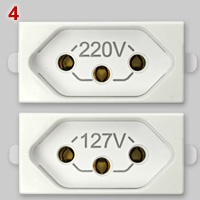
We recommend you get an international adapter; which can be found in supermarkets or hardware stores.
Smoking
Smoking is not allowed in public closed spaces in the state of Rio Grande do Sul. Restaurants, airports, shopping malls, buses, pubs, etc, included.
Tipping
Tipping in Brazil is typically not expected nor given. Usually, Brazilians only consider giving an extra if there was some special, non-standard service. At almost all restaurants and bars, a standard service fee of 10% is included as a line item at the end of the bill (“conta”). In restaurants the service charge will usually be included in the bill and is mandatory. If a waitperson is friendly and helpful you can give more. In a bar or a restaurant, you ask the bartender for your bill, and he brings a total (usually with full details). When the service charge is not included, a 10% tip is customary, but rarely will not be included. Taxi drivers don’t receive a tip, but it’s nice to round up the bill to the next integer.