

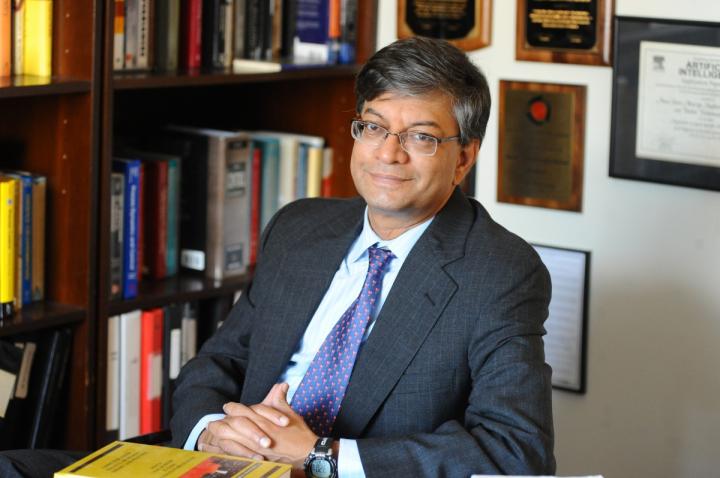
Venkat Venkatasubramanian
Columbia University
Palestra Plenária (Sessão de Abertura): Artificial Intelligence in Process Systems Engineering: Quo Vadis?
Artificial intelligence (AI) started off with great promise in the early 1980s, spurred by the success of the expert system paradigm in certain applications. This prompted a flurry of AI-based research efforts in process systems engineering (PSE) in the mid-1980s. However, as the ensuing three decades showed, AI didn’t quite live up to its early promise in PSE.
So, what went wrong with AI?
In this talk, I will review the different phases of AI in PSE in the last 35 years, providing some background and explanation to this question. I will also argue that this time it is different – I believe the time for AI in PSE, and in other domains, has arrived, finally. There are many applications that are ready to yield quick successes in this new data science phase of AI. I will highlight recent work in materials design and in process operations as examples of exciting progress. However, the really interesting and intellectually challenging problems lie in developing such conceptual frameworks as hybrid models, mechanism-based causal explanations, domain-specific knowledge discovery engines, and analytical theories of emergence. These breakthroughs would require going beyond purely data-centric machine learning, despite all the current excitement, and leveraging other knowledge representation and reasoning methods from the earlier phases of AI. They would require a proper integration of symbolic reasoning with data-driven processing. I will discuss these challenges and opportunities going forward in
Supplementary Material.
Biografia
Professor Venkat Venkatasubramanian is Samuel Ruben-Peter G. Viele Professor of Engineering in the Department of Chemical Engineering, Professor of Computer Science (Affiliate), and Professor of Industrial Engineering and Operations Research (Affiliate) at Columbia University in the City of New York. He earned his Ph. D. in Chemical Engineering at Cornell, M.S. in physics at Vanderbilt, and B. Tech. in Chemical Engineering at the University of Madras, India. Venkat worked as a Research Associate in Artificial Intelligence in the School of Computer Science at Carnegie-Mellon University. He taught at Purdue University for many years, before returning to Columbia in 2011. At Columbia, Venkat directs the research efforts in the Complex Resilient Intelligent Systems Laboratory. He is also the founding Co-Director of the Center for the Management of Systemic Risk, a transdisciplinary center focused on understanding how complex systems fail in order to prevent or mitigate such failures in the future, with faculty from a number of departments at Columbia University.
By inclination and education, Venkat is attracted to fundamental questions that are at the intersection of different disciplines. A leitmotif in his work is understanding emergent phenomena in self-organized complex systems, particularly using artificial intelligence, statistical mechanics, game theory, and systems engineering concepts and techniques. Venkat’s research contributions have been in the areas of process fault diagnosis and risk management, materials discovery analytics, pharmaceutical engineering, and income inequality.
Prof. Venkatasubramanian received the Norris Shreve Award for Outstanding Teaching in Chemical Engineering three times at Purdue University. He won the Computing in Chemical Engineering Award from AIChE and is a Fellow of AIChE. In 2011, the College of Engineering at Purdue University recognized his contributions with the Research Excellence Award. He is a past-President of the Computer Aids for Chemical Engineering (CACHE) Corporation. He currently serves as an Editor for Computers and Chemical Engineering. His new book, How Much Inequality is Fair? Mathematical Principles of a Moral, Optimal, and Stable Capitalist Society, was published in 2017. Venkat’s other interests include comparative theology, classical music, and cricket.
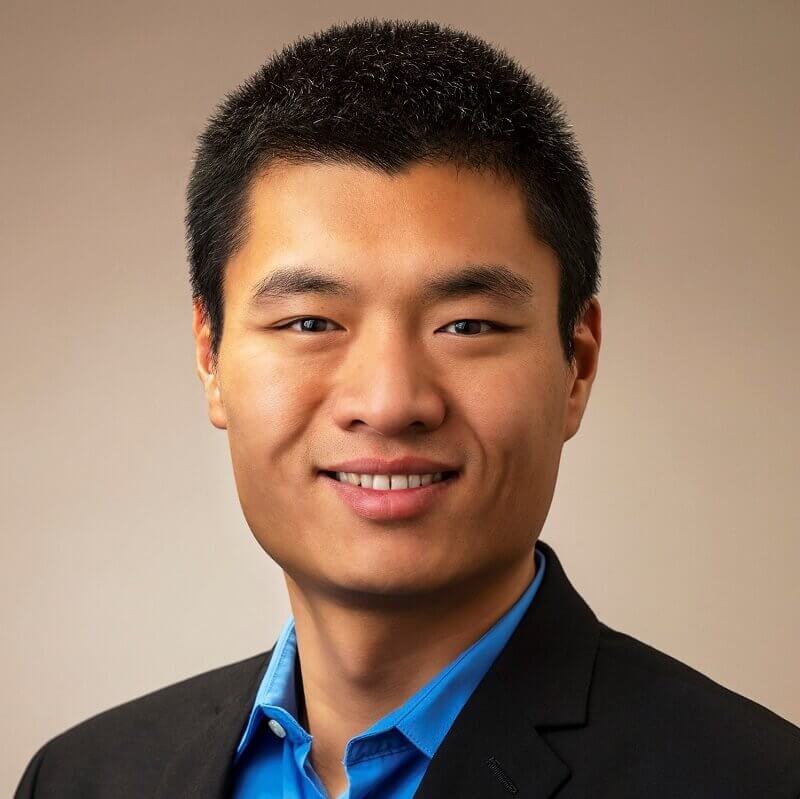
Fengqi You
Cornell University
Palestra Plenária (Terça-Feira): When Machine Learning Meets Robust Optimization and Control: Data-driven Adaptive Robust Optimization Models, Algorithms and Applications for Industry 4.0
Data-driven decision-making is an emerging paradigm that integrates model-based and data-driven systems for optimization and control under uncertainty. This organic integration of machine learning and mathematical programming leads to fundamentally more powerful and efficient data-driven optimization frameworks that close the loop between data analytics and decision support. In this presentation, we will introduce a data-driven adaptive robust optimization framework, which leverages Bayesian nonparametric methods to derive flexible data-driven uncertainty sets that were previously intractable for conventional robust optimization. The machine learning model is seamlessly integrated with adaptive robust optimization approach through a novel multi-level optimization framework, which explicitly accounts for the correlation, asymmetry and multimode of uncertainty data and automatically adjusts its complexity based on the data structure and complexity. The data-driven adaptive robust optimization framework is further extended to systematically and automatically handle labeled multi-class uncertainty data through a stochastic robust optimization approach with a bi-level structure. Tailored decomposition algorithms are further developed to solve the resulting multi-level optimization problem efficiently. Applications to planning, scheduling
Biografia
Fengqi You is the Roxanne E. and Michael J. Zak Professor at Cornell University, and is affiliated with Smith School of Chemical and Biomolecular Engineering, Graduate Fields of Operations Research and Information Engineering, Electrical and Computer Engineering, Civil and Environmental Engineering, Mechanical Engineering, Systems Engineering, and Center of Applied Mathematics. He also serves as Chair of Cornell Systems Engineering PhD Studies and Associate Director of Cornell Energy Systems Institute. He was on the faculty of Northwestern University from 2011 to 2016, and worked at Argonne National Laboratory as an Argonne Scholar from 2009 to 2011. He has published more than 120 peer-reviewed articles in leading journals, and has an h-index of 50. Some of his research results have been editorially highlighted in Science and Nature, featured on journal covers (e.g. Energy & Environmental Science, ACS Sustainable Chemistry & Engineering, and Industrial & Engineering Chemistry Research), and covered by major media outlets (e.g. The New York Times, BBC, BusinessWeek, and National Geographic). His recent awards include American Institute of Chemical Engineers (AIChE) W. David Smith, Jr. Publication Award (2011), Northwestern-Argonne Early Career Investigator Award (2013), National Science Foundation CAREER Award (2016), AIChE Environmental Division Early Career Award (2017), AIChE Sustainable Engineering Research Excellence Award (2017), Computing and Systems Technology (CAST) Outstanding Young Researcher Award from AIChE (2018), Cornell Engineering Research Excellence Award (2018), and ACS Sustainable Chemistry & Engineering Lectureship Award (2018), as well as a number of best paper awards. He is currently an Editor of Computers & Chemical Engineering, a Consulting Editor of AIChE Journal, and an editorial board member of several leading journals (e.g. ACS Sustainable Chemistry & Engineering and Industrial &
Engineering Chemistry Research). His research focuses on novel computational models, optimization algorithms, statistical machine learning methods, and multi-scale systems analysis tools for smart manufacturing, digital agriculture, data analytics, energy systems, and sustainability.
For more information about his research group: http://www.peese.org