While much has been made of the fulminant cases of presumed viral pneumonia
in 1918, Dr. Brundage's research indicates that the majority of pneumonia
cases, even in 1918, were either secondary bacterial pneumonias following
an influenza infection or mixed viral and bacterial pneumonias. In the
pre-antibiotic era, these cases of bacterial pneumonia carried a very high
mortality rate; however, with appropriate antibiotic therapy, many such
patients may be saved. There is still a deficit of comprehensive seroprevalence
data to establish the true frequency of subclinical infections and the
relevance of these sporadic accounts of atypical infections listed above.
-
another small outbreak in the town of Kokonoe in Oita Prefecture
(on the southern island of Kyushu, across a narrow body of water from Yamaguchi)
was confirmed on Feb 18 after a private breeder reported to the town hall
that 7 of 13 Japanese bantam roosters (also known as capon chickens or
Chabo; kept as pets) he raised at his home (together with 1 duck) had died
since Feb 14 : 2 of 7 bantams were confirmed
-
about 67 000 out of 198 000 chickens have died since Feb 18 to 28 at the
Asada Nosan's Funai Nojo chicken farm in the town of Tamba, Kyoto
Prefecture : the farm, however, failed to report to the authorities and
about 160 000 eggs per day were shipped to 5 prefectures. 9900 live chickens
were shipped to a processing plant in the western prefecture of Hyogo (after
> 1000 birds died at the Tamba farm on 20 Feb 2004) and 15 000 live chickens
to a meat packing firm in the town of Yachiyo in Aichi prefecture on Feb
25-26. Local authorities inspected the farm 27 Feb, based on an anonymous
tip. Of the 12 kg trans-shipped to numerous sites in Osaka, 9.3 kg were
recovered. 8.4 kg of chicken bones and meat for soup that came from the
Hyogo processor were processed into soup stock and sold to a restaurant
in Osaka, Japan's second-largest urban area, but only 2.7 kg were sold
to consumers at 2 stores. This is a remarkable example of product tracing
within 48 hours and an indication of the amount of concern for food safety
that exists in the nation : Japan's efforts to prevent HPAI-infected or
suspected poultry products from reaching the retail markets are motivated
by the fact that raw eggs are widely consumed in Japan; and in Sashimi
cooking, raw chicken is often used. Animals taken to slaughterhouse/meat
processing plants such as the affected one in Hyogo Prefecture cannot be
processed instantly. Newly arrived animals tend to be held with others
for a short period of time. A spokesman for the plant in Hyogo Prefecture
indicated that all the meat from the 7000 birds received from the farm
in Tamba was in frozen storage, and would be destroyed so it would never
reach consumers. But the chickens were alive when they arrived, and presumably
were able to infect other birds at the site. The live birds at the site
tested positive for AI. On March 7 the 67-year-old farm owner Hajimu Asada
and his 64-year-old wife Chisako committed suicide and apologised for having
caused a great deal of inconvenience to society. Hideaki Asada, 41, president
of Asada Nosan Co., and 2 farm officials have been arrested on suspicion
of failing to report the chicken deaths in violation of a law to prevent
infectious diseases among livestock and poultry : he received 1-year prison
term, suspended for 3 years, in August in a Kyoto District Court ruling
for failing to report the bird flu outbreak at the farm to authorities.
2 crows among 4 found dead at the infected Asada Nosan Funai Farm (2) and
within the movement control area in the nearby township of Sonobe (2; 8-9
km away) were confirmed to be infected with H5N1
on Mar 8 : ministry officials are investigating the contagion route at
the Asada Nosan Funai Nojo farm in Tanba and the neighboring town of Sonobe.
One more in Ibaraki city (a distance of 30 km from Tanba, Osaka prefecture
(state)) also tested positive for the disease and a 6th crow was found
in the town of Tamba on Mar 13. It is the first time in Japan that wild
birds, other than caged poultry, have been confirmed with AI : once a crow
contracts the flu, it dies off quickly and its radius of movement is also
limited, limiting the possibility of spreading the virus over a wide area.
It is most imperative to prevent wild birds from entering poultry farms.
5
people (4 workers and 1 firefighter) out of a group of about 60 made
up of mostly Kyoto Prefectural Government employees involved in the clean-up
at the Asano Nosan farm all made complete recoveries after being affected
by minor ailments : one farm worker, who exhibited seroconversion, had
a sore throat for several days just after participating in the operation.
However, this person did not develop fever or other systemic symptoms.
4 other people also failed to show systemic flu-like symptoms such as fever.
Micro-neutralizing assays showed a significant increase of neutralizing
antibody titers (> 1:10) against the influenza A(H5N1)
Kyoto strain (A/Chicken/Kyoto/3/2004), suggesting their bodies had adjust
to fight off the disease. All clean-up workers took oseltamivir
 phosphate, wore protective clothing and surgical masks. Neither the virus
nor its genes were detected among the 5. Some 240,000 chickens and 20 million
eggs were disposed of at the farm and another nearby farm to prevent the
infection from spreading.
-
on Mar 5 AI was found in chickens at the family-run Takada farm, about
5 km north of Asada Nosan's Funai, in the town of Tamba, where >
130 000 birds perished last week in a flu outbreak, but in the latest case
had no contact with birds from the former outbreak.
-
on Mar 2 a farm in Shimane prefecture, about 720 kilometres west of Tokyo
-
on Mar 11 at a slaughterhouse in Kitakyushu, Fukuoka Prefecture, 126 among
930 chickens were found dead overnight. Initial tests on 10 animals were
all negative and birds may have died of heat stroke
-
on Mar 14 6 dead bantam chickens were found on a riverbank of the Sakai
River in Shitara, Aichi Prefecture, along with 5 live ones, by a man who
came to fish in the area
-
3 crows found dead in Kameoka city (Kyoto prefecture), and one of them
found positive to H5N1 virus
-
Japan will have spent 104.8 million yen (USD 951 427) by 31 Mar 2004 on
emergency measures to eradicate AI
4 outbreaks in Japan since 2007 :
-
3 in Miyazaki prefecture :
-
since 10 Jan 2007, 3500 chickens died of bird flu in one of the 3 poultry
houses of Taniguchi Furanjo Kurosaka Farm in the town of Kiyotake
in the Miyazaki prefecture, about 900 km (560 miles) southwest of Tokyo
and the nation's largest poultry producing region, and tested positive
for HPAI H5N1ref1,
ref2.
All the chickens at the farm - about 12,000 in all - will be culled and
incineratedref.
The town of Kiyotake, located in the southern center of Miyazaki Prefecture,
borders the city of Miyazaki on the North, East, and South, and the town
of Tano on the West. It is on Kyushu, the southernmost island in Japanref.
> 150 households are breeding a total of around 1600 avian species in the
town, including parakeets and other small birds kept as pets. The local
government mobilized about 150 workers to dispose of all the chickens at
the farm in the town of Kiyotake, including about 3800 already dead, under
the law to prevent infectious disease in livestock. The chickens, to be
killed with carbon dioxide, will be put in bags and incinerated, while
the farm will be cleaned and disinfected. The work is expected to be completed
in about 3 daysref.
The strain was at least a 99% match in terms of DNA sequencing with the
H5N1 strain confirmed in China in May 2005ref
-
about 1300 birds died in mass from Monday to Wednesday 22-24 Jan 2007 at
a farm in the city of Hyuga, 60 km away from Kiyotake. It was the
2nd bird flu case in a month in the prefecture and the 6th in Japan since
2004 : birds tested positive for HPAI H5 at the National Institute
of Animal Health in Tsukuba, Ibaraki Prefectureref1,
ref2
-
about 300 chickens out of 93000 susceptible were found dead at the farm
in Shintomi, southwestern Miyazaki prefecture, in Jan 2007. The
birds had been infected with H5N1ref
-
dozens of chickens died of H5 infection in a poultry farm in
the city of Takahashi, Okayama prefecture, during the past days,
the prefectural government said on Mon 29 Jan 2007 morningref
H5N1 was detected by the laboratory at Tottori University
in the body of an endangered female mountain hawk eagle found to be ailing
in the village of Sagara, Kumamoto Prefecture, on Jan. 4 2007 and died
shortly afterwardref
-
North Korea : on Jan 25 the Rescue
the North Korean People's Urgent Action Network (RENK) reported that a
woman in Pyongyang was infected with bird flu in Dec 2005, after chickens
carrying the disease were found, and was admitted to a Red Cross hospital.
Scientists from a group representing pro-Pyongyang Koreans living in Japan
(the Association of Chosun People in Japan) went to North Korea in Sep
2005 carrying 10 packs of oseltamivir
and make checks : however members of the group could not verify whether
the woman had been infected with the virulent H5N1
strain of avian influenza or a less virulent strain. There have been outbreaks
of bird flu in rural areas of North Korea since September 2005 and outbreaks
in 3 areas of Pyongyang in December 2005. An outbreak of bird flu that
infected humans could be devastating in North Korea, where poultry is an
important source of meat for its 23 million people When North Korean leader
Kim Jong-Il met Chinese President Hu Jintao during his visit to China earlier
in January 2006, he could have asked for Beijing's help in fighting bird
flu. Kim reportedly visited a Beijing hospital during the secrecy-shrouded
9-day visit. The Sankei newspaper said it was possible Kim was tested for
bird flu at Beijing's No. 301 Hospital of the Chinese People's Liberation
Armyref.
The Ministry of Agriculture ruled out all these kinds of rumors, and there
is no outbreak and no human casesref
-
Cambodiaref1,
ref2,
ref3,
which is still recovering still recovering from 3 decades of civil war
and the Khmer Rouge, under whose radical back-to-the-land rule an estimated
1.7 million people were killed, or died of starvation and disease : the
1st case of H5N1 was observed on 15 Dec 2003 at the
Tamao Wildlife Rescue Centre. The 1st case in poultry took place on 24
Dec in a semi-commercial layer flock in Phnom Penh. This was the 1st case
reported to the Department of Animal Health and Production (DAHP). Investigation
took place on the same day, and the result was reported to the OIE. From
1 Jan to 29 Apr 2004, a total of 91 reports of avian mortality were reported
to DAHP, of which 33 were investigated and 12 were confirmed as H5N1+.
Currently there are 3 task forces (TF) in the government to handle various
measures: TF-1 (Surveillance, Investigation & Diagnosis); TF-2 (Communication
and Mass Media) and TF-3 (Outbreak Control Measures). Stamping out is usually
instituted on suspicion of HPAI on commercial/semi-commercial operations,
but requires owner consent. In cases involving village chickens, culling
of chickens usually takes place at the infected location. The Government
enforced a Prakas (decree) on 16 Jan that bans cross-border movements of
poultry and poultry products. This may have led a dramatically reduction
in external infection pressure. The Prakas also prohibits movement of live
poultry into or out of the protection zone (3 km surrounding the affected
area), but only after official confirmation of the outbreak -- often a
lag of 2-3 weeks from laboratory confirmation. Due to the movement control,
some commercial farms in the protection zone decided to sell out all poultry
in late January 2004, because they could not afford the cost for keeping
birds. There is a common practice of throwing out viscera to be scavenged
by free-ranging chickens in villages, and this was a likely factor to virus
re-circulation. Poor biosecurity practices appear to have contributed significantly
to the spread of the disease. There is a need to start active surveillance
with commercial poultry operation providing chicks and feed to many operations
around Phnom Penh, and 3-4 km protection zone would follow in its early
stages. Laboratory competency must be assured when conducting IFAT and
HI testing, as these will be used widely during all surveillance phases.
Pathogenicity testing and detailed sequencing work has not yet been carried
out on the Cambodian H5N1 isolates. Detailed analyses
should be conducted in collaboration with OIE/FAO/WHO reference laboratories.
Chickens (commercial broilers, layers, and village chickens) are typical
of the HPAI clinical forms; ranging from peracute (sudden death with no
clinical signs) to acute (2-3 days period until death) manifestations,
predominantly seen in younger birds. Lachrymal and nasal discharges, periorbital
edema or generally edematous heads, deep red or cyanotic wattles and combs,
diarrhea and panting was evident in birds surviving beyond 2-3 days. Soft-shelled
eggs characterize affected layer flocks. Mortality can approach 100% in
7-week old birds on an affected layer enterprise. Morbidity and mortality
in older birds is more difficult to assess, as owners of commercial enterprises
often sold their poultry soon after suspicion of the disease. In a village
setting, with a range of ages and low bird density, mortality varied between
50 and 90% at an individual household level. Ducks demonstrated a 2-3 day
disease course with clinical signs including lethargy, inability to walk,
flaccid necks, and yellow diarrhea. Overall morbidity reached 10% in Black
ducks and 20% in White ducks. White ducks appeared to have increased susceptibility
with respect to fatality rates approaching 40% in affected individuals.
H5N1 was also isolated in 2 outbreaks involving non-poultry
avian species. A large variety of captive birds as well as free-flying
crows were affected in the outbreak at Tamao Zoo, Kandal province. The
disease appeared first in raptors such as grey-headed fish eagle, serpent
eagles, hawk eagles, spotted wood owls, brown fish owl, spot-bellied eagle
owl, and buffy fish owls in the first 2-3 days. The raptors were fed chicken
meat or carcasses obtained from the Kandal Market in central Phnom Penh.
Consideration must be given to the oral point of entry or respiratory if
the contaminated carcass was soiled with affected bird feces. The live
poultry market located approximately 30-40 m away from where the serpent
eagle's enclosure is another possibility. Herons, egrets and cranes were
subsequently affected, suggesting respiratory transmission or mediated
through free or wild birds such as crows, which frequent the aviary areas.
Psittacines were affected in a further outbreak, although only 2 recent
introductions died in an aviary group of 30. A total of 86 birds died and
261 birds remained clinically unaffected. Clinical signs, primarily lethargy
and inappetence, were also evident in zoo cats (tiger, leopard, etc. all
have recovered). Despite officials initially said the deaths of 4.7 million
chickens since November in 3 farms in the outskirts of Phnom Penh had been
caused by exotic Newcastle disease, tests conducted by the Pasteur Institute
in Paris confirmed on 23 Jan 2004 (first official notification 24 Jan 2004)
that 40% have died from avian flu and 60% from Newcastle disease. The poultry
sector in Cambodia is relatively small. With customers shying away from
chicken for fear of catching the deadly flu virus that has killed millions
of birds and at least 20 people, rat butchers been selling more than 200
kg (440 lb) of rodent meat (fried, grilled or roasted with garlic and vegetables)
every morning -- twice the normal turnover, fetching around 40 cents a
kg in far-flung corners of the jungle-clad and impoverished nation. It
is not the only ingredient to be found scuttling on the rural Cambodian
menu : spiders, water beetles, crickets, snakes, frogs and ants are all
choice treats, with local tradition saying they were first eaten by starving
peasants during the Khmer Rouge genocide in the 1970s.
-
a Cambodian woman in the Takeo province who died in a Vietnamese hospital
didn't have the virus
-
a 27-year-old man also in Takeo who worked at a site where animals tested
positive for bird flu showed symptoms on Feb 18
5 fowl -- a crow, 2 eagles, a parakeet, and an owl -- among 59 wild birds
that mysteriously dropped dead at the Phnom Tamao zoo, 45 km south of Phnom
Penh, during Jan 2004 were found to be infected with flu. A dead heron
from the zoo had earlier tested positive for the H5N1
strain. 2 official notifications on HPAI in Cambodia have been received
by the OIE so far. The first one was received on 24 Jan 2004, reporting
one outbreak in a layer flock of 7000 chickens, of which 3300 died (though
"stamping out" was mentioned, the report indicates "0" as to the number
of destroyed or slaughtered animals). On 17 Mar 2004, Dr Sorn San, Chief
of National Animal Health and Production Investigation Center, Phnom Penh,
informed the OIE about 9 additional outbreaks (2 in the capital, 3 to the
famed Angkor complex, and 3 in Takeo, which borders Viet Nam), recorded
in 3 local chicken farms, 3 layer farms, 2 broiler farms, 1 duck flock
and 1 wildlife rescue centre (zoo) with raptors, herons, crows, etc. The
total Number of cases was 4799; 6125 animals were destroyedref.
2 more outbreaks, leading the total to 12, were recorded later than 17
Mar 2004 in northeastern Kampong Cham and southern Takeo provinces, both
bordering Viet Nam. 14 231 chickens, ducks, and swans had died from bird
flu in the kingdom, while more than 6000 birds had been culled (Cambodian
authorities cannot undertake the mass cullings that other countries have
initiated to control the virus due to most livestock being owned communally).
On 9 May 2004 4 birds were reported to be sick in Takeo Province. A farm
located about 5 km (3 miles) outside Phnom Pen was closed after about 2300
chickens fell ill and started dying of bird flu on Sat 18 Sep, apparently
the 1st cases of the disease in the country following an epidemic in Asia
earlier in 2004 : the remaining 2200 birds at the farm were destroyed on
22 Sep 2004 and earlier in the 4th week of Sep. There has been no outbreak
reported since October 2004. The passive surveillance system found
3 suspected cases that were investigated in May-July 2004, due to a possible
link with suspected human cases. An active surveillance program for markets
was launched in early August 2004 in the major live bird markets in the
town. Monitoring of repopulated farms has been proposed for previously
infected farms, and for farms located within a 3 km radius of outbreaks,
to declare those places free of disease, and some farms are being used
as sentinel farms in the country. The central epidemiology team has visited
every province involved in this monitoring. Monitoring has already started
in Phnom Penh and Kandal provinces. The identification and geo-referencing
of commercial and semi-commercial farms in the outbreak areas (3-4 km around
the outbreak) has been initiated and will be extended to the whole country.
The data collected will be shared with the statistics department of the
Ministry of Agriculture. A study based on interviews of citizens suggests
that many villages around the outbreak sites faced an HPAI outbreak. Preliminary
results also suggest that the spread of the virus was higher among "village
poultry" than between independent farms. Possible explanations for the
absence of new outbreaks since last April 2004 are: very high temperatures
from mid-April to mid-May; the very high case fatality rate in chickens
(often reaching 100%) prevented birds from acting as virus carriers; drastic
reductions in animal movements in the country and the number of live birds
in markets; and the low human and animal population density in the country.
Many ducks are reared for egg production in rice fields and are quite separate
from the local chickens. Looking at the regional mapref,
it seems almost impossible that Cambodia (and, for that matter, also Laos),
situated between 2 heavily infected countries, Thailand and Vietnam, could
remain unaffected by a disease spread by avian fauna. In view of official
confirmation of the 1st human case of avian influenza in Cambodia, one
cannot escape reflecting upon the Thai chronology. On 23 Feb 2004 Thailand
officially reported the 1st case of HPAI in poultry, a day after the reporting
of the 1st suspected human case. 3 fatal cases were reported from southern
province of Kampot bordering Vietnam :
-
a 14-year-old man from a village become sick on mid-January, went
to a doctor for treatment, and died on Jan 21 from respiratory failure
before he could be rushed to a hospital. In December the 50 chickens -
5 hens and the rest chicks - of his father fell sick for a few hours and
then died 2 or 3 every day for 20 days, ending in early January 2005. Outbreaks
of the virus were last detected in Cambodia in September 2004. No human
casualties have been reported there.
-
her 25-year-old sister developed respiratory symptoms on 21 Jan.
She was admitted at a local Cambodian clinic in Kampot, which is about
5 km from the Vietnamese border, sought medical care in neighbouring Viet
Nam on 27 Jan, and was admitted with a high fever and cough on Jan 28 to
a hospital in Kien Giang's province capital, Rach Gia, 250 km (155 miles)
southwest of Ho Chi Minh City, which borders Cambodia. She had slaughtered
fowls for meal 2 weeks before. Tests undertaken at the Pasteur Institute,
Ho Chi Minh City, Viet Nam on 1 Feb 2005 were positive
for influenza A/H5. She is the first human case of H5
infection reported from Cambodia.
-
other members of the family were suffering from high fevers and respiratory
problems but no avian influenza A (H5N1) virus was
found among 7 relatives as well as the family's fowl
-
a 28-year-old man (Meas Ran) from Tram Sasor village, Bantey Meas
district (only 20 km away from the first victim), first fell ill in Keatha
Vong Leu village on 17 Mar 2005, was hospitalized in Phnom Penh on 21 Mar,
and died on 22 Mar 205 of bird flu : the same day, laboratory tests by
the Pasteur Institute in Phnom Penh confirmed
that the man was infected with avian influenza A (H5N1)
virus. Between 400 and 500 chickens and ducks had died in the village,
but it was not known whether the deceased, who worked as a traveling businessman
and occasionally went to Viet Nam, had been in contact with them. He added
that 8 people who had been in contact with the victim tested negative for
bird flu but. Hospital staff in contact with the victim had also
tested negative. > 600 chickens had died in 6 villages in Kampot in the
last 20 days and a further 100 had been culled on Wed 23 Mar 2005
-
test results on
an 18-year-old boy (Hon Sopheap) bird
flu suspect in the southern province of Kampot, home to both previous cases,
had proved negative on Mar 25
-
a 8-year-old girl from Tram Sasor village, Bantey Meas district,
became ill with a fever on the 29 Mar 2005. Her condition deteriorated
rapidly on 7 Apr 2005, when she was taken to a district referral hospital
and then transferred to privately-funded Kuntha Bopha Hospital in Phnom
Penh, where she died on Apr 7 2005 night and was confirmed
: she was in contact with chickens when they were dying in February 2005
butnot in the 2 weeks preceding onset of symptoms, so the exposure period
is too long, so epidemiologists are looking at the potential role of ducks
as asymptomatic carriers. 13 people who had been in contact with the victim
-- 4 family members and 9 hospital workers -- were being tested for the
virus, but none were suffering symptoms, and the results were expected
to be negative
-
a 20 year old girl, a secondary school student and part-time poultry
seller from Kompong Trach district in Kampot province (the same district
as the 1st case reported from Cambodia in February 2005) was taken across
the nearby Vietnamese border on Tue 19 Apr 2005 suffering a high fever
and respiratory problems and was rushed to a Vietnamese hospital in Kien
Giang with suspected AI, was connected to a respirator, but died on 20
Apr. The girl's relatives said chickens had died of unknown causes near
her home and she ate chicken 8 days before falling ill. Swab samples taken
from the woman tested positive at Ho Chi Minh
City's Pasteur Institute, 250 km (155 miles) away. There was no mortality
of poultry in her village, but poultry deaths occurred in a village where
the woman used to go to school. In Kampol Meas village, poultry deaths
were observed in late March/early April and continued into Khmer New Year
(14-15 Apr 2005). A couple of chickens also died in nearby Phnom Srongab
village.
Cambodia's last official report to the OIE (Follow-up report No. 3) on
the occurrence of HPAI was received on 22 Sep 2004. It included data on
an outbreak in a broiler farm in Kean Svay district, Kandal province, where
avian influenza A (H5N1) virus was identifiedref.
No official reports on later outbreaks are available. Follow-up report
No. 4 (1 Apr 2005) decribed outbreaks in backyard chickens in Kro Peuha,
Takmao district, Kandal province, about 12 km south from the capital Phnom
Penh, (70 deaths and 35 destroyed since Feb 2), and Kia Thavong Leu, Banteay
Meas district, Kompot province (19 deaths and 19 destroyed since Mar 24).
Last known outbreak: 22-28 Mar 2005. A total of 139 chickens and ducks
have been culled in Keatha Vong Leu village near the Vietnamese border.
In Cambodia, authorities on Wed Sep 21, 2005 sprayed vaccine at 7 north
western farms containing nearly 16,000 ducks as a precaution after a mystery
illness decimated the flocks, even though tests so far had proved negative
for bird flu. A senior official from the agriculture ministry's department
of animal health confirmed local media reports that concerned duck farmers
had first reported mass deaths and illness in the flocks at farms just
outside the north western city of Battambang on 11 Sep 2005. Despite initial
tests proving negative for the H5N1 strain of bird
flu, the birds were continuing to die in significant numbers and no cause
had as yet been identified. They are spraying the farms as a precaution
because the results returned on 13 Sep from initial tests were negative
for H5N1, as were tests results returned to us from
the lab on Sep 20, but ducks there are still dying : the 7 farms under
observation supported around 15,480 ducks, and Battambang, which lies just
20 km to the south of the affected farms, is a major transport hub for
livestock and goods arriving from the nearby border with Thailand. At least
1000 ducks had succumbed to the mystery illness in the past weekref.
Since January, National Animal Health and Production Investigation
Center (NAHPIC) introduced 30 sentinel ducks in 3 flocks in Kampong Seim
district of the eastern province of Kampong Cham Province, about
50 miles (80 km) east of Phnom Penh, around Boeung Thom Lake to detect
H5N1 virus circulation in the zone, by collecting
blood and swab samples every 2 weeks. On 6 Feb 2006, 5 sera in 1 flock
were tested positive, and H5N1 was confirmed in 1
swab sample by PCR at the Pasteur Institute. An intersectoral meeting was
held, and Department of Animal Health and Production of the Ministry of
Agriculture, Forestry and Fisheries decided to implement culling of the
remaining 200 ducks in the infected flock, disinfection of all duck flocks'
premises and surroundings in the Lake zone. The government had banned the
movement of 10 000 ducks being raised near the 12 square km (4.6 square
mile) lake, home to water fowl believed capable of spreading the virus
without falling ill. Samples were collected before culling. In addition,
investigation and sampling has been conducted to assess virus circulation
in 3 villages in the Lake zone to clarify H5N1 epidemiology
in free-ranging duck flocks and no infection was found in the nearby village.
The government of impoverished Cambodia was trying to persuade other duck
raisers in the area to kill their birds but could not afford to pay them
to do itref1,
ref2.
-
a 3-year-old girl who lived in Phum Prich village in Kampong
Speu Province, about 40 miles (60 km) west of the capital Phnom Penh, developed
fever on March 14, was hospitalized in Phnom Penh on Mar 20 and died on
Tue Mar 21, 2006 a few days after playing with sick birds and tested positive
for H5N1. The child is known to have played with
chickens, including some showing signs of illness, but an agriculture ministry
official said on Sat 25 Mar 2006 that there was no evidence yet the poultry
died of H5N1 virus infection.Cambodia's last outbreak
of avian influenza in humans occurred in early 2005, while the virus has
been found in ducks in eastern Kampong Cham province twice since February
2006, triggering the slaughter of hundreds of birds. Thousands of birds
smuggled in from neighboring Viet Nam, where 42 people have died from bird
flu since December 2004, have also been destroyed in recent months. A team
from the WHO and the Health Ministry found
7 residents
of the village who developed fever the same day the girl died, but none
of the respiratory symptoms typical of the disease, and they all tested
negativeref.
All had a history of recent contact with diseased birds or had been involved
in caring for the child : although none of these people presently shows
symptoms compatible with H5N1 infection, all have
been placed under medical observation as a precautionref1,
ref2.
Another
42 people from Phum Prich who came into contact with the dead
girl or the suspected cases have also tested negative for H5N1ref.
The child's 23-year-old mother said she still had no idea what had killed
her daughter, an indication that bird flu public education campaigns in
one of Asia's poorest nations still have a long way to goref1,ref2
-
1 adult and 2 children are being treated for fever and respiratory
problems at a hospital in the capital Phnom Penh. 5 other people
who had contact with the suspected cases are also being tested. It is unknown
how the 3 might have become infected with the H5N1
virusref
-
a 12-year-old boy from southeastern province of Prey Vengref,
which borders Viet Nam, developed symptoms of fever and headache on 29
Mar 2006. He was initially treated at a private clinic, then hospitalized
in Calmette hospital in Phnom Penh on 4 Apr 2006. He died on Wed 5 Apr
2006. Samples from the boy tested positive for H5N1
infection at the Pasteur Institute in Cambodia. Numerous chicken deaths
and some duck deaths were noted in the neighbourhood in recent weeks. The
child reportedly gathered dead chickens for distribution to village families
for consumption. The investigative team identified 25 close contacts of
the child. None of these people show signs of illness at present. House-to-house
surveillance for signs of influenza-like illness is continuingref1,
ref2,
ref3
All 6 human cases of avian influenza virus infection
in Cambodia have been fatal, whereas in Thailand and Viet Nam, approximately
half of all confirmed cases of AI virus infection have survived. This would
suggest that some less severe cases of avian influenza virus infection
in the Cambodian/Viet Nam border region may have gone unrecognized. To
better understand avian-to-human transmission of H5N1
in Tram Sasor village, a retrospective poultry mortality survey was conducted
in March 2005 and a sero-epidemiologic investigation in June 2005. Poultry
surveys were conducted within a 1 km radius from the human H5N1
case’s household and cloacal swabs were collected from randomly selected
poultry for H5N1 testing by rRT-PCR. A household
chicken flock was considered likely to have been infected with H5N1
during the previous 6 months if >60% of the flock died, CFR was 100% and
each young and mature bird died suddenly within 1-2 days. In June, villagers
in households near the H5N1 case’s household were
asked about exposures to poultry and poultry products in the past year
and tested for H5N1 antibodies by microneutralization.
The poultry mortality survey showed a high level of ownership: 95% (155/163)
of households raised chickens; 32% (52/163) raised ducks. Based on the
risk definition for H5N1 among poultry, 42 households
were considered at risk during Jan-Mar 2005, including a cluster of 26
with a relative risk of H5N1 of 7.9 (p=0.001) within
30 days of the survey. H5N1 virus was isolated in
2 sick chickens from the household next to that of the human case. Although
a high proportion of participants reported collecting dead or sick poultry
(50%) and chicken faeces (47%) or plucking feathers of dead poultry (47%)
during the past year, none of the 351 participants from 93 households had
neutralizing antibodies suggestive of H5N1 virus
infection (Buchy, P. Low Frequency of Avian-to-human Transmission of H5N1
in Southern Cambodia, 2005. ICEID 2006 Abstract 68ref)ref.
Even a doctor who was involved in a difficult process to insert a ventilator
tube into the windpipe of an H5N1 patient did not
became infected : the doctor wore no protective gear, because he didn't
realize what his patient was suffering from. It was also true with several
other doctors and nurses, and none of them were positive. Blood samples
taken from 2 veterinarians who had autopsied birds that had died from H5N1
without any precautions were negative, tooref.
2 outbreaks of HPAI have been reported inref
:
-
Tuol Prich village, Moha Russei commune, Kong Pisey district, Kompong
Speu province. Number of animals in the outbreak: susceptible: 700 cases:
402; deaths: 402; destroyed: 200. Affected population: backyard chickens.
-
Kamakor village, Samlanh commune, Angkor Chey district, Kompot province.
Number of animals in the outbreak : susceptible: 247; cases: 76; deaths:
76; destroyed: 171. Affected population: backyard ducks and free-ranging
ducksref.
Cambodia's last report to the OIE was sent a year ago, namely on 1 Apr
2005ref.
Since 20 Mar 2006 an outbreak in Kompong Speu (Tuol Prich) killed 402 backyard
chickens and another outbreak in Kompot (Kamakor) 76 backyard ducks and
free-ranging ducks. Kompong Speu is a large province which is home to the
capital, Phnom Pnen and Kompot is to the south, bordering the gulf of Thailandref.
-
since Aug 2, 2006 ducks in Rokar Chuor Timuoy village in Prey Veng
province, 30 miles southeast of the capital Phnom Penh, began falling sick
and 1200 of them dropped dead in following days (another 400 ducks were
killed by health authorities) : on Sat Aug 12 authorities confirmed the
outbreak of H5N1 virusref.
-
2 new outbreaks of the H5N1 virus were discovered
on 18 Aug 2006 in Kampong Cham province, just northeast of the capital
Phnom Penh.
-
One outbreak originated with ducks from Rokar Chuor Timuoy, where bird
flu was detected on 12 Aug 2006, after a farmer smuggled 2000 ducks out
of the area where authorities were slaughtering birds to prevent the disease
from spreading. Those ducks were taken to Tbong Khmum district,
125 km (80 miles) northeast of the capital, where most of them had died
by Fri 18 Aug 2006. Health authorities slaughtered the remaining ducks,
and one official was fired for failing to prevent the movement of the birds.
-
A separate outbreak was detected in nearby Batheay district, where
ducks began falling ill on 12 Aug 2006 : 700 birds in that district have
died or been killedref.
A survey experience showed that up to 15% of live ducks carried the virusref
-
Hong Kong : a total of 5 outbreaks
of H5N1 were detected during Dec 2002 and Jan 2003
in poultry markets and farms. No further cases have been detected since
31 Jan 2003. 3 outbreaks in parks, Nov-Dec 2002 (the virus from the waterfowl
and little egrets at Penfold Park were genetically distinct from the viruses
from Kowloon Park and the other wild bird virusesref)
: the current strain resembles the one spotted Penfold Park (it appears
to replicate more successfully than usual in ducks, infects a wide range
of wild birds, and is shed orally as well as in faeces -- all characteristics
that help it spread). Swab and tissue samples from a dead grey heron
(Ardea
cinerea), found on Nov 1 2004 by a worker at a construction
site of ecological mitigation area of the Lok Ma Chau Spur Line Project
within the restricted area near the mainland China border, tested positive
for the H5N1 virus on Nov 3 : it is an abundant winter
visitor, but a scarce summer visitor, in Hong Kong (it is not a resident
species in Hong Kong). Another grey heron (Ardea
cinerea) collected for isolation and observation in the same
place on 3 Dec died on 4 Dec, submission for post-mortem and virological
examination was undertaken on 8 Dec; sampling was carried out on 9 Dec;
was confirmed as an H5 avian flu suspect on 11 Dec, and tested
positive for the H5N1 virus on 14 Dec (estimated
date of primary infection: between 27 Nov and 1 Dec 2004). All 6 staff
who had contact with the bird are in good health. The grey heron is an
abundant winter visitor to Hong Kong but not a resident species. About
1200 grey herons were recorded in the Deep Bay area of Hong Kong in a survey
conducted in the winter of 2003-04. Grey herons are found in a range of
habitats such as marshes, tidal mudflats, estuaries, rice fields and flood
plains. They feed mainly on fish but also eat amphibians, molluscs, crustaceans,
aquatic insects, snakes and small rodents. No spread has been detected.
Extensive virus culture and surveillance is conducted in wholesale and
retail poultry markets and in bird parks and wild bird populations throughout
Hong Kong. Since January 2004, 1,325 dead birds and 14,200 environmental
swabs from wholesale and retail bird markets have been tested and no evidence
of H5N1 has been detected. In addition, > 6900 samples
from wild birds, 4500 captive birds in parks and 5100 pet birds have been
tested by Agriculture Fisheries and Conservation Department (AFCD) and
Hong Kong University (HKU) as part of the AI surveillance programme. The
only 3 cases of H5N1 infection detected in 2004 were
the peregrine falcon reported on 19 Jan (see under China),
the grey heron reported on 3 Nov and this grey heron, all migratory wild
birds. There have been no abnormal deaths in all 20 poultry farms within
5 km of the location, and the chickens show no symptoms of bird flu, possibly
reflect the efficacy of the heterologous (H5N2)
vaccine, compulsorily used in Hong Kong within the application of a DIVAref.
A "Chinese pond heron" (Ardeola
bacchus) was found dead in the New Territories ecological mitigation
area of Lok Ma Chau Spur Line Project 1 on 10/01/05. Avian influenza virus
subtype H5N1 was confirmed in the heron. Genetic
sequencing of the hemagglutinin cleavage site is to be conducted. All poultry
farms within 5 km of where the heron was found have been checked and no
unusual mortalities or illness were detected. An H5N1-infected
dead
heron was also detected in Cambodia in January 2004. In fact,
we don't know at this time whether this virus is genetically the same as
the one isolated from Viet Nam and Thailand. The genetic characterization
is still in progress. However, the H5N1 virus isolated
from a grey heron at the same location in early November 2004 was genetically
different from the Viet Nam/Thai isolates, and there is no evidence for
this virus infecting humans. There are > 60 individual biosecurity measures
in place on the farms (or relating to movements of birds, people or materials
to and from farms) that now form part of the license conditions for chicken
farms in Hong Kong. All chicken farms are routinely vaccinated with inactivated
H5N2vaccine and a DIVA strategy is in place that
involves the inclusion of 60 individually identified unvaccinated sentinel
birds within every batch of vaccinated chickens on farms. The sentinel
birds are checked and tested serologically within 5 days of sale of each
batch to confirm the absence of infection in the vaccinated flock. Risk
perceptionref.
In 2006, 16 birds tested positive for H5N1 :
-
an adult male oriental magpie robin (a resident species), Copsychus
saularis (Order: Passeriformes, Family: Muscicapidae) found dead
on 10 Jan 2006 by a villager in Kam Shan Tsuen, Tai Po, a rural bush area
of the New Territories in Hong Kong tested positive for H5N1
on Thu 19 Jan 2006ref1,
ref2.
The oriental magpie robin is an insectivorous species which is a resident
breeder in tropical southern Asia : it is distributed in the Indian subcontinent,
Southeast Asia, Indochina, the Philippines, the Andamans, Greater Sundas
and southern China south of the Yangtze River. This bird is a common resident
in Hong Kong. It inhabits a wide range of habitats, such as gardens/parks,
villages, secondary forests, open forests and mangroves. Insects are the
main diet of the bird. It is a commonly found species in Hong Kong; according
to birdwatchers, usually seen at large urban parks and the countryside,
such as Victoria Peak, Kowloon Park, Mai Po Marshes, and Tai am Country
Park; it is protected by lawref.
We are not aware of earlier recordings of HPAI H5N1
in the oriental magpie robin. However, several other passerines have been
reportedly been infected, namely: house finch, jungle crow, black drongo,
hill mynah, red-billed leiothrix, scaly-breasted munia, black-naped oriole,
house sparrow, Eurasian tree-sparrow, Korean magpie, European starling,
and zebra finch. A second magpie robin was found dead on Thu Jan
26 in a privately owned hut (Sheung Wo Hang Tsuen) in an area called Sha
Tau Kok, not far from the border with China, Tuen Mun district of the mainly
rural New Territories and tested positive for H5N1
strain of the virus on Jan 29 : 6 members of the family who own the house
near where the bird was found were found not to have any symptoms of the
disease, but were placed under medical watchref.
13 people in Hong Kong are under medical surveillance, after a wild bird
that died of a suspected H5 influenza infection was found in
a village hut in an area bordering Shenzhen. The Centre for Health Protection
is examining 6 front line staff from the Agriculture, Fisheries and Conservation
Department (AFCD) and 7 family members who own the village house and hut
where the bird was found. However, none had any symptoms of disease. All
poultry farms within 5 km of where the Oriental magpie robin was found
have been checked, and no unusual mortality or illness was detected. An
intensive surveillance system is in place on all poultry farms and other
locations. Local poultry farms are routinely under a constant monitoring
and surveillance program involving serological and virological testing
and have individual farm biosecurity plans, which include bird-proofing
of all sheds. All chicken farms are routinely vaccinated with inactivated
H5N2 vaccine, and each batch of chickens has 60 unvaccinated
individually identified sentinels, which are monitored over the production
life of the batch. Extensive virus culture and surveillance is conducted
in wholesale and retail poultry markets and in bird parks and wild bird
populations throughout Hong Kong. In 2005, over 9800 fecal or cloacal/tracheal
swabs from local poultry farms, 14,100 from wholesale or retail live poultry
markets, 2900 from waterfowl and aviaries in recreational parks, 3000 from
pet bird shops and markets and 9000 from wild birds were tested in Hong
Kong as part of the avian influenza surveillance program. The only case
of H5N1 infection detected was the Chinese pond heron
reported on 14 Jan 2005. In the past 3 months, over 1600 wild bird carcasses
collected from various locations were tested, and the only positive case
was this one. There were no reports of unusual mortality in wild birds.
Ongoing territory-wide surveillance is continuing. Information received
on 25 Jan 2006 from the Director of the Agriculture, Fisheries and Conservation
Department (AFCD), Hong Kong: The virus was confirmed as a highly pathogenic
H5N1 isolate by PCR and sequencing of the HA connecting
peptide region. Molecular analysis showed that the HA protein of A/MRb/HK/75/06
[H5N1] has the multiple basic amino acids to satisfy
the motif of a HPAI virus for chickens, but there is a deletion in the
2nd to last position of the connecting peptide (LRERRRK-R). Phylogenetic
analysis showed that A/MRb/HK/75/06 [H5N1] belongs
to H5N1 genotype V, which has previously been recorded
in southern China, Japan and South Korea. Genotype V differs from the dominant
genotype Z, which is widespread throughout Asia, in the source of the PA
gene. The H5-HA gene of this virus has high homology (98%) to the HA gene
of A/Dk/Hunan/5806/03 [H5N1]. There are no changes
from A/Gs/GD/1/96 at the receptor binding sites of the hemagglutinin. The
NA gene has the 20 amino acid deletion that is characteristic of genotype
Z H5N1 viruses. The M gene has Ser at position 31
and has no other mutations that are known to confer amantadine resistance.
The NS1 gene has the 5 amino acid deletion seen in genotype Z viruses and
has Asp at position 92. The PB2 gene has Glu at position 627
-
on Feb 1, 2006, 2 dead birds -- a wild crested myna (Acridotheres
cristatellus), found dead in an urban playgroundrefand
a
domestic chicken (Gallus
gallus) smuggled in from mainland China -- tested positive for
H5N1 virus : authorities do not know whether the
chicken was infected in the mainland or whether it was infected in Hong
Kong. The bird was smuggled into Hong Kong on 26 Jan 2006 without symptoms
and became ill on 31 Jan 2006. The typical incubation period for the disease
in birds is 2 to 10 days. The chicken was brought illegally into Hong Kong
ahead of the Lunar New Year period. Despite bird flu worries, the government
increased the number of chickens shipped into Hong Kong from mainland China
around the 29 Jan 2006 Lunar New Year. The chicken fell ill and died about
half a km (0.3 miles) from the border with China in an area where on 29
Jan 2006 an Oriental magpie robin also died of H5N1.
3
asymptomatic people in Sha Tau Kok village on the border with mainland
China (a 42-year-old man, his 79-year-old mother and a 39-year-old female
relative) were treated with oseltamivir
and placed in an isolation ward of a hospital in the Hong Kong S.A.R. of
China after it was found another chicken brought from China they had contact
(killed and eaten) during a family feast had nested with the infected chickenref.
They have shown no signs of infection, as further tests are carried outref.
It is unlikely that these 3 patients will be found to have contracted bird
flu, as infection cannot contracted directly from eat-processed chicken,
and it is not certain that the bird itself was infected (only in contact
with a diseased bird). As a precaution, the government will cull all poultry
within 5 km (3.1 miles) of the small holding where the chicken died and
also close the city's walk-in aviaries and a large nature reserve. Household
poultry-keeping is set to be banned to reduce the risk of a bird flu outbreak
in Hong Kongref.
With the introduction of the legislative amendments that came into force
on Feb. 13, 2006, households will not be allowed to keep any backyard poultry.
Unauthorized keeping of 5 kinds of live poultry (chickens, ducks, geese,
pigeons and quails, while pet birds that have received injection were not
included) would be an offense with a fine of 50,000 to 100,000 HK dollars
(about 6,400 to 12,900 US$). Agriculture department staff have been searching
homes in villages throughout the territory's rural areas in what was expected
to be a 6-week programme to clear Hong Kong of an estimated 9000 chickens
and 3500 ducks kept in homesref
-
late on Wed 8 Feb 2006 a dead egret found earlier this week in an
urban Hong Kong district has tested positive for the deadly H5N1
strain of bird flu
-
a dead chicken (Gallus
gallus) and on a Japanese white-eye [Zosterops
japonica simplexref],
a small wild bird found near a local school, tested positive for H5N1
on 10 Feb 2006
-
on Thu 9 Feb, officials collected another dead bird, a
red-whiskered
bulbul [Pycnonotus
jocosusref],
in the same area. It will be tested for avian flu but wasn't yet considered
a suspect caseref.
-
a common magpie (Pica
pica sericearef)
found dead on Thu Feb 16 in Sham Shui Po, a district crammed with open-air
markets, run-down residential buildings and often unsanitary alleyways,
tested positive for the H5N1 on Sat, 18 Feb 2006.
It was the 9th bird to be found infected with the disease since late January
2006 in Hong Kong.
-
another common magpie found dead on Fri Feb 17 in a flower market
in Mongkok district, another heavily populated district that is home to
a pet bird market, tested positive for H5N1
on Feb
20. Magpies are common in this crowded city of nearly 7 million people
and are often kept as petsref.
-
a dead large-billed crow [Corvus
macrorhynchosref]
found in Kowloon on Sat Feb 17 and a munia [species?!]
-
a white-backed (white-rumped) munia [Lonchura
striataref]
discovered separately on Hong Kong island on Sun Feb 18, 2006.
-
a house crow (Corvus
splendens) found on Thu 23 Feb 2006 in Shek Kip Mei in the Kowloon
area, indicated a suspected case of H5 avian influenzaref
-
little egret (Egretta
garzetta)ref
Information on H5N1-infected birds found in Hong
Kong so far in 2006 had been uploaded onto the website of Hong
Kong Agriculture, Fisheries and Conservation Department (AFCD) : chicken
(2); common magpie (4); crested myna (1); house crow (2); Japanese white
eye (1); large-billed crow (1); little egret (1); munia (1); Oriental magpie
robins (2); white-backed munia (1).
From 2005 to the end of February 2006, > 11,400 fecal or cloacal/tracheal
swabs from local poultry farms, 15,300 from wholesale or retail live poultry
markets, 3200 from waterfowl and aviaries in recreational parks, 3500 from
pet bird shops and markets, and 13,700 from wild birds were tested in Hong
Kong as part of the avian influenza surveillance program. There have been
no reports of unusual mortality in wild birds. All chicken farms are routinely
vaccinated with inactivated H5N2 vaccine, and each
batch of chickens has 60 unvaccinated individually identified sentinels,
which are monitored over the production life of the batch. The H5-HA
genes of these viruses have the highest homology (99%) to each other's
HA1 gene and high homology (98%) to that of A/Dk/Hunan/5806/03 (H5N1).
Phylogenetic analysis showed that these viruses all belong to H5N1
genotype V, which has previously been recorded in southern China, Japan
and South Korea.
Virus samples taken from the 8 wild birds and 2 stray chickens found
dead with H5N1 in January 2006 in Hong Kong were
of V-genotype, closely linked to a strain of the H5N1
virus that surfaced in Japan and South Korea in 2004, but not the one spreading
in Europeref.
Authorities ordered the closure of all bird parks in Hong Kong and the
Mi Pu Park of Natural Reserve on 1 Feb 2006.
A cat was sent to the Society for the Prevention of Cruelty
to Animals (SPCA) in Hong Kong on Wed 8 Mar 2006 : it brought home a dead
bird from the garden.
Since an enhanced surveillance programme began 15 Jun 2006, the Hospital
Authority e-Flu system has received 90 reports of pneumonia of an unidentified
cause and who had travelled to affected areas or countries with confirmed
human cases of bird flu in the 7 days before the onset of symptoms. On
Jun 22, 2006, 9 cases, involving 7 men and 2 women who visited Guangdong,
Hunan, Hubei, Zhejiang and Fujian provinces before the onset of symptomsref1,
ref2.
While this number may sound alarming, one does not know what the baseline
rate of pneumonia of unknown etiology is in Hong Kong. With a population
estimated at 6.9 million, a report of 70 cases of pneumonia in one week
yields a rate of approximately 1 case per 100 000 population. In
contrast, in a report on pneumonia surveillance in the state of Connecticut
over a 3-year period (2001-2004), there were an average of 305 hospital
admissions per week, with an increase to over 350 pneumonia cases per week
during the influenza season in 2003-2004ref.
With an average population of 3.5 million during the 3-year periodref,
the weekly pneumonia rate was an estimated 8.8 per 100 000 population.
While the reported pneumonia admissions as presented in the Connecticut
study did not differentiate by etiologic agent, the estimated rate in Connecticut
is almost 9 times higher than that seen in Hong Kong
during the past week of active surveillance. Clearly more information
from knowledgeable sources in Hong Kong would be greatly appreciated to
help put the above reports into perspective.
Outbreaks in animals in 2006-2007ref
:
-
6 scaly-breasted munias (Lonchura punctulata)ref
carcasses found on Leighton Road, Causeway Bayref,
on 31 Dec 2006 tested positive for the H5 virusref1,
ref2.,
then confirmed as H5N1ref.
Lonchura
punctulata is distributed in southern China from south Yunan east to
Guangxi and Fujian, Taipei China and Hainan, Northern Thailand, Laos, Cambodia,
and Vietnam. This bird is a common resident in Hong Kong. The virus has
been confirmed as an highly pathogenic avian influenza H5N1.
An intensive surveillance system is in place on all poultry farms and other
locations in Hong Kong. All chicken farms are routinely vaccinated with
inactivated H5N2 vaccine and each batch of chickens
has 60 unvaccinated individually identified sentinels, which are monitored
over the production life of the batch. University of Hong Kong (local laboratory)
undertook gene sequencing on wild species on 15 Jan 2007, with positive
results. Leighton Road is near stops on the main tram route from Harcourt
Garden/Central east to North Point and beyond. Also, it is close to a major
MTR station. Causeway Bay is a bustling area, especially for shopping.
The main HK bird market isn't here, but in Kowloon. There are, however,
a few bird shops scattered about. I can't remember whether there are any
in the Causeway Bay area, but it is plausible that they might be found
on side streets. There is a Tin Hau temple a few hundred meters to the
east. I can't recall other temples, but there are plenty of temples scattered
around HK. This is suggestive of being dropped from a vehicle. The road
is lined with commercial buildings, maybe with a few expensive apartment
blocks, not the kind of place I'd expect to be a transient point for birds.
2006 minor flurry of H5N1 in "wild birds" involved
several rather similar chiefly urban cases, at least one of which was only
a block or 2 away from the main bird market, another of which was very
close to a major temple. I figured that any traders with birds dying of
what could have been H5N1 would try to dispose of
them without officials finding out. Meanwhile, our key reserve for wild
birds has yet to record a single case, despite extensive testingref.
A study by a post-doctoral student in 2006 estimated that between 500,000
and a million birds are imported for release every year. These birds are
mostly caught in China. They are not vaccinated, quarantined or inspected,
and they were transported into Hong Kong in appallingly dirty and crowded
conditions. Many of them are sick and injuredref.
-
On 9 Jan 2007 the carcass of the crested goshawk was collected by
department staff at the hill behind Shek Kip Mei Health Centre, after being
alerted by a member of the public, and tested positive for H5
avian influenza. Shek Kip Mei is about 3 miles north of the Tsim Sha Tsui
tourist district in the city's Kowloon peninsula. The crested goshawk (Accipiter
trivirgatus) is a bird of prey in the family Accipitridae, which
also includes many other diurnal raptors such as eagles, buzzards and harriers.
The crested goshawk breeds in southern Asia from India and Sri Lanka to
south China, Indonesia and the Philippines. It is found in Kam Shan Country
Park of Hong Kong. It is a forest bird that builds a stick nest in a tree
and lays 2 or 3 eggsref1,
ref2.
This particular species seems not to have been previously found infected
by H5N1; another family-member, the northern goshawk
Accipiter
gentilis, was found infected in Dranske, in the northern part of the
island of Rugen, Germany in February 2006ref.
-
a blue magpie found dead on the ground floor of North Kowloon Magistracy,
Tai Po Road, in Sham Shui Po on 6 Feb 2007 tested positive for H5
avian fluref
-
a chestnut munia (Lonchura atricapilla)ref
was collected by department staff on 18 Feb 2007, in the vicinity of St
Teresa's Hospital at Prince Edward Road Westin Kowloon City, following
a public referralref
-
the carcass of the scaly-breasted munia (Lonchura punctulata)ref
was found on 19 Feb 2007 at the junction of Sing Woo Road and Wong Nai
Chung Road, in Happy Valleyref
-
a long-tailed shrike [Lanius schach, Order: Passeiformes, family:
Laniidae, genus: Laniusref]
found dead on 3 Mar 2007 in the densely populated Hung Hom district was
confirmed with H5N1 by the government's agriculture,
fisheries and conservation departmentref.
Hong Kong (Special Administrative Region) maintains an exemplary
programme for avian influenza surveillance and prevention. Results of the
veterinary laboratory tests in collected carcasses of wild birds are accessible
in the website of the Agriculture,
Fisheries, and Conservation Department (AFCP). According to an update
of 26 Feb 2007, 12 wild birds of 10 species have been found H5N1
positive since the beginning of 2007, namely 2 scaly-breasted munias, 2
house crows, and one each of the following: crested goshawk, Japanese white-eye,
white-rumped munia, peregrine falcon, blue magpie, silver-eared mesia,
common kestrel, and a chestnut munia. In 2006, 17 wild birds, belonging
to 11 species, were reportedly found infected, all of them during the winter
months, between 10 Jan and 22 Mar 2006ref.
The long-tailed shrike is the 1st of its species, and the 15th wild bird
found positive since the beginning of 2007. The success of the authorities
in preventing outbreaks in local domestic poultry and human cases, in spite
of the apparent endemicity of the virus within the wild bird population,
is impressive. A table and map with dates and locations of each collected
wild birdref.
Prayer bird species range from munias, Japanese white-eye, white-rumped
munia and tree sparrows costing as little as HK 4 (USD 0.50) each, to the
more expensive azure-winged magpies and Mongolian larks. Hunters in China
use large fine "mist" nets that the birds fly into. While the Hong Kong
government tightly regulates poultry imports, laws for wild bird imports
are much more lax, making it a potential crack in the city's bird flu defenses.
The territory banned imports of poultry from Japan on Mon 15 Jan 2007 after
a fresh outbreak of bird flu thereref
The carcass of the Japanese white-eye (Zosterops japonicusref)
was collected by AFCD staff on 15 Jan 2007 on Convair Drive, San Po Kong.
The house crow and the white-backed munia (Lonchura striataref)
were found on 16 Jan 2007 from Lai On Estate, Sham Shui Po and at 101
109 Boundary Street, Mong Kok, respectively. All 3 tested positive for
H5N1 on 22 Jan 2007ref
-
Macao : 140 dead bird reports were registered
since October 2005 to Feb 4 2006 but none of the cases tested positive
for the avian flu up to nowref
-
Indonesiaref1,
ref2,
ref3,
ref4
(a sprawling archipelago of some 17,000 islands and 220 million people;
first rumors 19 Nov 2003; first official confirmation to press, 26 Jan
2004, indicating H5N1 since Nov-Dec 2003; first official
notification to OIE : 3 Feb) : about 60% of 4.7 million chickens that have
died since August 2003 were infected by Newcastle disease while 40% of
them were infected with AI and Newcastle disease. It first hit the Central
Java provincial town of Pekalongan on 29 Aug 2003. The disease later spread
to at least 400 farms in Central Java, with 127 outbreaks in 80 districts
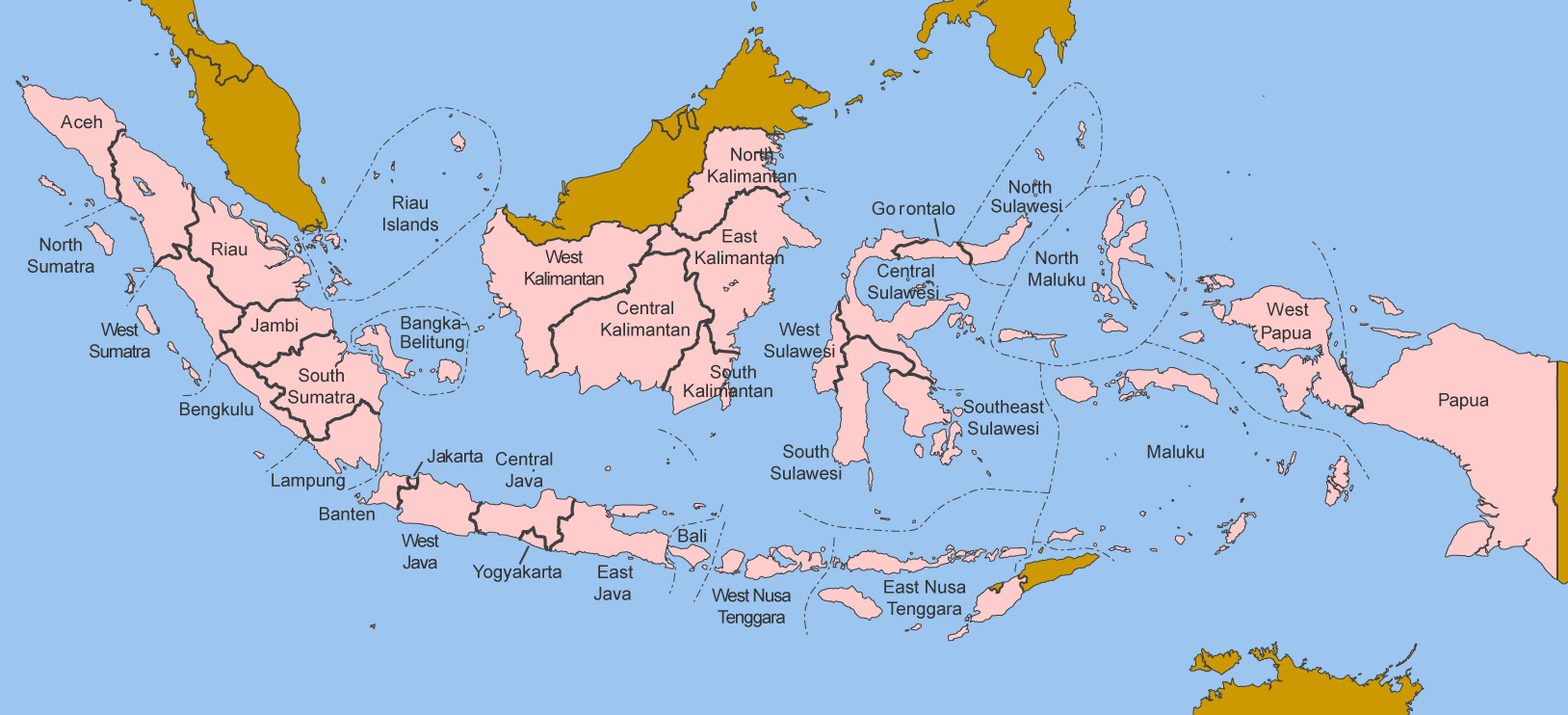
within 10 provinces :
-
Banten province (1 district)/ 12
-
West Java province (6 districts)/ 12
-
Central Java province (17 districts)/ 26
-
Jakarta province (1 district)/ 1
-
Yogyakarta province (3 districts)/ 8
-
East Java province (13 districts)/ 26
-
Lampung province (3 districts)/ 4
-
Bali province (5 districts)/ 30
-
South Kalimantan (1 district)/ 1
-
Central Kalimantan (1 district)/ 1
-
South Sumatra (6 districts)/ 6
Estimated date of primary infection, according to this notification, was
11 Dec 2003; date of initial detection of animal health incident: 15 Dec
2003. Indonesia is an archipelago comprising > 17,000 islands of
which approximately 6,000 are inhabited and 1,000 have permanent settlements.
The current situation with AI is now involving provinces on 4 of the larger
islands -- Bali, Java (West Java, Central Java, East Java and Yogyakarta),
Sumatra (Lampung), and now Borneo (West Kalimantan). There are 3 countries
that share territory on the island of Borneo -- Indonesia, Malaysia and
Brunei. The newly infected Province, West Kalimantan borders with Sarawak,
Malaysia. On Mar 20, 2004 the virus had extended its range in southern
Sumatra, while West Kalimantan recently became the latest province to be
infected with the AI influenza : the disease is strongly suspected to have
also spread to Lombok, Sumbawa, Flores, and West Timor. Among the 11 provinces
that had previously reported bird flu cases, 5 provinces reported 0 cases
in February 2004, while only 14 regencies were affected, down from 51 in
Jan 2004. In addition, the total number of chickens dying of bird flu dropped
to 1.2 million in January 2004 and to 966,000 in February after reaching
the highest level of 1.6 million in December 2003 : it is true that West
Kalimantan was added to the list recently, but Banten, Jakarta, West Java,
South Kalimantan, and Lampung have not reported any cases in February 2004.
According to data from the ministry, the 6 provinces that reported bird
flu cases in February 2004 were Central Java with 527 319 cases, Yogyakarta
31,075 cases, East Java 65,161 cases, Bali 333 268 cases, Central Kalimantan
4279 cases, and West Kalimantan 5770 cases. The official death toll of
chickens has been estimated at 6.2 million as of the end of Feb 2004 (this
figure excludes those chickens that were culled), and the number of chickens
culled estimated at 2.5 million. However, the FAO estimates that a total
of 15 million chickens have died or been culled.
Around 16 million fowl, out of a population of around one billion,
have died in Indonesia since the end of 2003 due to AI and Newcastle disease.
Indonesia's Agriculture Ministry faced criticism Fri 6 Feb 2004 for
allowing 30 million doses of an unaccredited and allegedly ineffective
bird flu vaccine imported from China by Bio
Farma to enter the country. While the need in Indonesia is 120 million
doses per month, the local production capacity in Indonesia is currently
47 million doses per month. In the 6-month period until 31 Jul 2004 the
Indonesian government will import 184 million vaccine doses from China
and the rest of the world.
The RNA of Indonesian virus is similar to the kind in the Yunan province
on mainland China, and distinct from that in Viet Nam and Thailand.
Suspected human case : 3-year-old son whose mother worked at an infected
chicken farm in the Tabanan district on the resort island of Bali died.
On April 2004 : new outbreaks in 1 district in Central Java Province
and 2 districts in Bali Province.
New cases in 4 previously infected districts occurred at the end of
May 2004 and were reported between 1 and 16 Jun 2004. They are Musi Rawas
(South Sumatra province), Gunung Kidul (regional area of DI Yogyakarta),
Demak and Purworejo (Central Java province). The new cases in Central Java,
and DI Yogyakarta. The total number of infected provinces is 14, comprising
92 districts. The disease hit a chicken farm in Grobogan District, Central
Java in the final week of Sep 2004, killing 350 of 1500 birds.
On December 2004 HPAI H5N1 broke out in several
parts of West Nusa Tenggara (NTB) [Nusa Tenggara Barat], killing > 20,000
birds, or 43% of the poultry population in 10 out of the 23 subdistricts
in the provincial capital of Mataram, South-east Indonesia, < 100 km
east of Bali. The outbreak was less severe in the other 13 subdistricts,
where about 10% of the total poultry population was affected. The virus
is believed to have been introduced by poultry from the neighboring island
of Bali or from Sulawesi [> 600 km north-west of Mataram]ref.
According to OIE's statistics summarizing the number of outbreaks accumulated
since the beginning of the Eastern-Asia epizootic in early 2004, Indonesia
ranks 3rd, with 169 foci, following 1749 in Viet Nam, and 994 in Thailandref.
Bird flu resurfaced in Indonesia, killing at least 21,000 chickens
on farms in 5 regencies and municipalities in the province of West Java
over the last 2 months (Cirebon regency and municipality, Subang regency,
Indramayu regency and Sukabumi regency). Cirebon municipality had the most
reported cases of bird flu, with about 12,000 chickens killed by the H5N1and
H7N1 viruses. During 2004, bird flu was reported
in 10 areas in West Java and killed about 1.6 million out of 6 million
farmed chickens in the province, or 25.3%. They have prepared 50 million
doses of vaccine to stop the spread of the virus in 2005. According to
estimates from the FAO, which were announced during a recent 28-nation
conference on bird flu in Vietnam, bird flu cost Asian farmers and agricultural
industries 10 billion USD in 2004. Indonesia's last avian influenza
case was recorded on 13 Dec 2004. According to OIE's data, the 4 countries
suffering the highest number of HPAI outbreaks since the beginning of the
panzootic in Dec 2003, are (in brackets -- accumulated number of outbreaks
as of 25 Feb 2005): Viet Nam --1764; Thailand -- 1077; Indonesia -- 169;
China -- 50. The respective dates of their last follow-up reports to the
OIE are: 22 Feb 2005; 24 Feb 2005; 6 Oct 2004; 6 Jul 2004. Absence of report
does not necessarily indicate the absence of disease. According to a reportage
(allegedly from an official source), bird flu has been killing > 33,000
chickens on farms in West Java in Jan and Feb 2005 : this might mean that
the outbreak has been continuing without an interval but remained unreported
to the OIE. Reporting can trigger difficult consequences. Many countries
find it difficult to report outbreaks of contagious diseases because these
can impact trade and tourism, or it can injure their international standing
or self-image. The Central Government decided to isolate South Sulawesi
in February 2005 and West Java in January 2005 from chicken trading, as
a fresh outbreak of bird flu killed some 25,000 chickens the 2nd week March
2005 in the regencies of Maros, Sidrap, Wajo, Pinrang, Soppeng & Parepare:
government had also distributed some 200 000 doses of a locally produced
vaccine to try and stop the disease from spreading. Indonesia sent its
last follow-up report, No. 7, to the OIE on 10 Mar 2005, indicating H5N1
outbreaks in 2 districts -- Wajo and Soppeng -- in the Sulawesi Selatan
Province. According to the report, the disease, affecting native chicken
layers and broilers, was introduced by illegal movement of animals from
neighboring countries (imported fighting cocks). Official information on
the situation in West Java will help. According to the previous follow-up
report, 6 Oct 2004, the outbreaks were in East and central Java. For an
administrative map of Indonesiaref.
60 000 quail (out of 130,000 farmed) had either died from H5N1
or had been culled at farms in Central Java provincea since February 2005.
In the January-March 2005 period, bird flu had killed a total of 281 730
fowl in 3 provinces of South Sulawesi, West Java and Central Java. Indonesia's
last HPAI follow-up report, received by the OIE on 10 Mar 2005, referred
to outbreaks in Sulawesi Selatan Province, reportedly caused by HPAI virus
subtype H5N1. The outbreaks that, according to the
current newswire, have taken place during January-March 2005 in West Java
and Central Java have yet to be officially reported. In case genetic studies
of Indonesian H5N1 virus strains are being carried
out, their results will be of interest, in particular, data on the relationship
of these strains to other recent Asian H5N1 virus
strains and their virulence to various avian and mammal species.
Ca Nidom, a molecular biology researcher from the Centre for Tropical
Disease Control, Airlangga University, Surabaya, East Java, has reportedly
identified avian influenza virus by RT-PCR in throat swabs and sera of
10 out of 20 asymptomatic pigs living 100 yards away from a chicken farm
in Surabaya on Java island that was struck by bird flu during 2004 : inactivated
RNA isolates have been sent to the Tokyo University, where 8 fragments
(HA, NA, PA, PB1, PB2, M, NP, NS) were sequenced. It is the same
"HPAI" variant (based on the study regarding the cleavage site) that causes
severe disease in chickens. And the isolated virus's gene for haemagglutinin
was > 98% identical to samples taken from infected Indonesian chickens
and quail. Traces of H5N1 infection had been reported
in 1 pig in Vietnam and 2 in China in 2004, but this is the 1st time that
a virus isolated from a natural infection in pigs has been genetically
sequenced. Could culled chickens be used (illegally, of course) as
food for pigs? Farmers hate to waste anything and might not understand
the finer points of infectious disease transmission. Feeding of chicken
manure, often including chicken carcasses or parts thereof, to food animals
-- herbivores included -- has been widely practiced in many countries.
Most countries require that the recycled material be derived only from
farms considered free of infectious diseases. Some countries allow it only
in certain species and/or husbandry methods. In Bali there were 1000 chickens
living over 20 pig pens with just slats between them. It is a farming system
called tampung sari. This way the chickens' faeces falls directly to the
pigs and they eat it. Apparently pigs can get up to 40% of the RDA from
chicken faeces, and it is common practice to feed chicken faeces to pigs.
To my knowledge culled chickens are not used to feed pigs (at least in
tampung sari), but it is possible. It is well known that chicken faeces
[i.e., feces from infected chickens] contain H5N1,
so the exposure from chicken faeces is enough to explain the finding. Likewise,
in China, ducks and pigs live closely together so that it is easy to explain
the finding of H5N1 in pigs in China in 2004. Integrated
farming systems are meant to utilize the products of one sub-system by
another sub-system, generating useful materials like protein biomass in
the process. Various combinations are known. In Southeast Asia, integrated
systems combining chickens/ducks, pigs and fish are widely applied. The
Indonesian Agriculture ministry conducted tests on pigs after local scientists
reported that pigs in several farms on the main island of Java were infected.
During Jan - Mar 2005, HPAI had killed a total of 281,730 birds in
Central Java, South Sulawesi and West Java Provinces. In Central Java Province,
some quail farms have been affected and over 77,000 poultry have either
died or been culled. The disease also attacked the native chicken in Bojolali
and Sragen districts. In South Sulawesi Province, the deaths of the birds
were observed in Maros, Parepare, Pinrang, Sidrap, Soppeng and Wajo Regencies.
Inter-island chicken trade from South Sulawesi has been banned since mid
March 2005. In West Java Province, 21,000 dead chickens were reported between
Jan - early Mar in Cirebon, Subang, Indramayu, Purwakarta and Sukabumi
regencies/municipalities. Cirebon municipality had the highest reported
cases with about 12,000 chickens affected. No bird flu cases were reported
in Cirebon in 2004. HPAI had mostly affected quails in West Java. In Cirebon,
destroyed quails were said to have been brought from Sleman (Yogyakarta).
Some 200,000 doses of vaccine against H5N1 infection
had been distributed to infected areas, and the government has set aside
Rp 750 million (USD 79 000) and Rp 250 million [USD 26 000] backup fund
to assist poultry breeders who destroyed their bird flu-infected flocks.
Since 31 Mar 2005, West Java authorities have stopped all poultry traffic
into the area. Cirebon has been declared as an epidemic area. The poultry-check
operation targeting chickens, quails and ducks was held in the Losari area,
which is on the border and main route of poultry trucks from Central Java,
Yogyakarta and East Java.
30 chickens were found dead recently in Sidomulya subdistrict, Samarinda,
East Kalimantan near the end of April 2005.
On June 2 2005, the OIE declared H5N1 AI endemic
in Indonesia; that means the OIE believes there is a strong chance for
new widespread outbreaks of the highly virulent strain. Despite that announcement,
Indonesia's government hasn't yet changed their plans to be bird flu free
by 2007.
Follow-up reports : 6
Feb 2004, 5
Mar 2004, 9
Apr 2004, 14
May 2004, 2
Jul 2004, 6
Aug 2004, 8
Oct 2004, 11
Mar 2005, 8
Apr 2005
Follow-up report No.8 : 1 June 2005 : Information received on 23 May
2005 from Prof. H.R. Wasito, Director General of Livestock Services, Department
of Agriculture, Jakarta: end of previous report period: 6 Apr 2005 (see
Disease Information, 18 [14], 102, dated 8 Apr 2005). End of this report
period: 23 May 2005. Precise identification of agent: HPAI virus subtype
H5N1. 3 surveys were conducted in Tangerang district,
Banten province, using purposive and pooled sampling. A total of 187 samples
were taken during the surveys.
-
the 1st survey was conducted on 23 Feb 2005 in a farm in Babat village,
Legok subdistrict, where 5 out of 10 nasal swabs were positive and the
subtype involved was identified as H5N1.
-
as a follow-up, the 2nd survey was conducted on 14 Apr 2005 in Rancaiyuh
village, Panongan subdistrict, where 6 out of 10 nasal swabs taken from
31 pigs over 5 months old were positive for H5N1.
-
the 3rd survey was on 26 Apr 2005 in Babat village, Legok subdistrict,
where one out of 6 nasal swabs taken from 6 pigs over one year old was
positive for H5N1.
Not a single pig has shown clinical signs of avian influenza. Details of
outbreaks:
-
1st administrative division: Jawa Barat (West Java); Lower administrative
division: Banten province; Type of epidemiological unit: village; Name
of the location: Legok subdistrict; Date of start of the outbreak: 24 Feb
2005; Species: sui; Number of animals in the outbreaks : susceptible: 897;
cases: 6 (infected animals without clinical signs); deaths: 0; destroyed:
0; slaughtered: ...
-
1st administrative division: Jawa Barat (West Java); Lower administrative
division: Banten province; Type of epidemiological unit: village; Name
of the location: Panongan subdistrict; Date of start of the outbreak: 14
Apr 2005; Species: sui; Number of animals in the outbreaks: susceptible:
823; cases: 6 (infected animals without clinical signs); deaths: 0; destroyed:
0; slaughtered: ...
Diagnosis: laboratories where diagnosis was made: Faculty of medicine,
Airlangga University; Species examined: sui; Diagnostic tests used: RT-PCR
(1); Date: 7 Mar 2005; Results: H5N1. Laboratories
where diagnosis was made: Research Institute for Veterinary; Science, Bogor;
Species examined: sui; Diagnostic tests used: agar-gel precipitation test,
RT-PCR(1) and sequencing analysis; Date: 28 Apr 2005; Results: H5N1
Laboratories where diagnosis was made: Disease Investigation Centre
Region I-VII; Species examined: sui; Diagnostic tests used: hemagglutination
inhibition test; Date: 2 May 2005; Results: H5N1
Further investigations have been made in 7 provinces (Central Java,
West Java, West Kalimantan, South Sulawesi, Bali, Riau and North Sumatra).
The results of the serological testing of 250 samples (sera and swabs)
were all negative. Source of outbreaks or origin of infection: these pig
farms are adjacent to
backyard chicken farms. The infection in pigs was due to contamination
with chicken manure. Control measures:
-
undertaken: quarantine; movement control inside the country; disinfection
of infected premises/establishment(s).
-
to be undertaken: partial stamping out; no treatment of affected animals;
no prohibited vaccinationref
Details of new outbreaks: 1st administrative division (province) (in brackets:
2nd admin div):
-
1. Jambi: 7 outbreaks (3 in Batang Hari, 4 in Jambi);
-
2. Kalimantan Timur (East Kalimantan): 1 outbreak (Tenggarong) ;
-
3. Sumatera Utara ( North Sumatra): 1 outbreak (Simalungun);
(Total: 9 outbreaks between 7 Mar 2005 - 4 May 2005). Description of affected
populations: layers, broilers, ducks, native poultry, fighting cocks.
A 22-year-old man (Khairil Anwar) resident of Pussanti hamlet in
Sinjai regency (southern Sulawesi island) some 150 km south of Makassar
city, farm worker in Soppeng regency, is healthy and currently shows
no symptoms of illness but 2 tests at a Hong Kong laboratory confirmed
that he had been infected by H5N1 AI virus, making
Indonesia the 4th country to register a human case of avian influenza.
The farm worker was initially tested in late March after the epidemic spread
to Sulawesi, killing > 25,000 chickens. That outbreak prompted officials
to limit the transfer of poultry off the island and take blood samples
from laborers, veterinarians and others exposed to sick chickens. Efforts
to complete a second round of testing in Hong Kong were prolonged in part
because the farm worker had left his job and health investigators had to
track him back to his home village elsewhere on the island. The second
test, finally completed earlier this month, confirmed that the laborer
had been infected by bird flu but the concentration of antibodies was relatively
low, officials said. That finding meant the worker was no longer carrying
the virus but it was impossible to determine how long ago he had been infected.
In total, 81 people were tested and all but one of the samples came back
negative. He has gone back to his hometown in the last 2 months after a
poultry farm where he worked in Soppeng regency went out of business after
being hit by the virus, killing 10,000 chickens in just 20 days. While
working at the farm, Khairil was completely unaware of the danger of bird
flu or the precautionary measures that should have been taken, such as
wearing masks or gloves to shield him from infection. No officials had
ever come in to provide the poultry farmers and workers with such information.
He only learned there might be something wrong with him after WHO staff
came to take his blood sample for the second time, all the while asking
about his health condition and then gave him Rp 500,000 (US$53) to go to
the doctor in case he felt sick. Since 2003, the highly lethal disease
has struck chickens, quail and other birds in 18 Indonesian provinces on
7 islands. The H5N1 virus circulating in Indonesia
is (genetically) distinct from other East Asian isolates and as a consequence
may be less pathogenic in humansref.
A 8-year-old female living in Tangerang suburb of Banten Province,
Jakarta, became ill with fever, diarrhoea, then cough, on 24 Jun 2005.
She was brought to Siloam Gleneagles Hospital, Tangerang, on 28 Jun, where
she died with respiratory distress 20 days after onset on Thu 14 Jul morning
: her 38-yrs old father (Iwan Rapei), an auditor of the Supreme
Audit Agency (BPK), who often visited her, and her 1-year-old sister
developed the same symptoms on 2 Jul and 29 Jun, respectively. The 2 were
admitted to the Siloam Gleneagles Hospital in Tangerang, Banten Province
about 25 km (15.5 miles) west of Jakarta, on 7 Jul, for high fever and
respiratory problems. The 1-year-old girl died 10 days after onset on Sat
9 Jul at the Harapan Kita Hospital in West Jakarta after being treated
for 2 days. The father died 10 days after onset on Tue 12 Jul : samples
from the man tested positive for avian influenza
H5N1 virus by the WHO H5 reference laboratories
at the Department of Microbiology, University of Hong Kong, and the Centers
for Disease Control and Prevention, Atlanta USA. Samples from the 2 children
are being tested : on 29 Jul the same 2 labs detected high positive rising
micro-neutralisation titres specific for H5N1 in
2 samples taken 3 days apart from the 8-year-old girl (the initial case),
suggesting she was a
probable avian influenza
A/H5
case, based on analysis of serological samples : on 3 Apr
2006 H5N1 was confirmed by the WHO lab in Hong Kongref.
Laboratory results for the 1-year-old daughter are still pending. Genotyping
of the PCR-amplified isolate from the confirmed case shows high homogeneity
with other H5N1 isolates from poultry in Java, and
no evidence of reassortment of genome sub-units. The remaining 4 residents
of the house (2 members of the family and 2 household workers) remain healthy
and show no symptoms to date. The restriction of the Indonesia outbreak
to 3 members of one family, leaving at least 2 others unaffected, is curious.
The mystery of the route of transmission of infection is further complicated
by the fact that the family reside in an affluent suburban area of the
capital city. The Ministry of Health is closely following over 300 contacts,
including health care workers, family members, school and office colleagues
and neighbours. None of these contacts has shown any symptoms to date.
They also plan to carry out extensive tests on animals within a 20 km (12
mile) radius of the family's house and slaughter those infected : H5-infected
bird faeces were detected in a bird cage on the side of the road opposite
the family's house; cloacal and throat swabs of the pet bird inside the
cage were negative for H5. This is the 1st, and, thus far, the
only, indication of a possible source of exposure. Other environmental
sampling was negative. Media reports that claimed that the affected family
had just returned from India and Hong Kong have been denied : according
to his passport, the father's last trip abroad was in October 2004 to Hungary
without his family, adding that the deceased man was also scheduled to
visit South Africa this week on business. While the 3 Indonesian family
members had no known contact with poultry before they died, a more thorough
investigation could turn up evidence to the contrary : on Wed 10 Aug 2005
Indonesian health authorities decided to abandon the quest. It seems quite
possible to me that an infected bird -- or a bird that had recently recovered
from infection -- could have been removed from the cage only hours or perhaps
even minutes before inspectors arrived at the house. Given human nature
and the fear of official retribution common to ordinary people in most
countries of world, the bird could have been clandestinely removed or released
in response to news that government inspectors were in the neighborhood
checking birds for signs of possible illness. How likely is it that a false
positive (as opposed to a false negative) would be obtained from bird feces
-- even if old? Also, if this is in fact the case, why wouldn't WHO
have cited reservations regarding the diagnosis in their update? No indication
of the estimated age of the feces was given; it seems possible that the
infected bird could have been removed only hours or even minutes before
inspectors arrived at the house. However, this does not explain why only
those 3 were affected, while the other family members showed negative results
for both serologic and PCR tests. Also, none of the neighboring families
showed a positive result. There is also a question as to whether those
3 victims were exposed to the source at the same time or whether one of
them was the index case and transmitted the virus to the other close family
members sharing the same genetic susceptibility to the virus. As we know,
the 2nd case showed symptoms 10-11 days after the 1st, the 3rd case a few
days later: an unusual incubation period for avian influenza if they were
exposed at the same time. My hypothesis is that they were grossly exposed
to a (so far unknown) source, possibly repeatedly. Alternatively, one victim
could have become a new infection source for the others who have similar
genetic susceptibility. This is an issue that deserves further study, particularly
with respect to an apparent greater vulnerability of Vietnamese people
to avian influenza virus infectionCould an intentional targeted spreading
of the virus possibly play a role in this case? Indonesia has sent specimens
to Hong Kong to confirm the results, which will take 7 to 10 days. Though
there is no evidence yet that the 3 had contact with infected poultry,
human-to-human transmission of the disease appeared unlikely at this stage.
The virus strain that killed them had not mutated to ease such transmission.
The Federation of North Sumatra Fowl Associations (Gapsu) claimed that
the outbreak was caused by the distribution of hatching eggs smuggled from
Malaysia (a country that hasn't really reported AI) besides the entry of
chicken from areas already infected with the virus, like Java and Thailand.
From 23 Aug 2004 the Indonesian government has banned the import of fowl
products from Malaysia but to date, their hatching eggs can still be found
in North Sumatra. 4 seaports in Batam, namely Sekupang, Batuampar, Telaga
Punggar and Pusat Batam, were placed under strict surveillance to prevent
the entry of items that could carry the bird flu virus including chicken
eggs and dressed chicken. Other hypotheses involve a smuggled fighting
cock from Thailand, and migratory birds en route to Australia. About 383,000
chickens had died of bird flu in south Sulawesi since March 2005. Bird
flu outbreak has affected at least 132 regencies and cities in 21 out of
30 provinces in Indonesia with the number of chickens killed by the virus
totaling 9.53 million. Further data on the suspected source of their infection
have not been provided; it would help if information on possible contacts
with the pig farms found infected in Tangerang earlier in 2005 becomes
available. The farms were in Babat village, Legok subdistrict and Rancaiyuh
village, Panongan subdistrict. The Indonesian authorities will on Sun 24
Jul 2005 kill, burn and bury some 200 pigs infected by bird flu in Tangerang.
A 37 years-old woman in Jakarta developed symptoms on 31 Aug,
was admitted at the Bintaro International Hospital in South Jakarta on
3 September, suffered from pneumonia and flu-like respiratory problems
since 6 Sep 2005 and died on Sat 10 Aug 2005 night, becoming the country's
5th case (4th death) of the disease : tests by the WHO reference laboratory
in Hong Kong on 16 Sep were positive for H5N1.
The woman was an immigration agent and dealt with many expatriates. Inquiries
so far had found that people she had contact with were healthy. Unlike
most bird flu victims, she rarely had contact with animals, but reportedly
lived near a poultry slaughterhouse and some of her neighbours kept chickens
and ducks. No recent poultry deaths have been reported in the area. She
had a wild type H5N1 cleavage site, RERRRKKR, and was reportedly linked
to fertilizer, and presented the PB2 E627K mutation. However, the only
bird H5N1 sequences with PB2 E627K is the Qinghai
strain and the description of the isolate from the second confirmed case
indicated it was a clade 2 sequence, like poultry sequences in Indonesia.
Therefore, none of the human sequences match a published bird sequence
in the area, highlighting the need for more H5N1
sequences from West Java, and the need to release the existing human sequences.
The acquisition of PB2 E627K could have been due to random mutation within
the patient. However, E627K could also have been acquired via recombination,
since all mammalian sero-types isolated from humans have E627K. Similarly,
all Qinghai strains of H5N1 also have E627K. so recombination
could have happened between two avian isolates. Although E627K could have
also been acquired via reassortment involving avian genes, such reassortment
would have probably mentioned in the WHO update. In the Qinghai strain,
the wild type cleavage site is GERRRKKR, which may not be as virulent as
RERRRKKR. Earlier human isolates from Hong Kong, Vietnam, and Thailand
that combined the wild type H5N1 cleavage site with
PB2 E627K were almost universally fatal. Similarly the combination in mammals,
such as the tigers in the zoo in Thailand, a domestic cat or domestic dog
also led to fatalities. E627K also increased virulence in laboratory mice.
The infections in the tigers in Thailand also lead to efficient tiger to
tiger transmission. All 147 of the exposed tigers either died or were euthanized,
even though culling and oseltamivir
was used to try to control the outbreakref.
-
a neighbor of the woman had been hospitalized with symptoms consistent
with avian influenza. But the authorities said they were still awaiting
lab results before confirming she had contracted H5N1
avian influenza virus infection. 15 blood samples taken by a Health Ministry
team from her relatives and neighbors (including those taken from 3 people
who had helped to bury the woman) tested negative for H5N1on
Tue 13 Sep 2005. It should be noted that, with regard to the cluster of
3 deaths in the same family referred to in the above reports, WHO has stated
that H5N1 infection was confirmed in the 38-year-old
father but that laboratory test results for his 2 daughters did not meet
criteria for acute H5N1 infection. WHO reports only
laboratory-confirmed cases. Therefore, the number of confirmed human cases
of avian influenza in Indonesia is 2, not 4 as repeatedly stated by the
Indonesian authorities.
The estimated number of chickens killed by avian influenza in Indonesia
is 9.5 million, whereas the number of animals culled in 2005 is 71. The
virus has spread to 22 provinces out of 33 in the sprawling Indonesian
archipelago, killing more than 9.5 million poultry since late 2003.
The the 140 hectare Ragunan zoo in south Jakarta was shut on
Sep 19, 2005 after 19 out of 27 birds (including peacocks, mynahs, wild
ducks, pigmy chickens, eagles, and herons) that were randomly tested were
found infected with AI : it was closed to the public through Oct 11. Usually
2 weeks are enough but they decided to raise it to 3 weeks to make sure
unwanted things would not happen : some 2,100 birds in the zoo's collection
will be tested for the virus. An important question is how did the virus
get there? Was it spread from migratory birds; did someone illegally bring
and feed infected poultry arcasses to animals in the collection? Was it
spread mechanically from poultry either in Jakarta or outside the city,
as people do visit important zoos often and from substantial distances?
The report also underscores the importance of including zoos in a comprehensive
surveillance strategy for avian influenza, and other diseases. The inclusion
of information derived from a zoo was critical in unraveling the 1999 West
Nile incursion into New York City in the USA. No better example of the
benefits of zoo surveillance could be found than the key observations and
subsequent isolation of West Nile virus spearheaded by Tracy McNamara at
the Bronx Zoo, when she noted that the pattern of mortality in her zoo
collection was not likely to be due to St Louis encephalitis, the prevailing
presumptive diagnosis for the human cases early in the West Nile outbreak
in New York City. Seeing the pattern of occurrence in all animals can be
very helpful. Zoos provide a wide range of species, which may have varying
susceptibilities for new agents or strains. It is, therefore, imperative
that surveillance at zoos be one element, along with surveillance in humans,
pet bird populations, backyard poultry, commercial poultry and, of course,
migratory birds, swine and other species in a comprehensive surveillance
strategy. How to optimize surveillance in terms of cost, time and personnel
is, of course, a key decision for responsible human and animal health authorities.
Management of avian zoo population, now that avian influenza has been found
in the collection, presents real dilemmas and significant tradeoffs. Although
I don't know the status of the zoo collection presently, it is my understanding
that this zoo is likely to contain several species that are very rare and
qualify for special treatment under the CITES (Convention on International
Trade in Endangered Species) treaty, which protects endangered species.
Birds such as Argus pheasants, Bali mynahs and Birds of Paradise are likely
to be included at a key zoo location such as the Ragunan Zoo. Depopulation,
particularly as exemplified in Hong Kong in 1997, has been one of the most
effective public health measures taken when avian influenza-infected live
birds exist in urban markets. In this case, however, depopulation should
be a last resort, not a knee jerk reaction. A plan for quarantining and
testing selected rare, positive or exposed birds in an enclosed aviary
should be considered. Clearly, although an AI-infected resident population
in zoos presents many problems, optimal solutions, short of complete depopulation,
that both protect public health and rare endangered species should be sought.
Another management option for the protection of captive collections of
endangered bird species is preventive vaccination. This option was used
in Dutch zoos during an outbreak of highly pathogenic avian influenza virus
(H7N7) in poultry in the Netherlands in 2003. When
the area of the outbreak threatened to encroach on Dutch zoos, the Dutch
Federation of Zoos requested permission from the European Commission for
preventive vaccination of zoo birds to avoid pre-emptive culling of valuable
and sometimes endangered bird species in their collections. The European
Commission granted permission (for details, see European Commission directiveref)
providing that the zoos fulfilled strict conditions. These conditions included
collection of blood before and after vaccination, registration of all vaccinated
birds, and a specific standstill of vaccinated animals and products of
vaccinated animals. Birds in 10 zoos from the Netherlands were vaccinated
with an inactivated, adjuvanted H7N1 virus vaccine
previously used in poultry. The difference in the neuraminidase (N1
in the vaccine strain instead of N7 in the field strain) made
it possible to distinguish vaccinated birds from infected birds. Of 211
birds in 13 orders tested, 81.5% developed a titre > 40, which is considered
protective in chickens. The results of this study suggest that vaccination
with a heterologous strain is a useful tool for the protection of birds
in zoos against highly pathogenic H7 virus infection, and is
a suitable alternative or additional measure for confinement and pre-emptive
culling when implemented together with virological monitoring and strict
bio-security measures at zoos. We are aware that the 2003 outbreak of H7N7
virus in the Netherlands differs in certain aspects from the ongoing outbreak
of H5N1 virus in Asia. Despite these differences,
we strongly feel that preventive vaccination of bird collections in zoos
by use of a high-quality, adjuvanted H5 virus vaccine should
be considered as part of the protective management strategy against H5N1virus
infection. Definitely, when collections of endangered bird species are
involved, this option should not be neglected. HPAI (H7N7):
vaccination of zoo birds and transmission to non-poultry species. In 2003
an outbreak of HPAI virus (H7N7) struck poultry in
the Netherlands. A European Commission directive (Commission Decision 2003/291/EC
of 25 April 2003) made vaccination of valuable species in zoo collections
possible under strict conditions. We determined pre- and post-vaccination
antibody titres in 211 birds by haemagglutination inhibition test as a
measure of vaccine efficacy. After booster vaccination, 81.5 per cent of
vaccinated birds developed a titre of 40, while overall geometric mean
titre (GMT) was 190 (IC95 : 144-251). Birds of the orders Anseriformes,
Galliformes
and Phoenicopteriformes showed higher GMT and larger percentages
developed titres 40 than those of the other orders. Antibody response decreased
with increasing mean body weight in birds 1.5 kg body weight. In the vicinity
of the outbreak, H7N7 was detected by RT-PCR in wild
species (mallards and mute swans) kept in captivity together with infected
poultry, illustrating the potential threat of transmission from poultry
into other avian species, and the importance of protecting valuable avian
species by means of vaccinationref.
The situation in Jakarta is different from the Netherlands in some significant
respects. Foremost is the propensity of this H5N1
to cause human deaths and that Jakarta itself has been declared an "extraordinary
case region". Nevertheless, the vaccination strategy detailed above does
appear to have several advantages when combined with strict biosecurity.
First, it can differentiate between vaccinated birds and H5N1-infected
birds. Secondly, if the protection levels are adequate in the captive birds,
zoo keepers and other personnel would have enhanced protection against
being infected. Finally, vaccination as one tool in a comprehensive strategy
might allow for the preservation of very rare or endangered species until
H5N1 can be controlled and possibly eliminated from
Jakarta. For any Pacific Island Country or Territory which has a rare bird
collection, it might be prudent to consider a contingency plan for these
collections of birds. Closure of the facility to the public may be wise
during any outbreak or suspected outbreak to minimise the risk of contact
with infected material. Improved biosecurity of the facility to minimise
direct or indirect contact with wild birds would also reduce the chances
of infection. Vaccination may be another strategy worthy of consideration,
and here the vaccine of choice would probably be an oil adjuvant killed
H5N2 vaccine, which is currently available commercially
and is heterologous to the current H5N1 strain affecting
SE Asia for purposes of DIVA. Different species of bird are known to respond
to this kind of vaccine, but there are some data from the Netherlands and
Singapore on this. The Pacific Community is 22 islands and territories
ranging from the
Northern Marianas to Pitcairn Island, with a population of about 7
million. Some places are rapidly increasing in population and others are
decreasing. The members of the Pacific Community are spread over 30 million
km2, > 98% of which consists of ocean; the Pacific region is
vast. Of its 7500 islands, only about 500 are inhabited. The islands themselves
feature great geographical diversity. Papua New Guinea accounts for 83%
of the land area, while Nauru, Pitcairn, Tokelau, and Tuvalu are each <
30 km2ref.
Nearly 85 people are being treated for suspected bird flu from
at least 9 provinces out of 33 in the country (with Jakarta having the
highest case number of 28) but only 10 patients have tested positive:
of the total, 20 patients were under observation at Jakarta's Sulianti
Saroso hospital for infectious diseases :
-
children :
-
a 1-year old girl was admitted on Sep 24
-
a 2-years old girl died at Jakarta's Christian PGI Hospital after
suffering a high fever and respiratory problems : no results have yet been
announced
-
a 2-year-old infant would be able to leave the hospital once a clearance
was obtained from the Health Ministry
-
a 3 year old child
-
a 4-year old boy from Lampung province on Sumatra
-
a 5-year old girl was transferred from a private Jakarta
hospital on Sep 20 and died on Sep 21 : on Sep 23 tests carried out in
Indonesia showed she did not have the virus. Indonesia was not planning
to send her blood samples to a laboratory in Hong Kong for confirmation
-
a 5-year-old girl tested positive in
Indonesia. By WHO standards, however, the final proof rests on the outcome
of a PCR test, which in the girl's case showed negative (?)
a 5-year-old boy from Wonogondo village, Kebonagung subdistrict,
Madiun, East Java, was rushed to Dr Soedono Hospital on Fri Sep 30 night
after being treated at the Pacitan Regional Hospital since Thu. The boy's
mother said her son got bird flu symptoms after 15 of her chickens were
found dead suddenly. The boy is the 2nd suspected avian influenza case
in East Java.
-
a 6-year old-girl
-
a 7 year old boy
-
an 8 (9?)-year-old boy (Firdaus), nephew of the 27-yrs old Jakarta
woman who died of bird flu on Sep 16, was hospitalized on Sep 17 has been
confirmed
to have H5N1 virus by a WHO reference laboratory
in Hong Kong. The boy remains in hospital for observation and treatment.
He didn't live with her, but had contact with his aunt after she became
ill. Onset of his symptoms occurred four days after she became sick. It's
possible that there's a common source of infection, but given the timing,
we can't rule out human-to-human transmissionref
-
a 20-month-old baby who was suspected of developing bird flu symptoms
finally died on Wed Oct 5 after 3 days of intensive treatment at the Sulianti
Saroso Hospital in Jakarta due to respiratory problems and worsening pneumonia
-
adults :
-
a 27-year-old woman from Jakarta developed symptoms on 17 Sep 2005,
was hospitalized in Jakarta on 19 Sep 2005, and died on Mon 26 Sep 2005.
It was unclear how the woman got the disease, but she had been in contact
with 15 diseased and dying chickens in her household shortly before the
onset of illness. Tests done in Indonesia on Her saliva and blood were
positive
for bird flu both in local tests and in confirmatory testing conducted
at a WHO reference laboratory in Hong Kongref
-
a 23-year-old man (Slamet Wibowo) resident of Bogor, West Java,
was referred on late Tue Sep 27 Sulianti Saroso from a private hospital
in Cibinong, registered positive for the bird
flu virus at RT-PCR in both clinical and blood tests shortly and died on
Sep 30. He had had direct contact with birds and poultry as he bred birds
and many of his neighbours raised chickens
-
a 30-year-old housewife died during intensive hospital treatment
for developing bird flu symptoms
-
SP, a woman from Ponggok village, Kota sub district, Pacitan district
is currently under intensive treatment at the Dr Soetomo Hospital here
for suspected AI
-
a critically ill 68-year-old man suspected of having contracted
AI died on Sun 2 Oct 2005 after being treated in hospital for less than
a week. The patient died at the Sulianti Saroso Hospital for infectious
diseases after being admitted on 30 Sep 2005. He owned a chicken farm in
Bogor. 2 tests had produced negative results
-
a 21-year old man from the province of Lampung on the island of
Sumatra developed symptoms on 20 Sep 2005, was hospitalized on 24 Sep at
the Abdul Moeloek general hospital in Lampung, tested positive
at RT-PCR on Oct 6 2005, and fully recovered. Initial investigation has
revealed that the man had direct exposure to diseased and dying chickens
in his household shortly before the onset of illness.
-
his 4 year old nephew developed symptoms on 4 Oct 2005, was hospitalized,
was found positive to H5N1
avian influenza virus in Hong Kong, recovered fully, and has returned home
-
his 5-year-old boy developed symptoms in October 2005 and fully
recovered. Both the child and his brother had direct exposure to diseased
chickens during slaughtering. As initial diagnostic tests produced inconclusive
results, retrospective confirmation of the child's infection relied on
antibody levels in acute blood samples taken during his illness and convalescent
samples taken following recovery. He tested positive
on Feb 5ref1,
ref2
-
a man died on Oct 11 after just a few hours at Sulianti Saroso hospital.
The man showed symptoms of bird flu but the results of tests were not yet
available
11 of 22 patients had been to Jakarta's Ragunan zoo before birds fell ill
:
-
3 workers : of the 500 zoo employees, 143 have been identified as being
at high risk for exposure to the virus
-
a 28 year old guide
-
a 39 year old vendor
-
a food worker was hospitalized on Sep 19
-
a 9 year old girl
... suspected of contracting the disease were being treated the Sulianti
Saroso infectious diseases Hospital in north Jakarta : 2 are suspected
of having the symptoms of bird flu based on the lab tests. The other one
is still under observation. Blood samples from the 3 have been sent to
Hong Kong for testing : the 3 children - 2 of whom were in serious condition
in the hospital's intensive care unit - are not believed to have contracted
the virus from the zoo. 5 out of 22 people who had been admitted to the
hospital were allowed to go home because they had been found not to have
the disease
-
a boy who died in East Kalimantan province on Borneo island in the
3rd week of Sep had bird flu symptoms. Officials have not said if he was
tested for the virus.
The Indonesian government has been hoping to attract 6 million foreign
tourists in 2005, which would generate USD 5.8 billion in foreign exchange
from the industry -- higher than last year's 5.3 million tourists and USD
5 billion in revenues. The number of foreign arrivals during the year's
1st 7 months was 2.45 million, according to the Central Statistics Agency,
down 4.08 per cent from the same period in 2004. Indonesia's tourism sector
has been in the doldrums since the Bali bombings in 2002, and terror attacks
on the JW Marriott Hotel and the Australian Embassy, both in South Jakarta,
the following years, scared off potential tourists. At the same time, a
series of SARS and influenza epidemics in the region, as well as the 26
Dec 2005 tsunami, made things worse for the sector. The occupancy rates
of hotels in the country dropped from an average of 55% to 30% during the
SARS outbreak.
The virus has spread to 22 provinces out of 33 in the Indonesian archipelago,
killing > 9.5 million domesticated birds since 2003.
On October 2005 Indonesian health authorities found chickens which
tested positive for the H5N1 bird flu virus but which
appear to be healthy instead of dying within 24 hours of contracting it,
a sign that the bug may become harder to detect. In case the test
was a serological one, there could have been various reasons for the lack
of clinical symptoms: a low-pathogenic virus, natural resistance of the
birds, or their immunity. Such an immunity could have been established
also by a heterologous H5 virus, either a wild one or a vaccine
strain (mass vaccinations are reportedly being carried out in Indonesia).
Obviously, background epidemiological details, as well as data on the virus
itself, are necessary before an evaluation of the Indonesian H5N1
virus strain and hypotheses on public-health implications can be made.
It would help if such information were obtained directly from Indonesia.
Some testing conducted in Java in 2004 showed the vaccine's protection
level was only about 11.8 to 28% : local producers intentionally lowered
the vaccine quality to make more profits from the contract. Farmers across
the country had also complained they had not received compensation for
culling flocks because officials had embezzled the money. According to
the last follow-up report of Indonesia to theOIE, dated 2 Aug 2005, there
had not been any outbreaks ofavian influenza with clinical signs in Tangerang
district --where fatal cases in humans were reported -- since April 2005.
It will be interesting to note whether the current reported suspicion,
related to deficient poultry vaccines, is based upon clinical observations.
One might wonder whether the suspicions are related to last week's information
on the Indonesian health authorities' discovery of asymptomatic chickens
which tested positive for the H5N1 bird flu virus.
One of the suggested explanations to this finding was immunity of the tested
chickens to H5N1, conferred by an heterologous H5
virus (vaccine strain ?!).
On Oct 20 2005 a 63-years old man and his 22-years old son
in Jakarta were suspected to be the 3rd cluster of related people suspected
of having contracted the bird flu virus, but on Oct 21 laboratory testing
in Jakarta has not confirmed the initial clinical diagnosis and at present
these cases are not ranked as avian influenza cases. Also a baby not related
to the father and son was admitted to Jakarta hospital with suspected bird
flu on the same day.
> 25 previously healthy backyard chickens dropped dead since Oct 21
to Oct 26 2005 on the resort island of Bali. According to Indonesia's official
reports to the OIE, the last outbreak of clinical HPAI in avians occurred
in Indonesia on 4 May 2005, in the village Ujung Padang, Sumatra Utara
(Follow-up report No 9 of 27 Jun 2005ref.
Though human cases have been reported later, only serological findings
from asymptomatic avians have been reported in the last available follow-up
report No 10, dated 2 Aug 2005ref.
In view of the appearance of cases in humans, it is conceivable that cases
in avians do occur but remain undetected, underlining the need for enhanced
surveillance and reporting.
-
on Nov 5 it was confirmed that a 19-years
old woman from the town of Tangerang, near the capital Jakarta, developed
symptoms on 19 Oct 2005, was admitted to the hospital on 26 Oct 2005 and
died on 28 Oct 2005 had bird flu, bringing the total deaths from the disease
in the world's fourth most populous country to 5. One of the nurses
who
tended to the woman who died was admitted to Sulianti Saroso hospital
for infectious disease in north Jakarta just before midnight on Thu Nov
3 after complaining of bird flu-like symptoms and is now in an isolation
ward in Jakarta. The infectious diseases hospital has also been treating
the deceased
woman's daughter and 2 of her nephews, all under 5 years
of age, all admitted to the hospital on Tue Nov 1 with bird flu-like
symptoms : while all the 3 toddler-age children no longer suffer from high
fevers, coughs and respiratory problems, the woman's
8-years old brother
(nephew ?) developed symptoms on 25 Oct 2005 and tested positivefor
the disease, taking the number of confirmed Indonesian cases to 9. Field
investigation has found evidence of sick and dying chickens in the residential
area of the 8-year-old. His 19-year-old sister is known to have visited
this area.. Tests on the other 2 children came back negative. If
the nurse is confirmed as a human case of avian influenza virus infection,
this cluster of cases may be indicative of person-to-person transmission
of avian H5N1 influenza virus
-
a 16-year-old girl from Jakarta developed symptoms on 4 Nov 2005
was admitted to a Jakarta hospital on Sun 6 Nov 2005 suffering from high
fever and heavy pneumonia, died on Tue morning 8 Nov 2005, and was
confirmedas
H5N1 on Nov 10. She lived in an East Jakarta suburb
near a bird market and had chickens and pet birds in her house, but no
evidence of direct contact with infected fowl has yet been established.
-
a 20-year-old woman from Jakarta developed symptoms on 5 Nov, was
hospitalized on 9 Nov, and died late on Sat 12 Nov 2005 in Jakarta's Infectious
Diseases Hospitalref.
-
a 16 year old youth was admitted to the Sulianti Saroso Hospital
on 11 Nov 2005 in intensive care and tested positive
for H5N1 on 15 Nov 2005
-
a 13 year old girl died on 13 Nov 2005 : an initial local test on
the girl had proven negative for bird flu. However, it was reported later
by Reuters that shehad tested positive for H5N1 virus
infection by laboratory test carried out locallyref.
The results of confirmatory tests from Hong Kong were awaited.
-
a ?-years old man from Central Java province was admitted on 25
Nov 2005, recovered and his samples tested positive
for H5N1 at a WHO-recognized laboratory in Hong Kong
on 15 Nov 2005ref.
Is he the same as 46-years old father-of-two Darmanto, hospitalized
with 105°F fever, and transferred Dr. Moewardi Hospital in nearby Solo.
Though he continued to lose weight - 30 pounds in two weeks - and X-rays
of his lungs showed the rapid spread of the virus, he eventually recovered,
thanks in part to the anti-viral drug oseltamivir.
When Darmanto returned to Muntilan, his village 260 miles southeast of
the capital Jakarta, in December he was hurting financially and eager to
resume his job as a tailorref.
-
a 16-year-old boy from Bandung, West Java Province, probably had
contact with infected chickens, developed symptoms of fever and cough on
6 Nov 2005, followed by breathing difficulties a few days later, was admitted
at a hospital in Bandung on 15 Nov 2005. tested positivefor
H5N1
on 25 Nov 2005 and remains in stable condition : his 2 brothers, aged
7 and 20 years, had onset of illness on 3 Nov 2005 and died on 11 Nov,
5 days before his hospitalization, following symptoms of fever and breathing
difficulty. The presumptive diagnosis was typhoid fever. No samples were
taken before burial, which precludes definitive diagnosis. WHO reports
laboratory-confirmed cases only. No other cases of influenza-like illness
were detected in the 80 households of the village. The field investigation
found that chickens in the family household had died during the 2 weeks
preceding onset of illness in the deceased brothers. Samples from animals
have been collected for testing and the investigation continuesref.
-
a 25-year-old woman from Tangerang (west of Jakarta) had contact
with dead chickens around her house, developed symptoms of fever and stomach
discomfort on 17 Nov 2005, followed by cough and breathing difficulty.
She was admitted to hospital on 23 Nov 2005, died on 25 Nov 2005 at Jakarta's
main hospital for bird flu patients and tested positive
for H5N1ref
-
a 35-year-old man developed symptoms of fever, cough, and breathing
difficulty on 6 Nov 2005, was hospitalized at the private Pantai Indah
Kapuk hospital in North Jakarta on 9 Nov 2005, died on 19 Nov 2005 and
tested positive for H5N1
on Dec 13. The latest victim lived in a residential areas in the capital,
West Jakarta : he was building his house and had contact with free-ranging
chickens that carried the virus. Doctors had initially planned to transfer
the patient to the avian influenza treatment center at the Sulianti Saroso
Hospital, but were unable to move him due to his critical condition. Family
members and close contacts were placed under observation and tested for
possible infection. No evidence of additional cases has been detectedref
-
an 8-month-old baby may have caught the disease from an infected
pigeon and was put into an isolation ward at the Sulianti Soroso hospital
in Jakarta on 6 Dec 2005. 6 other patients are undergoing tests at the
hospital
-
5 new suspected avian influenza patients were admitted at Sulianti
Saroso Hospital overnight on Mon 12 and Tue 13 Dec 2005 from several areas
of Jakarta, which now has a total of 6 patients being treated for suspected
avian influenza infections. Some of the 5 new cases were in a worse condition
than the 6th patient, a 23 year old woman, who has been in intensive
care for the past few days.
-
a 39-year-old man from East Jakarta first reported symptoms of fever,
headache, cough, shortness of breath, and rapidly progressive leukopenia
on 9 Dec 2005. He was hospitalized on 11 Dec 2005 and died on 12 Dec 2005.
He tested positive for H5N1
on Dec 19. Family members and close contacts were placed under observation.
Investigations are being undertaken to determine the source of the man's
exposure. While he did not keep poultry in his household, chickens and
other birds were found in his neighbourhood. Samples from these birds have
been taken and are undergoing tests to determine whether they may have
been the source of infectionref
-
an 8-year-old boy from the Utan Kayu area on the east side of Jakarta
developed symptoms of fever and cough on 8 Dec 2005. He was
hospitalized on 13 Dec 2005, died on 15 Dec 2005 at a private Muslim
hospital in Jakarta and tested positive for
H5N1 on Dec19. Family members and close contacts
were placed under observation and tested for possible infection; however,
none have developed symptoms. Investigations have been undertaken to determine
the source of the boy's exposure and samples from pigeons around his household
are being testedref.
-
a 48-year-old man was admitted to the Tidar General Hospital
in the Central Java town of Magelang suffering high fever and respiratory
problems and died after 10 hours of treatment on Dec 31 2005, but tested
negative on Jan 2
-
a 39-year-old man from Tangerang in Banten province, a town south-west
of Jakarta where there have been bird flu outbreaks, died on Mon Jan 2
2005 after being treated for a day at Jakarta's Sulianti Saroso hospital.
Tested positive for H5N1
locally on 11 Jan
-
a 29-year-old woman a 29-year-old woman who worked as a midwife
at the maternity ward in a Jakarta hospital. She developed pneumonia-like
symptoms on 31 Dec 2005, was admitted to Jakarta's Sulianto Saroso hospital
on 2 Jan 2006, and died on 11 Jan 2006. She tested positive
locally on 11 Jan and in Hong Kong on 14 Jan. Investigations conducted
by the Ministry of Health and WHO found evidence of poultry deaths in her
neighbourhood in the 2 weeks prior to onset of illness. Other findings
indicate that the patient visited a live bird market to select and purchase
freshly slaughtered chicken in the days immediately prior to symptom onset.
Investigations at these sites are continuing. The possibility that the
patient acquired her infection from an occupational exposure is considered
unlikely. Investigations conducted today reveal that none of her co-workers
was ill prior to the start of her illness. According to hospital records,
no patients in the ward where she worked showed signs of influenza-like
illness while hospitalized. Contact tracing has been extensive for this
case, as the woman worked 2 shifts at the hospital at the time of symptom
onset. At this stage, there is no evidence that she transmitted the infection
to any patients under her care or to colleagues at the hospital. Similarly,
there are no signs of illness in family members or neighbours. Health monitoring
of contacts will continue until the maximum incubation period has endedref.
-
3 cases in one family coming from Indramayu, West Java (175 km (110
miles) east of Jakarta). They killed and ate infected birds on Jan 4 :
they all tested positive for bird flu on Jan
15, 2006ref
:
-
a 13-year-old girl (initialed Nref)
developed symptoms on 6 Jan 2006, was hospitalized in Indramayu. The medical
staff recommended she be moved to a better hospital, but she died on 12
Jan 2006 as the ambulance was coming to transport her.
-
her 4 (3 ?ref)-year-old
brother (initialed Eref)
developed symptoms on 8 Jan 2006, was hospitalized on 14 Jan 2006, and
died on 17 Jan 2006
-
her 14-year-old sister was next to become ill, with a slight fever,
not enough to keep her out of school. But health workers urged that she
too be admitted to the hospital in the West Java capital Bandung on 14
Jan 2006 : she recovered and was discharged on Jan 28ref
-
their 43 year-old father began complaining of trouble breathing
while overseeing the funeral for another of the children and was hospitalised
in the West Java city of Bandung with suspected AI on 17 Jan 2006 and was
discharged on Jan 28ref
-
an 11 year old girl (initialed KHref)
who lived near the 2 deceased children was hospitalized on Thu 19 Jan 2006
This was Indonesia's 5th cluster of bird flu cases, where people living
in close proximity had fallen ill. There was no evidence of human-to-human
transmission. Investigations conducted by the Ministry of Health and WHO
found evidence of a large poultry outbreak in the family's neighborhood.
Chickens kept by the family began to die 3 days before the 1st patient
developed symptoms. All family members had close contact with the diseased
chickens and assisted in the removal of dead birds. Contacts have been
traced; blood samples have been taken, and monitoring for signs of influenza-like
illness continues. The authorities began culling operations in the area
on 21 Jan 2006. The question of how the mother eluded the virus is part
of a puzzle now stumping global influenza experts. Little is known about
why some people become ill while others, with even greater exposure to
the infection, remain healthy. For instance, thousands of agricultural
workers, officials and soldiers have been culling poultry across Asia in
an effort to contain the spread of bird flu, at times lacking even basic
protection such as gloves, masks and goggles. Yet according to WHO records,
not one has fallen sick. This finding has reinforced the suspicion that
some people are more susceptible than others. Moreover, even if research
proves that some people are more susceptible, this information may have
little practical benefit if the virus mutates into a form that spreads
faster than people can be tested for genetic risk. Behavior and not genetics
might be the determining factor in who in a family gets sick. Could the
rest of the family have had more contact with sick chickens than the mother
did? That's doubtful because as a rural homemaker she was in daily contact
with livestock. Perhaps the 3 children contracted the virus by playing
with chickens. Could they have then passed it to their father but not their
mother? Relatives said the mother was the parent who usually looked after
the children and who carried her ailing son in a sling across her chest
for days. When pressed by a reporter, the mother suggested she was spared
because she did not eat chicken when the rest of the family feasted on
the sick birds. She said she had high blood pressure and avoided meat.
But back in the village, next door to the family's home, her mother-in-law
dismissed that explanation. "Many people ate that chicken. I ate the chicken,"
recalled [the mother-in-law], 70, sitting cross-legged on the porch. Beside
her in the rain-soaked yard were the abruptly abandoned reminders of her
family: her son's rickety meatball pushcart and her grandson's plastic
tricycle. "The rest of us didn't get sick," she continued, eyes reddening.
"So that can't be the reason". On the basis of the predominance of blood
relatives (22 clusters involving siblings, parent and child, children and
grandfather, or niece and aunt -- rather than only 3 clusters involving
husband and wife) -- among those infected in so-called "clusters"
of avian influenza virus infection, it is reasonable to suggest that genetic
constitution may play a role in the susceptibility and resistance of individuals
to infection. However, the numbers are small and other factors such as
age, nature of exposure, and behavior cannot be discounted. A compounding
factor is that there is little published information on the immune status
of the population in the affected communities. The observation that none
of those employed in commercial poultry operations and in the culling of
diseased fowl have been victims of H5N1 avian influenza
may indicate that asymptomatic infection and development of immunity is
widespread. Also the predominance of children and younger people among
the victims of infection could indicate protection of older people by development
of immune responses. Comprehensive data on seroprevalence are still lackingref.
Perhaps childhood exposure to a weaker form of H5N1(or
H9N2) would confer immunity on one spouse and not
the other. It would be interesting if this apparent immunity of one
spouse only occurs when the husband and wife grew up far apart -- in separate
towns or villages.
-
a 22-year-old man, a banana vendor at a traditional market in East
Jakarta where poultry meat was sold, was admitted to hospital, tested positive
for H5N1 according to local test results on Wed 25
Jan 2006, died at 2 p.m on 26 Jan 2006ref,
and definitevely tested positive for H5N1
on Feb 5ref1,
ref2.
Neighbors near his home reported poultry deaths prior to his onset of symptoms
-
a 15-year-old boy (identified only as "Y") from Padalarang developed
a high fever since Sat Jan 28 and over-the-counter drugs did not help.
The boy was then taken to Mitra Kasih Hospital in Cimahi, which referred
him to Hasan Sadikin Hospital in the West Java city of Bandung, where he
was admitted with a high fever and in severe respiratory distress on Mon
Jan 30. Although he received oseltamivirref
and was placed on a ventilator, he died on Wed Feb 1 morning and tested
positive
for H5N1 on Feb 4ref.
His father, Sriyono, said some 20 chickens began to die about 10 days ago
just 10 meters from the boy's houseref1,
ref2
-
a 9-year-old girl from around the town of Indramayu in West Java
province was hospitalized on 19 Jan 2006, tested positivefor
H5N1 on Feb 4, and has since fully recovered. She
lived in a village neighboring that of the 2 fatal cases in siblings confirmed
on 23 Jan 2006. The girl was unrelated to them. Investigation of these
cases resulted in the girl's prompt hospitalization and treatment. Poultry
deaths were reported in her village prior to symptom onsetref1,
ref2
-
a 38-year-old woman died in West Java on Feb 4. Local tests found
the woman had H5N1 infection, but samples were being
sent to the WHO-affiliated laboratory in Hong Kong for confirmationref
-
a 22-year-old woman from Bekasi developed symptoms on 25 Jan 2006,
was treated at Mitra Keluarga Hospital since Jan. 30 for a high fever,
was transferred to Sulianti Saroso infectious diseases hospital on Feb.
4, tested positive for H5N1
locally on Feb 7 and died on Feb 10ref.
Some reports affirmed no poultry or caged birds near her houseref,
but WHO reported Her neighbors kept chickens and samples from these chickens
and from pet birds in a market near the woman's home are being tested by
Indonesia's animal health authoritiesref
-
her 8-year-old brother was being treated in an isolation room at
Sulianti Saroso on Mon Feb 6
-
a 27-year-old woman from Bekasi (unrelated to the other) developed
symptoms on 31 Jan 2006, was treated in the designed bird flu hospital
of Sulianti Suroso in eastern of Jakarta and tested positive
for H5N1 locally on
Feb 8ref
and died on Feb 10ref.
Deaths of chickens in her neighborhood were reported 4 days prior to symptom
onsetref1,
ref2
-
a 23-year-old man (named Purnomo) working in a traditional market
in East Jakarta transporting chicken eggs that might have had droppings
on them developed symptoms on 5 Feb 2006, was hospitalized on 7 Feb 2006,
died on Fri 10 Feb 2006 in a Jakarta hospital and tested positive
for H5N1 on Feb 14 and at CDC on Feb 18 . None of
the contacts traced showed influenza-like illnessref1,
ref2,
ref3
-
4 members of a family which lives about 100 miles east of Jakarta
in the village of Cipedung in west Java province, in the modest dwelling
of a meatball peddler, with dirt floors, flimsy bamboo walls and a ramshackle
roof that leaks in the rain, had contact with chickens, were treated in
a hospital for symptoms of the virus and are under observationref.
Chickens often wandered inside, sleeping beneath the platform beds. Health
investigators have attributed the outbreak to infected poultry.
-
the country's suspected 6th cluster of human infections, involving 2
adults and their 2-year-old daughterref1,
ref2
-
a 27-year-old woman (Yulia Gino) from East Jakarta developed symptoms
on 13 Feb 2006 and died on Mon Feb 20 and tested positive
for H5N1 at CDC, Atlanta, on Feb 25. Investigations
carried out by local authorities found reports of chicken deaths in the
woman's neighborhood 4 days prior to her onset of symptomsref1,
ref2
-
a 13 (12?)-year-old girl (Hanif Cahaya Fitri) from Jurug (Karangkidulref)
village in Andong subdistrict, Boyolali regency of Central Java province
was suspected of having bird flu, was hospitalized for 9 days at Moewardi
hospital in Surakarta and died on Wed Mar 1 nightref.
Her body has been sent to her hometown in Boyolali, Central Java, for burial
: blood tests for the victim have been sent to a Jakarta laboratory for
confirmationref.
Her younger brother, 10-year old Nandya Kurniawan, died on Tue Feb
28 at a local hospital in their home town of Boyolali south of Solo. Both
children had been in contact with sick chicken as they live near a farmref.
A
neighbour was also hospitalizedref
-
a 31-year-old man (identified as Daryoto) with bird flu symptoms
is being treated at Moewardi hospital in Soloref.
The patient also used to live near large-scale quail breeding centers :
he was believed to have been infected by the carcasses of dead birds, which
had been dumped in the area during the past month. "Thousands of quail
died every day and their remains were just thrown away into a nearby river,"
the man's wife said.Clinical symptoms, including coughing and a high fever,
indicate that he is bird flu-positiveref
-
2 more patients suspected of having bird flu died, one at Tidar hospital
in Magelang and the other at Dr. Kariadi hospital in Semarangref
-
a 12 year old patient from Singkil village, Ponorogo, who is believed
to be infected with the virus, remained serious on Thu 2 Mar 2006 in Madiun,
East Java. A sample of the patient's blood has been sent to Jakarta for
testing and the results would be available within a weekref
-
a 7 year old boy was admitted to the intensive care unit at the
Saiful Anwar Hospital in Malang, with suspected avian influenza symptoms.
The boy, who had earlier been treated at the Muhammad Saleh Hospital in
Probolinggo, was still under observation to determine his illnessref
-
a 20-year-old and a 12-month-old were admitted separately
in the early hours of Wed 1 Mar 2006, both after the hospitals where they
were being treated suspected AI. 7 other patients were also being treated
as suspected cases at the hospital, after local tests cleared 2 more patients
who were to be dischargedref.
Another confirmed bird flu patient from Magelang, has already been discharged
from Moewardi hospital in Surakarta where he was treated. A second patient,
a resident of Klaten, is still being treated at Moewardi hospital
in Surakarta. His condition is reported to be improving.
-
a 3-year-old boy from Indonesia's Central Java province who had
been in contact with fowl died of bird flu on Mar 2-3, 2006ref
-
a 4-year-old boy (Wahyu Kurniawan) had contact with chickens that
had died near his home, developed symptoms on Feb 10 and died on Feb 28
at Karyadi hospital in Semarang (7° South and 110°24' East), central
Java, and tested positive for H5N1
on Mar 10ref1,
ref2
-
a 4-year-old boy died on Mon Mar 6 at Sayidiman hospital at Magetan
in East Java less than 10 minutes after arrivingref
-
a 12-year-old girl (Hanif) from Boyolali (approximately 7°30'
South and 110°30' East) in Central Java, developed symptoms (fever)
on 19 Feb 2006, was hospitalized on 23 Feb, died of bird flu on Mar 1 in
Solo and tested positive for H5N1
on Mar 10ref1,
ref2.
Chickens in her household died in the days preceding symptom onset : the
girl's 10-year-old brother also fell ill on 19 Feb and died on 28
Feb 2006. As his symptoms were compatible with a clinical diagnosis of
dengue
haemorrhagic fever,
no testing for H5N1 was carried out. It will therefore
never be known whether he may have died following co-infection with dengue
and H5N1 avian influenza. A local investigation was
conducted and no additional cases or symptomatic contacts were found. Rapid
tests detected the H5 virus subtype in chickens from the children's
householdref
-
in Bandung, the number of suspected bird flu patients rose by 11 to 66
as of Wed 1 Mar 2006. The latest patient was admitted to the city's Hasan
Sadikin Hospital on Wednesdayref
-
the recent deaths of
a pregnant mother and 2 children
tested negative for H5N1 locally on Wed 8 Mar 2006ref
-
a 25-year-old, 22 weeks pregnant woman (Yani Mulyani)
who lived with her family in Tanah Abang, Central Jakarta, was treated
for 2 days at Budi Kemulian Hospital before being transferred on March
1 to Sulianti Saroso Hospital with fever and respiratory problems. She
received a blood transfusion and assisting her with breathing aids, but
she died after 6 a.m. on Mon 6 Marref1,
ref2.
The woman's unborn baby also diedref,
but she tested negative for H5N1 locally on Wed 8
Mar 2006ref
-
a 10-year old boy from Andong subdistrict, Boyolali district (as
the 2 previousy confirmed cases) in Central Java died with suspected bird
flu on Sat Mar 4 in Soloref
-
a 5-year-old boy and a woman in her fifties were admitted
on Mar 8 to the Sayidiman Hospital in the East Java town of Magetan with
suspected avian fluref
-
a 15-year-old boy was transferred to Jakarta's Sulianti Saroso hospital
on
Mar 8 after being treated for one day in a hospital in Cianjur, West Java,
southeast of the capital city. Clinical symptoms indicate he could be suffering
from bird flu : dead pigeons and chickens found have been found in his
neighborhood, but there is no connection yet with the patientref
-
a 1-year-old girl from west Jakarta died on Thu 24 Mar 2006, shortly
after coming into a Jakarta hospital emergency roomref
and tested positive by WHO on Mar 31ref
-
a child under 5 years old who was referred by the Magetan General
Hospital to the Dr Soedono General Hospital in Madiunref,
East Java to the west of Surabaya, with symptoms compatible with bird flu
: the patient was accepted at the hospital at around 10:55 pm on Mon 27
Mar 2006 and died at 1:55 am on Tue 28 Mar 2006ref.
He was declared the country's 49th bird flu death on Sep 13, 2006ref
-
a 23 year old man employed as a poultry worker in West Java developed
symptoms on 20 Mar 2006, tested positive locally
on 31 Mar 2006ref
and fully recovered on Apr 12. Poultry deaths occurred in the 2 weeks preceding
his visit to a farmref
-
a 20-month-old girl who resided in Kapuk, West Jakarta, developed
symptoms of fever and cough on 17 Mar 2006, was hospitalized on 22 Mar,
and died on 23 Mar 2006ref
: she tested positive for on Apr 4. Field investigation found a history
of deaths in a chicken flock near her home about one week prior to symptom
onset. Chicken deaths in the neighbourhood have continued, but the cause
has not yet been identified. Family members and neighbours have been placed
under observation and samples from these people have been taken for testing.
Preliminary results are negative, but follow-up investigation is continuingref
-
a 23-year-old man working at a chicken farm in West Java became
sick and is still hospitalised at Jamil hospital in Padang, West Sumatra,
was confirmed to have bird flu on Tue 11 Apr
2006ref
-
a 24-year-old man from Tangerang, near Greater Jakarta, developed
symptoms on 29 Mar 2006, was hospitalized on 5 Apr 2006, and died on 8
Apr 2006ref
-
a family of 5 was admitted to Abdul Moeloek hospital in Bandurlampung
on Sun 16 Apr 2006, all suffering from suspected avian influenza. The family
-- the husband and his wife, both 52, and 3 of their 6 children, 12,
8 and 5 -- are now being treated in an isolation room. The 5 have all
had a high fever and a cough, symptoms of avian influenza. The wife has
been treated at the hospital since Thu 13 Apr 2006. Her other 3 children
had been diagnosed with bird flu earlier. The 1st one, 15, died
31 Mar 2006, and the 2nd one, 19, died 4 Apr 2006, while the 3rd
one, 26, is still being treated at the hospital. Both deceased children
died at home before they could be sent to the hospital. Their parents had
limited funds and knew little about the virus. Laboratory tests on drug
samples taken from the patients confirmed 4 of the children were infected
with avian influenza virus, while the remaining 2 were negative, according
to data from the Lampung health office. In 2004, at least 1.83 million
hens in 9 regencies throughout Lampung province died, possibly from bird
flu, and in 2005 the virus killed another 4305 hens in the province. 7
other suspected bird flu patients had been admitted to Abdul Moeloek hospital
before the family. After appropriate medical treatment, all recoveredref.
The Ministry of Health may report more fully, but in brief, the full investigation
has ruled out H5 as a cause of illness in this cluster in Lampung.
Epidemiological data also did not support an H5 etiology. Other
diagnoses for this cluster appear far more likelyref.
-
a 30 year old man from greater Jakarta who had a history of contact
with sick chickens near his house in Tangerang developed symptoms on 17
Apr 2006, was hospitalized on 21 Apr 2006, and died on 26 Apr 2006ref1,
ref2
-
a cluster of 7 casesref1,
ref2,
ref3,
all from a family -- which raised a small number of pigs and had chickens,
ducks and geese in the neighborhood -- in Kubu Simbelang village
in Tanah Karo regency in North Sumatra, fell ill after eating chicken together
in a family gathering barbecue on 29 Apr 2006, when they ate pork and chicken.
> 15 people attended the barbecue, but there were no signs of any spread
beyond this cluster of 7ref
(linked to contaminated fertilizer ?ref
: blood samples from all kinds of animals from an unspecified number of
chickens, 4 ducks, 4 geese, birds, cats and dogs turned out negative. 10
out of 11 pigs were initially positiveref,
but on May 19 swab tests from the pigs' nose by the Bogor animal research
centre came up negative for H5N1 virusref1,
ref2.
Manure was also been checked. The result is negativeref)ref.
The villagers are Christian, and some initially blamed the government of
Muslim-majority Indonesia for the deaths and declined to cooperate with
health workersref
-
7 from a family : family members resided in 4 households, 3 of which were
next-door neighbours in the village of Kubu Simbelang, Karo District, North
Sumatra. The 4th household was located about 10 kilometres away in the
nearby village of Kabanjahe. 3 of the confirmed cases spent the night of
29 Apr 2006 in a small room together with the initial case at a time when
she was symptomatic and coughing frequently. These cases include the woman's
2 sons and a 2nd brother, aged 25 years, who is the sole surviving case
among infected members of this family. Other infected family members lived
in adjacent homes. Full genetic sequencing of 2 viruses isolated from cases
in this cluster has been completed by WHO H5 reference laboratories in
Hong Kong and the USA. Sequencing of all 8 gene segments found no evidence
of genetic reassortment with human or pig influenza viruses and no evidence
of significant mutations. The viruses showed no mutations associated with
resistance to the neuraminidase inhibitors, including oseltamivirref1,
ref2
-
a 37-year-old woman selling fruits and chillies at a market in the
village of Tigapanah about 5 km (3 miles) from her home in Kubu Sembelang.
Her stand was located about 15 metres away from a stand where live chickens
were sold. The investigation uncovered no reports of poultry die-offs in
the marketref.
However, the woman kept a small number of backyard chickens, allowed into
the house at night. Three of her chickens reportedly died before she became
illref.
She is also known to have used chicken faeces from these household chickens
as fertilizer in her garden. A parallel agricultural investigation has
not, to date, detected H5N1 virus in PCR tests of
approximately 80 samples from poultry, other livestock and domestic pets,
and chicken fertilizer taken from the vicinity. The initial case developed
symptoms on 24 Apr, was hospitalized on 2 May, and died on 4 May 2006.
No samples were collected for testing prior to her burial, but she is considered
the initial case in this family cluster as her clinical course was
compatible with H5N1 infection. The initial case
had one sister and 3 brothers. The sister and 2 of the brothers subsequently
developed infection. The remaining cases occurred among children in these
families. The confirmed cases include 5 males and 2 females with an average
age of 19 years (range from 1 to 32 years). Of the 7 confirmed cases, 6
developed symptoms between 3 May and 5 May. These cases include 2 sons
of the initial case, her brother from Kabanjahe, her sister, the sister's
baby, and the son of a 2nd brother living in an adjacent house. This 2nd
brother, the last case in the cluster, developed symptoms on 15 May. Of
the 7 cases, 6 were fatal. On the night of 29 Apr, 9 family members spent
the night in a small room with the initial case at a time when she was
severely ill, prostrate, and coughing heavily. These family members included
the initial case and her 3 sons; the brother from Kabanjahe village, his
wife, and their 2 children; the 21-year-old daughter of another brother
(who did not become infected); and another young male visitor. Following
this event, 3 family members -- the woman's 2 sons and the visiting brother
from Kabanjahe -- developed symptoms from 5 to 6 days later. The woman's
sister, who lived in an adjacent house, developed symptoms at the same
time, as did her 18-month-old daughter. Prior to symptom onset, this sister,
accompanied by her daughter, provided close personal care of the initial
case. The last case in the cluster provided close care for his son throughout
his hospital stay, from 9 to 13 May. The son was a frequent visitor in
the home of the initial case and was present there on 29 Apr 2006ref.
-
the woman's 2 sons, aged 15 and 17 years, who died on 9 May and
12 May, respectively.
-
her 19-years old son (Roy Karokaro) (confirmed)
developed symptoms on June 28, was admitted on Mon May 8 and died on Tue
May 9ref
-
developed symptoms on May 5ref
-
The 28 year old sister of the initial case fell ill on May 5ref
and died on 10 May (confirmed).
-
his aunt, a 29-year-old woman (Anta br Gintingref
/ Anta Beru Gintingref)experienced
breathing problems and a high fever and died at Adam Malik Hospital on
Wed 10 May 2006 5 a.m. She was identified by some local sources as living
in Kabanjahe, the capital of the Karo Regency (district), and not in the
village where the others lived, but the accuracy of this last statement
is not known.
-
this sister had an 18 month old daughter (Reneita Boru Ginting)ref
(confirmed) was originally reported as having
died after intensive therapy in Adam's central Public Hospital the Owner,
Medan, North Sumatra on Friday 12 Mayref,
but it was later learned that he did not die until Sunday 14 May. This
date of death was confirmed Sunday by I Nyoman Kandun, director general
of disease control at the health ministry
-
The 5th confirmed case, who is still alive,
is
the 25 year old brother (Johannes or Jones Ginting) of the initial
case, a father of 2 and husband of Anestia Tarigan. He was discharged
from Adam Malik Hospital on July 21, 2006. Now an outpatient, Johannes
is still required to return to the hospital once a week for the next 6
months to get treatment for breathing difficultiesref
-
the 6th confirmed case is the 10 year old cousin Ulina Ginting (may
be another name for Rafael Ginting (8 or 10), nephew of the initial
case (confirmed), who was transferred to RS
Elizabethref.
He died Sat 13 May, at about 2 p.m. local time, at RS Elizabeth hospital,
also in Medan. This may be the individual identified by some news sources
as a cousin of the index man, a child aged 8. This also may be the source
of reports that 8 members of the family were hospitalized, rather than
the 7 for whom we have identification. A statement issued at the end of
the 3-day FAO/MOH/WHO closed meeting in Jakarta in June 2006 showed that
he had a mutated virusref
-
his 32-yo father Dowes Ginting (uncle of the initial case), who
grew limes, chilies and tomatoes, was transferred to RS Elizabeth the same
day as his children, received oseltamivir
but died on May 22, 2006ref1,
ref2.
The man helped care for his 10-year-old son at the Adam Malik Hospital
in Medan up until the boy's death on 13 May. This would be the first evidence
of a 3-person chain of infection. After returning to his home in Kubu Sembelang
on May 15, the man began coughing. He was examined on 18 May later by local
health-care workers, who observed avian flu-like symptoms. The WHO's Grein
recommended on 18 May that he be isolated and treated in the hospital with
the Roche Holding AG antiviral drug, Tamiflu. Instead the man fled local
health authorities and sought care from a witch doctor. Disease trackers
located the sick man late on 21 May in a nearby village. As a medicine
man treated Dowes Ginting, Indonesian and international health investigators
finally tracked him down and urged his family to take him to a hospital.
They demurred: He needed 2 more days of traditional treatment, they saidref.
Blood samples and swabs of his nose and throat for viral particles were
taken that day and flown to a laboratory in Jakarta. He received oseltamivir
but died on May 22 in the arms of his wife in the back of a jeep as he
was taken to the hospital after tests confirmed he had H5N1,
the WHO said on 23 May. Some residents of Kubu Sembelang resented the rapid
assessment by some government officials that there was avian flu in the
village. "The Minister of Health said that when the family got into the
hospital they must be infected with bird flu," Veronita, a food vendor
said in an interview on May 17. "The results of the tests hadn't even been
reported. Later the Minister of health changed her words and said they
`probably' have bird flu." To help instill confidence in the community,
"The district leader himself cut off the head of a chicken and had it cooked
to prove that the poultry here are safe to eat," Veronita said. Dozens
of poultry farmers and sellers from the deceased man's district slaughtered
chickens and drank the blood in Medan on 22 May in a demonstration of their
frustration at being branded by authorities as having been infected with
avian flu. Footage of the protests was broadcast on Trans TV television.
The Sumatra experience shows the government and international health authorities
need to do a better job educating communities and garnering their trust,
said Cheng. The deceased man's wife highlighted the family's suspicion
and lack of understanding when she said in a 17 May interview that she
believed Tamiflu poisoned her son. Investigators also are following 33
people known to have been in contact with infected family members. Some
of the people are taking oseltamivir to prevent the disease. No other suspected
cases had been reportedref.
On Jun 16 he was being investigated for rare neurological symptoms associated
with the illnessref
-
one additional family member, who had been hospitalized,
has subsequently been ruled out based on both negative laboratory results
and the absence of clinical symptoms compatible with H5N1
infection.
-
3 others from the family were suspected of having H5N1,
including
-
a 40-year-old female (Praise br Ginting; aka Fuji Finting, 40M))
passed away on 4 May 2006 at Elisabeth Hospital
-
a 18-year-old man (Bonny Karo-karo / Boni Karakarref)
died with the same symptoms in A Space of the Longing Isolation, the central
Public Hospital (RSUP) Adam the Owner, Street Bungalow, Medan, on Tue May
9, 2006ref
-
2 nurses who attended to some of the patients fell ill
with flu-like symptoms, although she seems to have shown symptoms prior
to
treating the patientsref,
tested negative on Jun 7ref
: one of the nurses, a 34-year-old woman, experienced
only mild symptoms and has subsequently tested negative for H5N1
infection. The 2nd nurse, a 42-year-old woman, developed
influenza-like illness on 1 June. Test results received today are also
negative for H5N1 infectionref.
All 7 victims from the family were related to one another by blood rather
than through marriage, reinforcing the suspicions of some influenza specialists
that genetic susceptibility could play a role in determining who catches
bird fluref.
54
surviving family members and other close contacts of cases
have been identified and placed under voluntary home quarantine. All
of these people, with the exception of pregnant women and infants, are
receiving prophylactic oseltamivir.
Public health teams visit these people daily, checking for symptoms. In
addition, active house-to-house surveillance for influenza-like illness
is being conducted throughout the village, which has around 400 households.
A command post for fever surveillance has been functioning in the village
since last week. As of Wed 31 May 2006, no new cases suggestive of H5N1
infection have been detected since 22 May. This finding is important as
it indicates that the virus has not spread beyond the members of this single
extended family. No hospital staff involved in the care of patients, in
some instances without adequate personal protective equipment, have developed
the disease. The last person in the cluster, who developed symptoms on
15 May and died on 22 May, refused hospitalization. He moved between 2
villages while ill, accompanied by his wife. The wife is under surveillance
and has not developed symptoms. Despite multiple opportunities for the
virus to spread to other family members, health care workers or into the
general community, it has not, on present evidence, done soref.
Fowl in North Sumatra have been affected by bird flu since July 2005ref.
On 13 May, local media reported panic in the region (but, if there were
panic, it likely was in the Karo district rather than in Medan itself).
They also reported that the 2 surviving members of the original family
were transferred to RS Elizabeth after they attempted to flee the hospital.
The accuracy of these reports of attempted flight have not been verified,
but it is known that the 2 survivors (not the toddler) were transferred
to RS Elizabeth, where one of them died on 13 May. Other sources reported
that the 2 were released from hospital, but hospitalized again after their
conditions became worse. This last report seems far more unlikely than
that they attempted to flee. Both local and international media reported
that one or more family members originally contracted the disease from
contact with contaminated fertilizer. According to local sources, the family
often bought manure from 2 unidentified vendors whose poultry had recently
been found positive for the H5N1 virus. On 12 May,
in addition to reporting 2 deaths (one of which did not happen), local
sources also reported that 12 people remained hospitalized in RSUP Adam
with suspected bird flu symptoms. It was not stated if these people were
other relatives, friends and neighbors, or just what their exact association
with them was. These sources also reported that, worried by the spread
of the disease, the provincial government of North Sumatra ordered the
Karo district health service to sterilize the family's home along with
an area of 1 km radius surrounding it. This also means culling or vaccinating
all poultry
in that area. WHO officials in Indonesia said Sunday that tests of
livestock in the village showed positive results for the H5N1
virus and now poultry and swine in the village are being tested. No indication
was given if by "livestock" the WHO meant cattle, nor why (if it does mean
cattle) these animals were tested before poultry and swine, both of which
have stronger indications for infection than do cattle. This outbreak is
the largest familial cluster reported in Indonesia to date. It also may
be the largest familial cluster ever reported for the H5N1
virus and has international health officials worried that the disease may
be mutating to become more easily transmitted between humansref.
Readers also should be aware of the following language issues with
reports coming out of the North Sumatra area: Karokaro is sometimes transliterated
as Karakar or as Karo-karo; Beru is sometimes transliterated as Boru, and
is often abbreviated as Br.
33 other people in Kubu Sembilang who had contact with the family have
been quarantined or have been treated with oseltamivirref.
Despite being wild-type for Q226 and G228, the increased levels of
H5N1 in the nose and throat in patients in north
Sumatra may signal the presence of E627K, which allows the H5N1
to grow more efficiently at lower temperatures, 33°C (since the body
temperature of birds is 41°C and of humans is 37°C)ref.
Thus, the combination of a wild type HA cleavage site, amantadine resistance,
and PB2 E627K would be a combination of changes that would be cause for
concern. Since none of the above would necessarily be considered significant
mutations, they would not be covered in the WHO description of the sequences
from the Sumatra cluster. Moreover, Hong Kong's decline to comment on specific
questions about these mutations increases the need to make these sequences
public immediatelyref.
On 23 May 2006, the WHO said genetic sequencing of 2 viruses from the case
cluster had shown "no evidence of genetic reassortment with human or pig
influenza viruses and no evidence of significant mutations"ref.
A
total of 32 mutations were identified in viruses collected from 6 patients
in the family case cluster : 21 mutations were identified in a virus from
the father of the 10-year-old boy, involving 7 of the virus's 8 genes,
suggesting that the virus was evolving rapidly as it spread. In addition,
from one to 4 mutations were found in viruses collected from 5 other patients.
One of the mutations confers resistance to the antiviral drug amantadine,
a finding not reported by the WHO. Viruses from 6 of the 8 cases in the
cluster have been sequenced, but the WHO has not shared the findings, saying
they belong to Indonesiaref1,
ref2.
-
a 38-year-old catering businesswoman from Surabaya city in East
Java who had dealt with live pigs and pork meat developed symptoms on 2
May, was hospitalized on 7 May, and died on 12 May 2006. The case is the
first reported from this arearef1,
ref2
-
a 12-year-old Indonesian boy from Bekasi in East Jakarta was hospitalized
on 7 May and died of bird flu on May 13 2006ref1,
ref2
-
an 18-year-old East Java shuttlecock maker developed symptoms on
6 May and was hospitalized on 17 May. He is now recovering. The investigation
found a history of exposure to dead chickens in his home within the week
prior to symptom onset. No further cases of influenza-like illness have
been
identified during the investigation and monitoring of his close contacts.
Hewas diagnosed with bird flu on Sun 21 May 2006 and confirmed by WHO on
May 27ref1,
ref2.
A sample of his blood will be sent to WHO Hong Kong laboratory for further
testing. Authorities are still tracing where the factory got the feathersref
-
2 siblings (a 10-year-old girl and a 18-year old boy) from Bandung,
West Java province, developed symptoms on 16 May, were admitted to
hospital on May 22 and died on Tue 23 May 2006 within hours of each other,
and tested positive locally for H5N1 on May 25ref1,
ref2.
Both children had a history of close contact with sick and dying chickens
at their home in the week before symptom onset. The identical onset dates
strongly suggest that they acquired their infection following a shared
exposure to poultry, and not from each other. Follow-up of contacts has
not identified further cases of influenza-like illness. The WHO lab in
Hong Kong on May 27 confirmed H5N1 in the 10-yo girl;
the 18-yo boy was considered a borderline case (he tested negative for
some procedures), but new tests were positive on May 30ref3.
It may be because of the procedure of specimen collection, handling, maybe
the Hong Kong lab had problemsref.
-
a 25-years-old nurse who had never had contact with poultry,
developed 39.6°C fever and other flu-like symptoms about 10 days after
treating the 2 siblings at Ujungberung Hospital, was isolated at the Hasan
Sadikin Hospital on Jun 1ref
and given oseltamivir
: she tested negative at Hong Kong WHO lab on Jun 4, was improving and
will likely be released this week after finishing the full course of Tamifluref1,
ref2,
ref3
-
another nurse who fell ill with flu-like symptoms tested
negative on Jun 7. One nurse was shown to be infected with a seasonal
influenza A (H1N1) virus, which is now circulating widely throughout
Indonesia. The 2nd nurse experienced only mild and transient symptoms,
but was tested urgently as a precautionary measure. Her test results were
also negative for H5N1 infectionref1,
ref2
-
a 43-year-old man from South Jakarta developed symptoms on 6 May,
tested positive for H5N1
at the WHO lab in Hong Kong on May 27, has recovered and been discharged
from hospitaref1,
ref3
-
a 39-years old man from West Jakarta developed symptoms on 9 May,
was hospitalized on 16 May, died on 19 May and tested positive
for H5N1 at the WHO lab in Hong Kong on May 27. The
investigation determined that the man cleaned pigeon faeces from blocked
roof gutters at his home shortly before symptom onset. No further potential
source of exposure was identifiedref1,
ref2,
ref3
-
a 15-years old girl from West Sumatra became ill on 17 May and is
still in the hospital as May 30ref
-
a 15-year-old boy from Tasikmalaya town in West Java province had
contact with infected poultry near his home and his own chickens : the
boy's grandfather was a chicken farmer and 40 of his chickens died recently.
He developed symptoms on 24 May, was hospitalized on 26 May, was admitted
to hospital in Bandung on Mon May 29, died on Tue May 30 and tested positive
for H5N1ref1,
ref2.
All chickens will be killed within 1 km of the boy's houseref.
On Thu 1 Jun 2006, workers culled around 1600 chickens in a village in
Tasikmalayaref1,
ref2
-
a 7-years old girl (named Yohana) from Tangerang districtref,
Banten Province (Pamulang area southwest of Jakarta ?), developed symptoms
on 26 May, was hospitalized on 30 May, and late on Thu Jun 1 on the way
to Sulianti Saroso hospital after being treated for 2 days in a hospital
in South Jakarta and tested positive locally for H5N1
on Jun 3ref1,
ref2,
but negative at the WHO lab in Hong Kong on Jun 7, the first time of a
discordant resultref.
The girl's
10-year-old brother Tony died on Tue May 30 in the emergency
room before being treated, and the family immediately took him home for
burial before samples could be taken from him for testing. The family reported
that a number of chickens near their house died before the children went
sick. The children's parents and their 2 siblings were taking oseltamivirafter
suffering similar flu-like symptoms, but they refused to be admitted to
a hospitalref
-
a 13 (14?)-year-old boy from south of Jakarta developed symptoms
on 9 Jun 2006 one week after helping his grandfather slaughter diseased
chickens at the family home. The boy was hospitalized on 13 Jun 2006,
died on 14 Jun 2006, and tested positive for
H5N1 both locally and at WHO Hong Kong lab on Jun
20ref1,
ref2.
The grandfather remains healthy. Contact tracing and monitoring are under
way to ensure no further cases arise from this exposure setting.
-
a 5-year-old boy became ill on 8 Jun 2006, was hospitalized on 14
Jun 2005 and died on 16 Jun 2006 in Tulungagung district, East Java province.
A dead chicken was found in a cage 15 m from the boy's homeref1,
ref2
-
a 3-year-old girl from Cisauk village southwest of Jakarta who had
had contact with sick neighbour's chickens became ill on 23 Jun 2006, was
hospitalized on 5 Jul 2006 and died on Jul 6, 2006 : she tested positive
for H5N1 on Jul 14ref1,
ref2,
ref3,
ref4
-
a 44-year-old male (identified by the initial K) developed symptoms
on 24 Jun 2006, was hospitalized July 10 and died on 12 Jul 2006 and tested
positive
for H5N1 on Jul 16ref1,
ref2,
ref3.
Experts believe he may have been infected by poultry around his home. Another
potential source of infection was a local wet market, which he regularly
visited during the course of his work as the owner of a food stallref
-
7 people from Sumber Mufakat village (about 5 km (3 miles) from
one where as many as 7 members of an extended family died from bird flu
in May 2006) in Karo district in North Sumatra provinceref
people were admitted to the local Kaban Jahe hospital, with 3 children
- 2 siblings aged 10 and 6 and their 18 month old neighbor referred
to the state-run Adam Malik hospital on Tue 1 Aug 2006 after showing symptoms
of bird fluref1,
ref2.
Investigations by the ministry of health lab and Namru, too, on August
2 and 3 on all specimens collected from 6 of the 7 suspected cases in Kabanjahe
district came up positive for seasonal fluref1,
ref2.
-
a 16-year-old boy in the West Java district of Bekasi had contact
with H5-infected chicken in his household, developed symptoms
on 26 Jul, was admitted to Sulianti Suroso hospital on Fri Aug 4, tested
positive
for H5N1 on Aug 7 2006, and died on Mon 7 nightref1,
ref2.
Family members and
close contacts have been placed under surveillanceref
-
a 16-year-old boy from Cikarang district on the southern outskirts
of Jakarta died at the Sulianti Saroso hospital on late afternoon of Mon
7 Aug 2006ref
-
a 17-years old girl from Jakarta Province developed symptoms on
28 Jul 2006, was admitted to hospital on 4 Aug 2006 in Tangerang, west
of Jakarta, but died on Tue 8 Aug 2006 before she could be transferred
to the capital and tested positive for H5N1ref.
Pet pigeons were kept inside her home and that several neighboring households
maintained flocks of backyard poultryref
-
Cikelet village in Garut district, West Java Province, 150 km (90
miles) southeast of the capital Jakarta and 130 km southeast of Bandung,
the
capital city of West Java : possible bird flu cases have occurred in
five hamlets -- Jojok, Rancasalak, Cigandok, Sawah Bera and Tipar -- raising
fears of a new cluster of the diseaseref.
16 cases under surveillance, 3 confirmed cases including 2 deaths. Cikelet
sub-district consists of around 20 isolated hamlets, each with a population
of around 200 to 400 persons, many living in large extended families. The
hamlets sit in a basin surrounded by steep mountains with rocky winding
paths best accessed by foot or horseback. In this area, mortality from
endemic diseases, especially malaria, is common, access to health care
is poor, and medical records of deaths are scanty or non-existent. Prior
to late June 2006, no mass die-offs of poultry are known to have occurred
in the area. At that time, live chickens were purchased from an outside
market in preparation for a religious feast and were integrated into local
flocks. Shortly thereafter, chickens began dying in large numbers in an
outbreak that continued throughout July 2006 and the 1st week of August
2006, gradually spreading from one hamlet to another. As the population
had no experience with this disease, high-risk behaviors commonly occurred
during the disposal of carcasses or the preparation of sick or dead birds
for consumption. These exposures are, at present, thought to be the source
of infection for most confirmed or suspected casesref.
WHO investigation focused on 3 villages, each home to around 200 to 400
people, in an area best accessed by foot or horseback. Though some of these
undiagnosed deaths occurred in family members of confirmed cases, the investigation
has found no evidence of human-to-human transmission and no evidence that
the virus is spreading more easily from birds to humans. House-to-house
surveillance was under way and > 13,000 oseltamivir
tablets had already been distributed to some 2,400 residents in close contact
with the cases and to those showing symptoms of the disease, with 4,000
more on the wayref
-
a 17-year-old male developed symptoms on 26 Jul 2006 and was referred
to hospital on 9 Aug 2006. At the hospital, medical staff suspected H5N1
infection based on his respiratory symptoms and a history of exposure to
dead poultry. Because of this suspicion, specimens were collected from
the patient and sent for testing. Results received on 12 Aug 2006 were
positive
for H5N1 infection, but has stayed at home as, being
a villager living in an isolated area, he thought that he's just suffering
from ordinary flu after visiting a local health clinic and refused to be
treated at the main hospital in Bandungref1,
ref2.
The patient is presently recovering. A thorough field investigation found
that chicken and duck deaths occurred in the patient's household and neighborhood
during the week prior to symptom onset. The case reportedly had direct
contact with diseased chickens during the disposal of carcasses.
-
his 20-year-old male cousin, who lived in a neighboring household
where chickens were also dying developed symptoms on 26 Jul 2006 and sought
care at the local health center on 5 Aug 2006. As both young men developed
symptoms on the same day (26 Jul), epidemiologists assume that they acquired
their infection from a shared environmental source. The currently recognized
incubation period for H5N1 infection of 2 to 8 days
makes human-human transmission between the 2 highly improbable. He died
of respiratory disease on 6 Aug 2006 before arrangements could be made
for transfer to hospital and before samples could be taken for testing.
The cause of his illness and death remain undeterminedref1,
ref2
-
a 9-year-old girl (named "D") developed symptoms on 1 Aug 2006 and
was admitted to hospital on Mon Aug 14 afternoon with pneumonia. She was
immediately taken to the isolation unit, had samples taken and then received
treatment, but her condition was already failing at the time. She remained
unconscious until her death on Tue Aug 15. Garut hospital lacked ventilation
and defibrillation equipment and also needed vehicles for surveillance
in isolated areas. It takes 4 hours by motorcycle to reach Cikeletref1,
ref2.
She was initially thought to be typhus (no blood sampled ?ref)
but tested positive on Thu Aug 17ref1,
ref2
-
her 35-years old mother (named "E") died on Thu Aug 17 night 3 hours
after being admitted to Dr. Slamet Hospital in West Java province with
symptoms of bird fluref
-
a 9-year-old girl (identified as A) died on Tue Aug 15ref
-
a 14-year-old boy (identified as U), who had been taken home by
his family, fell illref
-
a 5-year-old girl (identified as I) from Jojok hamlet was treated
at Hasan Sadikin hospital in Bandung since Wed Aug 16, where she was given
oseltamivirref1,
ref2
-
an 8-year-old girl (identified as S) from Sawah Bera was treated
since Thu Aug 17 and is recoveringref.
Her mother, who is 4 months pregnant, said four out of her 15 chickens
died before her daughter got sick. Instead of disposing of the dead chickens,
she cooked them. I didn't have the heart to throw them away, especially
the rooster. Its meat was so delicious
-
a 32-year-old (identified as EK) from Tipar hamlet, was admitted
to a Garut hospital Fri Aug 18 and immediately rushed to Hasan Sadikin
Hospitalref
-
a 35-year-old woman from the hamlet of Pasir Gambir was referred
by a doctor in Garut to the local Dr Slamet Hospital with breathlessness
and high temperature, so doctors isolated her and planned to send her to
Bandung hospital, but she died on 17 Aug 2006 after 3 hours of treatment
and tested positive on 20 Aug 2006ref1,
ref2,
ref3,
ref4
-
her 9-year-old daughter died week before her mother after showing
pneumonia and breathlessness, although no specimens were taken for testingref1,
ref2
-
2 other people from the village died with symptoms of bird flu before
tests could be takenref1,
ref2
-
a 35-years old female, who is in the 14th week of pregnancy, was
admitted to Hasan Sadikin hospital in the West Java capital of Bandung
at 7:30 p.m on Fri 18 Aug 2006ref
and was still in the hospital suffering from pneumonia on Aug 23. Medical
staff are not sure whether the virus has infected the babyref.
She agreed to receive oseltamivir and miscarried : he woman was already
bleeding from her womb when she arrived at the hospital and the fetus was
very weakref1,
ref2.
Animal studies don't indicate direct or indirect harmful effects on pregnancy
or fetal developmentref
As of Aug 23, 2006, 12 survivors are still receiving medical treatment
in Hasan Sadikin Hospital and Slamet Hospital in Garut regency, except
a
17-year-old whose family insisted on bringing him home despite his
illness. 2 young children who received medical treatment in Hasan Sadikin
Hospital were found negative for bird flu after preliminary tests were
taken. Doctors are still not willing to ignore such symptoms, as their
residences were in the same village as a victim. The children are still
under observation at the hospital in an isolated room while waiting for
more tests. To avoid more infections, Health Ministry officials have distributed
> 20 000 doses of the drug oseltamivir to people near villages where dead
chickens were found. The distribution is also aimed at increasing public
awareness of bird flu, with an emphasis on elementary school childrenref.
-
a 6-year-old girl from Jatiasih districtref
in Bekasi, an eastern suburb of Jakarta, West Java Province, developed
symptoms on 6 Aug 2006 and was hospitalized on 11 Aug 2006, and tested
positive for bird flu on Tue 22 Aug 2006ref.
She remains hospitalized but is recovering. The source of her infection
is currently under investigationref
-
a 35 years old resident of Silima Kuta subdistrict, Simalungun district,
North Sumatra, was admitted to H. Adam Malik Hospital in Meda on Tue 22
Aug 2006 at about 3 pm due to high fever reaching 39.6°C and blood
pressure with a systolic/diastolic reading of 110/80 and was still treated
in an isolation room as of Wed 23 Aug 2006. Earlier, the local husbandry
office found dead poultry near the patient's house, and the office claimed
that the poultry was positively affected by avian influenza virusref
-
a 61-year-old resident of Cimangke village who is being treated
at Hasan Sadikin General Hospital in the West Java capital of Bandungref.
-
2 toddlers aged 2 and 1.5 years and a 21-year-old housewife from
Kamonji district in Sulawesi province were treated at the Undata Hospital
in the provincial capital of Paludue to high fever and respiratory problems.
They live in where authorities recently found dozens of chickens killed
by avian influenzaref.
-
5 residents in Palu (Central Sulawesi) were hospitalized on Aug
25, 2006, for developing bird flu symptoms : officials began to cull hundreds
of chickens to prevent an outbreakref1,
ref2
-
a 17 years old, was taken on Tue 29 Aug 2006 to the hospital in
Garut, West Java, from the hamlet of Ranca Salak in the subdistrict of
Cikelet, where 3 people have already been infected by bird flu. Birds in
Ranca Salak tested positive for the H5N1 strain of
the disease, but no information was obtained on whether Ridwan had been
in contact with themref
-
a 39 year old man from the nearby hamlet of Cigadog who showed symptoms
of bird flu was adamitted on 29 Aug 2006 to Garut general hospital overnightref
-
a woman from South Sulawesi province tested positive
on on 24 Jun 2006 and died on 7 Sep 2006ref
-
a 11-years old boy (identified only by the initial A.) from Karanggentong,
Tulung Agung district of East Java province, had contacted with fowl, developed
symptoms of fever and cough on 16 Sep 2006, was hospitalized on 18 Sep
2006, and died the same day. Poultry in the child's household began dying
in the month prior to symptom onset, and poultry deaths continued thereafter
in his neighborhood. The result of bird flu test was positiveref1,
ref2,
ref3,
ref4,
ref5,
ref6,
ref7
-
his 21-years old sister also had contact with sick and dead fowl,
developed symptoms on 19 Sep 2006, was traced and immediately given oseltamivir
on 24 Sep and was hospitalized on 25 Sep 2006 at Dr. Soetomo Hospital in
Surabaya, East Java. She tested positive.
As of 3 Oct she remains hospitalized in stable conditions but her pneumonia
has not improved yet. She is still being supported by a respiratorref1,
ref2,
ref3
-
a 9-year-old boy resident of Ciputat Raya in South Jakarta, had
contact with a sick bird, suffered from fever, cough, runny nose and pneumonia
after since Wed 13 Sep 2006, was hospitalized in Jakarta on 20 September,
and died on Fri 22 Sep 2006 : he tested positive
on Sep 24ref1,
ref2
-
a 20-year-old male (Taufik Zakaria) resident of Bandung, West Java,
developed symptoms of fever and cough on 17 Sep 2006 and was hospitalized
on 24 Sep 2006 and tested positive locally
for H5N1 on Sep 26 : his condition had not improved
since his treatment began in an isolation ward at the hospital. He remains
unconscious and showed signs of respiratory distress. His white blood cell
level is still under 2,000. He's still on a ventilator and we are watching
him closely. The pneumonia which was previously only found on the lower
side of his left lung has now spread to both sides : he was transferred
to Hasan Sadikin hospitalref1,
ref2,
but died early in the morning of 28 Sepref1,
ref2
-
his 23-year-old brother developed symptoms on 16 Sep 2006 and died
of respiratory disease on Sun Sep 24 afternoon, 2 hours after admission
to a Christian hospital and was buried before he could be taken to hospital
for testingref1,
ref2
-
their 15-year-old sister was admitted to Hasan Sadikin hospital
Mon Sep 25 night after developing a fever and cough. Initial test results
received on 27 Sep 2006 were negative for the H5 virus subtype
and positive for the H1 subtype, indicating an infection with
normal seasonal influenza. She remains hospitalized in a stable conditionref
The investigations are focusing on the family's feeding of dead chickens
to their dogsref.
The incubation period shows that they were exposed and had contracted the
virus from the same source. the family kept ducks and fighting cocks which
had shown immunity to the H5N1 virus, meaning they
had been infected at one point. Two doves at a neighbour's house had also
tested positive for the virus but shown immunityref.
Anyway the brothers often bought dead chickens to feed their dog, but the
girl had no known history of contact with chickensref.
4 out of 20 healthy chickens around the house of the 2 dead flu victims
in Kebonwaru area, Batunggal tested seropositive with H5N1
virus. Out of Bandung's 26 cities and regencies, only 2 -- Tasikmalaya
city and Ciamis regency -- are free of H5N1 virus
in poultry. Finding a seroconversion in a healthy bird is not the same
as proving that these birds are or are not capable of transmitting the
virus. While it is over-simplistic to hold that only sick birds transmit
virus, one would like to see evidence of a more thorough investigation
as to other flocks that these 2 men might have been exposed to in their
village. And are 4 putative viraemic birds sufficient to infect 2 men and
no more chickens in intimate contact?. Meanwhile, serology tests on 11
dogs kept by the family of the bird flu cluster in Kebonwaru have came
back negativeref
-
on Sep 27 tests are being carried out on members of a family of 5 showing
flu symptoms who were hospitalised in North Sumatra's Medan. The condition
of 2 of the 5 was improvingref
-
a 41-year-old woman native of Sapan in Bandung regency was suspected
of having bird flu upon her arrival at Hasan Sadikin Hospital on Fri Sep
29 morning : she also showed symptoms of dengue fever. She's in a poor
health condition, feverish but her lungs are fine. Still, authorities consider
her a suspected (bird flu) case because there were dead fowl in her neighborhoodref
-
7 people showing symptoms of bird flu have been admitted to a hospital
in Makassar, South Sulawesi. The patients, most < 10 years old, were
being treated in the Pakis isolation room at Wahidin Sudirohusodo Hospital
on Thu 5 Oct 2006 for high fever and vomiting. The 7 patients' blood had
tested negative for the H5N1 bird flu virus. To be
certain of the diagnosis, however, he said doctors needed the results of
tests on the patients' nasal mucus from a laboratory in Jakartaref
-
an 11-year-old boy from South Jakarta, Jakarta Province, developed
symptoms on 2 Oct 2006, was hospitalized on 5 Oct 2006, and died on 14
Oct 2006. His recent history included exposure to dead chickens in his
neighborhood. He tested positive for H5N1ref1,
ref2,
ref3
-
a 67 year old woman had contact with fowl which suddenly died, developed
fever and encephalitis on 3 Oct 2006, was admitted to hospital on 7 Oct
2006 in the Hasan Sadikin hospital in Bandung, capital of West Java provincel,
and her 3rd sample tested positive for H5N1
by the Health Ministry Laboratory and NAMRU on Wed 11 Oct 2006ref1,
ref2
: she died on Oct 15. Diagnosis was complicated by the presence of chronic
diseases. Chickens reportedly died in her household and neighborhood prior
to symptom onset.ref1,
ref2
-
a 27-year-old female from Central Java Province developed symptoms
on 8 Oct 2006, was hospitalized on 12 Oct 2006, and died on 13 Oct 2006.
The source of her exposure is currently under investigationref
-
a 1-year-old boy from the South Sulawesi district of Maros died
17 Oct 2006, hours after he was admitted to the Wahidin Sudirohusodo Hospital
in Makassar with flu-like symptoms. Tests for bird flu are being run on
9 peopleref
-
a 17-year-old boy from Central Java came into contact with sick
poultry one month before, fell sick with high fever, difficulty of breathing,
and other bird flu symptoms on Oct 27, was admitted to the main hospital,
Ningrum, on 5 Nov and died on Mon 6 Nov 2005ref
-
a 30-month-old boy from Kerawang in West Java province developed
symptoms on 5 Nov 2006, was admitted to Jakarta's Sulianti Suroso hospital
on 10 Nov 2006, and died on Mon 13 Nov 2006 morning. An initial investigation
of his exposure source found reports of chicken deathsref1,
ref2,
ref3
-
a 35-year-old woman resident of Taman Adiyaksa, Tanggerang, Banten
Province, in the outskirts of Jakarta, developed symptoms on 7 Nov 2006,
was hospitalized in Paramita Hospital, Tangerang. Having shown no sign
of recovery, the woman was transferred to Honoris Hospital, Karawang, on
10 Nov 2006, and the same day, she was again transferred to Sulianti Saroso
Infectious Disease Hospital. Before she died, she experienced severe coughing,
fever and respiratory problems. She was confirmed
to be H5N1 infected on Nov 13 and died on Tue Nov
28 morning at 00:00 local timeref.
Her source of exposure is currently under investigationref1,
ref2.
A history of contact with poultry has not been establishedref
-
a 6-year-old child experienced a high fever for 2 weeks, following
the death of a number of chickens around his house and died at 1 a.m. Wed
Nov 15 2006 morning with a temperature of 39°C after experiencing breathing
difficulties, coughing and loss of appetite. The victim was previously
admitted to a private hospital near his home. However, because his condition
did not improve, he was transferred to Adam Malik Hospital in Medan, North
Sumatraref
-
a 14-year-old boy from West Jakarta developed symptoms on 31 Dec
2006 and was admitted at the Persahabatan hospital in Jakarta on 4 Jan
2007. He and tested positive for bird flu on Sun 7 Jan 2007 and died on
Wed Jan 10 2007ref.
Deaths among poultry in the neighbourhood have recently been reported.
The source of exposure is currently under investigationref1,
ref2
-
a 38-year-old woman from the industrial city of Tangerang, Banten
Province, developed symptoms on 1 Jan 2007 and was admitted at the Persahabatan
hospital on 6 Jan 2007. Initial investigations suggest sick poultry as
the possible source of infection. She was in critical condition on Mon
8 Jan 2007ref1,
ref2
and died on 11 Janref
-
her 42 (46?)-year-old husband and 18-years-old son from Serpong
in west Java were admitted to Jakarta's Friendship Hospital on Thu Jan
11. The son tested positive and his condition
is worsening and he has been placed in an isolation unit but his father
is improvingref.
On the contrary the father tested negative at 3 rounds of testsref.
Their admission has brought the bird flu suspected patients in the hospital
to 12. But 5 of them were allowed to leave later by the hospital after
days of observationref
-
a 22 (27?)-years old woman (Yulfa) from South Jakarta was admitted
to Persahabatan hospital on Thu Jan 11, tested positive
and died at 11:00 p.m. Fri Jan 12ref
-
a 22-years old woman (Ani Apriani) from Tangerang city developed
symptoms on 3 Jan 2007ref,
tested positive and was admitted to Persahabatan
hospital on Thu Jan 11 and died early Sat Jan 13ref.
The women bought live chickens from a market on December 30 for the Muslim
Eid festival but the birds later died suddenlyref1,
ref2
-
a 33-year-old woman and her 2 children, a 14-year-old boy and an 8-month-old
baby girl, from Cicalengka in Bandung regency, West Java, remained
in Hasan Sadikin hospital Fri 12 Jan 2007. The woman's husband said his
wife and 2 children started suffering from high fever and coughing over
the past 10 days. Around Idul Adha (31 Dec 2006), some 30 chickens around
our house suddenly died. One of them even died in our front yard. The 3
were referred to the Bandung hospital Thu 11 Jan 2007 by a local community
health center, since they had a history of contact with dead chickens.
Rapid test results from the dead chickens around their house showed 2 were
H5N1 positive.
-
a 55-year-old poultry farm owner from Purwakarta, Bandung, West
Java, had shown symptoms for 3 days before being taken to Hasan Sadikin
hospital Thu 11 Jan 2007. No evidence of alteration in transmissibility
of the outbreak virus has been observedref
-
a 19 year old woman from West Java had contact with a H5N1-infected
chicken on 5 Jan 2007, fell ill on 11 Jan, had a high temperature and cough
and then entered Garut hospital on 17 Jan : she tested positive
and died on Fri 19 Jan 2007ref
-
a 8-years old girl from Magelang in Central Java died on Jan 19
2007 and tested positiveref
-
a 6-year-old Indonesian girl from Magelang District in Central Java
Province developed symptoms on 8 Jan 2007 and died in a hospital in Yogyakarta
Fri 19 Jan 2007; she tested positive for bird
flu on Thu 26 Jan 2007ref.
Initial investigations into the source of her infection indicate exposure
to dead poultryref
-
as of Sun 21 2007, Arf (male, 18) has recovered from avian flu and
has been moved to an ordinary ward, a team of doctors at Persahabatan Hospital,
East Jakarta, said. Chairman of the team of doctors in charge of bird flu
patients Dr Mochtar Ikhsan said here on Wed 24 Jan 2007 that Arf still
has to be treated for his leukocyte count, which is not yet normal. He
is now no longer an AI (avian influenza) patient. At present, there are
4 AI suspects being treated at an isolated ward. They are As (male, 30),
Rh (female, 26), R (female, 42) and F (5). F checked in Wednesday morning,
The patient was formerly treated at a hospital in Kemang, South Jakarta.
We have permitted As and Rh to leave the hospital for home today (Wed 24
Jan 2007) as their 3 PCRs turned out negative. Arf's mother is Ryh, who
was a positive AI patient and who died on 2 Jan 2007. Now doctors at Persahabatan
were told that residents in Arf's neighborhood at Seerpong tend to isolate
the family. Arf's father was also treated as an AI suspect but was not
proven ill following 3 PRC tests. Hospital doctors and staff will shortly
visit Pondok Jagung Serpong to make things clearref
-
5 suspected bird flu patients from Tamamaung village in Panakkukang district,
South Sulawesi province, were admitted within 2 days to Wahidin Sudirohusodo
Hospital in the provincial capital Makassarref1,
ref2.
It was said chickens have died in the area ref:
-
3 children -- one 11 years old, one 2 years old, and one 22 months old
were admitted on Tue 23 Jan 2007 after coming down with similar symptoms:
a high fever and breathing problems. Quick test results found that one
was infected with influenza virus type A. The team has sent blood and mucus
samples to Jakarta to determine whether the patient has bird flu.
-
3 suspected bird flu patients in Semarang, Central Java province :
-
a 51-year-old resident of Bangunharjo, suffered from high fever
with respiratory difficulties since 18 Jan was admitted to Kariadi Hospital
on Sun 21 Jan 2007ref
-
his 26-years old wife was similarly admittedref
-
a 26-year-old resident of Bambankerep in Ngaliyan district had close
contact with poultry before coming down with a high fever and cough : he
was admitted to Kariadi Hospital on Mon 22 Jan 2007
-
his 22-month-old baby suffered from a high fever, with a temperature
reaching 39°C, for 3 days, was briefly treated at Tugu Hospital before
being sent to an isolation room at Kariadi Hospital later on Mon 22 Jan
2007 night. The team is also awaiting the results of blood and mucus tests
from Jakarta. It will take up to 3 days to get the results
-
another suspected bird flu patient treated at the hospital has recovered
and gone home : a patient identified as YD who was admitted on Sat 27 Jan
was allowed to go homeref
-
a patient identified as DS (14) from Depok, Sleman, was admitted on Sat
27 Jan 2007 evening and a a quick test with an accuracy rate only 50% showed
he was infected with bird fluref
-
a patient identified as DF (1) from Prambanan, Sleman,
on Sun 28 Jan afternoon but tested negativeref
-
a 15-year-old girl from Jakarta's Menteng district where many high
ranking officials and foreign diplomats reside, caught a wild bird (EXCEPTIONAL
CASE !!) which died 2 days later and tested positive on Tue
6 Feb 2007ref
-
a 30-year-old man in West Java living in an area where many poultry
had died and who had raised 3 chickens in his kitchen fell ill one week
before being admitted to hospital and tested positive
for H5N1 on Tue 6 Feb 2007, and died on ?ref1,
ref2
On Feb 6, 2007, bird flu reemerged in Gowa regency, South Sulawesi, where
about 13 000 fowl raised by local people died suddenly in 2 villages in
Bontonompo districtref.
-
retrospectively confirmed cases :
-
a 14-year-old female from Makassar, South Sulawesi Province, developed
symptoms on 18 Jun 2006, was hospitalized on 23 Jun 2006 and died on 24
Jun 2006. The case had contact with poultry near her homeref.
This case was detected through the Ministry's routine influenza surveillance
system : samples were sent by the provincial health office to Jakarta on
23 Jun 2006 and she was confirmed on Sep 8
2006ref;
her doctor had diagnosed dengue fever, but her suspicious parents free
all their chickens and pet birds and destroyed the coop and cages immediately
after her funeral. The girl's mother and elder sister, both of whom exhibited
bird flu symptoms, died before her. After her death, her father, 2 other
siblings, an in-law and a cousin were in turns taken to the hospital with
high fevers, but soon recovered. The family had suspected the 3 died of
bird flu but could not confirm the matter since they were all diagnosed
as suffering from dengue fever : blood samples would be taken from the
victim's 11 family members and her closest neighborsref
-
an 8-year-old female from Tangerang in Banten Province developed
symptoms on 24 Jun 2005 and died on 14 Jul 2005. She was part of a family
cluster reported to WHO in July 2005ref
-
a 45-year-old male from Magelang, Central Java Province, developed
symptoms on 25 Nov 2005 following direct contact with diseased poultry
and subsequently recoveredref
-
a 27-year-old male from Solok, West Sumatra Province, was identified
during the tracing of contacts of the man's sister, a 15-year-old female
who developed symptoms on 17 May 2006 and was subsequently confirmed
to be H5N1 infected. Her brother spent 6 days caring
for her during her hospital stay. The brother developed mild symptoms of
cough and abdominal discomfort, with no fever, on 28 May 2006; his symptoms
remained mild and he recovered within a few days. Despite his mild and
atypical symptoms, the brother was tested as part of the Ministry of Health's
protocol for contact tracing and the management of any contacts with symptoms.
He was given a 5-day course of oseltamivir beginning on 1 June and was
placed in voluntary isolation pending recovery. Initial tests of samples
collected from the 27-year-old male were negative for H5N1
infection. In August, follow-up testing of paired-serum samples found a
4-fold rise in neutralization antibody
titer for H5N1, a test result which meets the
WHO criteria for laboratory confirmation. The 27-year-old male reported
no contact with diseased or dead poultry in the days prior to symptom onset
as he spent most of his time at the hospital. The investigation determined
that he had
exposure to his sister during her hospital stay, and that human-to-human
transmission could not be ruled out as the source of his infection. He
was confirmed as infected with the H5N1
virus on Sep 12, 2006. Both brother and sister recoveredref1,
ref2
-
a 5-year-old male from East Bekasi, West Java Province, developed
symptoms on 4 March 2006, was admitted to hospital on 6 Mar, and died on
19 Mar. Test results, using 2 different assays, showed high antibody titer
for H5N1 on consecutive serum samples taken on days
11 and 15 of his illness. These test results are consistent with new WHO
criteria for laboratory confirmation. A field investigation at the time
found that the case was exposed to diseased poultry in the vicinity of
his home, where some birds tested positive for the H5 virus
subtype. He was confirmed on Sep 14, 2006ref1,
ref2
-
a 29-years old man was admitted to the Arifin Achmad Hospital in
Pekanbaru in Riau province on Sumatra Island on Mon Jun 11 2007. The man
lived on a palm oil plantation in a remote area and kept some chickens
in his house. At least three died all of a sudden and he slaughtered the
rest and the family then ate them and the man fell sick the next day. He
suffered from high fever and had difficulty breathing and died on Jun 14
(80th fatality in Indonesia). So far, none of his family have developed
bird flu symptomsref
-
a 29-year-old woman from a village in the district of Jembrana,
105 km from the Balinese capital Denpasar, was suffering from a high fever
before dying of multiple organ failure in Bali in Aug 2007 and tested positive
for H5N1. There had been sick chickens around the
woman's house and many had died suddenly in recent weeks. The villagers
didn't burn the carcasses. Instead they buried them or fed them to pigs.
The woman had started showing symptoms more than a week ago, but was only
admitted to hospital six days later. She was transferred to a bigger hospital
in Denpasar on Friday, where she was treated in the isolation unit. Her
5-year-old daughter had been suffering from similar symptoms when she
died on Aug 3. A 2-year-old girl living close by had also developed bird
flu symptoms, but was recovering in hospitalref
-
a 28-year-old female poultry distributor from Tabanan District was
admitted to Bali's Sanglah Hospital suffering bird flu-like symptoms on
Sun Aug 19, died on Tue Aug 21 2007 and tested positive
for H5N1ref.
-
a 58-year-old male garbage worker, had contact with dead
chickens through his job was treated at Sanglah Hospital has also been
tested for bird flu but his condition appeared to be improving and he tested
negativeref
-
a 21-year-old man from West Jakarta fell ill on September 18 2007,
was only hospitalised on Sep 27 when already suffering from pneumonia and
died in hospital on Sunday Sep 30ref
On 24 Nov 2005 outbreaks of bird flu were detected among Arabic (variety
of) chickens in 3 districts including Pidie in the northeastern part of
Aceh province, where tens of thousands of people still live in crowded
refugee camps following the 26 Dec 2005 tsunami (> 130,000 people died
in the province and another half million were left homeless). Bird flu
has now been found in 23 of Indonesia's 30 provinces.
On Tue Mar 27 2007 Indonesia agreed to cooperate with the Global
Initiative on Sharing Avian Influenza Database (GISAID) (formed at
a World Health Organization (WHO) technical meeting on the practice of
avian influenza sharing on March 26-28, 2007 in Jakarta) by providing the
country's bird flu virus samples for developing commercial vaccinesref1,
ref2
Over the Dec 18-19, 2005 weekend the government expected to vaccinate
47 million people who have direct contact with poultry and birds across
the country against regular human influenza. This would reduce the opportunity
for H5N1 to interact by genetic reassortment with
the ordinary human flu virus and becomes easily transmissible. The cost
of the vaccination drive, however, is estimated at Rp 5 trillion (nearly
US$500 million), which the state budget cannot afford.
According to Indonesia's last report to the OIE, sent on 6 Jan 2006,
the following main regions had been affected by avian influenza: Nanggroe
Aceh Darussalam; Bali Badung; Jakarta South; Jambi Sarolangun; West Jawa;
Central Jawa; Lampung Bandar; West Lampung; Lampung Tangamus; Lampung Tulang;
Riau Dumai; South Sulawesi; South-east Sulawesi; West Sulawesi; South Selatan;
North Sumatra; Yogyakarta.
> 21,000 chickens have died in Indramayu, Sukabumi, Subang, Cirebon
regencies and Ciberon municipality, West Java since Dec 2005 to Feb 2006ref
As of Feb 5, 2006, Indonesia is still awaiting the result of WHO tests
on 11 other probable cases, 4 of them fatal, tested positive locallyref.
Chickens tested positive for the deadly H5N1
virus in 17 of the 25 regencies in West Java, while human infection has
been found in 12 regencies : mass culling would be conducted in 5 regencies
-- Boyolali, Klaten, Karanganyar, Sukoharjo and Sragen -- where 151,000
of 161,640 chickens tested positive for the virusref.
Andrew Jeremijenko, head of influenza surveillance at the US Naval
Medical Research Unit 2 in Jakarta, Indonesia, detected H5N1
in a kitten he found near a poultry outbreak in Cipedang, West Java,
and tested out of curiosity on 22 Jan 2006. The virus from the kitten is
closely related to recent H5N1 strains isolated from
humans in Indonesia: it shares genetic changes found in human strains that
are not present in samples from birds. Peter Roeder, a consultant for the
UN Food and Agriculture Organization, says locals have an onomatopoeic
name for bird flu "that sounds like 'plop', the sound of a chicken hitting
the ground when it falls out of a tree. They also have a name for the cat
form of avian flu — 'aaargh plop' — because cats make a screaming noise
before they fall out of the tree"ref1,
ref2.
4 dead chickens and one ailing chicken in Batam tested positive
on Sat 11 Mar 2006. The blood sample from a sick chicken in Kampung
Tiban Koperasi in Sekupang had also tested positive for the H5N1
virusref.
Batam is one of the islands in the Riau Islands province of Indonesia,
415 sq/km, with about 600 000 inhabitants. The island is located about
20 km south of Singapore, a mere one hour ferry ride awayref
On Thu 23 Mar 2006 a Post-Courier front page story alleged the outbreak
of the deadly bird flu virus in Timikaref
in south central Papua Province, Indonesia, which shares the same land
mass with Papua New Guinea. Many people living in Kiunga and Tabubil liked
to take cassowary chicks [any of several large flightless birds of the
genus Casuarius of Australia, New Guinea, and adjacent areas, having
a large bony projection on the top of the head and brightly colored wattles]
and guria pigeons [crested or crowned pigeons, Goura victoriaref]
from the 2 towns back to their home provinces when they go on holiday breaks.
But on 27 Mar the National Agriculture Quarantine and Inspection Authority
(NAQIA) reported it was caused by hog cholera : the closest bird flu-infected
province in Indonesia to Papua is South Sulawesi in the east and quite
far from PNGref.
Indonesia formally notified OIE on 27 Apr 2006ref,
in its first report to OIE since 6 Jan 2006) of the occurrence in March
of H5N1 HPAI in a village near Manokwari in
the north west part of the western half of the island of New Guinea (in
a part of West Papua Province that Indonesia now calls Irian Jawa
[Jaya] Barat Province): 15 birds were reported dead and 350 destroyed.
This outbreak was previously reported in an article (in Bahasa Indonesian)
in the Manokwari Post on 7 Apr 2006 (that does not appear to have been
picked up by other media). Some recent media reports included mention of
the outbreak in articles covering a FAO/WHO/Asia Pacific governments' meeting
this week in Jakarta 'to discuss food security, poverty and preparing for
disasters' (such as "Bird Flu Infects Indonesia's Papua Province as Virus
Moves East'"ref).
Reuters news service has since also reported itref.
Despite this recent media coverage, the outbreak referred to occurred 2
months ago, and appears to have been quickly and effectively eradicated.
The location of Manokwari can be seen on the mapref.
New Guinea, the world's 2nd largest island after Greenland, is politically
divided into 2 sections: the Indonesian provinces of Papua and West Irian
Jaya in the west and the independent country of Papua New Guinea in the
eastref.
This outbreak has been the closest one to Australia so far.
On 25 Apr 2006, 432 ducks (392 from a farm and the rest from its surrounding
areas) smuggled from neighboring Java island were burned in Gianyar regency
on Bali islandref,
after initial tests ("South Korean-made rapid testing kits") showed that
16 ducks were positive for the H5N1 bird flu virusref.
A precautionary 9,500 treatment doses of Tamiflu from a separate WHO stockpile,
along with protective gear, were flown into Indonesia on Fri May 26ref.
Although outbreaks of animal disease have occurred widely throughout
the archipelago, so far human cases has occurred predominantly in the central
region and in northern Sumatra. The northern Sumatra cluster is geographically
detached from the main body of human cases and conceivably might be associated
with an atypical virus.
Dumping manure and carcasses into fish ponds, a farming method once
promoted by FAO, and having them eaten by fish possibly results in ponds
that can be reservoirs for flu virus and possibility of transfer via farm
fish, in bellies, on skins, or with water if live fish are transported.
If fish farms play a role, just slaughtering poultry is not adequate for
control, especially if a proportion of those poultry are then used as fish
foodref.
In this regard, it is interesting that Webster et al. have reported H5N1
virus surviving for longer in fairly warm water than regular wild bird
flu viruses. Scholtissek & Naylor indicated in 1988: "Global developments
in aquaculture -- the so-called 'Blue Revolution' -- will mean increased
colocation of people, ducks and pigs". (Fish farming and influenza pandemics;
Nature 331, 215). Depositing poultry faeces into the pond water would put
any wildfowl swimming in those waters at a real risk of becoming infected...Birds
faeces repeatedly trucked in for fish food would act in the same way as
a constant risk to birds flying into and out of the fish pond areas". Situations
resembling the one described in Indonesia may prevail in other countries
as well. Aquaculture's potential hazard in HPAI epidemiology deserves
serious consideration and attention, not red herringing the role of migratory
birds in spreading the virus to longer distances. It was possible that
live H5N1 virus could be present in the intestinal
tract of detritus-feeding fish, like carp, that may eat infected poultry
manure or as an environmental contaminant in the intestinal tract of fish
that had been raised in ponds fertilized with infected poultry manure.
Live virus could also be present as an environmental contaminant in the
water used to transport live fish from farm to market. Offal from commercial
poultry slaughterhouses is reportedly used as a source of feed for fish
farms in Thailand that raise northern snakeheads (Channa striata).
The point which your correspondents seem to miss is that Indonesian subsistence
farmers live in their poultry houses or rotate their families through them
for security, they drink crudely filtered pond water, dress birds in the
Kampong, and generally have intimate contact with poultry, live bird dealers
and all they come in contact with! There is a lot of blame to go around,
the inherently primitive farming system in Indonesia (Suharto's edict against
corporate farming placing a 10 000-bird limit on flocks during the 1980s),
lack of veterinary resources, poverty, ignorance, superstition, etc.The
situation in Thailand is marginally better, especially in the commercial
operations (SAHA, Sun Valley, CP), but HPAI is endemic and non-reported
in the hinterland. China has done an excellent job of saturation vaccination
of the intensive and semi-intensive industry segments and withholding information
which is inconvenient. My conclusion is that migratory birds acquire infection
and either die if susceptible or serve as transitory shedders, establishing
rolling infections among diverse species. Once HPAI is introduced into
an area, deficiencies in biosecurity, including primitive farming practices
and live bird sales requiring movement by itinerant traders, disseminates
infection. Humans with sialic acid 2-3 glycan receptors are unfortunately
zapped. Please remember that the gene pool in some of the villages in Indonesia,
Turkey and other areas is very shallow, or to put it another way, sibling
rivalry is grounds for divorce!
Random tests carried out in September 2006 in areas where the virus
is most prevalent on the island of Java detected the H5N1
influenza strain in as much as 27% of fowl and caged birds. 10%
of backyard poultry are vaccinated to prevent the disease. Poultry are
raised in the backyards of 80% of the country's 55 million households,
according to the UN's Children's Fund. About 62% of Indonesian poultry
are found on Java, where > two-thirds of the country's human H5N1
fatalities have occurred. The virus has been found in fowl in 30 out of
33 provinces in the archipelago of 18,000 islandsref
The Health Ministry's Bird Flu Information Center reported that as
of Tue 27 Nov 2006, Indonesia has recorded 79
confirmed human cases, of which 63 have died (31 in 2006); 12
probable cases, of which 4 died; 187 suspect cases, of which 50 died; one
exposure case; in addition, 539 cases have tested negative for bird flu.
In Indonesia, confirmed human cases have occurred in 9 provinces, they
are: Jakarta (with 18 cases, of which 16 were fatal); Banten (9 cases,
of which 8 died); West Java (25 cases, of which 20 died); Central Java
(4 cases, of which 3 died), East Java (5 cases, of which 3 died), North
Sumatra (7 cases, of which 6 died), South Sulawesi (one fatality), Lampung
(3 cases, all of which survived), and West Sumatra (2 cases, both survived).
However, in relation to population size, human deaths in Viet Nam have
been approximately 3 times more frequent than observed so far in Indonesia.
Indonesia has, so far, refrained from carrying out mass culls of poultry
in all infected areas, saying it cannot afford to compensate farmers. Reportedly,
biosecurity is poorly applied, and awareness of the disease, specifically
in the countryside, is deficient. Culling has been undertaken on a (very)
limited scale. Vaccination is allowed, but seems to lack coordination,
while not covering the huge backyard fowl population. Fighting cocks play
their role as well, as apparent from Indonesia's last follow-up notification
to the OIE, dated 21 Apr 2006ref.
The striking dissemination of avian influenza in Indonesia is presented
in WHO's mapref.
Very few — if any — avian flu samples from Indonesian birds have been sent
to official labs for sequencing since August 2005 to July 2006. Without
thorough genetic sequencing of bird viruses from the area it is difficult
to tell whether the virus is mutating, or how the human cases correspond
to birds in the area. There have been some human viruses found in Java
that so far have no obvious avian counterparts: perhaps simply because
matching strains in birds have not been sequenced, or perhaps not. Only
in July 2006 has a batch of such samples finally arrived at the OIE reference
library in Geelong, Australia. Good news: >100 animal isolates ready to
go, reads a report from an international expert consultation on combating
H5N1 in Indonesia, held in Jakarta in late June.
Some 91 of these samples have now arrived. This activity may have been
spurred by the limited human-to-human spread of H5N1
seen within a family in Kubu Sembelang in May 2006. Scientists are keen
to compare the human viruses with previous avian outbreaks in the area,
but no such recent samples have been available. Reporting of poultry results
from Indonesia is inadequate, with specimens going into a 'black box' :
this lack of information on avian H5N1 viruses requires
urgent attention. Over the next few months there will be quite intensive
genetic analysis of the samples : this is something we really have to get
on top of. It has been difficult to organize sampling in Indonesia, with
a decentralized system of responsibility for collecting viral material
in a country spread over some 6,000 inhabited islands, with many backyard
farms. But that seems to be improving. There is an Indonesian government
strategic plan, being assisted by the FAO, to create a large, coordinated
surveillance and control programme around the country. A pilot scheme involving
12 teams has been running in the area around Jakarta since January 2006.
The results of that pilot have proven startling. The Jakarta teams alone
have discovered an average of 24 previously unknown infected locations
a week between January and May. The community surveillance system is starting
to work. Around 300 birds died of the virus over the past week in Bali's
westernmost Jembrana district on 1 Aug 2006ref.
On Aug 5, 2006 Indonesian government declared that genomic data on bird
flu viruses can be accessed by anyone, but in future cooperation on bird
flu with other countries, the delivery of specimens should be regulated
under 'Material Transfer Agreement' documents as is commonly practiced
in scientific cooperationref.
Sequence data for viruses isolated from about 40 human cases have in August
2006 been placed in public-access databasesref.
Indonesia has 3 independent labs in Jakarta which are capable of detecting
bird flu virus in humans : Eijkman Biomolecular Institute, the Health Ministry's
National Institute of Health Research and Development Laboratory (Badan
Litbangkes) and the US NAMRU-2. The US Naval Medical Research Unit No.
2 (NAMRU-2) was set up in Indonesia in 1970 under a bilateral agreement
with the USA. But the Indonesian military has been opposed to the centre's
presence since the imposition of a US arms embargo in 1999. This followed
violence involving the army during Indonesia's withdrawal from the newly
independent East Timor. NAMRU-2 has been working with the country's authorities
to improve their ability to monitor and diagnose avian fluref
(see C. G. Beckett et al. Clin. Infect. Dis. 39, 443–449; 2004). Although
the centre's original agreement with Indonesia expired on January 2000,
until recently the government had turned a blind eye to its continued operation.
But on 23 Nov 2005, Indonesia's health ministry posted a memo on its website
addressed to all health agencies and hospitals, dated 25 October, stating
that "all NAMRU-2 activities must end by 31 December 2005", and not be
restarted without a new formal agreement. The US health secretary Michael
Leavitt visited NAMRU-2 in mid-October to bolster belated US efforts to
build an international coalition against avian flu. He visited NAMRU-2,
and promised it US$10 million in extra funding. That the health ministry's
memo should appear following Leavitt's visit points to internal government
power-play, says one scientist, adding that on 16 November they had been
privately assured by Dino Djalal, one of the Indonesian president's chief
advisers, that the centre would be allowed to continue. "If this is my
government's policy then they must have their reasons," says Sardikin Giriputro,
deputy director of the Sulianti Saroso Infectious Disease Hospital in Jakarta,
which treats most of the country's avian flu victims. "I have enjoyed a
lot of benefits and cooperation with NAMRU-2 — it would be a great pity
if its activities were stopped"ref.
On Dec 23, 2005, following talks between Namru-2 and the health ministry,
however, the government is to assess the centre's research projects on
a case-by-case basis, and may grant them extensions to continue beyond
the 31 December deadline, pending negotiation by the US and Indonesian
governments of a new agreement on the centre's future.
About 174 chickens died of the H5N1 virus in
Mimika regency in the Indonesian Papua province of New Guinea as of 11
Jul 2006, while 414 others were culled due to suspected infectionref.
Based on a lab analysis from the Bogor Veterinary Research Center conducted
on 19 Jul 2006, 3 of 37 birds (1 from SP3 Timika Jaya and 2 from the traditional
market) tested were positive for H5N1ref.
As of Aug 2006 the government had culled some 5.9 million fowls in
various affected regions since the outbreak of bird flu in Indonesia in
2004. Besides that, the government has also provided free vaccines for
262 million birds : at present there were about 30 million households which
raised fowls so that it was quite difficult for the government to control
all of themref.
A full-grown chicken sells for 35 000 rupiah [USD 3.85] in Jakarta,
but the government only offers between 10 000-12 500 [USD 1.10-1.37] for
each fowl killed.
The spread of the bird flu (avian influenza/AI) virus in North Sumatra
is still worrying despite the cull of some 73,096 poultry in the province
recently : 37 458 were in Karo District, 20,012 in Simalungun, 14,727 in
Dairi and 899 in Deli Serdang District. For every chicken or bird culled,
the government provided compensation worth Rp 12,500 [USD 1.37] each. Bird
flu cases have occurred in 16 districts out of the total 25 districts in
North Sumatra up to August 2006. Among the affected districts are Deli
Serdang, Binjai, Dairi, Medan, Tebing Tinggi, Langkat, Samosir, Serdang
Bedagai, Simalungun, Tapanuli Selatan, Tapanuli Utara, Toba Samosir, Mandailing
Natal, Humbang Hasundutan, and Kabupaten Karoref.
On Oct 2006 the H5N1 virus is believed to be killing
poultry in 17 kampongs in the Central Java regencies of Semarang, Temanggung,
Purbalingga, Pekalongan and Pemalangref.
Tests on 49 samples taken from birds on the islands of Sumatra, Java and
Bali, between September 2005 and March 2006 showed the H5N1
avian influenza virus has undergone no major changesref
On Fri 6 Oct 2006 the Team of Veterinary Faculty at Udayana University
disclosed that out of 20 pigs tested in Gianyar and Tabanan, in
Bali, 2 were positively infected by H5N1 virus. In
Bali, 900 000 pigs live side by side with other cattleref.
A study conducted by the Indonesian Environment Information Center (PILI)
in Yogyakarta found that stray cats had caught the H5N1
virus through contact with infected poultry at traditional marketsref.
On Nov 2006 authorities reported that the ratio of confirmed cases
compared to reported suspect cases was decreasing, from 30-35% in March
2006 to about 14%. Although bird flu had been found in 30 of the country's
32 provinces, human infections were contained to 9 provinces. The fatality
rate for confirmed cases remained largely unchanged at about 75%, due to
late treatment following late diagnosis, and limited health facilitiesref.
3 clusters of Indonesian cases with at least 2 ill persons hospitalized
with laboratory evidence of H5N1 virus infection
from June through October 2005. Epidemiologic, clinical, and virologic
data on these patients were collected and analyzed. Severe disease occurred
among all 3 clusters, including deaths in 2 clusters. Mild illness in children
was documented in 2 clusters. The median age of the 8 patients was 8.5
years (range, 1 to 38). Four patients required mechanical ventilation,
and four of the 8 patients (50%) died. In each cluster, patients with H5N1
virus infection were members of the same family, and most lived in the
same home. In 2 clusters, the source of H5N1 virus
infection in the index patient was not determined. Virus isolates were
available for one patient in each of 2 clusters, and molecular sequence
analyses determined that the isolates were clade 2 H5N1
viruses of avian origin. In 2005 in Indonesia, clusters of human infection
with clade 2 H5N1 viruses included mild, severe,
and fatal cases among family membersref.
The government banned on Mon 15 Jan 2007 the presence of commercial
animal husbandry in residence areasref.
On 17 Jan 2007 Jakarta governor Sutiyoso told city residents that their
backyard fowl would be confiscated and destroyed if they failed to get
rid of the birds by the end of the month. On 19 Jan 2007, Sutiyoso set
fire to about 1600 chickens, ducks, and pigeons that had been slaughtered
and dumped into a pit overnight in a densely populated neighborhoodref
As of Jan 15, 2007, 9 people with bird flu symptoms, including a 5-year-old
girl in intensive care, were being treated at Jakarta's Persahabatan hospital
and its isolation rooms could accept no more patients, the head of the
hospital's bird flu ward said. If they get more patients, they will send
them to Sulianti Saroso. 7 of the patients at Persahabatan came from Bekasi,
a town east of Jakartaref.
Test results showed at least 10 patients hospitalized for suspected H5N1
were negative for the virus, said Muhammad Nadirin, an official at
the Indonesian Health Ministry's avian flu information center. The patients
were being treated in hospitals in the western part of Java island, Lampung,
North Sulawesi and South Sumatra provincesref
Chairul Anwar Nidom of Airlangga University in Surabaya, Indonesia,
who also found the virus in Indonesian pigs in 2005, told journalists last
week that he had taken blood samples from 500 stray cats near poultry markets
in 4 areas of Java, including the capital, Jakarta, and one area in Sumatra,
all of which have recently had outbreaks of H5N1
in poultry and people. Of these cats, 20% carried antibodies to H5N1. This
does not mean that they were still carrying the virus, only that they had
been infected, probably through eating birds that had H5N1.
Many other cats that were infected are likely to have died from the resulting
illness, so many > 20% of the original cat populations may have acquired
H5N1. He plans further tests of the samples at the
University of Tokyo in February 2007. The infection has also been found
in dogs and cats on the Indonesian island of Bali, which has also had outbreaks
of H5N1ref.
Osterhaus's lab in 2004 found that cats can catch the H5N1
virus. Like humans, some cats die and some recover. But unlike humans,
infected cats shed large amounts of the virus and pass it to each other.
No cats have been tested in Hong Kong or China. In Bangkok, Thailand all
the cats in one household are known to have died of H5N1in
2004. Tigers and leopards in Thai zoos also died, while in 2006 2 cats
near an outbreak in poultry and people in Iraq were confirmed to have died
of H5N1, as were 3 German cats that ate wild birds.
In Austria, cats were infected but remained healthy (New Scientist, 18
Mar 2006, p 6). Killing cats won't solve the problem, Osterhaus warns.
Like shooting wild birds, it is unlikely to have much impact and could
send infected animals elsewhere. It would also lead to a population explosion
of disease-carrying rodents, which the cats normally keep in check. Cats
must just be kept from eating sick chickens.
3 chickens were found dead in Sinangpanong village in Bojong subdistrict
and of Raharja village in Wanayasa subdistrict, Purwakartaref,
West Java, and positively identified as having died of H5N1
on Jan 31 2007ref
From April to June 2007 FAO will test blood samples from Indonesian
stray cat to confirm a study which showed a 50% seroprevalenceref.
The prevalence of the virus is quite high" judging from preliminary tests
on swabs of the cats' upper airways, C.A. Nidom, a scientist at Airlangga
University in Surabaya, said in a telephone interview on 28 Feb 2007. Nidom
found H5N1 in 98 of 500 cats living near poultry markets in high-risk areas
on the island of Java and in Lampung province on southern Sumatra island.
Web resources : WHO
Avian influenza in Indonesia
-
Brunei : the second Bird Flu exercise
(codename "Operasi Serama 2") was held at the area of Kampong Maraburong,
Tutong District and the Pengiran Muda Mahkota Pengiran Muda Hj Al-Muhtadee
Billah Tutong Hospital on April 3 to April 9)ref
-
Laosref
: since 11 Jan 2004 (first official notification 27 Jan 2004ref),
3300 deaths in Pong Peay village, Sangkat Phnom Penh Thmei, Khan Russei
Keo, Phnom Penh (Vientiane). Initially believed them to be bird cholera,
H5Nx was confimed by RT-PCR at Pasteur Institute
of Paris on Mon 26 Jan 2004. Since 27 Jan, Laos has culled > 40,000 chickens
at farms around Vientiane. Most of the country's chickens, ducks and geese
are raised in villages and on small farms, and only about 3 million are
kept at nearly 40 small industrial farms around Vientiane : bird flu outbreaks
have been confirmed at 18 of the farms.
There has been no outbreak reported
since February 2004. At the time of the outbreak, the river between
Thailand and Lao PDR was extremely low. Migratory birds may have been attracted
to remaining water reservoirs and ponds in villages and farms adjacent
to the river. Almost all reports of infection came from locations close
to the river. The Lao Ministry of Agriculture and Fisheries imposed a ban
on the introduction of poultry from Thailand, and this decree is still
in place. Check points have been established at major traffic points to
monitor movements. Public awareness programs emphasize the need for improved
"local" quarantine and prevention of exposure, as far as practicable, in
both villages and commercial premises. Interviews with farmers revealed
that, within infected farms, the disease spread more quickly where birds
were kept on litter than in layer cages, suggesting that the fecal-oral
route of transmission was more important than aerosol transmission. Some
20% of the national poultry flock is held in commercial enterprises servicing
the larger urban human populations around the cities of Vientiane, Luang
Prabang, Champasack and Savannakhet. Of these, egg producers obtain most
of their replacements as "point-of-lay" 16 week-old pullets from Thailand.
Similarly, day-old commercial broiler chicks are imported into farms and
are available in small numbers at the larger district markets. There is
no commercial production of ducks or turkeys. Village poultry in Lao PDR
have close contact with each other, with pigs and with children, creating
a risk of inter-species transmission. There are no large "wet" markets
in Lao. Poultry are sold in the village or the local district market. The
system of selling poultry in the market in Lao is unique: Consumers are
offered live birds by traders in the market; birds that are not sold that
day are processed and offered as fresh or cooked carcasses the following
day. At the market level, this system effectively works on an "all-In,
all-Out" basis. There are no large commercial poultry slaughtering establishments
in Lao. Rather, processing is done by owners or traders with small basic
facilities. Village poultry populations are self-replacing with few introductions
from outside the village. Thus, in the event of HPAI outbreaks in the village,
disease may be limited to the locality, with little risk of further spread.
Active surveillance must be continued, encouraged and results recorded.
On Wed May 17, 2006 FAO said that H5N1 had been found
in a duck in Laos, but there was no sign the virus was spreadingref.
On May 2006 a duck, discovered in February 2006 by researchers on
a surveillance project in the area, tested positive for H5N1
in a backyard farm 20 km (12 miles) south of Vientiane, the 1st since the
South East Asian nation reported an outbreak among poultry in early 2004ref.
Some 20% of the national poultry flock is held in commercial enterprises
servicing the larger urban human populations around the cities of Vientiane,
Luang Prabang, Champasack and Savannakhet. Of these, egg producers obtain
most of their replacements as "point-of-lay" 16 week old pullets from Thailand.
Similarly, day-old commercial broiler chicks are imported into farms and
are available in small numbers at the larger district markets. There is
no commercial production of ducks or turkeys. Village poultry in Lao PDR
have close contact with each other, with pigs and with children, creating
a risk of inter-species transmission. There are no large "wet" markets
in Lao. Poultry are sold in the village or the local district market. The
system of selling poultry in the market in Lao is unique: Consumers are
offered live birds by traders in the market; birds
that are not sold that day are processed and offered as fresh or cooked
carcasses the following day. At the market level, this system effectively
works on an "all-in, all-out" basis. There are no large commercial poultry
slaughtering establishments in Lao. Rather, processing is done by owners
or traders with small basic facilities. Village poultry populations are
self-replacing with few introductions from outside the village. Thus, in
the event of HPAI outbreaks in the village, disease may be limited to the
locality, with little risk of further spread.
According to the January 2006 FAOAIDE's update No 38ref,
the following visits have been carried out recently in Laos by the agency's
experts:
-
Dr D Castellan (Canada) OSRO/RAS/505/USA (chief technical advisor), 20
Nov to 29 Dec 2005.
-
Dr W Kalpravidh, FAO RAP (Bangkok), project coordinator, 26 Nov (?) to
20 Dec 2005.
-
Dr C Bemigno, FAO RAP (Bangkok), animal health officer, USAID project,
16 to 21 Jan 2006.
An outbreak of the H5N1 strain of bird flu killed
2,580
chickens on 18 Jul 2006 on the Dongbang poultry farm in Xaythany districtref1,
ref2,
25 km (15 miles) south of Vientiane, close to the Mekong River : veterinarians
slaughtered 6,000 more birds on the farm about 25 km south of Vientiane,
disinfected the cages and declared a 5-km surveillance zoneref.
The same farm experienced an outbreak in early 2004ref.
In October 2005, the USA announced it was granting USD 3.4 million (2.7
million euros) in aid for impoverished Laos to fend off the disease. Since
14 Jul 2006 2500 chickens in a commercial farm in Dong Bang village, Xaythani
district, Vientiane, started dying and 3500 more were culled : H5N1
was confirmed on Aug 10ref.
Health teams have surveyed and interviewed residents in more than 7800
households in 20 villages of Xaysettha and Sisattanak districts, being
areas identified as red and yellow zones respectively, after the avian
influenza outbreak was detected on 16 Feb 2007. Doctors have recorded 150
cases of people who have reported symptoms of illnesses such as colds and
flu in the surveyed areas. They continued researching 11 of the 150 cases
in more detail, as we suspected that these people might have been infected
with bird flu. We found that only 3 of them were possibly infected with
the virus. Finally, just one girl is currently suspected to be infected
with avian influenza : a 15-year-old female from Vientiane developed
influenza-like symptoms on 10 Feb 2007 and was admitted to Setthathirath
hospital in Vientiane on Feb 15 with symptoms of headache, cough
and fever; she was suspected on 27 Feb 2007ref
; her parents sent her for treatment in a hospital in Thailand 's Nong
Khai province on 17 Feb 2007. Later, samples were sent to Bangkok for testing,
but she died on Sun 4 Mar 2007 at about 14:30ref
: she tested positive on Mar 8ref1,
ref2.
According to the girl's family, she has no contact with dead poultry before
falling illref.
-
a 42-year-old woman was hospitalized with avian influenza symptoms
since 28 Feb 2007 and died. On 2 Mar 2007, clinical samples taken from
the patient tested positive for H5ref,
but tests have not yet confirmed she had contracted H5N1
virus infectionref
-
China (14 billion poultry : 12 billion
chickens and 3 billion domestic waterfowl (ducks and geese); 20% of the
global total)ref1,
ref2,
ref3,
ref4
: the People's Republic of China comprises 31 administrative units: 22
sheng (provinces), 5 zizhiqu (autonomous regions), and 4 shih (municipalities
under direct control of the central government)ref.
It also has 2 special autonomous regions (Hong Kong and Macau) and claims
sovereignty over a 23rd province (Taiwan).
Ducks originating in China have been found infected with the A/H5N1
virus several times in recent years.
-
May 2001, an avian H5N1 influenza A virus was isolated
from Cherry Valley Pekin duck meat that had been imported to South Korea
from China. The meat had been processed at a food factory in Shanghai,
mainland China, brought from farms located in the Shanghai region. Phylogenetic
analysis of the HA gene of A/Duck/Anyang/AVL-1/2001(H5N1)
showed that the virus clustered with the A/Goose/Guangdong/1/96(H5N1)lineage
and 1997 Hong Kong human isolates and possessed an HA cleavage site sequence
identical to these isolates. Following intravenous or intranasal inoculation,
this virus was highly pathogenic and replicated to high titers in chickens,
while no clinical signs of disease were observed in inoculated ducks. However,
the infectious virus could be detected in lung tissue, cloacal, or oropharyngeal
swabs of the inoculated ducks. Virus inoculations in mice caused weight
loss and resulted in 22-33% mortality. The said results led the writers
to the conclusion that HPAI H5N1 virus strains are
still circulating in China and may present a risk for transmission of the
virus to humansref1,
ref2.
-
May 2003 : an influenza A (H5N1) virus was isolated
from duck meat processed for human consumption, imported to Japan from
Shandong Province, China. This virus was antigenically different from other
H5 viruses, including the Hong Kong H5N1viruses
isolated from humans in 1997 and 2003. Sequence analysis revealed that
6 genes (PB1, PA, HA, NA, M, and NS) of this virus showed > 97% nucleotide
identity with their counterparts from recent H5N1
viruses, but that the remaining 2 genes (PB2 and NP) were derived from
other unknown viruses. This duck meat isolate was highly pathogenic to
chickens upon intravenous or intranasal inoculation, replicated well in
the lungs of mice and spread to the brain, but was not as pathogenic in
mice as H5N1 human isolates (with a LD50of
mice (MLD50) = 5 x 106 = 50% egg infectious doses
[EID50]). However, viruses isolated from the brain of mice previously
infected with the virus were substantially more pathogenic (MLD50
= approximately 102 EID50) and possessed some amino
acid substitutions relative to the original virus. These results show that
poultry products contaminated with influenza viruses of high pathogenic
potential to mammals are a threat to public health even in countries where
the virus is not enzootic and represent a possible source of influenza
outbreaks in poultry. Significant features of this report are:
-
the apparent survival of an avian influenza virus in processed duck meat
destined for export
-
the antigenic distinctiveness of this virus from other H5N1viruses
known to be in circulation between 1997 and 2003, notwithstanding the>
97% nucleotide identity of the HA and NA genome subunits
-
the characterization of this virus as a reassortant with 2 genome subunits
from one or more unknown influenza virus.
Biological characterization of the virus in mice suggested that it was
less pathogenic than human isolates of H5N1 viruses
but that it had potential to be come more virulent, although extrapolation
from mouse to man seems a dubious procedure at this stage of knowledge.
Perhaps the most intriguing feature of this report is the unresolved identity
of the influenza virus (or viruses) contributing the PB2 and NP genome
subunits, which one must assume was/were circulating in some host somewhere
in China at that time or beforeref.
-
December 2003, A/H5N1 strains were isolated from
tracheal swabs taken before the destruction of 6 smuggled ducks in Taiwanref
A 24-year-old man, who served in the army in Beijing, had pneumonia
and respiratory distress on November 25, 2003, the year China experienced
the severe acute respiratory syndrome (SARS)
outbreak. He was rushed to the No 309 Hospital of the People's Liberation
Army on Nov 30, but died of pneumonia without clear cause on December 3,
2003ref.
Because the clinical manifestations were consistent with those of the SARS
and occurred when sporadic cases of SARS were described in southern Chinaref,
serum and lung tissue from the patient, as well as fluid aspirated from
his chest, were examined for SARS coronavirus with the use of indirect
fluorescence antibody tests and the reverse-transcriptase polymerase chain
reaction (RT-PCR). All tests were negative for SARS. A virus was isolated
from the lung tissue in Vero-cell cultures and was characteristic of influenza
A virus on electron microscopy. A serum sample collected on day 8 of the
patient's illness was positive for IgM antibody against the isolated virus.
Fragments of both the influenza A virus matrix gene (M) and the H5-subtype
hemagglutinin gene (HA) were amplified from the infected Vero cells with
the use of RT-PCR assayref1,
ref2.
The nucleotide sequences of the fragments were identical to those amplified
from the stored specimens of the patient's serum, chest fluid, and lung
tissue. The genomic sequence of the virus (A/Beijing/01/2003) was determined,
and its eight segments were genetically related most closely to corresponding
sequences of influenza A (H5N1) viruses that had
been isolated from chickens in various regions of China in 2004. The segments
of the polymerase basic protein 1 gene (PB) and the nonstructural gene
(NS) were most closely related to those from Guangdong Province (in southeastern
China), with 99% identity. The segments of the polymerase basic protein
2 gene (PB2) and HA gene were closest to those from Jilin Province (in
northeastern China), with 99% and 97% identity, respectively. The segments
of the neuraminidase gene (NA), nucleoprotein gene (NP), and M gene were
closest to those from Hubei Province (in mideastern China), with 98%, 98%,
and 99% identity, respectively, and the polymerase acidic protein gene
(PA) segment was closest to that from Japan, with 99% identity. These findings
suggest that influenza A/Beijing/01/2003 may be a mixed virus. Phylogenetic
analyses of the HA and NA genes of the representative influenza A (H5N1)
strains have revealed that the viruses isolated from patients in Thailand
and Vietnam in 2004 and 2005 belong to the same clade, and those obtained
from patients in Hong Kong in 1997 and 1998 are from another clade. A sample
of virus obtained from a patient in Hong Kong in 2003 seems to represent
a transitional genotype, of which the HA gene sequence was close to the
cluster from southeastern Asia, whereas the NA gene sequence was close
to that of the cluster from Hong Kong in 1997 and 1998. Phylogenetic analyses
of the HA or NA gene indicated that the influenza A/Beijing/01/2003 strain
was genetically distant from viruses previously isolated from humans, although
it appears to have originated from a lineage similar to the influenza A/goose/Guangdong/1/96
(Gs/GD) lineageref.
These findings have important implications for selecting viruses for the
development of vaccines to prevent infection in humans. The genetic distance
between the isolate reported and the strain currently proposed for vaccine
development (A/Vietnam/1203/2004)refimplies
that viruses from different regions may need to be considered in the development
of an effective vaccine against influenza A virusref.
This case was the same time that the virus had started taking human lives
in some other countries, Vietnam, Thailand. At least one scientist e-mailed
the New England Journal of Medicine Wednesday morning, asking that
the report be withdrawn. With the article already in print, journal editors
were waiting to see whether the authors would now retract the paper. "We
can't speculate" what the problem was, said journal spokeswoman Karen Pedersenref1,
ref2.
On Tue 8 Aug 2006, China officials confirmed that the man died of avian
influenzaref.
The
source of his H5N1 infection remains uncertain, particularly
as no poultry outbreaks of H5N1 avian influenza have
been reported in Beijing. China's Health Ministry had said military
scientists first tested the soldier and found he had been infected with
H5N1 but did not tell the Health Ministry until much
laterref.
Firstly, the November 2003 case cited above is not the 1st WHO-recognized,
laboratory-confirmed case in China during 2003. During February of that
year, 2 human H5N1 cases (one fatal) from a family
cluster were confirmed in Hong Kong during February 2003, after a 3rd family
member died in Fujian province from a suspected but undiagnosed case (see
above).
Secondly, the November 2003 case in China occurred after the date of the
1st known H5N1 fatality in Viet Nam, which was confirmed
retroactively from a child who died in Hanoi on 31 Oct 2003ref.
On 19 Jan 2004 a single scarce resident and winter visitor peregrine
falcon (Falco
peregrinus : a predator perhaps infected from eating a duck) was
found dead due to H5N1 near a residential development
at Gold Coast, New Territories, < 11 km (7 miles), from the border between
Hong Kong, a special autonomous region of China, and Shenzhen, an adjacent
Chinese city, near 2 chicken farms in Hong Kong, that had the virus. >
10 000 bramblings (small birds that are members of the finch family with
an orange breast and shoulder patch, a white rump, and a black tail --
fly south from China's north east every winter) dropped like "bird rain"
from the sky over Communist Party chief Hu Jintao's birthplace Taizhou,
in the eastern coastal province of Jiangsu, on Tuesday, considered a bad
omen at the beginning of the new lunar year : a toxic cloud that the birds
flew through may have caused such a death. Teflon is know to produce sudden
deaths in avians. Chlorine gas could also cause such a phenomenon, but
it would likely have affected people as well. Storms are known to cause
some problems with some birds, but there is no mention of it here. The
first HPAI case in China was confirmed in Long'an County of Guangxi Province
on 27 Jan 2004. Afterwards, 49 laboratory confimed bird flu outbreaksref1,
ref2
in poultry, ducks, geese, and doves, in 16 mainland regions of the country's
31 provinces, autonomous regions, and municipalities have so far been found
infected (date of first report in brackets):
-
1. Guangxi Zhuang Autonomous Region (27 Jan 2004; first official notification
28 Jan 2004) :
-
a duck farm in Long'an County. The local government sealed the affected
area, destroyed all poultry within a radius of 3 kilometers, and quarantined
all poultry within a radius of 5 km in line with laws and regulations
-
Xingning district, Nanning city (suspected)
-
2. Hubei Province, central China (26 Jan 2004)
-
Wuxue County :
-
Ezhou city
-
Xiangfan City
-
Macheng city (10 Feb 2004)
-
Yichang city
-
Honghu City
-
Gongan county
-
Songzi city
-
Yangxin county
-
Huangmei county
-
3. Hunan Province, central China (26 Jan 2004) :
-
a duck outbreak in Wugang County confirmed on Jan 31
-
Pingjiang County
-
Shaodong county
-
Heshan district, Yiyang city
-
Suxian district, Chenzhou city
-
4. Anhui Province, east China (30 Jan 2004) : in Fuyang and Jieshou cities.
1 case in doves (3 Feb 2004)
-
Yushan district, Maanshan city
-
Guangde county, Yingzhou district, Fuyang and Jieshou city
-
Gansu Province Gaolan county
-
5. Guangdong Province, south China (30 Jan 2004)
-
Chao'an county
-
Haifeng county : Luoding city (suspected)
-
Jiedong county
-
Doumen district, Zhuhai city (suspected : > 1000 chickens died at a poultry
farm in Doman Sangli village on 8 Feb 2004)
-
Jiangcheng district, Yangjiang city, Shenzhen city, Nanxiong city
-
Maogang district, Maomin city
-
6. Shanghai (30 Jan 2004) : Nanhui district, an eastern suburb
-
7. Zhejiang Province (1 Feb 2004) : Yongkang city
-
8. Yunnan Province, southwest China (1 Feb 2004) :
-
Guandu District : Kunming city, Yunnan's capital city
-
Chenggong County
-
Xishan district : Kunming city and Anning city (10 Feb 2004)
-
Shilin county
-
Songming county (suspected)
-
Tianjin Jinnan district
-
Zhejaing Province Yongkang city
-
Shanghai Nanhui district
-
9. Henan Province (1 Feb 2004) : Pingyu county
-
10. Xinjiang Autonomous Region 12th Agriculture Division under the Xinjiang
Production and Construction Corps (1 Feb 2004)
-
11. Gansu Province, northwest China (1 Feb 2004) : farms in
-
12. Shaanxi Province, northwest China (3 Feb 2004) :
-
Changan district : Xi'an City
-
Huayin city (10 Feb 2004)
-
13. Jiangxi Province (6 Feb 204)
-
Qingyunpu district : Nanchang city
-
Dongxiang county : Guixi city
-
14. Tianjin's Jinnan district (10 Feb 2004)
-
15. Xizang (Tibet) Autonomous Region : Yaowangshan live poultry wholesale
market, capital Lhasa (about 3,600 m (11 800 ft) above sea level). Himalayan
region's (one of China's poorest regions, which is home to about 2.7 million
people and is famed for its Buddhist tradition). Reports suggested that
the introduction of H5N1 to Lhasa in January 2004
followed the movement of poultry from Lanzhou, Gansu province, China; a
distance of approximately 1500 km (FAO 2004). The death of poultry from
an identical viral strain in locations many kilometres apart says nothing
about how the virus was transferred between the 2 places. Major railway
lines link southern China to Kazakhstan, Russia and Eastern Europe, and
many believe these could be a route for transmission of the virus from
Asia to Eurasiaref.
-
16. Jilin Province, northeast China : Zhenlai county, Baicheng City
Lifting of isolation measures began on 22 Feb 2004 after 21 days of
isolation. 4 of the infected provinces have common borders with neighboring
countries: Yunnan (Burma, Laos and Viet Nam); Guangxi (Viet Nam); Gansu
(Mongolia); Xinjiang (Pakistan, Afganistan, Tajikistan, Kyrgyzstan, Kazachstan,
Russian Federation and Mongolia). The cumulated number of diseased birds
is 144 800, of which 127 900 have died; 9 016 300 have been culled and
10 211 800 poultry have been compulsorily vaccinated. As of 19 Mar 2004
there have been no new epidemic reports in China for 32 consecutive days.
And cordons on epidemic areas have been lifted. Meanwhile, some black swans
died unusually in a wild zoo in Shenzhen, Guangdong's boomtown neighboring
Hong Kong. H5 serotype viruses are generally less fatal to ducks,
so it is uncommon for so many ducks to die and this means this particular
strain of AI A(H5N1) virus has become more virulent.
Asia's growing prosperity has been accompanied by a boom in intensive poultry
production : after 1997, when all the chickens in Hong Kong were destroyed
after H5N1 bird flu killed 6 people, Chinese producers
decided to take no chances, and started vaccinating
birds with inactivated H5N1 virus. This may have
been a mistake : if the vaccine is not a good match for the virus -- as
is the case with the H5N1 strain now sweeping Asia
-- it can still replicate, but most animals do not show signs of disease.
In this way, the intensive vaccination schemes in south China may have
allowed the virus to spread widely without being spotted. The outbreak
of bird flu comes just weeks ahead of the lunar new year celebrations,
traditionally marked by feasting and festivities in China and by Chinese
people across Asia, pushing poultry sales higher. Controlling outbreaks
in China, which raised 8 billion chickens in 2003 and before the AI outbreak
was expected to produce some 10.1 million tonnes of poultry in 2004, is
worrisome to health experts because nearly 60-80% of of China's 13.2 billion
chickens, ducks and other fowl are raised on household farms, where peasants
live in close proximity with their animals. The lowest price of chicken
wings per kilogram has dropped to 20 yuan (USD 2.41). Now it is 23.8 yuan
(USD 2.87), but still lower than the usual 27 yuan (USD 3.25). There
has been no outbreak since July 2004. The Ministry of Public Health
has recently discussed an emergency program to guard against HPAI. Large
cities have stepped up surveillance. Yunnan Province, which shares a 1200
km border with Viet Nam, has taken emergency measures to prevent HPAI from
spreading from Viet Nam into China. Poultry farms, regions on the China-Viet
Nam border, and places that experienced HPAI early in 2004 have been urged
to vaccinate poultry. The provincial government is encouraging local agriculture,
health, import and export quarantine, public security, quality inspection
and customs officers to work together to monitor the spread of HPAI and
to become better informed on the distribution of poultry and egg products.
The local animal husbandry department has set up a 30-km-wide "immune protection
zone" in the area bordering Viet Nam and has established disinfection stations
at the frontier crossings and border ports to check and disinfect all vehicles
and personnel crossing. Any outbreak of bird flu must be reported to authorities
within 24 hours.
21 H5N1 flu virus samples taken from apparently
healthy ducks, which act as a natural reservoir for the disease, in southern
China between 1999 and 2002 inoculated into chickens, mice and ducks :
as expected, ducks were immune to the virus's effects and the chickens
fell sick. However, the mice also became ill, losing weight and the use
of their limbs. Crucially, the severity of their illness was linked with
the year from which the virus sample was taken : viruses isolated in 2001
and 2002 made the animals more ill than those isolated earlier onref.
These observations conflict with the results of previous phylogenetic analysis,
which indicated that AI viruses from wild fowl have not evolved much over
the past 60 years in contrast to mammalian viruses, and as a consequence
it has been concluded that influenza viruses in wild birds appear to be
in "evolutionary stasis". A series of genetic reassortment events traceable
to the precursor of the H5N1 viruses that caused
the initial human outbreak in Hong Kong in 1997, and, subsequent avian
outbreaks in 2001 and 2002 gave rise to a dominant H5N1
genotype (Z) in chickens and ducks that was responsible for the regional
outbreak in 2003-2004. Domestic ducks in southern China had a central role
in the generation and maintenance of this virus, and, also, wild birds
may have contributed to the increasingly wide spread of the virus in Asia.
H5N1 viruses with pandemic potential have become
endemic in the region and are not easily eradicable. These developments
pose a threat to public and veterinary health in the region, and, potentially,
the world, and suggest that long-term control measures are requiredref.
Sus scrofa
tested positive for H5N1 viruses in 2003 and 2004.
On 14 Apr 2005, 2 Taiwanese men were arrested for allegedly smuggling
nearly 4 tons of raw duck tongues from about a million ducks from China,
with a retail value of about NT 10 million (USD 317 000) : they were destroyed
immediately. Cooked duck tongues are a delicacy among many locals and Hong
Kong touristsref.
The national bird flu reference laboratory confirmed, on Tue 6 Jul
2004, that H5N1 caused 1520 deaths since 24 Jun at
a chicken farm of the Juchao District, Chaohu City, east Anhui Province
: 6640 animals were culled. Since the farm is close to Chaohu lake; it
is very possible that the disease was transmitted by migratory birds and
wild waterfowl. It was China's 1st report of the avian illness since it
declared it had "stamped out" the disease nearly 4 months ago.
Since Apr 15 2005, > 6,000 migratory birds of 5 species
(90% were bar-headed goose Anser
indicus (which breeds on Bird Island in Qinghai Hu (Koko Nur)),
but also great black-headed gull (Larus
ichthyaetus), brown-headed gull (Larus
brunnicephalus), ruddy shelduck (Tadorna
ferruginea) and great cormorant (Phalacrocorax
carbo)) at Lake Qinghai Nature Reserve, the nation's largest
saltwater lake, in Niannaisuoma village, Quanji town, Gangcha city of the
western province of Qinghai, neighboring Tibet and Xinjiang, between 4
and 8 May 2005 was caused by the deadly H5N1 virus,
the 1st report of H5N1 detected in China since 2004.
China has rushed >3 million doses of bird flu vaccine there. Bar-headed
geese breed in Central Asia (mainly China and Mongolia), and most of the
population winters in India, with smaller numbers in Pakistan, Nepal, Bangladesh,
northern Myanmar and southwest China. Waterfowl populations can be broadly
separated into "flyways." These indicate the migration route used during
migration and the breeding and wintering areas that the route connects.
Bar-headed geese which have been banded/ringed at Niao Dao subsequently
have been recorded in India (as far west as Karnataka) in the Central Asian
Flyway; Cao Hai, Guizhou Province, China in the East Asian Flyway; and
Bangladesh, which is in an area where the 2 flyways overlap. There could
be potential for future spread of virus between waterfowl populations through
mixing on the wintering grounds, thereby facilitating a natural north/west
spread of virus through the Central Asian Flyway. Most of these species
do not migrate to Southeast China or to Southeast Asia. Some, such as the
bar-headed geese, fly southwest for the winter to India and Bangladesh.
There have been no reports of H5N1 outbreaks in India
or Bangladesh occurring this past winter, reasonably suggesting that migratory
birds neither carried H5N1 with them from China last
fall, nor returned with it this spring. If there was a high mortality in
Quinghai, it would suggest that H5N1 is also highly
pathogenic to the wild species affected, rather than making them likely
sub-clinical carriers -- as domestic ducks are. The percentage mortality
of the various wild species has not been reported, nor has the percentage
of dead birds that tested positive for H5N1. More
likely than migratory birds bringing the virus from India or Bangladesh,
uninfected wild birds arriving on summer breeding grounds in China could
have easily been infected by local domestic ducks (or domestic chickens
or geese) close to the end of the migration route. The migratory birds
are still on the island, but they will begin flying to other parts of China
and neighboring countries in about a month : many asymptomatic birds can
fly from here to 1000 km (621 miles) further up. Chinese authorities have
cordoned off a 50-km (31-mile) radius around Lake Qinghai and nature reserve.
However, the WHO says only 12 birds and 2 people (out of nearly 600 people
who had contact with the wild birds) have been tested for the strain and
found negative so far because the population is so dispersed: China has
not carried out a cull of the birds, a common practice with infected domesticated
flocks, because they are rare and protected species. Samples of 12 dead
birds have been sent to the national laboratory in Harbin, Northeast China's
Heilongjiang Province, for testing. Indeed, more testing is required to
accurately assess if the avian influenza virus is the only or main causative
agent of the mass mortality observed among several water-bird species at
Lake Qinghai. The pathogenicity of the virus should preferably be tested
in wild birds of the same species, as well as in poultry. In addition,
other etiological factors, including clostridial toxins, should be ruled
out. By 4 May 2005, bird mortality was > 100 a day; by 20 May 2005, the
outbreak had spread to other islets, with some 1500 birds dead. On 29 Jun
birds are still dying in Qinghai Province at the rate of 20 a day.
28 H5N1 viruses were isolated from 92 cloacal, tracheal
and faecal swabs from all 3 species, and a further 5 viruses from tissue
samples from bar-headed geese. Sequence comparison revealed that the H5N1
viruses were almost identical across all gene segments. The haemagglutinin
gene retains the motif of basic amino acids (QGERRRKKR) in the connecting
peptide that characterizes HPAI. All Qinghai isolates had a E627K mutation
in the PB2 gene, which has been associated with increased virulence in
mice. Phylogenetic analysis of these isolates and 8 other H5N1
viruses, isolated from poultry markets in Fujian, Guangdong, Hunan and
Yunnan provinces during 2005, indicated that the haemagglutinin, neuraminidase
and nucleoprotein genes of the Qinghai viruses were closely related to
the H5N1virus A/Chicken/Shantou/4231/2003 (genotype
V). However, the other 5 internal genes, represented by the matrix-protein
gene, were closely related to H5N1 viruses isolated
from domestic poultry in southern China during 2005, represented by the
virus A/Chicken/ Shantou/810/2005 (genotype Z). These viruses are therefore
characterized as H5N1 genotype Z, but are clearly
distinguishable from those that have caused human infection in Thailand
and Vietnam. This indicates that the virus causing the outbreak at Qinghai
Lake was a single introduction, most probably from poultry in southern
China. Qinghai Lake is an important aggregation and breeding site for bar-headed
geese that are distributed over central Asia. From September, they migrate
southwards to Myanmar and over the Himalayas to India, returning to Qinghai
around April. The findings indicate that H5N1 viruses
are now being transmitted between migratory birds at the lake. Although
the outbreak could burn itself out, the large migratory bird population
at Qinghai Lake makes this unlikely. The viruses might also move to other
migratory species that could act as carriers, remaining highly pathogenic
for domestic chickens and possibly humans. Like its precursor, A/Goose/Guangdong/1/96,
the current H5N1 virus could become established in
bar-headed geese. There is a danger that it might be carried along the
birds' winter migration routes to densely populated areas in the South
Asian subcontinent, a region that seems free of this virus, and spread
along migratory flyways linked to Europe. This would vastly expand the
geographical distribution of H5N1. Increased surveillance
of poultry is called for, because previous experience has shown that control
measures become almost impossible once the virus is entrenched in poultry
populationsref.
The Chinese Ministry of Health, plus 6 other ministries including the Ministry
of Science and Technology Authority, Education Authority, and Health Authority
signed on Jul 6 2005 new rules about AI. Rule number 4 of the new act states
that no other entity except for the Veterinary Bureau within the Ministry
of Agriculture can disseminate information on animal diseases. The final
rule warns that "legal action will be taken against a person who defies
these laws"ref.
None of the article's writers have been to Qinghai Lake to collect samples,
and the migratory birds in Qinghai Lake, which fly to China from the west,
will not pass the southern and eastern parts of China, so the article's
conclusion lacks credibility, said Jia Youling, a Ministry of Agriculture
spokesman and director general of the Veterinary Bureau. No bird flu has
broken out in southern China since the beginning of 2005, and the writers'
laboratory lacks the basic conditions for biological safety. The writers
did not apply government approval for carrying out such bird flu virus
researchref1,
ref2.
Yuen Kwok-yung research into the AI strain at the center's Shantou laboratory
had been suspended after its director Guan Yi, a University of Hong Kong
virologist, was told his investigation was in violation of biosafety laws
recently implemented by the Chinese Ministry of Agricultureref1,
ref2.
Guan had collected H5N1 strains from apparently healthy
chickens and sequenced them—actions that were technically outside the law
because he did not have permission to gather strains that had the potential
to cause a pandemic in animals : they were collecting samples from healthy
looking chickens and poultry, and then theoretically they're not affected
by AI... so they are not collecting outbreak strains or viruses, but some
of the viruses, as it turns out, contain genetic characteristics of pathogenic
viruses, so they should not be collecting these for that particular lab
in Shantou. Regarding the presence of H5N1 in southern
Chinaref.
There are some questions awaiting clarifications in this case, such as
the exceptionally high mortality in wild waterbirds of different species.
What was their respective susceptibility? Which other 5 viruses have been
isolated? Could other factors, additional to H5N1,
have played their role? A reply, excluding other potentially
plausible etiologies, such as botulism, comes from a second work : "On
4 May 2005, a few birds were found dead on "Bird Island" and by the end
of June more than a thousand birds were affected. This lake is one of the
most important breeding locations for migratory birds that overwinter in
Southeast Asia, Tibet and India. Several species were infected, including
the bar-headed goose (Anser
indicus), great black-headed gull (Larus
ichthyaetus) and brownheaded gull (Larus
brunnicephalus). 2 key symptoms were noticed: abnormal neurological
signs (tremor and opisthotonus) and diarrhea. Among the gross lesions,
pancreatic necrosis was obvious and was confirmed by tissue section where
extensive areas of lytic necrosis were seen, consistent with pathology
observed in domestic geese and ducks infected with H5N1AIV.
Brain sections revealed glial cell infiltration, perivascular cuffing,
and congestion in the blood vessels. Serological tests from one bar-headed
goose and one brown-headed gull confirmed the presence of high-titer antibody
against H5N1 AIV. Several H5N1
viruses were isolated from the viscera, brain and the swabs of the oropharynx
and cloaca of sick and dead birds. 4 of the isolates from different bird
species were completely sequenced and appeared to be closely related. None
of the GenBank sequence data for known H5N1 AIV genomes
completely matched our sequences, implying the viruses are reassortants.
5 of the 8 genomic segments (M, PA, PB1, PB2 and NS) were closely related
to a Hong Kong 2004 isolate (A/peregrine falcon/HK/D0028/04). We observed
several characteristics in our 4 isolates: first, the sequence, PQGERRRKKR/G,
denoting multiple basic amino acids at the cleavage site of the haemagglutinin
(HA); 2nd, a virulence island in the PB2 gene, E627K, first seen in Hong
Kong in 1997 (5); and 3rd, a deletion of 20 amino acids in NA (amino acid
position 49-69), also associated with high virulence. To test virulence,
mice and chickens were infected with the BhGoose/QH/1/05 isolate. All 8
infected chickens died within 20 hours and 7 of 8 infected mice died within
72 hours, and the last died 96 hours post-infection. Earlier isolates taken
from ducks in China were less virulent in mice and chickens. Hence viruses
might be emerging from reassortants originating in birds overwintering
in Southeast Asia. The occurrence of HPAI H5N1 virus
infection in migrant waterfowl indicates that this virus has the potential
to be a global threat: Lake Qinghaihu is a breeding center for migrant
birds that congregate from Southeast Asia, Siberia, Australia and New Zealand"ref.
The paper does not mention the number of birds sampled. Reportedly the
Chinese have vaccinated 2 million chickens in the region following the
Qinghai outbreak.
Chinese agriculture officials are quoted as saying that migratory birds
may have brought the virus from South East and Central Asia, so other parts
of China should not be affected. There are 3 major migrating routes for
birds in China. The recent outbreak appeared in the western route, from
south and central Asian countries to the northern part of the Indian Peninsula
then over Tibet and the Himalayas to Qinghai province. Because the bar-headed
geese that were killed most in this outbreak were only found on this route,
so other parts of China won't be affected. However it is unclear from the
media reports whether the identity of the Qinghai virus has been determined.
It is important not to jump to conclusions; c.f. the late
2004 report of H5N1 in a mallard (Anas platyrhynchos)
in Siberia. Other factors, infectious or otherwise, might be involved
and should be ruled out prior to final incrimination of the demonstrated
virus strain as the sole causative agent. Apparently, as many as 100,000
birds congregate on this lake, and so 500 dead birds may not be unusual,
and it is possible that avian influenza was isolated from birds that died
of something else. Cause-of-death determinations may have been done, but
those data are not publicly available presently. If they were not done,
it may be too late to determine cause-of-death in this case, but such determinations
are a critical part of any disease outbreak. We don't know how many of
these 519 birds actually had avian influenza. In some die-offs, detailed
investigation is done on a few animals, and then the results of those investigations
are extrapolated to the rest of the dead animals. H5N1
avian influenza is known to be circulating in domestic poultry in Southeast
Asia, but very few wild birds have been found with the virus there. It
is possible that one of these 5 bird species (or one of the many other
species that congregate at Qinghai) brought the virus to the preserve from
Southeast Asia. Alternatively, it is also possible that there is an unreported
outbreak of H5N1 in domestic poultry in central China
from which the wild birds picked up the virus.
In a Chinese language news site where people can post articles,
there are unsubstantiated reports of 121 human deaths in 18 villages in
Qinghai Province due to an unknown cause since the end of April 2005. Some
bloggers have speculated that these are human cases of influenza, but at
this point there, is no evidence for or against this theory. After 1 May
2005, some tourists who visited the areas were severely affected, and 6
of them died: 2 (a man and a woman) from Chengdu, and one man from
Chongqing, Sichuang province. It is unknown from where the remaining casualties
come. During the month of April 2005, a large-scale dissemination of the
infection took place involving both humans and domesticated animals. The
affected area is vast but sparsely populated. Thus, the problem of large-scale
of infection involving both humans and domesticated animals is relatively
unnoticeable. The feral birds migrate freely and so expand the area
of transmission. The Chinese authorities have admitted the outbreaks and
started to seal off the affected area. This unofficial information needs
substantiation : Chinese health authorities have denied Internet reports
that there have been human infections and deaths caused by the H5N1
influenza virus in their country, the head of the World Health Organization's
influenza branch said on Wed 25 May 2005.
Though AI virus has been isolated from geese in various countries,
clinically manifested disease is not common in this species. In China,
outbreaks of disease due to HPAI viruses of the H5 subtype were
not reported in geese until 1996. During the summer and early fall of 1996,
an outbreak of disease with 40% morbidity occurred on a goose farm in Guangdong
Province. At least 2 influenza A (H5N1) viruses from
sick birds were isolated. The pathogenicity of one of these isolates, A/Goose/Guangdong/1/96,
was evaluated in experimentally-inoculated geese and chickens and found
to cause disease and death in these birdsref.
The total number of H5N1 outbreaks, reported by China
throughout the regional panzootic, which started at the end of 2003, is
50 -- compared to significantly higher figures in neighboring Thailand
(1092) and Viet Nam (1837). China's last report on its HPAI H5N1
situation was sent to the OIE on 6 Jul 2004. For fairness sake, it should
be mentioned that in China, mass vaccinations in chickens and in domestic
ducks and geese are widely applied, preventing infections or suppressing
clinical manifestation of the disease.
China plans to launch an early warning system to detect and prevent
the spread of bird flu in cases similar to the recent outbreak of the virus
in northwest China, authorities said on 31 May 2005. The network will be
based on a wide array of information technologies. The system will feature
a nationwide virus database, epidemic analysis and information sharing
among foreign experts and regular information releases to the public. The
development of a state-of-the-art animal-disease warning system in China
should be warmly welcomed by all concerned about the current rate of transparency
regarding avian influenza. This is underlined by the fact that China's
agriculture maintains 62% of the world's duck population (661 million out
of 1065 million) and 49% of the world's pig population (457 million out
of 940 million) (FAO statistics, 2002). In the meantime, essential data
are expected to become available by means of the existing animal disease
surveillance systems, supported by the reputable Chinese diagnostic laboratories.
A current example: data on suspected avian influenza in migrating birds
were initially mentioned in the media on 10 May 2005. China officially
notified the incident to the OIE on 23 May 2005, incriminating avian influenza
virus type H5N1 as the causal agent killing 519 wild
birds of 5 species (a number which seems to have increased to 1000 according
to subsequent newswires). An AI virus which will kill such numbers of wild
birds belonging to different species and within a short time frame seemed
rather exceptional.
2 outbreaks occurred in the north western Xinjiang autonomous region
(which borders the province of Qinghai, where an extensive outbreak in
wild geese and other wild birds was eventually reported by the Chinese
authorities on 21 May 2005, and 25 km from the border with East Kazakhstan)
-
an index farm in Tacheng city, Chuguchak (Tacheng) district in SUAR
province, had 2177 geese, 1042 were positive for H5N1,
and, as of 8 Jun 2005, 460 had died. 13,457 birds were culled in order
to contain the new outbreak. Xinjiang authorities have adopted various
control measures, including modified stamping out and vaccination.
-
a second outbreak in this region was reported by the Ministry of Agriculture
(MOA) on June 21 2005 : 128 geese and ducks were infected and 63 died.
The authorities have culled 1490 birds, including the infected geese and
ducks and those raised in nearby farms : the outbreak is now under control
Rumors, denied by the government, affirmed that the Chinese Agriculture
Ministry approved the production and sale of the drug amantadine
for use in chickens, although such use is barred in the USA and many other
countries. China's use of amantadine both to treat chickens sickened by
bird flu and to prevent healthy ones from catching it was widespread since
1990s (it was introduced into China in the 1970s for human use), although
China did not report an avian influenza outbreaks of its poultry until
February 2004, according to pharmaceutical company executives and veterinarians.
Local government veterinary stations instructed Chinese farmers on how
to use the drug and at times supplied it. Amantadine is widely used in
the entire country : many pharmaceutical factories around China produce
amantadine, and farmers can buy it easily in veterinary medicine stores.
Amantadine sells for about US$10 a pound, a fraction of the drug's cost
in Europe and the USA, where its price would be prohibitive for all but
human consumption. In 1987, researchers at a U.S. Department of Agriculture
laboratory demonstrated that bird flu viruses developed drug resistance
within a matter of days when infected chickens received amantadine. Both
amantadines, the cheapest drugs against flu, are now ineffective against
the H5N1 strain. The Chinese Ministry of Agriculture
(MOA) plans to dispatch inspection teams nationwide to stop. It is not
clear where and how amantadine is applied in poultry. This seems an uneconomical,
and most probably inefficient drug for mass protection/treatment of commercial
poultry against HPAI. Is it possible that the application is undertaken
to protect electively expensive birds, such as fighting cocks, or that
some financial interests of suppliers/professional advisers are at the
background exploiting the misery and trust of naive farmers? On top of
that, the efficacy of such treatment is doubtful. The WHO Collaborating
Center for Reference and Research on Influenza and the WHO H5
Reference Laboratory in the National Institute of Infectious Diseases,
Japan found that all 9 tested viruses isolated from specimens collected
from confirmed and suspected H5N1 human cases in
southern Viet Nam between 24 Dec 2004 and 29 Jan 2005 showed genetic resistance
to amantadine. Previously, several avian influenza virus strains of hemagglutinin
subtype 5 were found to exhibit resistance against amantidineref.
Amantadine was developed by Du Pont > 30 years ago and has not proven to
have much application in control of human influenza. (But Webster and colleagues
have described a possible strategy for employing amantadine in conjunction
with vaccine). The target of the drug is known now to be the M-2 protein
(which forms a transmembrane ion channel transporting protons). Amantadine
blocks ion transport in the case of all influenza A viruses, but not influenza
B viruses because influenza B virus does not express a M-2 protein. Mutation
to amantadine-resistance occurs at appreciable frequency and this has limited
the use of amantadine in human medicine. Another factor limiting its use
in humans is that it must be administered 24 hours before exposure to infection
and it must be maintained at high concentration for at least 10 days. Side
effects are common, particularly those affecting the CNS. Amantadine survives
as a therapeutic drug, not because of its anti-influenza A virus activity,
but because it has some beneficial use in treatment of Parkinson's disease.
A methylated derivative -- rimantadine -- was developed in Russia which
does not cross the blood-brain barrier and consequently has fewer neurological
side-affects.
> 300 egrets died in a Guangzhou forest park in Baiyun District on
Jul 2005 (20 to 30 every day) : some villagers blamed the heat, but others
feared it was linked to the bird-flu virus and urged the government to
investigate. There are people who have started eating egrets, with some
being cooked on barbecues : people had also caught the sick birds to sell
at markets. Bird die-off might be caused by a multitude of causes; laboratory
investigation is essential to confirm -- or exclude -- the involvement
of avian influenza. However, no such investigation is necessary to convince
folk that consuming dead egrets is not recommended. Electronic tracking
devices can be implanted into a bird's back, but they cost thousands of
dollars a bird, including the price of the receiving station necessary
to monitor the birds' movements. The forestry bureau has asked China's
Finance Ministry for more funding, and that request is pending
But even as governments spend millions of dollars on preventive measures,
tracking the birds remains a problem. Back in 1983, when Chinese park rangers
tagged migratory birds that visited Qinghai Lake for a research project,
they used nets : the tactic worked, but too many birds choked to death
as a result. > 2 decades later, without nets, the task has proved far
more difficult. Brazilian ornithologists have had no trouble catching and
banding hundreds of adult shore birds in nylon mist nets on their migration
routes. They do not choke to death as long as the nets are checked frequently.
Since 1 Aug 2005, 133 chickens out of 2608 infected with H5N1
HPAI
(diagnosed by HI on Aug 4 and by RT-PCR and IVPI on Aug 10) died in a farm
belonging to the Regional Institute of Animal Husbandry Science close to
the capital Lhasa, capital of southwest China's Tibet Autonomous
Region (the 3rd region hit in China, probably infected from western provinces
of Xinjiang and Qinghai), which prompted authorities to cull an additional
2475 birds in the surrounding area. Vaccination has been applied, using
an inactivated monovalent H5N2 vaccine, to all areas
across Tibet except Ngari Prefectureref.
New outbreaks occurred since Oct 2005 :
-
Inner Mongolia : since 14 to 19 Oct 2005 2,600 birds died of the
H5N1 strain of bird flu in a breeding facility in
Tengjiaying
village (500 km west of Beijing in the Eastern part of Inner Mongolia (Lat:
40 49 00 N Long: 111 37 00 E)), near Huhehot municipality, the capital
of Inner Mongoliaref
: the epidemic was placed under control after 91,100 birds (3400
in the oubtreak area and 87 700 birds outside the outbreak) were destroyed
and 166,177 birds in Inner Mongolia have been vaccinated with monovalent
inactivated vaccine against subtype H5N2ref.
On 15 Nov an outbreak in Wulan village, Molidawa Dawo'er autonomous county
klled 176 birds and 3202 were culled. On Nov 25 a new outbreak was reported
in the northern Inner Mongolia region, bringing the total number of outbreaks
for the country in recent weeks to at least 23 : the latest outbreak killed
246 birds (3380 slaughtered) at a farm in Dashuiquancum village, Zalantun
city, on Nov. 20, prompting officials to kill 16,567 birds in the arearef
Anhui province : since 20 Oct 2005 an outbreak of HPAI H5,
in the village
Liangying, involved chicken and goose and was confirmed
by the laboratory on 24 Oct 2005 based upon HI, RT-PCR and IPVI tests :
almost 45 000 birds were destroyed. In response to the outbreak, 140 000
avians have been vaccinated with an inactivated mono H5N2vaccine.
Anhui province was reportedly infected with HPAI in 2004; an export ban
on poultry products was imposed by China's quarantine authority on 7 Jul
2005, lifted on 31 Aug 2004 following the declared eradication of the outbreak.
An 20 Oct 2005 outbreak in the city of Tiancheng killed about 550 birds.
Qiao Songju, a resident of Gaoyou county in Jiangsu province, attained
a brief heroic reputation for informing authorities of a massive bird-flu
outbreak in Anhui province in October 2005. Tipped by Qiao, the Ministry
of Agriculture confirmed the outbreak of the deadly H5N1 bird flu among
geese and chicken in Liangying village of Chuzhou city. Qiao gained overnight
fame as the first informer of a bird-flu outbreak. But his joy did not
last long. One month later, Gaoyou police paid a midnight visit to Qiao's
home and "invited" him to the station for a "chat", which turned out to
be the prologue to detention. The next day, Qiao was arrested on suspected
fraud and blackmail activities. His arrest happened 2 days after he attempted
to report another bird flu outbreak -- this time in his own hometown. His
arrest made headlines. Observers pointed out that the timing of Qiao's
arrest suggested it was hardly coincidental. Many believed he was being
framed. The Guangzhou-based and often outspoken South Metropolis News pointed
out Qiao's arrest took place when he was preparing to expose the bird flu
outbreak in Gaoyou. Qiao was tried on 21 and 26 Apr 2006. The court has
yet to hand down a verdict. In China, it is rare for such a case to be
tried twice without a court ruling. Analysts said it was likely that the
central government intervened, so the case now seems to be moving to Qiao's
advantage. Near the Jiangsu provincial capital Nanjing, Gaoyou abounds
in geese and ducks. Poultry and eggs provide almost the entire gross domestic
product (GDP) to Gaoyou. For the locals, an outbreak of bird flu there
could mean the end of the world. To the local farmers, Qiao was just a
"bad guy". Because of his tip-off, the government decided to destroy all
reared poultry in the neighborhood, but the state compensation did not
suffice to cover the colossal lossref.
-
a 24 year old previously healthy female poultry worker who was four
months pregnant in Zongyang County in Anhui Province developed fever,
chills, and cough on 2 Nov 2005. Chickens and ducks in her household had
become ill and had died during October. From October 25 through October
30, the patient had been actively involved in slaughtering and defeathering
sick poultry before they were cooked for family consumption. She presented
to the hospital in Tongling City, China, on November 7 with dyspnea, cyanosis,
a temperature of 38.8°C, a pulse of 118 bpm, a RR of 37 bpm, and an
O2 saturation of 69%. Her white-cell count was 4050/ml,
with a lymphocyte count of 608/ml. A chest radiograph
showed bilateral diffuse infiltrates in the lower lobes. Her condition
deteriorated despite treatment with azithromycin and cefotaxime. She required
intubation that evening. The following day, her chest radiograph showed
extensive infiltration of both lungs. Despite intensive supportive care,
DIC and MOF developed, and she died on November 10. She tested positive
for
H5N1on
Nov 16, similar to that of influenza A/duck/Fujian/1734/2005, a clade 2
virusref
: 22 farmers who had close contact with the woman were all ok. Women in
the second and third trimesters of pregnancy are at increased risk for
complications of influenza and should be considered for vaccinationref1,
ref2
-
a 35-year-old female farmer (surname : Xu) in Xiuning County in
the eastern Anhui province (about 100 km (60 miles) northwest of Zongyang
County) developed fever and pneumonia-like symptoms on Nov 11 after contact
with sick and dead poultry, was hospitalized on 15 Nov 2005, died on Nov
22 and tested positive on Nov 24ref.
Qiao Songju, a Chinese farmer, was arrested in November 2005. Detained
for 2 weeks, he has been denied contact with his lawyer. His wife fears
that Qiao was arrested for reporting an avian-influenza outbreak in Anhui
province 8 weeks ago.
-
a 26-year-old female farmer (surnamed Wang) from Yingshang County
had contact with sick and dead poultry in her neighborhood, developed fever
and pneumonia symptoms on Feb. 11, 2006 and tested positive
for
H5N1
by both the Anhui provincial CDC and the national CDC. He recovered and
was discharged on Mar 23ref.
inspection teams from the Ministry of Agriculture and the provincial agricultural
authorities found 13 chickens died in Jitai Village on Feb. 22. H5N1
virus were isolated from samples of 4 dead chickens by the national bird
flu reference laboratory on Sat Feb 25. The local government has culled
> 200 fowls in the area and intensified prevention measures. Those having
close contacts with Wang have been put under medical observation by local
health authorities : so far, no abnormal symptoms have been reportedref1,
ref2
-
Hunan province (also famous in China as Mao Zedong's birthplace)
: since Oct 22 another outbreak affected 687 and killed 545 chickens and
ducks in the village of Wantangref,
Xiangtan County (near the provincial capital, Changsha) on Sat Oct 22,
was confirmed Tue Oct 25, and prompted authorities to destroy 2,487 others.
In response to the outbreak, 43 750 avians have been vaccinated with an
inactivated mono H5N2 vaccineref.
Veterinary staff and villagers celebrated the end of the quarantine by
burning their protective suits and warning banners that had been used to
cordoned off the area. The live poultry markets in a 10 km radius from
the affected region were also allowed to reopen.
-
12-years old He Yin, native of Wantang fell ill after the family
ate a chicken out of 2 dozens chickens and duchs that died of an unspecified
disease on Oct 6 : the girl became ill on 11 (10?) Oct 2005 with a fever
and coughing and died on Oct 17 (13 ?) in the intensive care unit
of the children's hospital in Changsha, the provincial capital, but tested
negative for bird flu on Oct 27, but further tests were positive
forH5N1.
No abnormal signs were detected in 152 villagers who came in contact with
the 9 year old boy or his 12 year old sister, including the father (He
Tieguang)
-
her 9-year-old brother He Junyao, who started showing flu-like symptoms
only after the sister's death, was hospitalized with respiratory symptoms
on 17 Oct 2005, was quarantined in the same hospital on Oct 27, fully recovered,
and was discharged on Nov 12. He tested negative
in initial antibody tests, but tested positive for
H5N1
on Nov 15 [the 1st admission of a human bird flu infection on the mainland
: anyway readers are reminded of the H5N1 infection
confirmed in a 9 year old boy and his 33 year old father who had returned
from Fujian Province to Hong Kong in February 2003. The boy survived, his
father died and his 12 year old sister had died of an undiagnosed respiratory
illness in Fujian prior to their return to Hong Kong. At that time,
the source of infection was speculated to be in Fujian province where the
family had been visiting, but it was never confirmed] : Hunan Provincial
Children's Hospital Zhu Yimin will arrange regular checkups for the boy
until he is 18 years oldref.
The poor farmer spent > 10,000 yuan (US$1,200) on his children's treatment;
and the hospital said he still owed 6,000 yuan (US$740). The boy given
a clean bill of health following medical checks performed on Sat Nov 11,
2006 at the Hunan Provincial Children's Hospital : the hospital will provide
free medical exams for He until he is 18ref
-
a 36-years old middle school teacher, who lived in a different
part of the county, injured his hand while cutting raw chicken meat before
falling ill and has since recovered : she tested negative. What may hamper
investigations is that the 12-year-old girl's body has been cremated, but
samples taken before cremation can still be studied and so can the other
2 victims.
On 18 Nov 2005 an outbreak in Laobutou village, Yongzhou city affected
456 birds causing 402 deaths and 5608 slaughteredref.
-
a 12-year-old Chinese girl from rural Hunan developed a fever, sore
throat, and cough on Oct 8 and died 9 days later. She tested positive
on Dec 19.
-
her 9-year-old brother developed fever and a cough on Oct 10 but
responded to antiviral treatment in hospital. He was discharged on November
12 and has remained symptom-free.
The researchers found that the children's close contacts, totalling 191
people, were all healthy. The family had 22 chickens and ducks kept in
cages within the house close to the bathroom and toilets. Between October
6 and October 12, up to 6 birds were dying each day.
-
a 6-year-old boy (surnamed Ouyang) from Guiyang county in the central
province of Hunan developed symptoms of fever and pneumonia on 24 Dec 2005,
tested positive on Jan 9, 2006 and was transferred
to Hunan Provincial Children's Hospital on Jan 11 : he recovered and was
discharged on Feb 23 : Hunan Provincial Children's Hospital Zhu Yimin will
arrange regular checkups for the boy until he is 18 years oldref1,
ref2.
Poultry at the boy's home died before he fell ill. The earlier Hunan case,
which was one of the 1st 2 reported in China in mid-November 2005, lived
around 300 kilometres away from the present caseref.
-
a 20-year-old female farmer developed symptoms on 27 Jan 2006 and
was subsequently hospitalized with severe pneumonia. Symptom onset followed
the culling of poultry raised by her household. She died on 4 Feb 2006ref1,
ref2
-
Liaoning province : since Nov 3 2005, H5 subtype AI was
detected in an outbreakref
in chickens, > 20 magpies and other kinds of wild birds died since Oct
26 in Gongtai village, Badaohao town of Heishan county, Jinzhou city and
Fuxin cityref1,
ref2
: 8940 chickens died, 6,000,000 domestic birds were culled and another
13.9 million vaccinated. Heishan County lies around 300 km northeast of
Beijing and is on the migratory bird route from East Asia to Australia.
Birds first started flocking into Liaoning in mid-October 2005. Most come
from Siberia and usually stay in Liaoning for 1-2 weeks : birds will leave
at the end of this month when the temperature plummets below 0°C. On
Sat 12 Nov 2005, the Liaoning Provincial Control Office of HPAI ruled out
6 suspected HPAI outbreaks in this northeast China province : the office
has erased Nanwa Village in Xinmin City of Shenyang, Jintun Village of
Jinzhou City, Bajiazi Village of Jinzhou, Guojia Village of Jinzhou, the
Beizhen Street of Beining City in Jinzhou and Yujiatun Village of Heishan
County from the bird flu blacklist. According to Avibase,
the denomination "magpie" is used for 6 species of Chinese birds belonging
to the family Corvidae, in addition to the common Eurasian magpie (Pica
pica). The other species are: azure-winged magpie (Cyanopica cyana),
gold-billed magpie (Urocissa flavirostris), blue magpie (Urocissa
erythrorhyncha), white-winged magpie (Urocissa whiteheadi),
green magpie (Cissa chinensis), and yellow-breasted magpie (Cissa
hypoleuca). There are 3 species of magpie that are actually found in
Liaoning
Province (the area of one outbreak in NE China).
-
the Eurasian magpie Pica pica;
-
the Asian azure-winged magpie Cyanopica cyanus;
-
the red-billed blue magpie Urocissa erythrorhyncha.
All 3 species are largely resident, though there might be some local dispersal
(esp. in autumn). The Eurasian Magpie is an abundant bird, found around
villages, towns, anywhere with disturbed habitat. They are omnivores, and
very fond of scavenging around farms etc. Considered a lucky omen generally,
they are not often persecuted. It is also apparently the only wild
bird species that was found dead in South Korea after the outbreak here
(2003/2004), resumably after eating infected poultry or waste. Asian Azure-wingeds
are rather more local, and again are often found around villages and farms.
They are also omnivores, but very often feed largely on fruits and seeds
(at least here in South Korea). The Red-billed Blue Magpie is a common
bird of "forest edge, scrub and even villages" (Mackinnon and Phillipps,
A Field Guide to the Birds of China, OUP, 2000).
Accurate identification of the "magpies" reportedly affected by H5N1
in the current outbreak might be useful in evaluating their respective
role in the spread of the virus. 116 people were quarantined. About
1100 chickens were killed in the latest 2 outbreaks in Beiningref,
Jinzhaou city, and Fuxin, which were reported to the provincial health
authorities on 6 Nov 2005. 198 million chickens have been vaccinated in
the said province in response to the outbreak. 3 vaccines have been appliedref
:
-
inactivated mono H5N2 vaccine
-
inactivated recombinant H5N1 vaccine
-
live recombinant avian pox virus vectored H5 vaccine
The quantities of each vaccine were not specified.
The 9 plants officially certified by the authorities to produce AI
vaccines as of November 2005 :
-
manufacturer: Harbin Veterinary Research
Institute, Harbin. [alternative URL].
Affiliation: Harbin Veterinary Research Institute. Types of Vaccines:
-
inactivated mono H5N2 vaccine;
-
inactivated recombinant H5N1 vaccine [This is probably
the reverse genetic produced influenza A inactivated vaccine, described
in 20050210.0456 and 20050307.0680];
-
live recombinant avian pox virus vectored H5 vaccine (For chickens
only). [See 20050210.0456 and 20050307.0680].
-
manufacturer: Zhengzhou Bio-pharm Co., Ltd., Zhengzhou city, Henan
Province. Affiliation: China Animal Husbandry Group (CAHG). Type of Vaccine:
Inactivated mono H5N2 Vaccine.
-
manufacturer: Qingdao Yebio Bioengineering
Co., Ltd, Qingdao City, Shandong Province. Affiliation: the National
Animal Quarantine Institute of the Ministry of Agriculture. Type of Vaccine:
-
inactivated mono H5N2 Vaccine;
-
inactivated Vaccine of Avian Influenza (H9 Subtype);
-
bivalent Inactivated Vaccine of Avian Influenza (H5N2)
and Avian Influenza (H9).
-
manufacturer: Guangdong Yongshun Bio-pharm Co., Ltd (Former Guangdong Bio-pharm
Co.), Guangdong Province. Type of Vaccine: Inactivated mono H5N2
Vaccine.
-
manufacturer: Zhaoqing
Dahua agriculture Bio-Pharm Co., Ltd, Zhaoqing City, Guangdong. Affiliation:
Veterinary College of Southern China Agriculture University. Type of Vaccine:
Inactivated mono H5N2 Vaccine.
-
manufacturer: Liaoning Yikang Bioengineering Co., Ltd, Liaoyang City, Liaoning
Province. Type of Vaccine: Inactivated mono H5N2
Vaccine.
-
manufacturer: Nanjing Merial Animal products Co., Ltd. Affiliation: China
Animal Husbandry Group (CAHG). Location: Nanjing City, Jiangsu Province.
Type of Vaccine: Inactivated mono H5N2 Vaccine.
-
manufacturer: Qilu Animal Health Products
Factory, Ji'nan City, Shandong Province. Type of Vaccine: Inactivated
mono H5N2 Vaccine.
-
manufacturer: Chengdu Jianghua
Bioproducts Co., Ltd. Affiliation: Jianghua Group. Location:
Ziyang City, Sichuan Province. Type of Vaccine: Inactivated mono H5N2
Vaccine.
The use of live AI virus vaccines in poultry is a very risky proposition,
especially for H5 and H7 subtypes, and is in theory
strongly discouraged; mutations of low-pathogenicity (LP) AI field viruses
to high pathogenicity (HP) have been well documented in several countries.
However, with the advent of reverse genetics, changes in one or more genes
may result in the creation of a live AI virus with reduced potential for
mutation to HP. Furthermore, a cold-adapted AI virus may be produced by
selection of virus strains at lower temperature. However, such viruses
would need extensive safety testing for reversion before accepting them
as safe to apply in the field. Any vaccine -- before use -- must be thoroughly
investigated by the "competent authority" of a country's government to
determine its safety, purity, and potency. After the principal approval
of a vaccine type, it remains the responsibility of the authority to supervise
and monitor the control upon the production, testing, distribution and
application of each batch. It would be reassuring to have confirmation
that all batches of AI vaccines undergo such procedures.
A 31-year-old female chicken farmer in Fangshan Town in Heishan
county (which was hit by bird flu on Nov. 3 and declared free from the
epidemic on December 1) fell ill on 30 Oct 2005 following contact with
dead birds with high fever (38°C). Then her condition worsened with
more flu symptoms like coughs and shortness of breath on Nov. 3. She suffered
from severe pneumonia and acute respiratory distress on Nov. 7, about one
week after falling sick. Following treatment at a hospital, the woman recovered
and was discharged on 29 Oct 2005, after no flu symptoms had been detected
for 14 consecutive days. During treatment, Liaoning Provincial Disease
Prevention and Control Center tested her blood four times - in the acute
period, at 14 days, at 21 days after she got sick, and 28 days after she
got sick and was recovering. The previous three tests were negative, while
the last one was positive. The outcome was confirmed in further tests by
the China Disease Prevention and Control Center. The local disease control
and prevention center found the blood sample on Nov. 26 positive, namely
28 days after the woman got sick. The sample was forwarded to the China
National Disease Prevention and Control Center, which found it negative.
But antibody testing using a microneutralization test on Dec. 5 with local
H5N1 bird flu virus from Heishan was positive
and confirmed her as China's 5th human case of AI H5N1.
The information was sent to a local disease control and prevention center
and publicized in the following 2 days. 9 people in close contact with
Liu, including her husband, son, daughter, mother-in-law, a village doctor
and four county medical workers, showed no flu-like symptoms after having
been observed for 7 daysref.
Using this test, a positive diagnosis is made when antibody levels in a
blood sample taken late in illness are at least 4 times higher than those
found in a sample taken early in illness. Diagnostic confirmation using
antibody tests, though reliable, is thus slower than that achieved using
direct tests for virus RNAref.
-
Hubei province : on Nov 13 2005 a fresh outbreak of H5N1
virus killed 3500 birds (and other 3800 culled) in Swan economic developing
area, Shishou city, HPAI H5N1 virus was found in
dead fowl sent from some family farms in Zepu Country and Urumqi County,
both in southern Xinjiang : in the 2 bird-flu-hit counties, a total of
322 500 family birds within a radius of 3 km have been culled. In a picture
titled "Chinese health workers cull chicken in Zepu County, north west
China's Xinjiang Ugyur Autonomous Region in this photo taken on 12 Nov
2005," the workers are dressed in protection gear, including facial masks.
However, eyes remained unprotectedref.
-
Ningxia autonomous region : since 17 Nov 2005 an outbreak in Shangqian
Cheng village, Yinchuan city, killed 230 birds (other 900 culled).
-
Xinjiang Uygur autonomous regionref
:
-
since 15 Nov 2005 an outbreak in Niuzhuangzi village, Miquan city, killed
2064 birds (other 4056 culled).
-
around Urumchi, the regional capital :
-
since 16 Nov 2005 an outbreak in Daban Cheng village, Urumchi city, killed
38 birds (other 87 destroyed)
-
since 12 Nov 2005 another outbreak killed 8 birds and destroyed 48 in Wulabo
village
-
on Nov 24 300 fouls died (380 slaughtered) in Biesituobie village, Xinyuan
County. Local authorities culled 118,153 poultry within 3 km (2 miles)
of the affected area to contain spreadref
-
since Nov 22 288 deaths (512 slaughtered) in Shanshan countyref
-
a 62-year-old farmer from Jimsar county in the northwest region
of Xinjiang fell ill on 19 Jun 2006 and died on 12 Jul 2006 : the Regional
Center for Disease Control (CDC) and Prevention tested his samples and
got negative results 14 days after he fell ill, but the re-test by the
national CDC on 16 Jul 2006 indicated he was H5N1-positive.
On 2 Aug 2006, the national CDC tested the rest of his samples left from
previous tests and again got positive results. For one month before falling
ill, the man did not have close contact with any human cases of bird flu,
and there was no evidence he had been near sick or dead poultry. The man
had no history of travel during the month prior to symptom onset. People
who had been in contact with the deceased patient have been placed under
observation. An outbreak of bird flu in poultry in Xinjiang's Aksu City
was confirmed on 14 Jul 2006. A total of 3045 chickens were killed by the
disease and another 356 976 were culled when the outbreak was confirmed,
according to the Ministry of Agriculture. It announced on 10 Aug 2006 that
the outbreak had been brought under controlref1,
ref2
-
Yunnan province : since 17 Nov 2005 an outbreak in Hehua village,
Chuxiong city, killed 2500 birds (other 8500 culled).
-
Jiangxi province :
-
a 35-year-old peddler man surnamed Guo in Suichuan County of Jiangxi
Province, east China, fell ill with fever and pneumonia symptoms on December
4, died on Dec 16, 2005 and tested positive
for H5N1
on Jan 11ref.
A
new avian influenza case [a 7th case?] had been confirmed in the
patient's village following the death of 1640 ducks raised by a fellow
villagerref
-
Sichuan province :
-
a 35-year-old woman (surnamed Wei) from Zhoujiaxiang village in
Sichuan province developed symptoms on Jan 3, was hospitalised Jan 10 with
fever and pneumonia and died on Jan 11, 2006 and tested positivefor
H5N1
on Jan 12. The woman was a poultry slaughterer.
Between Dec 25, 2005 and Jan 5, 2006, poultry in 8 other households in
Wei's neighbourhood had fallen sick and died, though it is unknwon if they
had succumbed to the H5N1. People who had come in
contact with the woman have been put under observation by local health
authorities. So far, they have reported no abnormal symptomsref1,
ref2.
No outbreak of the disease among poultry had been reported in Jianyang
city, with the closest H5N1 outbreak recorded in
Sichuan's Dazhu county 245 km (150 miles) eastref.
-
a 29-year old woman (surnamed Cao) who ran a shop in a farm goods
market in Jinhua town, close to the province capital Chengdu, developed
fever on 12 Jan 2006, was hospitalized with symptoms of pneumonia, tested
positive for H5N1
on Jan 23 : her condition
deteriorated rapidly, and she died on 23 Jan 2006. She was self-employed
in a shop selling dry goods. No information on possible exposure to diseased
birds as the source of her infection is presently available, but an investigation
is underway. Close contacts have been placed under medical observationref
-
an 8 year old girl (surnamed Sun) from Suining developed symptoms
of fever and pneumonia on 16 Apr 2006 and tested positive
for H5N1. She remains in hospital as of Apr 27 :
poultry deaths recently occurred near the child's homeref1,
ref2
-
Guanxi province :
-
a 10-year-old girl student (surnamed Tang) in Ziyuan County in the
southern Chinese province of Guangxi developed symptoms of fever and cough
on Nov. 23, followed by pneumonia, died on Dec 7, 2005 and tested positivefor
H5N1
on Jan 11ref
-
Fujian province :
-
a 41-year-old female factory worker (surnamed Zhou) from southern
Fujian province showed symptoms of fever and pneumonia on Dec 6, was hospitalized
on Dec 8, died in Sanming city on Wed 21 Dec 2005. On 13 Dec 2005, initial
laboratory tests on samples from the patient tested negative for H5N1
virus. But further tests on 23 Dec 2005 -- including PCR tests carried
out at the Chinese Center for Disease Control in Beijing -- showed positive
results, reported on Dec 29. The virus was also isolated from the patient.
Close contacts who have been placed under medical observation have not
displayed any symptoms, health authorities report. All 66,172 poultry raised
within 3 km of Zhou's home had been vaccinated by Dec 5. Investigators
tested and culled 230 birds near Zhou's home after the infection was confirmed,
but found no infections. Investigators have not been able to confirm any
direct contact between the patient and poultry prior to the onset of illness.
Zhou was already weak after an operation to remove a tumour in mid-October.
This 7th Chinese case (and 3rd death) is the 1st human case of H5N1
avian influenza reported from the southern province of Fujian. In accordance
with recent precedent, it is likely that the diagnosis will be accepted
by WHO without referral to a reference laboratory. It should be remembered
that Hong Kong health officials reported 2 confirmed cases of H5N1
(one of them fatal) from 2 members of a family of Hong Kong residents following
their return from a visit to Fujian province in February 2003 (a 33-year-old
man and his 9-year-old son; the father died). A possible additional fatal
case may have occurred in a 3rd family member (8-year-old daughter) who
reportedly died while the family was in Fujian on 4 Feb 2003 of unidentified
causes after exhibiting symptoms of "acute febrile infection with cough."
-
a 26-year-old female farmer (surnamed Lin) from Zhangpu county in
the southern province was reported as infected with bird flu on Feb 8,
2006 after being hospitalised with fever and pneumonia on January 10. After
medical treatment, the patient's condition is currently stable. Like most
of the other human cases detected in China, no outbreak among animals was
detected in Zhangpu county where Lin lived (319 poultry samples collected
within a 3-km (1.8-mile) radius of Lin's home tested negative), emphasising
the extent of the problem in the country and the inability of authorities
to effectively monitor the disease. She was highly likely to have had contact
with sick animalsref1,
ref2
-
a 6-year-old bird flu victim had been released from a hospital after
fully recoveringref
-
Shanxi province : since 10 Nov 2005 an outbreak in Gaoyang village,
Xiaoyi city, killed 8103 birds (other 1283 culled). On Feb 8, 2006, the
Chinese Ministry of Agriculture reported another AI outbreak in a large
poultry farm in northern China's Shanxi provinceref,
with 15,000 chickens dying from the virus in 2 days last week : it is already
under control (187,745 chickens culled). The previous outbreak was reported
on 10 Jan 2006 in the southern province of Guizhou, although human fatalities
have since been recorded in areas where the virus was not detectedref1,
ref2.
On Feb 10, 2006, 35 workers were confined to their homes in Yangquan city
and were receiving twice-daily medical check-upsref.
-
Zhejiang provinceref
: one of the smallest of the Chinese provinces, it includes the southern
half of the populous Yangtze River delta in the north; a complex of rugged
mountain ranges, with heights of more than 1900 m (6200 ft) in places,
in the south; and the offshore islands of the Zhoushan Archipelago, situated
at the entrance to Hangzhou Bay. Rice and silk are important lowland crops,
with tea a major product in upland areas
-
a 9-year-old girl (surnamed You) from Anji County visited relatives
twice in Guangde County of Anhui Province : during her visits, chickens
raised at her relatives' homes got sick and some died. She developed symptoms
of fever and pneumonia on Feb. 10, 2006, was hospitalized. She died on
Mon Mar 6, 2006ref1,
ref2.
You's samples tested H5N1 positive by both the Zhejiang
provincial center for disease control and prevention (CDC) and China's
national CDC : those having close contacts with You have been put under
medical observation by local health authorities. So far, no abnormal symptoms
have been reportedref1,
ref2,
ref3.
-
Guangdong provinceref
:
-
a 32-year-old man (Lao Qiliang) (unemployed) in the southern city
of Guangzhou developed fever and pneumonia on Feb 22 and died on Thu Feb
Mar 2, 2006ref1,
ref2,
ref3,
ref4.
Hong Kong is < 2 hours from Guangzhou, the capital of Guangdong, by
train, and the flow of travellers between the 2 cities is heavy. Although
Hong Kong has been free from human cases of the H5N1
bird flu virus since early 2003, the city continues to screen the temperatures
of people entering the city at immigration. No outbreaks in poultry have
been reported in Guangdong Province since 2004. The newly confirmed case
is the 1st human case reported from Guangdong Provinceref
-
a 41-year-old female identified as Ms Li, who lived in the
Xihua area of Yuexiu district and worked as a vegetable-sellerat a market
in Guangzhou, capital of Guangdong province, was admitted on March 25 at
Guangzhou No1 People's Hospital with a cough, fever and headache,
and tested positive on Mar 27. The case was reported on 30 Mar 2006 to
the WHO's Beijing office. The woman worked in an area 20 m from where live
poultry were sold, so she's being treated with caution. She has been given
a preliminary diagnosis of pneumonia of unknown origin since initial tests
at WHO were negative. The woman was in stable condition and tests results
could be released up to 5 weeks laterref1,
ref2
-
a 9-year-old boy at the Guangzhou Children's Hospital was reported
with a serious pneumonia on April 6
-
a 31-year-old man (surnamed Jiangref)
who worked as a truck driver in Shenzenref
(mainlander or a Hong Konger residing in Shenzhen) developed back pain,
fever, cough and pneumonia on 3 Jun 2006 after visiting a wet market in
the city where live chickens were on sale, and on Jun 9 was hospitalized
in a critical condition in a Shenzhen hospital, where he tested positive
for H5N1 on June 15. Shenzhen is a large and fast-growing
city in southern Guangdong province, just over the border from the Special
Administrative Region of which Hong Kong is a part. Shenzhen is approximately
22 miles from Hong Kong and 100 miles from Guangzhouref.
All 98 people who had close contact with Jiang tested negative for the
disease on Thu 15 Jun 2006ref1,
ref2.
The contacts included relatives of the 31-year-old male patient, medical
workers in a local clinic and in Shenzhen People's Hospital, where the
man had been treated, and the patients in the same ward. Tests on the 98
contacts all proved negative for the H5N1 strain
of the bird flu virus, but doctors will continue observations of them.
The man was still in critical condition and being treated in Donghu Hospital
in the city. A test sample from him had been sent to Beijing for verification
by the Ministry of Health. The patient was transferred to Donghu Hospital
on Tue 13 Jun 2006 for advanced treatment. The Shenzhen city government
has announced a 2nd-degree emergency as a precaution against bird flu in
the city. The male patient, a truck driver, had no contacts with birds
before becoming ill. However, his wife bought a freshly slaughtered chicken
from a local market 2 weeks ago and cooked it for dinner for 5 family members,
including the man. None of the man's family showed similar symptoms. They
and other close contacts are under medical observation. The confirmation
of this 19th human case in an area where apparently no outbreak of disease
in poultry has been reported prior to discovery of this human case suggests
that surveillance of animal disease may have been inadequate. However,
it is possible that the patient's occupation as a truck driver exposed
him to infection at another locality. It is reassuring to learn that there
has been no indication of transmissibility of the avian virus either among
close relatives or unrelated contactsref.
On Jun 21 X-rays showed the shadow on the patient's lungs had diminished,
but he was still critically illref.
On Jul 5, 2006, after 20, days in hospital, the man's respiratory functions
had improved, and he was reading, writing and listening to music. Examinations
showed the avian influenza virus was no longer in his system by 22 Jun
2006, and by 5 Jul he was able to breathe without the use of a respirator.ref.
On Aug 4, 2006, after being treated in the Donghu Hospital for 50 days,
the patient recovered sufficiently to leaveref
-
Shanghai province (economic hub of 17 million people)
-
a 29-year-old woman (surnamed Li), a migrant worker, showed symptoms
of fever and pneumonia on March 13, went to hospital for the first time
in Shanghai on Mar 15, died on Tue Mar 21 and tested positive
on Mar 23. Doctors and nurses who tended the patient were under quarantine.
No poultry outbreaks have been reported in the Shanghai area since Feb
2004ref1,
ref2,
ref3,
ref4,
ref5
-
Hubei province :
-
a 21-year-old man migrant worker who worked as a security guard
in the large industrial central city of Wuhan started showing symptoms
on 1 Apr 2006, was diagnosed with H5N1
strain on Mon 17 Apr 2006, and died on Wed 19 Apr 2006ref.
No poultry outbreaks have been reported in Hubei Province since November
2005. His close contacts have been placed under medical observationref1,
ref2,
ref3
The outbreaks reported hereref
literally span the width and breadth of China. The 3 outbreaks in
Xinjiang autonomous region are located north of Tibet, as far west as you
can go in Chinese territory. The outbreak in Yunnan is in south-central
China bordering Burma and Viet Nam. Hubei and Shanxi provinces are
right in the middle of China. If you add this wide swath of geography
to previous reports from Liaoning province in the extreme Northeast, then
you have pretty well covered all of Chinaref.
On October 14, 2005 Taiwan central Taichung harbour coast guard intercepted
a Panama-registered cargo ship from the southeast Chinese city of Fuzhou
(capital of Fujian province, southeast China) prior to landing and found
1037 smuggled birds of 19 species (276 dead), mice and turtles. This consignment
included pet birds : hill myna is a starling, Gracula
religiosa, family: Sturnidae, order: Passeriformes, native to Europe
and North America. It has the capacity to mimic human speech and often
kept as a pet. Red-billed leiothrix (Chinese nightingales), Leiothrix
lutea, family: Timaliidae, order: Passeriformes, is a babbler,
native to Southern Asia. The black-naped oriole, Oriolus
chinensis chinensis, order: Passeriformes, family: Corvidae,
is a songbird, native to India, southeast Asia and China. It will be interesting
to note which of the said species was found infected and whether they were
clinically affected or asymptomatic. The smuggled animals were destroyed
the next day and on Oct 20 tests showed all 8 of the sampled birds were
avian flu H5N1+. At the time of the operation,
a total of 25 people were on board; 24 of them left the country on the
same ship on 16 Oct 2005. One crew member from the ship, a Chinese national,
was held in quarantine in the Taichung Detention Center on the charge of
smuggling and was interrogated : he had no symptoms but was treated with
oseltamivir.
The remaining 24 crew members left Taiwan with the ship on Mon Oct 17.
A 40-person team that searched the ship and destroyed the birds was not
quarantined, as team members had worn protective gear and did not come
in direct contact with the infected birds, but they are being monitored
as a precaution. It was the 2nd time Taiwan has seized birds smuggled from
mainland China since the coast guard launched a crackdown on the illegal
trade in August 2005. Smugglers face up to 3 years imprisonment and a TWD
150 000 [USD 4400] fine. Officials are considering tightening the smuggling
law. In December 2003, the Taiwan authorities destroyed 6 smuggled ducks
which were found on the water near Taiwan's front-line island of Quemoy.
Reportedly, the ducks were found infected with the H5N1
virus that hit Hong Kong in 1997. Could it be assumed that a previous consignment
of birds smuggled from China, confiscated after August 2005, was tested
and not found positive? The authorities offered up to 3.6 million Taiwan
dollars (USD 107 462) for tip-offs on bird smuggling. Smuggling is rampant
between Taiwan and the Chinese mainland, which are separated by the Taiwan
Strait, 170 km wide at its most narrow point. Though members of the Anseriformes
order (particularly the Anatidae family, to which swans belong) have been
traditionally considered as the main reservoir and vectors of avian influenza
viruses, the role of Passeriformes should be studied as well. BAPHIQ said
that it has destroyed 81.68 tons of animal products smuggled from abroad
in 2005 as well as 5146 animals, including 5070 birds. Genetic characterization
of the H5N1 virus isolated from this incident showed
that it shared 96% homology with the virus derived from yet another smuggled
consignment of ducks in Kinmen (just offshore of the Fujian province of
China, but governed by Taiwan) from China during the 2003 SARS period;
(4) the virus isolated shares 99% homology with the H5N1
virus currently circulating in Fujian; and (5) H5N1
virus was found in Japan in a shipment of frozen duck meat from Shandong
province of China in 2003.
Seroprevalence ("presumptive antibody detected by single radial
hemolysis using antigenic material from avian virus only") of 13 HA subtypes
(H1 to H13) in 4 human populations. H5antibodies
were detected in 2% of samples from the Pearl River Delta (n=400), 7% of
samples from Jiangsu Province (n=300), 2% of samples from Taichung, Taiwan
(n=150), and nearly 0% of samples from Urban Hong Kong (n=100); the seropositivity
of human sera for H7, H9, H10 and H11
viruses was estimated to be as high as 38, 33.5, 17 and 15% respectively.
There are no corresponding data reported for N subtypesref,
so a conclusion that these antibodies indicate prior presence of H5N1
in the human population is unfounded, and there is no support for an estimate
of 35 million Chinese citizens with H5N1 antibodiesref
(but H5N1 is the only H5 virus known to
infect humans !). Though the number of people involved is large, it accounts
for only about < 2.9% of the entire Chinese population. From the serum
surveillance reports posted in recent years, it's a fair percentage for
poultry workers, but in the general population, the antibody level to H5
strains only amounts to 0.48% in Wuxi City and 0.75% in Shanghai. This
same paper reports the results of a study of ducks (8737), geese (1353),
and chickens (1708) originating from southern China and Hong Kong over
a 5-year period (Nov 1975-Oct 1980) at a poultry-dressing plant in Hong
Kong. Of 586 viral isolates obtained from this survey, 23 had HA
subtype H5: 22 of these isolates were H5N3
(one from a goose, and 21 from ducks), and one isolate was H5N2
(from a duck). No H5N1 virus was found.
There are suitable receptors for AIV in the human eye, and based
on analogies with other ocular viruses sharing the same receptor specificity,
the eye may be a portal of entry for avian influenza virusref.
The prevalence of antibodies to avian influenza viruses, including H5,
in the Chinese population is striking. Significantly there have been no
confirmed human cases of avian H5N1 influenza in
China during the current outbreak in the area. If this situation is mirrored
throughout the other H5-affected countries in East Asia, it
might explain the apparent absence of disease among workers in the poultry-rearing
and processing industries in the region, and among those involved in culling
diseased poultry (the single confirmed case of H5 infection
of a poultry worker appears to be an asymptomatic case in Indonesia, diagnosed
retrospectively). It may be that workers in the poultry industry are protected
by their pre-exposure to avian influenza viruses (and inadvertent immunization),
in contrast to those in domestic situations handling diseased birds without
prior exposure to avian influenza viruses
Xianghai National Nature Reserve, a major habitat of migratory birds
in north east China's Jilin Province, has closed off all of its scenic
spots on 12 Nov 2005 to prevent tourists from being exposed to avianborne
diseases. Jilin -- adjacent to bird-flu-hit Liaoning Province and the Inner
Mongolia Autonomous Region -- has strengthened inspection and quarantine
to keep the disease out of the province. The wetland reserve of Xianghai,
the Momoge Nature Reserve in the province, and Zhalong Nature Reserve in
Jilin's neighbouring Heilongjiang Province are the 3 major protection areas
for cranes. Xianghai, the home of 253 kinds of rare birds including some
60 red-crowned cranes, is on the flight route of migratory birds, which
increases the province's risk of bird flu outbreaks. Groups of migratory
birds have been flying south over the wetland these days : the reserve
administration has taken measures to strengthen surveillance of the
birds. The birds living in the reserve (wild birds, or domestic birds
maintained within the reserve?) have been injected with anti-bird flu vaccines
: 10 observation stations and a 60 person surveillance team have been set
up, carrying out round-the-clock watch on the birds.
It has been indicated recently that there are suitable receptors for
avian influenza virus in the human eye, and based on analogies with other
ocular viruses sharing the same receptor specificity, it is suggested that
the eye may be a portal of entry for avian influenza virus. The use of
goggles by sanitary teams engaged in the control activities of HPAI in
affected premises, initially prescribed during the 2003 outbreak in the
Netherlands, is strongly recommended.
China's public health authorities will report daily occurrences of
epidemics during the Beijing Olympiad to be held in August 2008ref.
On Mon 7 Nov 2005, in compliance with the central government's measures
against bird flu, Beijing has suspended poultry trading and culling in
all its 168
markets, poultry feeding in downtown areas, and poultry imports from
regions outside the national capital.
At the moment China has 5.2 billion birds (4 billion chickens and 1.2
billion ducks and geese) as livestock, while over the course of a year
the nation produces 14 billion poultry : China would inject all of the
nation's 5.2 billion chickens, geese, and ducks with a vaccine against
bird flu, the largest single vaccination effort ever for any species. Bird
vaccine has been widely available for several years. Costing merely 10
cents a dose and produced by a dozen manufacturers, it is nearly 100% effective.
China's Agriculture Ministry said it was producing 100 million doses a
day.
Dr. Masato Tashiro, a Japanese
WHO consultant, believes that China has had 3,000 infected cases and 300
human deaths from avian influenza, including 7 cases caused by human-to-human
transmission and is hiding the true extent of the disease from the rest
of the world, according to reports on the Internet portals including "New
Scientist" and "WorldNet daily". Dr. Masato Tashiro, Director of the WHO
Collaborating Center on Influenza at the National Institute of Infectious
Diseases, Tokyo, and head of the Department of Virology of the National
Institute of Infectious Disease (Japan), astonished colleagues with this
information during a speech at a recent retirement dinner for a fellow
virologist, Hans-Dieter Klenk, in Germany. Having just returned from the
Hunan province of China on behalf of the World Health Organization (WHO),
Dr. Masato Tashiro claimed that a reliable source had provided him with
details of the true nature of the H5N1 virus in China.
"We are systematically deceived," he is reported to have said. Tashiro
visited China on behalf of the World Health Organization (WHO) in Hunan
province. His laboratory, at the National Institute for Infection Research
in Tokyo, as one of the Asian points of contact for the United Nations,
had been particularly entrusted with investigations into avian influenza
in Asia and China. Dr. Masato gave his lecture in the University of Marburg
Clinic before some the most outstanding virologists in the world and shocked
the meeting with his unauthorized data report from inside China. The Japanese
virologist said he firmly believes in the reliability of the source and
its data. The secrecy of the Peking government is still causing concern
as it was at the beginning of the SARS epidemic disease, complained Tashiro.
At least 5 medical co-workers who should be reporting on the situation
in the provinces were arrested, and other publication-willing researchers
were threatened with punishmentsref.
Actually Dr. Masato was not there that time, despite he had have visited
there before, and was not a member of the WHO mission this time. As an
example of unauthorized information, he showed a slide which he received
from a private source. This indicates > 200 deaths distributed in several
provinces. The information he received indicated some human-to-human transmission
cases, although details were not clear.
On Nov 29 2005 U.S.-based Chinese-language news portal Boxun
listed the names and addresses of 77 workers brought in to help control
rampant H5N1 outbreaks in poultry in Liaoning province
in November have died of the virus, listing 14 names. Boxun reported the
extent of the outbreak in wild birds at Qinghai Lake in central China in
May, and alleged then that 120 people had been put in stringent hospital
isolation in a nearby town, possibly with bird flu.
On 30 Nov 2005 9 officials of the Jinyu Group, a company based in Inner
Mongolia that produces medicines, and of the Inner Mongolian Biological
Medical Products Factory have been arrested for selling fake bird flu vaccines
and are suspected to have contributed to an outbreak of the disease in
northeastern China's Liaoning province : the 2 companies had manufactured
and sold 200 000 vials of 12 different kinds of bird flu vaccine nationwide.
With 29 outbreaks of the disease discovered so far this year, China is
seeking to vaccinate its estimated 5.2 billion farm-raised birds, but requires
manufacturers to have a license to produce the vaccines. Police said that
the Jinyu Corporation failed to apply for a license from the state to manufacture
bird flu vaccines for poultry, but
labelled its products with fake government licensing numbers. Investigators
found the fake vaccines were used on farms in Liaoning's Jinzhou region,
where an outbreak of bird flu occurred in mid-October 2005. Some 2.5 million
farm raised birds were culled in the Jinzhou region following the outbreak,
devastating the livelihood of farmers in the region. The relationship between
the 2 suspected companies was not immediately clear, but one man arrested,
Wang Jiafu, was a vice director of the Jinyu Corporation as well as the
legal representative of the Inner Mongolian Biological Medical Products
Factory. The practice, apparently related to the higher prices (and more
laborious application mode?) of licensed vaccines, has been ongoing for
an extended period.
Shangai agriculture and health departments have built a database about
20,000 people who work in the city's poultry industry in jobs like poultry
production, transport, trade and processingref.
Significant observations in the WHO news conference of Dec 23 on China's
response to AI by Dr Shigeru Omi, WHO regional director for the Western
Pacific Region, are the followingref
:
-
from the > 30 reported (Chinese) outbreaks in animals in 2005, no viruses
have been made available (to international labs) so far
-
the front lines of the battle against avian influenza are at the grassroots
level. It is here that some 70% of China's estimated 14 billion poultry
are spread across backyard farms -- and from here that the 6 confirmed
human cases have come from
-
of the 6 confirmed human cases so far, 5 were not forewarned by reports
of poultry outbreaks in the local community.
The Agriculture Ministry has warned that the risk of the virus spreading
could be higher during the Chinese Lunar New Year, which falls at the end
of Jan 2006, as meat consumption and the transport of live poultry increases.
China's poultry industry, which state media says lost 60 billion yuan (USD
7.44 billion at USD 1 = 8.062 Yuan) alone in the 4th quarter of 2005, is
gearing up for more losses, according to one senior official. Prices of
chicks have fallen 80%, and the price of chicken in the markets is down
20%. Less severe poultry outbreaks in 2004 cost the industry an estimated
30 billion yuan (USD 4 billion), and the final figure for 2005 was likely
to be far higher.
Most of China's human bird flu cases were not treated with oseltamivir,
either because it was not available quickly enough to be effective or because
the cases were not identified soon enoughref.
What we've seen in quite a number of other cases in China is that the
Ministry of Agriculture has not been able to identify viruses in the animals
in that area. But there certainly have been reports from the health authorities
and patients themselves that animals in their areas have been dying and
have been sick for some weeks prior to their onset of their illness.
China culled 22,571,200 fowls in 2005 to curb bird flu : in 2005 about
163,100 fowls were found to have infected the H5N1
virus, 154,600 of which died of the pandemic. In 2005 China reported 31
HPAI outbreaks in poultry and 1 in migratory birds, with most appearing
since October. The outbreaks hit 13 provinces and 32 counties, but all
of them were effectively controlled without any large-scale virus spreading.
Chinese farmers raised about 15 billion poultry in 2005, or 21% of the
world's total. Since the beginning of 2006, other outbreaks among poultry
occurred : 37 outbreaks of bird flu since October 2005 :
-
Sichuan province : between 22 and 25 Dec 2005, 1800 chickens and
ducks died in 3 households in Yangjia Town's Liuyan village (Dazhu
county) : since they tested positive for H5N1 on
Jan 3 2006, 12,900 poultry in the region have been culled to try to contain
the virus. Sales of poultry, eggs and related products at all its 54 live
poultry markets have been banned in the county since Tue 3 Jan 2006 for
21 days. Blood tests of all the 16 people in close contact with the dead
poultry have proved negative. Dazhu, some 400 km east of provincial capital
Chengdu, is where migratory birds from North China such as white cranes
stop before flying further south to spend winter. Although most migratory
birds from the north have left Sichuan for the south, some remain and will
not leave until Spring Festival, which starts on 29 Jan 2006. In May 2006
it was announced that 5 officials in Dazhu county in Sichuan province had
been sacked for of dereliction of duty because they did not report and
contain the local outbreak in timeref.
-
Guizhou province : about 16 000 quail died between 1 and 6 Jan 2006
at a farm in Guiyang city's
Wudang area : they tested positive on
10 Jan. The local government's veterinarian department culled 42,000 quail
at the infection site on 6 Jan 2006
-
Shanxi Province : an outbreak of H5N1 was
reported in Yijing Township, Yangquan City, on 7 Feb 2006, and 202 745
poultry have died/been culled. In accordance with the "Contingency Plan
on High Pathogenic Avian Influenza", Ministry of Agriculture and Shanxi
Provincal authorities have taken a series of measure including stamping
out all the infected farms and disinfection of infected premises combined
with the immediate vaccination of all affected poultry within a 3-km radius.
On 19 Jun 2006 samples taken after the chickens died in Changzi county
of Changzhi City tested positive for the H5N1 strainref
-
Anhui Province : 13 chickens died in Yinshang County of Fuyang Cityref1,
ref2
-
Guangdong province : 6,000-9,000 chicks about 1 month old, which
were among a group of > 11,000 chicks, died over several weeks in the city
of Guangzhou from suspected Coccidia illness, but officials haven't
ruled out bird flu as a causeref.
On Feb 24, 2006 a duck farm in the Huadu District of the city registered
200 deaths due to Rimerella
anatipestiferref
-
Shandong province : on 18 Apr 2006 authorities have culled about
8000 chickens in a poultry farm in Laixi cityref1,
ref2,
after 400 chickens died there last week. The South China Morning Post said
the farmer, identified only by his surname Chen, was ordered by officials
not to talk about the cull as "it was a state secret". He and his wife
were given injections on Sunday, but they did not know what they were forref.
-
Liaoning province : 2 birds living in the wild and found dead in
northeast China were confirmed to be infected with H5N1bird
flu on Thu 20 Apr 2006. The provincial government has disinfected the region
where the magpie and wild duck were found : Liaoning has never had outbreaks
of bird flu. This statement disagrees with China's official notification
of 3 Nov 2005 to the OIE regarding an outbreak of HPAI H5 in
Badahoao, Jinzaou city, Liaoning Province, where 8940 chickens as well
as 20 magpies and other wild birds reportedly diedref.
The report also indicated that 13.9 million birds were vaccinated in the
Liaoning province with a monovalent, inactivated H5N2
vaccineref
-
Qinghai Province : a total of 1168 migratory birds had been found
dead in Qinghai and Tibet by 1 Jun 2006. The disease was striking more
species of birds than last year 2005ref
-
Gangcha County : a dead bar-headed goose was found carrying the
deadly virus Sat 29 Apr 2006
-
Yushu County, about 800 km (500 miles) from the provincial capital
Xining : 17 bar-headed geese (Anser indicus) were found dead on
a wetland on 23 Apr 2006. The number of dead wild birds had risen to 125
by Thu 4 May 2006, of which 123 were bar-headed geese. The place where
the outbreak happened is a high and cold area, located more than 800 km
away from Xining, the provincial capital, and Qinghai Lake, which is an
important habitant of a vast number of migrant birds. Yushu Countyref,
the nearest human residential area, is also more than 60 km awayref.
The bar-headed gooseis known to breed in Central Asia and migrate over
the Himalayas to winter in the wetlands of India. Could the affected birds
have recently returned from H5N1-affected areas in
India?ref
-
Xinjiang Uygur Autonomous Region is in the far north western region
of the country near Kazakhstan and Kyrgyzstanref
: on Jun 7, 2006, on a farm in Hetian/Hotan countyref
, 200 domestic poultry out of 637, all dying from the bird flu virusref1,
ref2.
Another outbreak was discovered on 14 Jul 2006 Yinglanganawatis village
in Akesu city, Xinjiang region, and included 6000 susceptible birds with
3045 chickens were found dead and nearly 356 976 were culledref
-
multiple outbreaks involving a large but unreported number of susceptible
birds have occurred in Shanxi province in the following villages: Shijiazhuang,
Nanchuanzhuang,
Beili,
Dongchang
and Xixhang. The report does not break down the outbreaks by location
but does indicate that over a million birds (1,470,000) were depopulated.
There were 2600 cases and 2400 deaths, again with no breakdown by location.
-
Almost a year after, new cases of flu among wild birds have been reported
since late April 2006 near Qinghai Lake and in Yushu county, a remote
nomadic region several hundred kilometres to the south of Qinghai Lakeref.
It has been revealed by bloggers that the Chinese government has been breeding
bar-headed geese near Qinghai Lakeref.
The breeding farms have been part of an experimental program, since 2003,
intended to domesticate the birds and to release some of them to repopulate
wild stocks. Birds at Qinghai Lake, and bar-headed geese in particular,
are thought to have been an important early source of H5N1avian
influenza infections in birds. News about the breeding farms raises the
possibility that these farms, rather than unfarmed flocks, might have been
major sites of H5N1 infection at Qinghai. If confirmed,
the finding is important, as changing the breeding practice might help
control the infection. Guan says he had heard rumors of the farming program
when he submitted his paperref,
but couldn't confirm them. There is no proof that China's breeding program
caused the Qinghai outbreak, but it does raise questions. The cultivation
of bar-headed geese increases the chance for these birds to mix with infected
domestic poultry. China's official report on the Qinghai outbreak, dated
27 May 2005, notified the deaths of 519 migratory birds, including bar-headed
geese (Anser indicus), great black-headed gulls (Larus ichthyaetus),
brown-headed gulls (Larus brunnicephalus), ruddy shelducks (Tadorna
ferruginea) and great cormorants (Phalacrocorax carbo). It further
indicated that the source of infection was under investigation, adding
that the site is an important rendezvous of migratory birds on one of their
Asia-Europe routes. The Bar-headed goose (Anser indicus)ref
breeds in Central Asia and migrates over the Himalayas to winter in the
wetlands of India, believed to be the highest flying bird, having been
seen at up to 30,000 feet. It lays 3-8 eggs in a nest near mountain lakes.
The Bar-headed Goose is often kept in captivity, from which it sometimes
escapes. The wild population is declining due to over-hunting. The Qinghai
H5N1 virus was found later involved in HPAI outbreaks
and infections in wild birds in Asia, Europe and Africa. If indeed a breeding
project was involved, its possible impacts on applied husbandry and genetic
intervention upon the exceptional (clinical) susceptibility of the geese
to the H5N1 virus deserve to be thoroughly investigated.
-
Tibetan Autonomous Prefecture : on Wed May 24, 2006, new outbreaks
in Tibet's Nagqu (Naqu) Prefectureref
and Qinghai's Golog (Guoluo) occurred on the same migratory route
where another outbreak in Yushu of Qinghai was reported early in May. A
total of 399 bar-headed geese and ruddy shelducks have been found
dead in the 2 areasref1,
ref2.
Golog prefecture is situated in southeast Qinghai, bordering Sichuan (south)
and Gansu (east). Yushu is situated in south-central Qinghai province.
Qinghai lake/bird island, the site of the mass mortality in wild birds
in May 2005, is west of Xining, in northeast Qinghairef.
-
Ningxia Hui Autonomous Region : H5N1 virus
was found on June 29, 2006 in dead birds in Zhongwei cityref.
Another outbreak in Helan Mountain Farm's (an alfalfa farm on about 2500
acresref),
Henan New Village in Xixia District of Yinchuan city, regional capital
of the desert-like Ningxia Hui autonomous region, killed about 1000 poultry
on Sep 2006 and prompted culling of 72 930 domestic poultryref1,
ref2,
ref3,
ref4
-
Hunan province : a total of 1805 ducks have died at a farm in Hanhui
village in the capital Changsha, since the 1st poultry death was reported
on 4 Aug 2006. About 217 000 ducks at the farm have been culled. A national
laboratory confirmed on Mon Aug 14 that the ducks had died from the H5N1
bird flu virusref
-
Inner Mongolia : Zhang Shaolin, owner of a farm in Xincheng village
of Xingsheng Township in Jiuyuan District of Baotouref,
and his wife bought some 5,400 chickens and ducks from August 21 to September
20 from other places of the county. The couple found more than 70 chickens
and ducks dead in the evening of September 20. Dead chickens and ducks
were also found in the following days and the death toll rose to 985 as
of September 27 when the couple reported the case to the veterinarian station
of Baotou city. Authorities destroyed 17,616 chickens and ducks to prevent
the virus from spreading. A batch of bird flu vaccines allocated by the
Ministry of Agriculture reached Baotou early Monday morning. All poultry
in Jiuyuan District will be inoculated in the coming 10 daysref1,
ref2,
ref3
The AP report from China said the government is setting up an avian flu
surveillance system in the eastern province of Jiangsu to focus on wild
birds. The system will consist of 100 monitoring stations staffed by 1,000
workers throughout the province. Experts estimate that about 3 million
migratory birds will fly to Jiangsu in the Mar-Apr and that another 5 million
birds will pass throughref
Led by microbiologist Guan Yi from the University of Hong Kong, researchers
collected 51,121 faecal and other samples from healthy-looking birds in
live-poultry markets across 7 provinces in southern China from January
2004 to June 2005. The H5N1 virus was found in 1.8%
of ducks, 1.9% of geese, 0.46% of minor poultry like pheasants and quail,
and 0.26% of chickensref.
The vaccines made in China at the Harbin Veterinary Institute conformed
to international standards and were fully effective, but there are local
companies in China that produce vaccines, and it's possible these don't
have the efficacy of those made at Harbinref
China will supply bird flu virus samples to the WHO, said WHO official
to Beijing on Tue Mar 21 2006. The first 20 samples will be delivered to
WHO's laboratories in Japan, Hong Kong, Australia or the UK within a couple
of weeks for them to develop vaccine and antiviral drugsref.
On 5 Sep 2006 vice
director of the Ministry of Agriculture's veterinary department Li
Jinxiang admitted that China has shared strains of the bird flu virus found
in humans, but hasn't shared any samples taken from animals since 2004,
when it provided samples from 5 animalsref.
The development of highly pathogenic avian H5N1
influenza viruses in poultry in Eurasia accompanied with the increase in
human infection in 2006 suggests that the virus has not been effectively
contained and that the pandemic threat persists. Updated virological and
epidemiological findings from market surveillance in southern China (Fujian,
Guangdong, Guangxi, Guizhou, Yunnan and Hunan) demonstrate that H5N1
influenza viruses continued to be panzootic in different types of poultry.
Genetic and antigenic analyses revealed the emergence and predominance
(95% : 103 out of 108 samples) of a previously uncharacterized H5N1
virus sublineage (Fujian-like) in poultry since late 2005. Viruses from
this sublineage gradually replaced those multiple regional distinct sublineages
and caused recent human infection in China. These viruses have already
transmitted to Hong Kong, Laos, Malaysia, and Thailand, resulting in a
new transmission and outbreak wave in Southeast Asia. Serological studies
suggest that H5N1 seroconversion in market poultry
is low and that vaccination may have facilitated the selection of the
Fujian-like sublineage. The predominance of this virus over a large
geographical region within a short period directly challenges current disease
control measuresref.
These observations, though highly significant in relation to control of
animal disease by vaccination, do not necessarily imply an increased risk
of emergence of a human pandemic virus. The conditions for evolution of
a human pandemic virus are still unknown and cannot be assessed on the
basis of present evidence. In that same period, however, the ministry reported
only three outbreaks in the same provinces. Despite that prevalence, the
ministry has not given the WHO any samples of the new strainref.
Anyway on Nov 2, 2006 Chinese Foreign Ministry spokesman Liu Jianchao told
a regular news conference China has found no evidence of a new strain of
H5N1 bird flu in its southern provinces and said
on Thu 2 Nov 2006 that there was no need to share virus samples with the
WHOref.
The nation's leading bird flu experts on Sat 4 Nov 2006 refuted the report
that a new strain of bird flu called the "Fujian-like virus", first isolated
in the southern Chinese province of Fujian in 2005, had become prevalent
in the Hong Kong Special
Administrative Region, Laos, Malaysia, & Thailand. Chen Hualan,
director of the National Bird Flu Reference Laboratory at the Chinese Academy
of Agricultural Sciences, rebuked the report saying its claims lack scientific
proof. The so-called 'Fujian-like virus' is not a new variant of the virus
: gene sequence analysis of the virus shows that it shares high conformity
with the H5N1 virus that was isolated in Hunan when
bird flu broke out there in early 2004." Samples from every domestic bird
flu outbreak are sent for isolation and gene sequence analysis at Chen's
lab. In 2005 and 2006, the lab had isolated some viruses in waterfowl in
southern China which was reported to the FAO and the OIE. These viruses
all remain steady in gene type and there is no marked change in their biological
characteristics. There was only one new variant of the virus, which was
isolated in north China's Shanxi Province and the Ningxia Hui Autonomous
Region at the beginning of 2006 and has been reported to the FAO &
OIE. Experimental results show that the variant is weak in triggering disease
in mammals, and a new vaccine, which has been put into use in these areas,
has effectively brought it under control. Chen also defended the effectiveness
of China's bird flu vaccine, saying that it had a good effect, in response
to the report's surmise that the current vaccine was less effective for
the "Fujian-like virus". The report claimed that through the analysis of
serum samples from 76 chickens for signs of antibodies against 3 H5N1 variants,
including the Fujian-like strain, they found almost all of the samples
displayed 2-4 times more antibodies to the other 2 variants than to the
Fujian virus, suggesting that the vaccine given to the chickens was less
effective against that strain. The evaluation of the vaccine was "not scientific",
as where the chickens were from and whether they had been vaccinated was
unknown. Since the country launched a strategy of culling and vaccination
to curb bird flu in the latter half of 2005, the number of bird flu cases
has plummeted. Statistics from the Ministry of Agriculture showed that
> 95% of domestic poultry had been vaccinated from January to October [2006].
10 cases of bird flu broke out in poultry populations from January to October
in 2006; there were 50 cases in 2004 and 31 last year. Shu Yuelong, director
of the National Influenza Centre at the Chinese Centre for Disease Control
and Prevention, also refuted the report's allegation that 5 people in southern
China were actually infected by the new "Fujian-like virus". Shu said that
altogether 16 variants of bird flu viruses have been found in the 20 confirmed
cases of human infections in the Chinese mainland since October 2005, 7
in 2005 and 13 in 2006. 15 out of the 16 variants were isolated from cases
in southern China and they belong to the same gene type. There is no proof
that 5 of them were infected by a new mutated virus. The viruses isolated
in South China and northern China were very different, and also differed
a lot with the virus isolated in Vietnam and Thailand. Chen Hualan also
attacked the report's allegations that the "Fujian-like virus" was causing
a 3rd wave of prevalence of bird flu in Southeast Asia. Judging from the
actual situation, these allegations are all subjective and arbitrary surmisesref.
On Fri Nov 10, 2006, senior health officials in Beijing said the latest
shipment of bird flu virus samples from China is expected to reach the
USA next week. Following the 5 bird flu strains delivered in 2004, the
Ministry of Agriculture has provided 20 more virus samples to the WHO collaborating
laboratory with the US CDC. China told the WHO Beijing office on March
1 that it was ready to provide the 20 samples requested by the UN organization
in early February, but it took time to arrange the logistics and go through
customs procedures for both the Chinese side, the WHO and the recipient
of the shipment of highly pathogenic virus samples. China has been co-operative
in sharing bird flu information and samples, despite four of five samples
submitted in 2004 being misused by some foreign researchers : the WHO made
the samples available to foreign researchers, who twice published the genetic
sequence and other data of 4 of the 5 samples without giving credit to
the Chinese scientists who did the researchref
On 26 Oct 2006 Chinese scientists at the Wuhan Institute of Virology,
in the central province of Hubei, said they had found the H5N1
bird flu virus in sparrows in 2004, the 1st time it has been detected in
non-migratory birds in China. Researchers found the virus in sparrows'
excrement following an outbreak of bird flu in a county in neighboring
Henan provinceref.
Beijing suspended live poultry trade, as well as bird marketing and
pigeon shooting from November 2006 : the government made the ban on live
poultry markets permanent on December 2006ref.
The decision was announced by the city's Agriculture Bureau on 14 Dec 2006
during its "Winter Season Highly Pathogenic Avian Influenza Prevention
and Control Working Conference." Although this announcement applies to
Beijing municipality only, it follows the release of State Council Document
#89 (2006) requiring "...large cities to gradually eliminate market sale
and slaughter of live poultry." Beijing appears to have been 1st to act
on the State Council's national directive. Beijing's Agriculture Bureau
also announced that all districts of the city must continue to implement
RE-1 strain and RE-4 strain immunizations. RE-1 is described as the original
H5N1 strain while RE-4 is described as "H5N1
mutated strain." China's avian influenza vaccines have been described in
the document "Poultry
avian influenza vaccination in China" published in October 2006 by
the Veterinary Bureau of the Ministry of Agriculture, P.R. China. There
is also an FAO listing of available vaccines worldwide, including the Chinese
ones. There are 4 vaccines applied in China against HPAI, namely the inactivated
vaccine (subtype H5, N28 strain), the recombined inactivated
vaccine (subtype H5N1, Re-1 strain), recombined fowl
pox vector gene engineered vaccine (subtype H5) and recombined
live vaccine against Avian Influenza and Newcastle Disease. All these 4
vaccines are developed by the National Avian Influenza Reference Laboratoryref.
-
H5/Turkey/England/N28/73(H5N2) (N28 strain
in abbreviation), harvest infected chicken embryo fluid, inactivate in
formaldehyde, emulsified with oil adjuvant to produce the vaccine against
AI. It is used to prevent AI subtype H5. Poultry will be immunized
14 days after vaccination. This vaccine should be kept in 2-8°C with
validity of 12 months. (FAO table: Strain: A/Turkey/England/N-28/73 subtype
H5N2, Low pathogenicity. Type: Inactivated monovalent).
-
H5N1 Rel strain, harvest infected chicken embryo
fluid, inactivated in formaldehyde, emulsified with oil adjuvant to produce
the recombined inactivated vaccine (subtype H5N1,
Re-1 strain). This vaccine is used to prevent AI of chicken, ducks and
geese caused by subtype H5. Poultry will be immunized 14 days
after vaccination. For ducks and geese, booster vaccination should be applied
3 weeks after the first vaccination. This vaccine should be kept in 2-8
deg C with validity of 12 months. The seed virus of Re-1 strain is a recombined
low pathogenic virus strain using reverse gene manipulation technique.
It has better efficacy compared to subtype H5N2.
Within the effective immunity period, vaccinated chicken, ducks, geese
and other poultry can be protected from wild strains of H5N1.
(FAO table: Strain: A/Goose/Guandong/1996, Subtype H5N1.
Type: Low pathogenicity Inactivated monovalent).
-
Recombined fowl pox viruses (strain rFPV-HA-NA, expressing HA and NA genes
of AI virus) were inoculated chicken embryo fibroblast, harvest virus cultures,
add appropriate stabilizer into virus cultures to produce the recombined
fowl pox vector gene engineered vaccine (subtype H5) after a
freeze and dry process. This vaccine is used to prevent AI caused by subtype
H5 virus. Poultry will be immunized 7 days after vaccination
with 9 months of immunity period. The vaccine needs to be kept under -15°C
with validity of 2 years. It is easy to use DIVA to distinguish vaccination
or wild virus infection by this vaccine.; (FAO table: Strain: A recombinant
virus from A/Goose/Guangdong/1996 and human influenza vaccine virus H5N1.
Type: Inactivated recombinan
-
Recombined Newcastle viruses (rL-H5 strain expressing HA gene
of subtype H5 AI) were inoculated SPF chicken embryos, harvest
allantoic fluid of infected chicken embryos, add appropriate stabilizer
to produce the recombined live vaccine against Avian Influenza and Newcastle
Disease after a freeze and dry process. This vaccine is used to prevent
subtype H5 AI and Newcastle disease of chicken. It should be
kept under -20°C with a valid period of 18 months (FAO table: Strain:
A recombinant avian pox virus expressed H5 from A/Goose/Guangdong/1996.
Type: Live recombinant avian pox virus vectored H5).
According to the Chinese document, all these 4 vaccines are developed by
the National Avian Influenza Reference Laboratory. The Chinese document
does not mention the terminology "RE-4 strain." The FAO tabled list covers
43 worldwide-available HPAI vaccines against various AI serotypes, includes
15 preparations from China (10 laboratories), 6 from France (3 laboratories),
3 from the Netherlands (one laboratory), 4 from Pakistan (4 laboratories),
7 from Mexico (5 laboratories), 5 from the USA (2 laboratories), one from
Italy and one from Germany. 29 of them are H5 vaccinesref.
A 37-years-old farmer (surnamed Li) in Tunxi in the eastern
province Anhui developed symptoms of fever and pneumonia on 10 Dec 2006,
was hospitalized on 17 Dec 2006 and was discharged from hospital on Sat
6 Jan 2007 after a full recovery. Information provided to WHO indicates
that he was a farmer and may have kept a number of birds in his backyard.
No information on possible exposure to diseased birds as the source of
his infection is presently available, but an investigation is under way.
ref1,
ref2.
People who have had close contact with him were quarantined for medical
observation until 29 Dec 2006, but showed no signs of the diseaseref.
There have been no bird flu outbreaks in poultry in the area. The WHO was
informed of the case as soon as he tested positive, and WHO praised the
fact that he was tested a 2nd time after his 1st tests turned up negative.
680 fowl died on 1 Mar 2007 in the outbreak in Chengguan Village near
Lhasa, the capital of Tibet, and nearly 7000 other birds there were culledref1,
ref2.
A 44 year old female farmer native of Damiao Village (a marketplace
in the mountainous township of Xiaosong) and resident in Jian Ou city,
Nanping, Fujian Province, who kept 5 chickens at her home, developed symptoms
including fever and pneumonia on 18 Feb 2007. She had visited village clinics
and township hospitals before being hospitalized on 24 Feb 2007 in the
Jian'ou City hospital : she was confirmed to be infected with H5N1
by the Chinese Center for Disease Control and Prevention on 27 Feb 2007.
She is known to have been in contact with dead poultry. She is in critical
but stable condition in hospital. The woman is receiving medical treatment
in Jian'ou City Hospital on Fri 2 Mar 2007. The woman patient was found
with inflammation in her left lung when she came to the hospital on 24
Feb 2007, but her pneumonia symptoms developed quickly and she went into
a coma the next day 25 Feb 2007. A chest x-ray on 25 Feb 2007 showed large
shadows on her lungs. As of Thursday evening 29 Feb 2007, Li's body temperature
and pulse had returned to normal, and her lungs and breathing appeared
to be functioning better but she was still breathing with the help of a
respirator. All live poultry in Damiao Village and its adjacent areas within
a 3 km radius have been culled, and the victim's home and adjacent areas
have been properly disinfected. Local markets for live fowls and processed
fowl products in Damiao and its adjacent regions have been closed until
further notice. Local health authorities said they were closely monitoring
people who had had close contacts with the patient. So far, they have showed
no symptoms of the diseaseref.
The farmer from east China's Anhui Province, who contracted the deadly
H5N1 strain of bird flu last December 2006 but later
recovered from the avian disease, was called in to donate his serum for
her treatmentref1,
ref2.
Further information is awaited regarding the outcome of this treatment
and whether other more conventional approaches such as the use of anti-neuraminidase
drugs have been used
Total : 22 cases, 15 deaths
Web resources : Flu
in China & Flu Information Centre (F.I.C.) : China
influenza map report
-
Indiaref1,
ref2:
poultry population was 489 million in 2003, according to the latest livestock
census released in January 2005, a USD 13.6 billion poultry industry. The
southern Indian state of Andhra Pradesh had the highest number of poultry
at 102.3 million. The poultry population increased 45% from 1997. Nandurbar
district had 3.1 million poultryref.
The country produced 45.2 billion eggs in the year to March 2005, placing
it among the top-5 egg-producing nations in the world. The per-capita availability
of eggs has gone up to 41 in the billion plus nation from 25 in 1990-91,
when India opened up its socialistic economy to foreign competition. Safety
measures instituted by the government to stop the outbreak of bird flu.
These measures were put in place in January 2004, soon after the virus
resurfaced in Asia: import of poultry and poultry-related products has
been completely banned from infected countries; check posts and quarantine
stations on borders with neighbouring countries have been set up; customs
has been directed not to clear poultry or poultry products from foreign
countries without getting it cleared from the quarantine departmentref.
-
no single report of an avian flu outbreak from India has been documented
since 2001.
-
samples drawn in 2002 from 3 poultry farm workers in Kattangalathur, Tamil
Nadu state, southern India, while routinely monitoring the human population
for influenza antibodies tested positive for anti-H5N1
antibodies at the Indian Council of Medical Research (ICMR) referral laboratory
at the King Institute of Preventive Medicine in Chennai. The samples were
drawn. The 3 poultry workers have not had bird flu and are doing well.
Results were then confirmed by the Centers for Disease Control and Prevention
(CDC), Atlanta late in 2004. Virus isolation and sequencing has not been
attempted in India, as there is a lack of such a secure bio-safety facility.
Migratory birds that arrive on Tamil Nadu's coast in Vedanthangal Bird
Sanctuary, north of Chennai, every year could be a source for the virus
strain. Poultry is a major state industry for the area, and migratory birds
arrive every year on Tamil Nadu's coast in Vedanthangal, north of Chennai.
Therefore, it is rather puzzling that 3 people were infected with the HPAI
H5N1 while working in the poultry farm(s), but that
no sick or dead birds were ever discovered or reported by the local or
national health authorities, such as ICMR.
-
> 10,000 poultry died in nearly 20 villages of northeastern Assam's Dhubri
district bordering Bangladesh since Jan 31 to Feb 8 2004. Neither Burma
nor Tibet, the Chinese province bordering India, have so far been reported
as infected. On Feb 26 2004, sudden death of pigeons observed in Kamakhya
Hindu temple in Guwahati, state of Assam (?)
-
a general alert has been sounded with the death toll of migratory birds
in the Okhla Bird Sanctuary on the banks of the Yamuna, registering yet
another casualty on Sun Feb 5 2006, taking the total number of dead birds
up to 48. Birds of 8 species comprising 40 shovellers, 2 common teals,
a lesser black-backed gull, a brown-headed gull, a little egret, a medium
cormorant, a little cormorant, and coot were recovered from the area. Some
of the recovered bodies were already putrefied and some were fresh, indicating
that death would have occurred at least 2 days before. While the death
of the migratory birds in Okhla Bird Sancutary has raised concern about
the plight of these annual winged visitors to India, death due to bird
flu has been ruled out after a post-mortem. Indications are that the deaths
could well have been caused by high levels of toxins in the Yamuna. The
post-mortem findings revealed rigor mortis, blotches of haemorrhagic spots
on the heart and kidneys and congestion in the lungs. Interestingly, in
the gizzard of one of the dissected birds, 3 fish were found undigested.
This indicates that the birds had fed recently before dying. 3 dead shovellers
were handed over to the Forest Department to be sent to the Indian Veterinary
Research Institute (IVRI), Bareilly, and High Security Disease Investigation
Laboratory, Bhopal, for confirmatory tests for toxicity and bird flu. One
dead bird has been sent to Bhopal and 2 to Bareilly. The rest of
the birds and fish were incinerated on the site in the presence of the
Forest Department officials
-
a survey carried out on some 1,296 birds showed that H9 has
been detected in Gujarat, with as many as 37 cases testing positive in
an extensive survey carried out in zoos, bird sanctuaries, wetlands and
poultry farms across the stateref.
-
Maharashtra stateref:
about 50,000 birds died since 27 Jan 2006 at 52 farms in Navapurref1,
ref2,
ref3,
Nandurbar
district, located just 30 km across the inter-state border with Gujarat
in Surat district, 400 km (250 miles) north of the Maharashtra state capital,
Mumbai (Bombay). On 14 Feb 2006, the outbreak in Maharashtra was reported
as a diagnosed case of Newcastle disease; fortunately, samples were forwarded
to the government laboratory in central Bhopal town, which confirmed H5N1
in 3 out of 8 birds on Feb 18, 2006ref1,
ref2,
ref3.
The samples will be sent to Australia for further verificationref.
Maharashtra state (population over 100 million, area 118,530 sq mi = 306,993
sq km) is situated in West India, on the Arabian Searef.
Maharashtra, India's most industrialised state, is the country's third
largest producer of eggs. The city of Mumbai [formerly Bombay] is the capital.
Around 500,000 birds will be killed in a 1.5-mile radius around the poultry
farmsref.
About 300,000 birds have been culled so farref.
The government will compensate farmers in Maharashtra for the culled chickens
by paying 10 rupees for each chick, 30 rupees for a broiler and 40 rupees
(90 cents) for a chickenref.
A 3 km (2-mile) exclusion zone has been established around the infected
farm, and another 1 million chickens in farms up to 10 km (6 miles) away
will be vaccinated : on Feb 18 authorities began vaccinating 300,000 birds.
The Ministry has already dispatched 9,000 doses of Tamiflu and 2,000 sets
of personal protective equipment (PPE) to Maharashtra and about 2,000 doses
of the drug and 1,000 PPEs have been sent to Gujaratref.
> 200 veterinary specialists in Maharashtra have been sent to help destroy
700,000 birds at 48 farms (200,000 on Feb 19)ref
and blood samples of 8 people with flu-like symptoms have been sent for
testing at a lab in Pune. 4 other people, including 3 children, are also
under close observationref.
There are nearly 1.2 - 1.4 million laying birds in 60-odd poultry sheds
around Navapur. These sheds supply eggs to Nashik, Jalgaon, Bhusawal, Surat
(Gujarat), Indore (MP), Mumbai and Hyderabad. On Feb 19 a report from a
top administrator of India's Surat district in the western Gujarat state
and the state's health minister suggested
a 28-year-old male poultry
farm owner from Nandurbar had fell sick and was admitted to hospital
on Feb 8 and died with suspected bird flu in Surat on Feb 18, but the health
ministry statement did not confirm thisref.
The government said the man had no history of handling poultry and his
death was on account of ``acute respiratory distress'' due to a bacterial
infectionref.
About 95 people are being tested for possible human infection as a precaution
: 51 clinical samples from people who had been in contact with poultry
or had symptoms of upper respiratory infection had been sent to the National
Institute of Virology in Maharashtra's Pune city and 44 samples to the
National Institute of Communicable Diseases in Delhiref.
12 patients with fever and respiratory illness in Navapur sub-district
have been hospitalized for observation as a precautionary measure : 2 patients
with mild URTI and normal chest X-rays were positive at preliminary tests,
were isolated and treated with oseltamivirref.
11 of the 12 had tested negative but the 12th was undergoing further testsref.
About 500 people have walked into makeshift medical camps in Navapur (town)
to get checked for cough and cold since Feb 21 : authorities had completed
a door-to-door search in Navapur where 30,000 people had been examined.
As of 22 Feb 2006, 208 892 birds have been culled in Maharashtraref.
12 people quarantined at the Navapur sub-divisional hospital in Maharashtra
were hospitalised after they displayed flu-like symptoms : the patients
have been isolated and treated with oseltamivir.
Clinically, they looked all right and none of them have shown any signs
of ‘acute distress’ yetref.
On Tue Mar 14, 2006, samples of dead birds sent last month to a laboratory
in Bhopal from 4 tehsils of Raver, Darangaon, Yaval and Chopada (spread
over 1,100 square km (425 square miles)) in the Jalgaon district
of Maharashtra (200 km (125 miles) from Navapur) tested positive for H5N1ref1,
ref2
: a total of 45,184 birds have been culled here. With the culling of 91,
000 birds in the avian influenza affected talukas over four days, the culling
operation in Jalgaon district of Maharashtra was declared "practically
over" on 19 Marref.
The deaths of 130 birds out of 30,000 purchased from Mumbai by a trader
for selling during Holi in Maval taluka of Pune district on March 14, which
triggered panic in the region, was not due to bird flu, but to shocks during
travel : a 5% mortality rate is normal in transportation of broilers as
they are weak in comparison to backyard poultry and cannot withstand the
shockref.
-
a 11-year-old boy with high fever (but no respiratory symptomsref)
and a history of exposure to dead birds was given oseltamivir
on Sat 18 Mar : the boy's fever, which developed on Fri 17 Mar, did not
come down with paracetamol and his temperature shot up to 103°C on
Sat nightref
-
a doctor (Dr DA Wankhede) who suffered from diabetes with fever
and respiratory problems walked into a local hospital and asked to be put
under observation. The doctor is not from the affected region and neither
was he exposed to dead birds, but we didn't want to take a chance. The
doctor complained of fever after an egg broke in his handsref
-
a 40-year-old woman (Sarlo Subhash More / Mrs Sarla Subhash Morayref),
a local poultry owner from Takiri Khurd / Takri Khu-rd village was
hospitalised on Sun 19 Mar and kept in isolation after health officials
carrying out door-to-door surveillance found her with fever and respiratory
problems. Investigations revealed that she had used bare hands to bury
a large number of chickens who died 8 days ago. She was treated with oseltamivirref.
She had recently had a lung operation tooref
-
a 5-year-old girl (Tina Deepak Nanavede) from Kochur village was
also diagnosed with classic symptoms. Her grandparents told health officials
that 6 chickens had died in their house a week ago and Tina had buried
them. She was treated with oseltamivirref
All 4 tested negative on Mar 21ref.
Health officials were monitoring 65,000 people spread over 17 villages.
Of them, some 150 people had fever, but authorities said the figure was
normalref.
On Tue 28 Mar 2006, the Center told state and Jalgaon district officials
that the virus had been detected in 6 new pockets of Jalgaon district.
The new areas Erandol, Uttran, Bhadgaon, Parola, Varad and Paladhi are
located close to the 4 villages of Jalgaon district where the bird flu
virus was earlier detected. For the state government, the news was not
unexpected, as it had made all arrangements for a culling operation about
10 days back over such fears.
On Apr 5, 2006, H5 was confirmed in 14 new villages
in the Jalgaon district of Maharashtra, near the site of 2 earlier outbreaksref.
Of the 3,509 samples from Madhya Pradesh tested at the Animal Disease Laboratory,
only one from Ichhapur village in Burhanpur district has tested
positive. On Apr 8, nearly 1,000 birds in 5 villages - Biroda, Bholawa,
Garhtal, Pipalphata and Mukhawara - where the birds are being culled are
within a radius of 10 km from Pipari village in Maharashtra's Jalgaon
district where some poultry samples had tested positiveref.
-
a 30-years old poultry farmer in India's bird-flu hit western region
approached authorities on Apr 7 and told them some 600 chicken on his farm
had died last week : he was hospitalised on Sat Apr 8 with flu-like symptoms
at a government hospital in Ahmedabadref
-
an Akola-based veterinary surgeon who had supervised culling
operations in the affected area of Nandurbar and Jalgaon in Maharashtra
fell ill with fever and died : his death was not due to avian influenza
infection but rather to jaundiceref1,
ref2
-
Gujarat state : government planned to go in for immediate vaccination
of birds in the border town of Ucchal of Surat district, with the help
of a Central teamref.
3 patients were hospitalized for observation in the Vaira sub-districtref.
As of 22 Feb 2006, 73,157 birds have been culled in Uchchhal Taluka, Surat
District. 6 chicken samples taken from 2 different poultry farms on
February 13 tested positive for bird flu on Feb 25, including some chickens
from the National Poultry Farm in Utchal taluka (Uchchhal Taluka).
It was confirmed by the Union government on 2 samples out of 13 sent from
the regionref
-
Uttar Pradesh state : poultry deaths were reported Sun Feb 19 from
a farm in Bakepur, Etawah district (at least 1,400 chickens died
in last 3 days), 230 km southwest of the state capital Lucknowref,
but on Feb 20 the Joint Secretary, Animal Husbandry Department, Upma Choudhary,
told these deaths were due to unhygienic conditions and not due to H5N1
virusref.
> 60% of the state's 2.5 million poultry workers have lost their jobsref
-
Madhya Pradesh stateref:
avian flu was detected in poultry samples of Ichhapur town in the
Burhanpur
district on Mar 28, 2006. In intensifying steps to curtail bird flu, over
6,600 chickens were culled in 23 villages. The culled birds were disposed
of in 18-10 feet deep pits dug across 5 quarantined zones within 10 km
radius of Ichhapur. The government has increased the compensation money
to poultry farmers to Rs 60 for every broiler chicken, Rs 40 for layer
and Rs 20 for each chick. The administration had recorded 716 birds in
6 villages falling under the alert zone (3 km radius of site of infection)
and 5,921 chickens in 17 villages of the surveillance zone (10 km radius
of Ichhapur). Around
112 veterinary department staff, including
23 rapid response teams comprising cullers, doctors and handlers, were
engaged in the entire operations and were equipped with adequate preventive
gear : the staff was administered
oseltamivir
to prevent spread of infection among them. The teams will cull, clean and
mop, following which a drive to disinfect the area and 2,300 houses will
be carried out for around 8 days : per Union Health Ministry instructions,
the staff involved in the operation will be kept under observation in Ichhapur
for 7 days. Vaccinations will not be carried out in the area as birds in
both alert and surveillance zones were culledref
-
Karnataka stateref
:
-
Telsang villageref,
located in the Belgaum District and around 30 km east of Athani : 25
people suffering from fever were reported to have symptoms of bird
flu and were rushed to the Primary Health Centre on Thur 20 Apr 2006. 3
more cases of suspected bird flu were reported on Apr 24, 2006ref
A study of the gene sequences (HA1 and HA2) of the 2 H5N1
strains (divergent by 3.5%) isolated from the Navapur and Jalgaon outbreaks,
concluded that the viruses originated independentely from Qinghai (central
China) and Jiangxi (south China), respectively. Jalgaon was the first to
be hit and not Navapur -- as widely believed. Though the outbreak at Jalgaon
was reported 12 days after Navapur (18 Feb 2006), its virus had evolved
earlier. Since the Jalgaon outbreak was in backyard poultry (involving
scattered deaths), it was reported later than the Navapur outbreak in which
a large number of birds in organised poultry farms died. That was also
the reason why it took more time in Jalgaon to control the disease, as
it had spread far and wide. Probably the Navapur virus was responsible
for the outbreak in Uchhal in Gujarat, and the Jalgaon virus for the Burhanpur
outbreak in Madhya Pradeshref.
The government has offered farmers compensation of 90 cents per bird,
a price farmers say is inadequate. Some 200,000 chickens and domestic birds
have been culled in India since 19 to 25 Feb 2006. Hyderabad-based Hetero
Drugs, which has been granted a licence for production of oseltamivir,
had already made available 5 lakh capsules and would deliver an additional
2 lakh capsules. Mumbai-based Cipla said it would start marketing its generic
version of oseltamivir
in a weekref.
The World Health Organization has supplied about 200 bottles of Tamiflu
in syrup formref.
Of the 2,100 species of birds found in India at any given time, 350 are
migratory. Every year, millions of migratory birds visit thousands of lakes
and water bodies in the country. Studies have proved that migratory birds
are found in each of the 593 districts in the country. A small district
like Bidar attracts 45 species of migratory birds. If migratory birds had
brought the disease, each district should have had the infection by now,
not just Nandurbar in Maharashtra. Secondly, migratory birds come in September
and leave by mid March. If these birds have been carrying the H5N1
virus all along, why did they not infect the local birds in September itselfref.
Maharashtra is likely to witness several such outbreaks in the coming weeks
because thousands of birds that were infected during the first outbreak
in Nandurbar had been illegally shifted to other places in the state instead
of being culled, the official said on condition of anonymity. The shifting
took place with the patronage of some politicians : such shifting will
have surely created fresh hot spots of infection in other places in the
state that can flare up anytime. According to the official, while 9 lakh
birds were officially claimed to have been culled, the cullers could actually
account for only 2.9 lakh birds. It is obvious that nearly 6 lakh birds,
many of them possibly infected, had been taken away to other placesref.
In India, 7 poultry farmers committed suicide because the H5N1
virus destroyed their livelihood, according to an Agence France Presse
(AFP) report that cited information from a farmers' organization. The H5N1
infections and subsequent culling that have swept India have cost the industry
USD 1.8 billion in 6 weeks, the National Egg Coordination Committee said
on 12 Apr 2006. The 7 suicides are not an unheard-of response to the stresses
of farming in India. The AFP story noted that nearly 9000 people in 4 Indian
states are
thought to have killed themselves in connection with rising costs,
debt, and repeated crop failures in the past 5 years.
5 new outbreaks involving large numbers of birds are reported. There
were 628,363 birds involved with farms ranging from approximately 11,000
to 251,
000. 4 of the outbreaks were at Jalgaon district, Maharashtra state;
the other outbreak was in Burhanpur district, Madhya Pradesh state. The
last
case was reported on 18 Apr 2006ref.
-
Myanmar (ruled by the military junta
since 1962)ref
: continued to remain free of bird flu. The country has little potential
to be affected, partly because chickens were kept in a condition not as
crowded as in other countries. Since the outbreak of bird-flu was reported
in neighboring countries in January 2004, Myanmar has checked about 8.5
million chickens at nearly 8000 poultry farms across the country as part
of its measures to prevent the possible outbreak of bird-flu. There are
63 million chickens in Myanmar, of which 50 million are bred outdoor in
rural areas. In the second week of Mar 2005 thousands of chickens
died suddenly at a farm at 6-mile Hill near Moulmein University, Mon State
in southern Burma. At the same time, some of the pigeons in Rangoon look
as if they are suffering from a kind of illness. Following the initial
reports of HPAI in Eastern Asia, in Dec 2003, the OIE tried to obtain 1st-hand
information on the true situation in all regional countries. Subsequently,
8 countries -- including Myanmar -- reported the absence of disease. The
Director General of the Livestock Breeding and Veterinary Department (LBVD)
in the Ministry of Livestock and Fisheries, Government of the Union of
Myanmar, sent on 16 Feb 2004 an official report to the OIE about the absence
of HPAI infection in his country. The report included the following description
of the relevant steps taken: "Surveillance and inspection teams have been
formed at state/division, district and township levels respectively involving
local authority, medical staff from the Health department, and vets from
the our department, LBVD. They are to inspect every poultry farm at their
designated areas and inform up to HQs through local vets when they find
normal or suspected cases. Most of the cases found in Myanmar are Newcastle
disease (NCD), Marek's disease and chronic respiratory disease (CRD = Mycoplasma).
Up to now, we have not encountered suspected case of AI that meet the criteria
of 100% mortality or above 40% within 3 days. We performed diagnosis based
on clinical signs, PM lesions, virus isolation, HA/HI tests and ELISA techniques.
No suspected human RDS case related to AI were reported from the medical
side as well". In January 2005, the following citation was published in
a newswire : "The World Health Organization has said the avian influenza
virus might already have infected people in countries neighboring Viet
Nam such as Cambodia, Laos and Myanmar, but these countries lack the infrastructure
or capacity to conduct necessary surveillance". Renewed surveillance efforts
are required to confirm or -- hopefully -- refute the recent rumors from
Myanmar. The other 7 countries which reported the absence of HPAI were
(parentheses indicate dates of notifications of "cleanliness"): Bangladesh
(2 Feb 2004); Mongolia (12 Feb 2004); Philippines (12 Feb 2004);
Singapore (12 Feb 2004); Nepal (16 Feb 2004); India (04 Mar 2004); Sri
Lanka (29 Jul 2004). The Norway-based opposition Democratic Voice of Burma
reported at the weekend that thousands of chickens had suddenly died in
Mon State and local residents feared it could be bird flu. On 16 Feb 2004,
the Livestock Breeding and Veterinary Department (LBVD) in the Ministry
of Livestock and Fisheries, Government of the Union of Myanmar, sent to
the OIE an official report about the absence of HPAI infectionref.
On 8 Mar 2006 112 chickens out of a flock of 780 died on a farm in Aung
Myae Thar Zan township near Mandalay, about 430 miles (700 km) north
of the capital Yangon [formerly known as Rangoon]. Officials destroyed
the remaining 668 chickens and sent samples for testing at the Central
Veterinary Diagnostic Laboratory, Yangon and the Regional Veterinary Diagnostic
Laboratory, in Mandalay : on Mar 12, H5N1 was confirmed
by the government laboratories in Mandalay and Yangon at a farm and 4-5
farms were quarantined; samples had also been sent to laboratories in Australia
and Thailandref1,
ref2,
ref3
and on Mar 16 tests confirmed the diagnosisref.
However, Myanmar apparently made no public announcement to its people about
the outbreak. Only a handful of residents in Mandalay, contacted by telephone,
had heard the news on shortwave radio stations broadcasting from overseasref.
In Yangon, state-controlled media ended a news blackout on Thu 16 Mar 2006
and published details of the Mandalay outbreak and the measures taken to
contain it. The New Light of Myanmar reported that a total of 5628
chickens and 4482 quail died in poultry farms in 3 townships (Shwebo, Kanbalu
and Khin U) in northwestern Sagaing division, and 4 townships (Pyigyidagun,
Chanmyathazi, Chanayethazan and Amarapura) in northern Mandalay
divisionref,
as of 16 Mar 2006 : authorities slaughtered a total of 13,970 chickens
and 77,018 quail and quail eggs in these townshipsref.
Officials temporarily closed poultry markets and banned bird movements
in the 2 townships. Officials investigated suspicious poultry deaths in
2 other townships in Sagaing Division but found no bird fluref.
Though neighboring countries (Thailand, Laos, China) have been affected
by H5N1 since the earliest stages of the H5N1
panzootic, Myanmar has persistently claimed freedom from the disease. On
16 Mar 2006,
7 new outbreaks were reported in layers chickens and
quail in Mandalay and one in Sagoing. In Mandalay, there were between 50
and 400 cases reported in the outbreaks and 155 cases in Sagoing. All the
cases resulted in deaths in Mandalay, while only 5 deaths were reported
in Sagoing division, Shewbo districtref.
On Apr 10 2006, a UN team reported that up to now, there are > 100 outbreaks,
mainly in 2 districts, Mandalay and Sagaing. A historic trading hub between
India, China and Thailand, Mandalay lies in the center of the country and
Sagaing in the northref.
4 townships in Yangon have been hit by H5N1 virus
in 2007, namely, Mayangon, Hlaingtharya, North Okkalapa and Hmawby with
Mingalardon township under suspicion of the virus since the first outbreak
of the avian influenza in the city near the end of February. In the outbreak,
1,863 fowls died of the virus with 37,883 culled. Suspicious avian influenza
was first detected on February 27 after 68 deaths in layer chickens, ducks
and pullets in a small private poultry farm in northwestern Yangon's suburban
township of 9 ward, Mayangon (West), (Rangoon)ref.
On March 12 and 13, new bird flu cases of H5 were detected on 66 dead pheasants
and 60 dead quails in two farms of North Okkalapa and Mingaladon townships.
On March 21 some dead ducks and quails in suspected farms in a suburban
township of Yangon were confirmed as been affected by H5N1ref.
-
Nepal : at least 90 persons have taken
seriously ill as at Thu, 4 Feb 2004 with an unknown disease which has spread
in the past few days in central district of Dolakha. The symptoms of the
disease are breathing difficulty, fever, giddiness, lethargy, and cough.
Those infected range in age from 1.5 to 75 years, and most of them came
from Pawati village, more than 100 km northeast of Kathmandu. The symptoms,
although scant in presentation, do make it sound like the illness could
be chemical in nature. If it were leishmaniasis, Japanese encephalitis,
Nipah, SARS, or AI, etc., the numbers of cases would be much lower in the
same time frame, and the spread would be much further. The number and ages
of people involved are rather suggestive of an aerosolized chemical. The
clinical signs/symptoms make one think of BZ.
An outbreak of suspected AI in Nepal was reported on 8 Feb 2004ref
: > 200 chickens died of an unknown disease in the previous 10 days in
the central district of Bara, causing panic among the local people, who
ascribed the deaths to bird flu that are spreading in some East Asian countries.
The epidemic broke out in Bramhatole Bairiyam of Kalaiya, over 100 km south
of Kathmandu. However, the district veterinary office chief said
that -- as neither the diseased nor dead chickens had been brought to the
veterinary office -- it was hard to tell what disease the chickens had
succumbed to. The age distribution of the cases in the current outbreak
of influenza in the human population, however, would be more consistent
with an outbreak of classical human influenza rather than AI. It
was reported on Mon 8 Mar 2004 that 16 people have died of viral influenza
within one week in Mugu district. The disease has hit several villages
of Ruhga VDC, but most of the casualties have been in Ward No.6. The deaths
of large numbers of pigeons at the premises of Manakamana temple in Gorkha
district, 175 km west of Kathmandu, on Oct 2005 were not related to bird
flu. The reason for the deaths could be change in climate, food and fatigue
caused by long journey : some of the pigeons were brought from terai region
and India in order to sell during the Durga Puja. Manakamana temple is
a famous Hindu pilgrimage site where thousands of devotees visit with the
belief that worshipping at the temple would get their wishes fulfilled.
Nepal government has already banned illegal import of chickens during the
festival seasons of Dussera and Diwali to prevent possible spread of bird
flu and established quarantine at the Kathmandu airport. Since 26 Mar 2006,
hundreds of wild and farmed birds including crows and doves died at Dabara
village of Buddhi VDC in Kapilvastu district (other names: Piprahwa, Taulia,
Taulihaw, situated on Nepal's (southern) border with India, Lat 27.5333,
Long 83.0500ref)
in western Nepal : it was not in a position to confirm or rule out the
possibility of avian influenza. Hundreds of wild and domesticated birds
had died in the far-western district of Kailali and in the eastern district
of Saptari a few days backref
-
Malaysiaref1,
ref2
was still free of bird flu after a suspected case in a bird shop owner
in Kelantan state near the Thai border proved to be a false alarm. An outbreak,
believed to have been spread by a fighting cock brought in from Thailand,
in 2 chickens at a backyard operation consisting of 103 chickens and ducks
and 62 pet birds of mixed ages reared in free-range began Aug 7 2004, was
discovered during routine checks on 17 Aug and was confirmed on Aug 19
in Kampung Baru Pasir Pekan village, Tumpat district, Kota Bharu, capital
of the northern state of Kelantan (N 06 min 07.003 - E 102 min 13.448),
some 10 km to the border with southern Thailand and 100 km south of Narathiwat,
Thailand, where bird flu cases were reported in February and July. Narathiwat
and Baru Pasir Pekan Village are connected by both river and road. H5
type AI has been detected on 19 Sep in 3 chickens in Jalan Bayam Guchil
at Teluk Baru village, just 6 km from Pasir Pekan Village. It has since
spread to 9 villages in 4 districts of the state -- Tumpat, Kota Baharu,
Pasir Mas and Bachok. Since the virus was detected in the state, a total
of 5119 chickens, ducks, and birds had been culled in Kelantan. The last
case of the virus was detected on 10 Oct, but new birds from Kelantan tested
positive on Nov 23. There has been no outbreak reported since November
2004ref.
During the last few outbreaks, there was an unusual disease pattern, with
low or no detected mortality (mortality 2 to 40% in infected village poultry).
The most recent isolates of virus (in November 2004) were from clinically
normal birds in villages with no apparent increase in chicken mortality.
Since Nov 3 2005 11 wild pigeons died in Taman Mutiara, Sungai Petani,
in Kedah state and in Perak state, but tested negative on 9 Nov 2005.
-
Selangor state (central) : on Feb 20, 2006, tests at Veterinary
Laboratory in Petaling Jaya and the Veterinary Research Institute in Ipoh
confirmed that 40 chickens died from H5N1 at 4 villages
within a 1.5-km radius (kampong's or kampung's : Pasir Wardieburnref
(Setapak city, Wilayah Persekutuan state; since Feb 6, 50 ayam kampung
(free-range chicken) deaths and 100 culled; hold by the 66-years old retired
soldier Sharip Ibrahim and by the 69-years old Hashimref),
Taman
Danau Kota, Pekan Danau Kota and Belakang JPJ) along
Jalan Genting-Klang in the central Malaysian Gombak suburb, just outside
Kuala Lumpurref1,
ref2.
Officials and staff of the Veterinary Services Department, Kuala Lumpur
City Hall health department and Health Ministry culled 495 chickens, ducks
and birds in a 5-hour operation that ended at 4 a.m. 22 Feb 2006ref.
The authorities screened > 2,000 people from 505 homes, but only 7 people
(2 adults and 5 children) with respiratory tract infections staying within
300 m (1000 feet) of the outbreak site and exposed to sick chickens were
admitted to hospital : on Feb 22 bird flu tests showed negative for 5 (2
adults and 3 children aged between 4 and 44) of them : authorities are
still waiting for test results on the remaining 2, both childrenref.
On Feb 24 all 10 people quarantined tested negativeref.
Surveillance tasks would be extended to a 10-km (6-mile) zone stretching
into the heart of Kuala Lumpur in an operation that will run until 3 Mar
2006. Since Mon Feb 20, 1970 chickens, 62 ducks and 72 other birds have
been killed and 516 eggs destroyed. No new cases of H5N1have
emerged since 19 Feb 2006, with clinical tests on swab samples from 329
birds so far turning out to be negative. Chicken sales plunged 30% following
a new outbreak of the deadly H5N1 virusref.
-
Perak state (southern) :
-
on 9 Mar 2006, as a routine surveillance, authorities sent 5 fecal samples
of birds in Ecopark of Bukit Merah Laketown Resort, near Taiping,
in the top NW corner of the countryref1,
ref2,
renowned for migratory birds, to the Veterinary Research Institute for
testing : on Mar 15, 2 cases of H5N1 avian flu strain
were detected. There are 249 birds from 30 species living in an enclosed
area at the Ecopark. The 0.404 ha bird park at the 1.2 ha resort would
be closed indefinitelyref.
The 22 staff members at the resort's Ecopark were asked to undergo medical
check upsref.
-
Kampung Changkat Tualang in Kota Baru near Gopeng, some 100 km from
the Ecopark, was near a bird sanctuary and near to a chicken and duck farm:
38,749 birds located within a 1 km radius of the affected areas would be
culledref.
500 kampung (free range) chickens at Kampung Changkat Tualang and chickens
and ducks at a poultry farm nearby would also be culled. The farm has 8000
day-old chicks, 20 000 day-old ducks and 10 000 ducks that were 50 days
old. At the Ecopark, a total of 249 birds from 30 different species will
be culledref.
On 16 Mar 2006,
a 34-year-old poultry farmer from Kampung
Changkat Tualang whose backyard free-range chickens died from H5N1
virus infection since Mar 12 (confirmed on Mar 15) was believed to have
suffered from symptoms related to avian influenza (anorexia, cough and
pruritus). About 80 villagers living in the area also reared poultry for
a livingref.
-
Kampung Changkat Legong near Gopeng : 2 free-range chickens in the
village were found infected on Mar 22, 2006 following random testing within
the 10-km radius of Kampung Changkat Tualang. 1500 free-range chickens
were culledref1,
ref2
-
Titi Gantung Agriculture Training Institute in Bota : on Mar 22,
2006 found in 6 samples of broiler chickenref1,
ref2
-
Taman Lapangan Perdana in Ipoh : outbreak discovered on Mon Mar
21, 2006 in 1 out of 2 dead burung gembala kerbau (cattle egret) discovered
by residents. Since their origin could not be determined, culling didn't
occurref1,
ref2
-
in Butterworth, the health authorities are monitoring areas (Kepala
Batas, Bumbung Lima, Tasek Gelugor, Pongsu Seribu, Teluk Air Tawar, Penaga,
Bagan Ajam, and Sungai Dua) within a 10-km radius of Permatang Bogak in
northern Seberang Perairef
On 18 Mar 2006, officers of Penangref
Bird Parkref
in Seberang Jaya slaughtered 20 chickens, 5 ducks and 7 geese in the premises
although they were free from H5N1 : while inbred
poultry is considered to have weaker immune systems, the rest of the park's
attractions were wild birds and unlikely to be at risk because they have
a natural immunity against the H5N1 avian flu strainref.
Penang Bird Park is the 1st and largest bird park of its kind in Malaysia.
Established in 1988, the 5-acre park on the mainland portion of Penang
State has a collection of >2500 birds of > 300 species from all over the
world, of which > 150 species are of Malaysian species. > 3000 birds in
this park are carefully and scientifically housed in > 150 cages for breeding
and conservation purposes. The Geodesic Domes and 2 giant sized Walk-in-Aviaries
keep hundreds of tamed birds, which offer a priceless memory and exciting
moment for visitors upon hand-feeding them. Exotic birds ranging from tiny
sunbirds to huge, gigantic 8-foot tall Ostriches frolic in an environment
that imitates their natural habitat. Penang Bird Park is particularly proud
of its hornbill, sunbird, and pheasant collection. It is an avian zoological
gardenref.
> 900 people of Permatang Bogak were checked by the Health Department
since March 20 following the detection of the H5N1
bird flu virus in the area to prevent its spread to humans : officials
from the department had checked more than 250 houses in Permatang Bogak
and also briefed the residents on the dangers of the disease. 3 of the
residents, who were down with temperature > 38°C and showed flu symptoms,
had been warded at the hospital. However, the results of the tests on 2
of the patients, who were admitted to the Penang Hospital and Kepala Batas
Hospital respectively, showed up negative for H5N1
and they were discharged from the hospital, while the third patient, a
girl who is 2 years and 9 months old, who was admitted to the Penang
Hospital Thursday was still under treatment while waiting for the outcome
of the test from the Institute of Medical Research in Kuala Lumpurref.
-
Penang state (northern) : on Mar 20 an outbreak was reported in
birds in Permatang Bagak villageref.
After tests confirmed that at least 6 chickens died of H5N1on
Mar 20, officials will slaughter > 200 birdsref
Wilayah Persekutuan, Perak, and Penang States in Peninsular Malaysia are
no longer considered HPAI-infected zones. Malaysia regained its highly
pathogenic avian influenza-free country status on June 22, 2006ref.
-
Mongolia : on Mar 11 2004, 17 birds
including 5 crows have been found dead around Erdenetsagaan soum county
of Suhbaatar aymag province, eastern Mongolia (?). Since Aug 2, 2 outbreaks
occurred in migratory birds (wild ducks, geese and swans) in the northern
part of the countryref
:
-
80 birds were found dead at Erhel lake, Alag-Ederne county, Huvsgel [Hovsgol]
province in northern Mongoliaref
: laboratory diagnosis was made on 7 Aug 2005. Causal agent: avian influenza
virus type A. Subtype identification is ongoing. The H5N1
outbreak in wild birds appears to have extended its range to include Western
Mongolia. Previous reports had just located an H5N1
virus in both Russia and Kazakhstan, some 1000 km further west. It would
be very important to determine whether all 3 outbreaks have a similar genetic
composition to the causative virusref.
At the lake the Wildlife Conservation Society (WCS)/Mongolian Government
team counted over 6500 apparently healthy birds of 55 different species.
Over the course of the survey, the team collected samples from 774 individual
birds from the 10 sites. The majority of samples were faecal samples but
also included tissues from 4 birds found dead at the site. Samples came
from the following species: bar-headed goose (Anser
indicus), herring gull (Larus
argentatus), black-headed gull (Larus
ridibundus), Eurasian widgeon (Anas
penelope), ruddy shelduck (Tadorna
ferruginea), and whooper swans (Cygnus
cygnus). Supported by FAO, the team sent the samples (774 in total)
to the USDA's Poultry Research Laboratory in Athens, Georgia, for further
testing to determine whether this virus is the H5N1
strain that has killed over 50 people in Southeast Asia and > 5000 wild
birds in western China. On Aug 19, a report from the Wildlife Conservation
Society, notified the identification of H5N1 using
RT-PCR in 1 dead whooper swan (Cygnus
cygnus) tested in USDA's Poultry Research Laboratory in Athens,
Georgia. The WCS posting also provided other important results from the
same lab: 30 live whooper swans living at the same site and also a nearby
lake were negative for the virus. Samples collected from other live birds
at the 2 sites, including 60 ruddy shelducks, 24 bar-headed geese, and
25 black-headed gulls, were found to be negative for the virusref.
Samples were sent by the Mongolian authorities on 15 Aug 2005 to the OIE
Reference laboratory in the Hokkaido University, Japan. Final results on
4 of them (samples No 1,3,4 and 6), 1 bar-headed goose (Anser
indicus) and 3 whooper swans (Cygnus
cygnus), were received on 24 Aug 2005 : the virus was identified
as H5N1; the laboratory is expected to further study
the isolate, particularly comparing it with previous isolates from the
regionref.
It has been argued that these (as well as previous observations in China's
Qinghai Lake wildlife refuge) may indicate that the waterfowl species typically
identified in recent outbreaks appear to be victims rather than effective
carriers of the disease. Further research is urgently in need. This event
reflects an exemplary proactive, transparent attitude of the Mongolian
authorities and a commendable cooperative effort of international experts
and laboratories. Lake Erhel is just 350 km southwest of Lake Baikal in
Siberia, the largest freshwater lake in Eurasia; it will be interesting
to note if surveillance in wild birds has been undertaken there as well.
-
9 birds died at Khunt lake, Saikhan county, Bulgan province
-
Singapore imports from the USA 9%
and from Brazil 50% of total frozen chicken meat. Singapore authorities
placed 19 sentinel chickens in the Jurong Bird Park, which has > 9000 birds
of 600 species including such endangered ones as the Toco Toucans, Caribbean
Flamingos and Dalmatian Pelicans (the world's largest in terms of number
of birds and 2nd largest in terms of land area after Germany's Vogelpark
Walsrode). Since 2004 the park has started vaccinating all other birds
and giving flu jabs to its staff. It has also introduced foot baths and
disinfecting floor mats to reduce the risk of spreading the virus. The
use of sentinels in zoos or open-air parks for the detection of newly-introduced
exotic disease agents, such as avian influenza or Newcastle disease, is
an interesting application of a technique which has previously been used
mainly in commercial farms. Some examples : in 1995, Mexico -- suffering
an H5N2 outbreak -- used sentinels, kept in AI vaccinated
poultry farms, to monitor the efficacy of the vaccine and to detect new
infections. During the 2003 epizootic of highly pathogenic H7N7
avian influenza in the Netherlands, repopulation of the culled affected
holdings was allowed only after "sentinel birds" demonstrated that the
virus was no longer present in the holding. In Hong Kong, the 1st territory
in southeast Asia which detected human infections with H5N1
(as early as 1997), all chicken farms are routinely vaccinated with inactivated
H5N2 vaccine, and each batch of chickens has 60 unvaccinated
individually identified sentinels monitored throughout the production life
of the batch. Hong Kong also conducts an extensive virus culture and surveillance
in bird parks and in captive birds. Singapore's decision to use sentinels
is a creative solution to a specific situation when direct or indirect
contacts (e.g. droppings) between the avian population of local parks on
the one side, and wild or migratory birds on the other side, cannot be
prevented. In contrast, commercial poultry are isolated from wild birds
by their housing, while indirect contacts can be prevented by adequate
biosecurity measures. A feverish 38-year-old Vietnamese woman married to
a Singaporean complained of fever and giddiness, went to a clinic near
her home on Saturday and was finally transferred to the Singapore's Communicable
Disease Center (CDC) as a precautionary measure because she had traveled
to Vietnam recently : she was been cleared of avian flu on Dec 18
-
Pakistanref1,
ref2
: during November 2004, outbreaks of H7 avian influenza were
reported in unvaccinated chickens in Haripur and Abbottabad, North Western
Frontier Province; H7N3 and H9N2
were isolated from chickens in Karachi. Since Feb 23, 2006, thousands of
chickens reportedly died in various border areas of Pakistani Kashmir,
including Dhadiyal and Mirpurref.
4 outbreaks confirmed :
-
since 23 Feb 2006, outbreaks occurred at a small breeder farm in Abtabad
/ Abbotabad / Abbottabad, 125 km (80 miles) north of the capital (16
000 susceptible / 1045 cases / 875 deaths / 15 125 destroyed), and at a
commercial egg farm in Charsadha / Charsada, 120 km (75 miles) northwest
of Islamabad (10 450 susceptible / 2420 cases / 2000 deaths / 8450 destroyed),
in North West Frontier Province (NWFP)ref.
On 26 Feb 2006 several dead birds tested positive for LPAI H5
and on 27 Feb Pakistan ordered the culling of 23,000 chickens and quarantined
some farmsref:
the samples tested positive at VLA on Mar 21ref1,
ref2.
The 1st suspected avian influenza death in Pakistan occurred at the Doctor's
Hospital, Johar Town : the victim, his mother, and younger brother also
allegedly died in a span of 15 days. The victim (a 27 year old man)
had been attending his younger brother : he was brought from Gujranwala
in serious condition on Feb 25, 2006 and was admitted to the Doctor's Hospital.
He was put in a private room, but transferred to the Medical Intensive
Care Unit (MICU) by Dr Kamran Cheema and Dr Sobia Qazi. He was kept in
a separate room in the MICU and all doctors and nurses concerned were handling
the patient with gloves. Nobody was allowed to meet the patient. There
were also rumours that another member of his family was being treated at
Doctor's Hospital. The victim's family said Dr Cheema had told them that
their
relative had died of the same virus his brother had died from. The
family took the victim's body back home, but left another family member
at the hospital for further treatmentref.
There had been no other cases of bird flu since the outbreak was first
reported on Feb 27, 2006, at farms in the North West Frontier Province
and there were no cases of humans being infectedref.
Tests on birds from central Punjab and southern Sindh provinces have proved
negative and a nationwide survey was being conducted as a precautionref.
No bird flu was found in 18,842 poultry samples, both commercial and domestic,
collected from April 2004 to Mar 2006 from Karachi, Hyderabad, Mirpurkhas,
Thatta, Dadu, Nawabshah, Sukkur, Larkana, Shikarpur and Khairpur. Since
November 2005 till date, 40 samples of migratory birds were also analysed
but no bird flu was discovered : samples were taken every week from Karachi,
Thatta, Hyderabad, Dadu and Mirpurkhas under a comprehensive system which
were being regularly analysed in Karachiref.
Over dozens of crows are dead in Dahangaw village, while > 100 chickens
died in Asatian village in Bamyan district [Punjab, Central
Afghanistan, Latitude 34.8167, Longitude 67.8167ref].
A cat also died after eating a dead bird that had shown the symptoms of
bird flu. Scores of wild migratory birds had been found dead in the Ghosak
area : the white birds had arrived during Nawroz festival days. People
in the area were concerned about the possible outbreak of bird flu. Authorities
don't have facilities for diagnosing bird flu. About 2 weeks earlier, many
dead birds had been found in a pool in the outskirts of Bamyan city; people
since then had stopped using water from that poolref.
According to Pakistan's follow-up report No. 1, sent to the OIE on 4 Apr
2006, no further outbreaks had occurred since February 2006, while -- as
a precautionary measure -- "the private sector has been allowed to import
5 million doses of avian influenza vaccine to deal with any eventual emergencyref.
Data on the vaccine used in Pakistan (probably H5N2)
will be appreciated
-
on Apr 16, 2006 bird flu was detected on a chicken farm in Sihala,
15 miles east of Islamabadon. Health officials have reportedly destroyed
3,600 chickens at the farm and are testing poultry at nearby farmsref1,
ref2.
Another poultry farm number 45 in the said locality has also been closed
down due to fear of presence of the deadly virus : up to 3000 chickens
were culled, the poultry farm has been completely sealed and people are
barred not to come close to the arearef
-
on Apr 20, 2006, officials had quarantined a farm and several workers in
Tarlaion
the outskirts of the capital Islamabad : 15,000 birds were culledref.
-
on Apr 23 13 farms tested positive in Tarlai and Alipur Farash areas,
and authorities culled over 40 000 birdsref
-
on Apr 30, a team of experts culled 800 birds at a poultry farm at village
Sarwala near Attock where avian flu virus was found. Attock Cityref,
appx 100km north-west of Islamabad and Rawalpindi, is the administrative
headquarters of Attock district in Punjab province of Pakistanref
-
on Thu 4 May 2006 authorities culled over 6000 chicks and chicken birds
following outbreak H5N1 at 2 poultry farms in the
Teratt
area of Murree, about 35 km north east of Islamabad, and
Sialkot,
400 km south east of Islamabadref
Human cases :
-
a 22-year-old man, his sister, 8, and another woman, 44, were brought
to the Pakistan Institute of Medical Sciences (PIMS) on Tue 18 Apr 2006
with apparent symptoms of avian influenza. All 3 are from Sihala village
near Islamabad, where the government confirmed the H5N1
strain in birds on Sun 17 Apr 2006. The administration of the hospital
has, however, very tactfully attempted to camouflage the incident by keeping
these patients in one of the medical wards rather than treating them at
the isolation ward meant for such cases. The incident took place a day
after federal Health Minister Nasir Khan ruled out the possibility of bird-to-human
transmission of the virus. It came 2 months after Pakistan 1st confirmed
the presence of the H5N1 virus in birds and 7 months
after the World Health Organization (WHO) warning that the bird flu could
hit South and Southeast Asia. The government and its agencies -- health
and food ministries -- have so far been telling people not to give up eating
cooked chicken and eggs in a desperate attempt to save the Rs 70 billion
[USD 1.2 billion] per annum poultry industry. After we received a call
from a source reporting the incident, PIMS officials denied any such case
when contacted for confirmation. Health Minister Nasir Khan and PIMS Executive
Director Dr Fazl-e-Hadi did not bother to receive telephone calls from
these correspondents. PIMS Spokesperson Dr Wasim Khwaja, when telephoned,
neither confirmed nor denied the case, with a view that it was a sensitive
matter and he could not comment on it. He referred these correspondents
to his deputy, Dr Ghulam Akbar, who at that time was on duty at the hospital.
Before that, when the isolation ward was visited, the doctor on duty, Dr
Abdullah, denied he had received any patient from the Sihala area with
avian influenza symptoms. Dr Abdullah said that if any patient with bird
flu came to the hospital, he or she would be treated at this ward and that
at the moment, there was no such caseref.
New outbreaks in domestic flock since February 2007 :
-
since 1 Feb 2007, 100 out of 187 susceptible backyard poultry (including
fancy birds like peacocks, pheasants, pigeons, ducks and parakeets) died
and the remaining 87 were culled at a farm in Lohar Banda, Manshera, Abbottabad,
Northwest Frontier
-
since 2 Feb 2007, 20 out of 40 susceptible backyard poultry (native hens)
were affected and 18 died at a farm in Roomilane, Rawalpindi, Punjab. They
tested positive for H5N1ref1,
ref2,
ref3,
ref4.
Workers in poultry farms were unaware of the dangers of bird flu and they
lacked proper training to handle sick and dead birds, adding that in poultry
farms there were no arrangements to keep healthy birds away from the sick
ones. He said that vehicles transporting eggs and poultry from poultry
farms to markets and shops were highly contaminated with bird saliva and
excrements, and that these vehicles were rarely washed. In addition, transportation
of birds and eggs in these dirty vehicles was a grave threat of spreading
poultry diseases, including bird flu
-
a fresh outbreak of bird flu struck at Marghazar Zoo in Pakistan's
capital Islamabad, where a gift batch of infected peacocks is blamed for
decimating bird displays on Tuesday 6 Feb 2007ref.
The virus hit only ordinary species of ducks, geese and peacocks kept in
one section of the leafy zoo nestling at the foot of the Margalla Hills.
Other birds like eagles, owls and birds of song tested negative for H5N1.
Other cases in peacocks were simultaneously detected in Pakistan's North-West
Frontier Province, where in February 2006, authorities carried out a preventive
cull of some 40 000 birdsref.
Peacocks (Pavo cristatus) are known to have been infected by H5N1
in the past, namely in May 2006 in Denmark
-
H5N1 virus was confirmed in the birds found dead
in Peshawar, Naushera and Charsadda districts in Feb 28 2007ref
-
Philippines : on 7 Jul 2005 in
a routine testing done on samples collected from a small farm (280 animals
: 230 native ducks, 20 native chickens, and 30 2-day-old chicks) in Calumpit
city, Bulacan province, a low pathogenic H5 AI virus was detected
in ducks only using hemagglutination inhibition and PCR. All ducks in the
farm are apparently healthy with no mortalitiesref.
Water poisoned by an "unlabeled antibiotic" bought from the local market
-- not bird flu -- caused the sudden death of 50 free-range chickens in
a northern village outside the town of Calumpit on Fri 7 Oct 2005. On Mar
20, 2006, members of the Task Force Bird Flu in the Autonomous Region in
Muslim Mindanao are closely monitoring Barangay Kauran village, Ampatuan,
Maguindanao following the successive deaths of poultry animals in the arearef.
-
Russiaref
: there are about 233 million head of poultry in commercial enterprises
in Russia. Influenza A viruses of different subtypes were isolated from
fecal samples of ducks in their nesting areas in Siberia in summer from
1996 to 1998. Phylogenetic analysis of the NP genes of the isolates in
Siberia and those in Hokkaido, Japan on their flyway of migration from
Siberia to the south in autumn revealed that they belong to the Eurasian
lineage of avian influenza viruses. It is noted that the genes of the isolates
in Siberia are closely related to those of H5N1 influenza
virus strains isolated from chickens and humans in Hong Kong in 1997 as
well as to those of isolates from domestic birds in southern China. The
results indicate that influenza viruses perpetuated in ducks nesting in
Siberia should have contributed genes in the emergence of the H5N1virus
in Hong Kong. Vaccine prepared from avirulent A/duck/Hokkaido/4/96 (H5N3)
influenza virus was potent enough to protect mice from challenge with lethal
dose of the pathogenic H5N1 virus. Intensive surveillance
study of aquatic birds especially in Siberia is, therefore, stressed to
provide information on the future pandemic influenza virus strains and
for vaccine preparationref.
In a joint AI project in wild birds between laboratories at the "Vector"
State Virology and Biotechnology Institute (Novosibirsk, Russia), the Ivanovski
Institute of Virology (Moscow, Russia) and the U.S. Department of Agriculture
(Athens, Georgia), several AI viruses including H5-type influenza
viruses have been isolated from migratory birds in Russia over the past
4 years. In 2003, an H5 LPAI A virus was isolated by the Laboratory
for Investigation and Surveillance of Emerging Zoonotic Diseases (Novosibirsk,
Russia) from a wild mallard duck on lake Chany in the south of Western
Siberia (in the lowland zone of Barabinsko-Kulundinskoj (Novosibirsk area),
where annually ducks and geese winter) and sequenced to determine relatedness
to other H5-type AI A viruses in Asian poultry. The A/mallard/Chany/9/03
AI A virus was related to, but was not identical to current AI A (H5N1)
viruses circulating in domestic poultry in Asia. The A/mallard/Chany/9/03
AI virus has HA sequence similarity in the 90-95% range to the current
Asian influenza A (H5N1) virus, which is similar
to sequences of other Eurasian H5-type AI viruses, including
A/duck/Potsdam/1402-6/86 (H5N2) and A/turkey/England/50-92/91
(H5N1). These data emphasize the need for continuing
surveillance of migratory birds for AI viruses, and studies of such viruses
will increase our understanding of the ecology of AI viruses, especially
in transfer of such viruses between migratory birds and domestic poultry.
However, the A/mallard/Chany/9/03 AI virus is not the same virus as the
Asian H5N1, and is not evidence of infection and
spreading of the current Asian H5N1 AI virus by migratory
birds outside of the 7 infected Asian countries/regions.
-
7 eastern regions bordering Kazakhstan
-
Russia's Siberian Federal District : although H5N1
outbreaks in Siberia followed migratory bird routes, they were also close
to the Trans-Siberian railway and road corridor and occurred in summer
when birds were moulting and non-migratory, suggesting human involvement
in virus transportref.
-
since 15 July 2005 an outbreak occurred in private farms of chickens, turkeys,
ducks, and geese in 11 (15?) settlements (with another 25 suspected) in
13 villages in the 4 districts of Kupino / Kupinsky (since Jul 18; 240),
Dovolnoye / Dovolinsky (since Jul 22; including 300 in the village of Suzdalka)
and Chistoozernoye / Chistoozerny (since Jul 22), and Zdvinsky in Novosibirsk
oblast (region) (Novosibirskaya oblast, situated within the more easterly
Siberian Federal District), among birds in non-commercial premises of open
type : this area is within the zone of Barabinsko-Kulundinskaya lowland,
adjacent to a crossroad of bird migratory routes. No human cases have been
reported. Significant mortality was detected on 18 July. > 2,000 birds
of different species (200 geese, ducks, turkeys, 100 chickens) died.
-
In 5 villages, birds have shown clinical signs of the disease, and deaths
have been reported; birds have tested positive to antibodies to H5,
and the virus has been isolated.
-
In 4 villages, no deaths have been reported, but birds have tested positive
for antibodies to H5, and the virus has been isolated.
-
In the remaining 4 villages, no deaths have been reported, nor has the
virus been detected in any of the birds. However, birds have tested positive
to antibodies to H5.
Pathological material was sent for laboratory analysis and the results
on Sat 23 Jul 2005 Alexander Shestopalov, a virologist with the state scientific
centre for virology and biotechnology (Vector), told the Russian news agency
Interfax that the virus was a low pathogenic strain called H5N2.
Russia's formal notification to the OIE on 24 July, however, indicated
that they had not yet characterized the virus, and knew only that it was
an H5 typeref.
Considering the low mortality rate (< 3.3% in localities where the infection
has resulted in deaths of birds), the virus titres are very high in some
samples of pathological material. No signs of the disease have appeared
in commercial poultry farms in the region. On 29 July 2005 new tests showed
serotype H5N1. Despite no evident species specificity,
and the pattern of spread within a settlement, HPAI was confirmed on 5
Aug 2005. Infection of domestic birds in all the affected localities, some
of which are up to 600 km apart, occurred simultaneously. In all cases,
the source of infection was wild waterfowl in lakes frequented by domestic
birds. This is proposed as the primary source of the virus. The Novosibirsk
region confirmed bird flu in 27 settlements in 8 villages and suspects
the infection in another 37. As of Aug 22, local veterinary services have
culled 69 658 poultry in the 11 affected settlements. No mass die-off has
been registered since Aug 24. In 2 settlements, medical observation has
ended. In Oct 2005 16 communities are currently under suspicion.
-
Altai territory ("Kray") : > 300 domestic fowl died in 18 villages
in 10 regions. As of 19 Aug 2005, bird flu was detected and confirmed by
laboratory tests in 17 villages in 10 districts (including Zavyalovsky,
Mamontovsky, Romanovsky, Baevsky, Yegorievsky) were affected by the epizootic.
In 5 settlements, medical observation has been discontinued and the quarantine
has been lifted. Mass die-offs in domestic birds has not been recorded
since Aug 24. Laboratory tests are being carried out for another 8 settlements
in 8 Altai districts. 13 667 birds were destroyed. A mass die-off of domestic
birds has been registered for the 1st time in the village of Khabary in
the district of Khabary. On 12 Oct 2005 outbreaks occurred in 2 settlements.
On 26 Oct 2005 an outbreak occurred in Pokrovka Village. On 27 Oct an outbreak
occurred in Novichiha Settlement. On Oct 31 2005 an outbreak occurred in
Grjaznova Village.
-
Omsk oblast (region), situated within the more easterly Siberian
Federal District: > 450 domestic fowl have died due to apparently non-HPAI
: bird flu was confirmed in 15 settlements in 3 (5?) districts (Sargatsky,
Marianovsky, Okoneshnikovsky), where 5997 birds have been killed, including
2 populated areas and on 4 lakes among waterfowl. Results of bird flu tests
are due in 32 Omsk region settlements. In 13 settlements deaths of domestic
birds were recorded; in 2, only deaths of wild birds. Since Aug 24, mass
die-offs of birds have not been recorded. Medical observation was ceased
in 2 villages.About 142 000 birds are being monitored at a commercial farm.
Another 18 settlements in eight districts are expecting test results for
a final confirmation. On Oct 27 an outbreak occurred in chickens and ducks
in Rozovka Settlement, near the border with Kazakhstan. On Nov 3 an outbreak
occurred in Novosanzharovka
-
Tomsk oblast (region) : as of 9 pm, 8 Sep 2005, 5460 blood samples
arrived at the regional veterinary laboratory for AI testing. 1956 samples
came from poultry plants, 73 account for synanthropic birds (pigeons),
2728 were from poultry (chickens, ducks, geese), 694 from wild birds, 9
from the zoo (Seversk). 5441 samples tested negative for AI. Blood serum
samples from wild ducks killed on 15 Aug 2005 in Verkhneketsky district
were found to contain antibodies to the H5 virus in the titre
1:32. The blood serum of 2 wild ducks from Orlovka, Teguldetsky district
contained antibodies to avian influenza H5 type in the titre
1:16. The blood serum from a raven that came in 19 Aug 2005 from Teguldet
contained antibodies to AI type H5 in the titre 1:32. Antibodies
to AI H5 were found in titre 1:32 in blood serum taken from
a wild duck killed 22 Aug 2005 near the village of Druzhny, Verkhneketsky
district. Antibodies to AI H5 were found in titre 1:32 in blood
serum from a wild duck that arrived 28 Aug 2005 from Rodionovka, Kolpashevsky
district. Antibodies to AI H5 were found in titre 1:16 in a
blood sample from the island of Timyan, Krivosheinsky district. 11 more
samples are being tested. Based on the results received from the Novosibirsk
interregional veterinary laboratory genetic material of AI type H5
was found in 4 samples taken from wild ducks that were delivered 30 Aug
2005 (Kolpashevsky, Verkhneketsky, Krivosheinsky, Tomsky district). No
outbreaks or losses of poultry in the Tomsk region have been registered.
It will be useful to obtain more information on the H5 virus
strain reportedly detected in Tomsk from wild ducks, as well as about the
ducks' clinical status. Was this an H5N1? If not,
which serotype? If affirmative, has it been compared to other Asian/Russian
isolates?
-
Altay Republic : a wild (healthy?) duck shot near the village of
Verkh-Karaguzh (Upper Karaguzh) is the only case found in the republic.
The Altai Republic is situated at the very centre of Asia at the junction
of the Siberian taiga, steppes of Kazakhstan, and semi-deserts of Mongolia,
bordering Mongolia (SE), China (S), Kazakhstan (S/SW), and Russian Siberia
(Kemerovo, Khakassia, and Tuva) on the north. Area 92 600 sq.km (35 800
sq mi); population (2002) 202 947.
The Altai territory ("Krai") and Altai republic are 2 different, though
neighbouring, entities. The republic is situated southeast of the krairef.
-
Urals Federal District (Administrative center: Yekaterinburg)ref1,
ref2:
-
Tyumen oblast (region) (a.k.a. Tioumen or Tiumen, a regional subdivision
within the Urals -- one of Russia's 7 federal districts), bordering on
Kazakhstan : 14 outbreaks (including Vorobyovo village) in 8 settlements
in 4 districts (Berdiuzhsky, Armizonsky, Kazansky, and village of Sladkovo
in Tyumensky districtref)
and on 7 lakes. Authorities culled all the poultry in 6 settlements and
in one settlement the quarantine has been lifted. 30,500 head of chickens,
ducks and geese have been slaughtered. Mass die-offs of birds have not
been registered. Regional authorities have allocated 6.2 million rubles
(about USD 218 000) to curb the spread of the virusref
-
Kurgan oblast (region) : apparently non-HPAI confirmed in 6 outbreaks
in 6 districts (Chistoozerny, Petukhovsky, Almenevsky, Kurtamyshsky, Makushinsky,
Lebyazhinsky); 5090 birds were killed. Another 14 settlements in 5 districts
are suspected bird flu contacts. The quarantine has been lifted in one
of the 21 settlements previously affected by the epizootic. Kurgan oblast,
where this outbreak is located, is situated within the Urals Federal District,
which is one of Russia's 7 main Federal Districts. In early Oct 2005 there
were 3 new confirmed outbreak sites and 3 suspected, which resulted in
the culling of > 460,000 birds. On Oct 29 an outbreak occurred in Polovinnoe
Village
-
Chelyabinsk oblast (region) (Urals region, technically still in
Siberia) : 3 outbreaks in 2 districts (Oktyabrsky, Uvelsky). 15 poultry
farms in 2 populated areas (60 birds had died in the village of Oktyabrskoye
since Sat Aug 13 2005; Barsuchye since Aug 17) have been hit by the bird
flu and nearly 500 birds killed. Chelyabinsk, which borders Kurgan on the
east side of the Ural mountains dividing European Russia and Asian Russia
(and Europe from Asia), is the westernmost region to have been struck so
far. It lies about 1000 km (600 miles) from the region where the 1st flu
outbreak was reported. 954 domestic birds were culled in the village to
prevent the virus, which has killed > 10,000 birds countrywide, from spreading
furtherref1,ref2.
Mass die-offs in domestic birds have not been noted. Medical observation
and quarantine measures in the affected settlements continue. On 22 and
26 Oct 2005 outbreaks occurred in Sunaly Village
-
none in Sverdlovsk oblast and in the autonomous districts of Khantia-Mansia
and Yamalia. On Oct 31 and Nov 1 outbreaks occurred in Shatrovo village
-
Kalmykia Republic (Caspian region, 2000 km (1200 miles) from the
region where Russia's 1st flu outbreak was reported; 1800 km south of Moscow
and is the only Buddhist region in Europe) : mass bird deaths occurred
on a small farm since Aug 17, in what could become the 1st case of the
deadly bird flu virus spreading to Europe. The virus could reach the Black
Sea and Caspian Sea regions this autumn and speed through European Russia
by the spring. The death of poultry in a Bashkortostan village and Kalmykia
was not related to bird flu, but rather caused by saline poisoning : the
birds were given the fodder intended for cattle by mistake : the Pyatigorsk
laboratory provided negative results for avian influenza on the afternoon
of 18 Aug 2005. No further details on the tests are available, but it seems
that these results are not final: samples have been forwarded for confirmation
to the virologic center in the city of Sergiev Posad, near Moscow, the
results of which are expected at the end of 22 Aug 2005ref1,
ref2.
The quarantine has been lifted.
13,724 head of domestic poultry have died since July 21 to Aug 22 in the
region's 13 districts and as many as 139,000 heads of poultry have
been slaughtered since July 21 : almost 9 million rubles [USD 315 000]
have been earmarked for compensation to the population. In addition, there
are reports of the disease in wild birds. There are rumors about the northwestward
spread of the disease in Siberia from Novosibirsk to the oblasts (regions,
administrative and territorial divisions). The death of poultry in the
Kalmyk republic had happened because of helminthiasis.
On Sep 23, 2005 49 Russian settlements in 7 regions have confirmed
cases of the bird disease, with another 81 suspected. Quarantine measures
have been lifted in 24 Russian settlements.
In the regions of Irkutsk, in eastern Siberia, and Penza, in European
Russia, local officials decided to open the hunting season for birds early,
hoping that possibly infected wild birds will be shot out of the air, even
though there have been no cases of bird flu in those regions.
H5N1 has been isolated many times and in many
places. In University of Minnesota, researchers isolated H5N1
from ducks in 1981 and 1985 and experimentally infected ducks with a duck
isolate of H5N1. None of these H5N1were
in any way related to the current SE Asia outbreak. With the current lack
of understanding in the media and general public, the detection (and subsequent
"reporting") of a generic H5N1 virus or antibody
could have devastating consequences related to panic and politics. Authorities
in neighboring Kazakhstan have been informed, as the 3 districts lie close
to the Kazakh border. The probability that they have the same type of virus
is very high, as some birds fly to Russia from China through Kazakhstan.
See map. Maria Pashkova,
a reporter for the state-owned broadcasting company Novosibirsk, visited
the districts of the Novosibirsk Region, fell ill, was hospitalized on
Aug 13 2005, and recovered. 4 other Russians were hospitalized with suspected
avian flu recently, but all 4 tested negative. The inferred amino acid
sequence of the haemagglutinin cleavage site for an isolate from a turkey
from the village of Suzdalka is PQGERRRKKR/GL, which is analogous to the
sequence of the HPAI found in 3 species of migratory water birds during
the epidemic in May/June on Qinghai Lake (People's Republic of China).
The nucleotide sequences of the PCR fragments of 2 other regions of the
haemagglutinin and neuraminidase sub-units showed highest similarity with
the nucleotide sequences of isolates from infected mountain geese and gulls
at the time of that epidemic. According to the sequence data, the cleavage
site structure is practically identical to that of the highly pathogenic
strain of subtype H5N1 isolated in Hong Kong in 1997.
If this sequence differs significantly from that of the current East Asian
viruses, it might indicate that the virus reached Siberia by a different
route. Phylogenetic analysis of the preliminary data on the neuraminidase
structure shows that it is practically identical to that of the isolate
from bar-headed geese (Anser indicus) from the Qinghai Lake region
(People's Republic of China)ref.
Transfer of the virus from one village to another has not been established,
and spread of infection within villages is slow. Infected localities do
not form clusters. There are 2 main reasons for this: 1st, stringent quarantine
measures; and 2nd, long average distances between localities (on average
12 km). Practically all the infected localities are close to reedy lakes
or marshes used by wild ducks. In these villages, the 1st birds to be affected
are those kept in homes close to reservoirs. Not a single poultry plant
(large closed commercial poultry plants with > 20,000 birds) has been found
to be infected or to contain a seropositive bird for A influenza of any
subtype. One infected farm has been identified (a free-range goose farm
in Altai Territory with approximately 10,000 birds) and was depopulated
the day after the infection was discovered. Human infection has not been
established, despite careful monitoring of residents of affected villages,
staff of veterinary laboratories and people engaged in the slaughter and
disposal of birds. Infection of pigs in the affected localities has not
been established. There is still a risk of new outbreaks of the disease
appearing in domestic birds. This is most likely to occur during the current
period (migration of birds from northern to southern Siberia) and in mid-September
(migration of wild water fowl to their wintering grounds). The level of
infection of the population of wild ducks and geese is not known precisely,
but is assumed to be extremely widespread. In all the places, deaths of
wild ducks have been reported. Slaughter of birds in the areas at risk
and monitoring of the virus are continuing. During the monitoring and diagnosis
process, approximately 32,000 tests have been conducted. The main laboratory
screening methods used are the following: haemagglutination test, haemagglutination
inhibition test, ELISA (revealing antibodies to NP protein) and PCR (revealing
the H5 gene in tissue and excrement)ref.
The European Commission banned poultry exports from Russia on 17 Aug 2005
due to the bird flu outbreak in the central and eastern parts of the country
: representatives of EU veterinary services on Tue 20 Sep 2005 evening
voted in favour of introducing a system in which poultry exports would
not be banned from the country as a whole, but just from the regions where
bird flu was registered. This is a very important decision since it opens
the door not just for poultry deliveries, but also provides the possibility
to export Russian grain to EU countries : when bird flu is registered in
an exporting country, an importing country can ban imports of meat and
grain, in particular feed grain, from that country as a safety measure.
The decision of the EU to allow resumed imports of poultry from unaffected
regions in Russia is based upon the principle of Zoning (or regionalisation).
According to article 1.3.5 of the International Animal Health Code, Member
Countries may establish and maintain a subpopulation with a different animal
health status within national boundaries, namely regionalized and separated
by natural or artificial geographical barriers. This may be done for the
purpose of disease control and/or international trade. If the EU sanctioned
the imports, this might have been based upon data confirming that the current
avian influenza outbreak remained restricted to the regions east of the
Urals, enabling western regions in Russia to be considered uninfected.
Such data will be helpful to the international community; Russia's last
follow-up report (No 2) on the H5N1 situation was
sent to the OIE on 20 Aug 2005
The following is a description of Russia's administrative divisions.
All of the federal subjects of Russia ("The Russian Federation") are grouped
into 7 federal districts (Russian federalnyye okruga, singular federalny
okrug), each administered by a governor appointed by the president of the
federation :
-
1.Central Federal District ( Tsentralny federalny okrug). Administrative
center: Moscow. Includes: Belgorod Oblast, Bryansk Oblast, Ivanovo Oblast,
Kaluga Oblast, Kostroma Oblast, Kursk Oblast, Lipetsk Oblast, Moscow (federal
city), Moscow Oblast, Oryol Oblast, Ryazan Oblast, Smolensk Oblast, Tambov
Oblast, Tver Oblast, Tula Oblast, Vladimir Oblast, Voronezh Oblast, Yaroslavl
Oblast.
-
2. Southern Federal District (Yuzhny federalny okrug). Administrative center:
Rostov-na-Donu. Includes: Adygeya Republic, Astrakhan Oblast, Chechnya
Republic, Dagestan Republic, Ingushetia Republic, Kabardino-Balkaria Republic,
Kalmykia Republic, Karachay-Cherkessia Republic, Krasnodar Krai, North
Ossetia-Alania Republic, Stavropol Krai, Rostov Oblast, Volgograd Oblast.
-
3. Northwestern Federal District (Severo-Zapadny federalny okrug). Administrative
center: St. Petersburg. Includes: Arkhangelsk Oblast, Nenetsia Autonomous
District, Kaliningrad Oblast, Leningrad Oblast, Karelia Republic, Komi
Republic, Murmansk Oblast, Novgorod Oblast, Pskov Oblast, St. Petersburg
(federal city), Vologda Oblast.
-
4. Far Eastern Federal District (Dalnevostochny federalny okrug). Administrative
center: Khabarovsk. Includes: Amur Oblast, Jewish Autonomous Oblast, Kamchatka
Oblast, Koryakia Autonomous District, Khabarovsk Krai, Magadan Oblast,
Chukotka Autonomous District, Primorsky Krai, Sakha (Yakutia) Republic,
Sakhalin Oblast.
-
5. Siberian Federal District (Sibirsky federalny okrug). Administrative
center: Novosibirsk. Includes: Altai Republic, Altai Krai, Buryatia Republic,
Chita Oblast, Aga Buryatia Autonomous District, Irkutsk Oblast, Ust-Orda
Buryatia Autonomous District, Khakassia Republic, Kemerovo Oblast, Krasnoyarsk
Krai, Taymyria Autonomous District, Evenkia Autonomous District, Novosibirsk
Oblast, Omsk Oblast, Tomsk Oblast, Tuva Republic.
-
6. Urals Federal District (Uralsky federalny okrug). Administrative center:
Yekaterinburg. Includes: Kurgan Oblast, Sverdlovsk Oblast, Tyumen Oblast,
Khantia-Mansia Autonomous District, Yamalia Autonomous District, Chelyabinsk
Oblast.
-
7. Privolzhsky (Volga) Federal District (Privolzhsky federalny okrug).
Administrative center: Nizhny Novgorod. Includes: Bashkortostan Republic,
Chuvashia Republic, Kirov Oblast, Mari El Republic, Mordovia Republic,
Nizhny Novgorod Oblast, Orenburg Oblast, Penza Oblast, Perm Oblast, Permyakia
Autonomous District, Samara Oblast, Saratov Oblast, Tatarstan Republic,
Udmurtia Republic, Ulyanovsk Oblast.
As of 5 Oct 2005, the number of towns and villages affected by the outbreak
have fallen from 50 to 7. Investigators are conducting tests in 19 other
settlements suspected to have the bird flu cases. During the epidemic,
the disease has been registered in 50 towns in 6 of the Russian Federation's
components, with 83 major cities suspected of contamination. Russia's last
follow-up report to the OIE on the avian influenza situation, including
a map of the affected regions, was received on 20 Aug 2005ref.
Have new outbreaks been suspected/confirmed? If affirmative, where? In
which species? How many avians have been affected, and what control measures
have been applied? A fresh follow-up report would help. The latest outbreak
was recorded in the Kurgan region in southern Siberia. The outbreak at
the Utyatskaya farm in the Kurgan region was the 1st to be recorded in
the region, located just east of the Ural Mountains. > 1/5 of the farm's
460 000 birds have died and authorities will likely slaughter the rest.
The farm stopped sales on 28 Sep 2005 when the 1st birds died. According
to additional information several foci of avian influenza have been registered
in other parts of the Kurgan region during August and September 2005, affecting
private farms. The current outbreak involves a large integrated farm.
At the request of the Russian authorities the World Organisation for
Animal Health sent a team of world-renowned experts in avian influenza
and ornithology to Siberia in order to assess the avian influenza situation
in the region (see OIE press release of the 4 Oct 2005). One of the main
conclusions of the report
is that in certain conditions migratory birds could carry the Asian H5N1
influenza virus to other parts of the world. The migratory routes of these
potentially infected wild birds are mainly directed to the Caspian Sea,
the Middle East, and Africa. A few of these birds could rest during the
migration or migrate to western Europe. Facing the current and potential
evolution of the Avian influenza spread, the OIE confirms its position
about the priority of eliminating the virus at the animal source, emphasizing
the importance of the early detection and rapid response mechanisms carried
out by Veterinary Services in
countries at risk. We will provide a few details of the aims and conclusions
extracted from various sections of the report. The conclusions address
2 main issues: surveillance, risk assessment and epidemiology needs(#1-8)
and laboratory capabilities and procedures (#9-14). Please consult the
report in its entirety for a complete picture
-
1. To assess the situation with regard to the possible relation between
infection of wildlife with HPAI of the H5N1 subtype
and the AI outbreaks in domestic poultry;
-
2. To assess the current capabilities of the Russian reference laboratory
and if possible other diagnostic laboratories in the diagnosis of AI
-
3. To submit an independent Mission Report to the OIE on completion of
the mission.
The risk of introduction of HPAI by wild birds to Europe : the existence
of known migration flyways of several bird species connecting South East
Asia, Siberia and Europe shows a possibility of the introduction of H5N1virus
to both Eastern and Western Europe. The possible continental spread of
HPAI H5N1 by migratory birds should be under continual
review particularly with reference to the results of investigations in
wild birds in the republic of Kalmykia since the region (Caspian Sea) is
recognised as a significant wintering area for water birds of various origins
(Europe and western Asia) and can be
considered a so-called biological hub. In the light of recent developments
with the detection of H5N1 HPAI virus that is very
similar to a virus isolated
from a wild birds in Novosibirsk district in August 2005, in Turkey
with further characterisation results from the H5 virus in Romania,
considering migratory bird movement, the spread and introduction of this
virus into Europe via wild birds may be recognized as probable.
Conclusions :
-
1. Full and complete analyses according to international standards for
H5 and other influenza viruses already isolated from both poultry and wild
birds should be given the utmost priority. Information on all H5viruses
from wild birds sampled before, during and after poultry outbreaks will
be critical for national and international authorities in both veterinary
and human health sectors.
-
2. Active surveillance and monitoring in wild birds should realized on
an international basis and should be focused on specific risk factors and
target species:
-
- where there is a high density of wintering water birds species and meeting
points of several flyways, so called biological hubs
-
- high-density poultry areas
-
- previously AI-infected areas
-
- places of wintering of bird species that spend summer within the affected
regions of Siberia.
Experts from the mission are available to provide direct support to developing
and establishing such programmes. There may be opportunities to harmonise
with such programmes being put in place in Europe.
-
3. Passive surveillance in wild birds should consist of early reporting
of unusual mortality in any species. Local hunters and ornithologists should
be informed and involved in this process and advised of the importance
of such early warning.
-
4. Current attempts at risk assessment suffer from a lack of quantified
information on bird migration and on the interaction between wild birds
either infected or not infected with HPAI-H5N1. To
assess the risk posed by migratory birds in transporting HPAI it is necessary
to:
-
- assess and monitor occurrence of AI in key species at strategic migratory
sites and at different times during the migration and breeding cycles of
the respective species
-
- analyse the cumulative bird ringing recovery data to estimate the importance
of the connection between the West Siberian and European bird populations
-
5. Virus strains isolated from domestic and wild birds should be submitted
to the OIE/FAO Laboratory Network on AI (OFFLU) and in particular this
should involve early sharing of current H5N1 viruses
isolated in Russia to support international efforts to combat the threats
posed.
-
6. A program of active surveillance should be set up in domestic poultry
both in backyard and commercial sectors for early detection of infection
including in Western Russia.
-
7. The developing and realization of vaccination programs for poultry of
backyard farms within the affected regions is strongly recommended.
-
8. Data collection, assimilation and analyses should be streamlined and
performed in a timely manner by epidemiologists.
-
9. To improve the diagnostic capabilities of the veterinary laboratories
in the Russian Federation the team strongly recommends that:
-
- the CVA of the Russian Federation should identify one National Reference
Laboratory for Avian Influenza (NRL), which should have all the necessary
equipment, reagents and expertise at least to perform standard procedures
for screening and characterisation of AI viruses
-
- quality assurance programs should be conducted in the laboratory network
of Russia under the supervision of the NRL
-
10. OFFLU should provide the NRL of the Russian Federation with reference
materials and advice as required to guarantee the reliability of AI tests.
-
11. The roles and responsibilities of laboratories involved surveillance
and diagnosis of AI would benefit from being clearly defined to ensure
resources are not duplicated or wasted.
-
12. Permanent links must be created between OFFLU and the Russian NRL for
avian influenza as soon as possible in order to improve 2-way collaboration,
provide training and to exchange technical and scientific information
-
13. A clear laboratory testing strategy in accordance with OIE guidelines
should be developed and applied to ensure that laboratory test results
critical for advising control and surveillance are available at the earliest
opportunity. This should involve the following minimum standards for all
H5 or H7 viruses in order of priority:
-
haemagglutinin subtype identification
-
pathogenicity determination
-
neuraminidase subtype identification
-
selected viruses should be analysed more fully at the genetic level to
provide information on molecular epidemiology
-
14. It is strongly recommended that consideration be given to an international
audit of laboratory processes to include the management of samples, testing
processes, reliability of results, use of facilities, use of data and measures
for delivery of results
240 chickens, ducks and geese died suddenly since Oct 14 2005 (but the
outbreak had started on 18 Jul 2005) in the village of Yandovka (Jandovka)
[Latitude: 53.034, Longitude: 38.399] in the country's Tula regionref,
about 200 km (125 miles) south of the Moscow in the Central Federal
District : the national reference laboratory on bird flu in Vladimir on
Oct 19 confirmed HPAI A(H5N1) virus. This is the
1st case of avian influenza H5N1 in the European
part of Russia. The mortality rate within the infected backyard farms was
estimated as follows: > 4% of ducks, > 44% of muscovy ducks; > 51% of chickens;
> 75% of geese; 100% of turkeys.
The deaths of up to 150 domestic birds (mostly ducks and geese) in
the village of Kolundayevsky, about 1,000 kilometres south of Moscow, in
the southern Russian region of Rostov are not tied with bird flu,
but rather pasteurellosis : a second outbreak in the village of Shabliyevka
caused death of 120 waterfowl.
On 18 Oct 2005 bird flu has been confirmed in 2 villages in the Kurgan,
while 19 villages in the Novosibirsk and Altai provinces are under observation.
3 other provinces where bird flu was detected earlier -- Chelyabinsk, Omsk
and Tyumen -- are now free of the virus.
On 22 Oct 2005 in the village of Sunaly in the Chelyabinsk region
in the southern Urals, 33 birds, among them turkeys, ducks, and chickens,
have died at 2 individual farms in the village of Sunaly. There are a total
of 26 individual farms in the village. Local authorities found bird flu
in 6 samples out of 12. All 1060 birds in the village will be killed. A
quarantine was imposed from Sat 22. Vaccination of all 89 people in the
village will start on Mon 24 Oct 2005ref
Tambov Region : Ioujnii village, located 400 km (250
miles) south east of Moscow, has confirmed an outbreak of H5N1
virus in some dead fowl tissue samples on 21 Oct 2005 : the disease killed
12 hens at a private dacha in Morshansk district, Morshanskogo, on 24 Oct
2005 and 3 Nov, after which local veterinary authorities destroyed 53 ducks
and hens remaining in the locality, and imposed a quarantine on it. On
26 Oct 2005 an outbreak occurred in Streltsy Settlement.
Late in Oct 2005, dead migratory waxwings were found in Asbest,
outside Yekaterinburg, the Urals. Waxwings belong to Order: Passeriformes,
Family: Bombycillidae, Genus: Bombycilla.
Russia has been fighting bird flu since mid-July 2005 and has killed
> 600 000 domestic fowl.
According to FAO's update on Avian Influenza No. 35, 5 Nov 2005 (see
20051106.3251), additional outbreaks have been recorded in Russia as follows:
-
Ioujnii Village, Tambov Region (21 Oct 2005);
-
Sunaly Village, Chelyabinsk Region (22 Oct 2005);
-
Morshansk, Morshanskogo, Tambov Region (24 Oct 2005);
-
Pokrovka Village, Altai Territory, Sunaly, Chelyabinsk Region and Streltsy
Settlement, Tambov Region (26 Oct 2005);
-
Novichiha Settlement, Altai Territory Rozovka Settlement, Omsk Region near
the border with Kazakhstan (27 Oct 2005);
-
Polovinnoe Village, Kurgan Region (29 Oct 2005);
-
Grjaznova Village, Altai Territory and Shatrovo Village, Chelyabinsk Region
(31 Oct 2005);
-
Shatrovo, Chelyabinsk Region (1 Nov 2005);
-
Morshanska, Tambov Region (2 Nov 2005)
-
Novosanzharovka, Omsk Region (3 Nov 2005)ref
For a time-line on bird-flu in Russiaref.
The outbreak in wild swans in Astrakhan (the Volga delta, bordering Kalmykia
on the west, Kazakhstan on the east and the Caspian sea on the south),
was not included in the above list because it did not affect domestic fowl.
The event was published by CNN on 23 Nov 2005: "....Meanwhile, Russian
veterinary authorities said Tuesday [22 Nov 2005] that bird flu had been
detected in a southern region and that measures were being taken to prevent
it from spreading, AP reports. The country's veterinary service identified
the H5 type of bird flu in 200 swans that were found dead in
the Volga River delta in the Astrakhan region, the Agriculture Ministry
said. It had not yet been determined whether it was the H5N1
strainref.
Final results of laboratory testing of the swan material will help. Astrakhan
has suffered recently cases of West Nile fever; West Nile virus is known
to be spread by migratory birds and several years ago caused a major outbreak
in Romania. Romania and Croatia reported cases of HPAI H5N1
in wild swans during October 2005. The Croatian notification to the OIE
mentioned 1500 wild migratory swans, of which 15 birds died. The mute swan
is to be found extensively across Europe, Asia, North America, South Africa,
Australia and New Zealand. Northern populations in Europe might migrate
to and winter in warmer areas in the northern Levant and the Black &
Caspian Seas. It will be interesting to obtain information on recent seasonal
movements of mute swans into and from these areas, and results of epidemiological
and virological surveillance in this species, if undertaken.
Almost 715,000 birds have died from bird flu in o regions of Russia
since July 2005 to Jan 2006 or been culled in an effort to stem the spread
of the virus. The 1st wave of avian flu swept through 6 Russian regions
of the Volga and Urals federal districts from 21 Jul to 29 Sep 2005. The
2nd outbreak was registered on 14 Oct 2005 in 5 regions of the Central,
Volga, Urals and Siberian federal districts.
No new outbreaks have been reported in poultry since late December
2005. Dead pigeons were found in Leninsk District, Murmansk Oblast : samples
from all poultry farms in the area were sent to the laboratory in St. Petersburg,
with negative results. Antibodies against AI have been detected in 2
workers out of 450 that have been sampled in 15 poultry-farming facilities
in the Rostov Oblast. On Fri 17 Mar 2006 evening some 2.65 million
doses of bird flu vaccine were delivered by plane from Moscow to the Rostov
region : all in all, 8 million domestic birds will be inoculated in the
Rostov region, through which birds migrate. The next phases of the inoculation
are planned for March 31 and April 14ref.
On Sun Feb 26, an official of the Russian Agricultural Ministry said
bird flu virus had been detected in wild fowl, including migratory birds,
in 6 Russian regions in southern Russia : in 4 of those regions, the virus
affected domestic poultryref
-
Republic of Kabardino-Balkaria
-
Republic of Kalmykia : 96 birds
died at the Komsomolets poultry farm in Kalmykia, which has 900 birds,
and a quarantine has been imposedref
-
Republic of Adygeya : H5
was identified in an affected village; final identification of the
virus is pending. Samples were sent to the reference laboratory.
All chickens at this village were destroy
-
Stavropol territory : 5 outbreaks :
-
Izobilnensky district
-
Shpakovsky district : on 22 Feb 2006 > 2000 hens at a private farm in the
village of Nadezhda and other 2 places. All infected birds were destroyed.
42 Nadezhda residents have been inoculated against bird flu and another
43 have undergone medical examinations. No bird flu cases among humans
have been reported in the villageref
-
Neftekumsky district
-
near Kislovodsk town
-
on Sat 11 Mar 2006 tests conducted by a laboratory of the Animal Protection
Institute in the city of Vladimir have confirmed that birds in the Bogoslovskaya
poultry farmref
(where > 70 000 chickens out of 120 000 died and the rest were killed)
in the Stavropol Territory were infected with H5N1ref
-
Krasnodar territory : on 13 Feb 2006, avian influenza was confirmed
in village Zlatoust, Cheliabinsk region (Ural Oblast). Authorities
began preparation for mass vaccination of birds. AI has been detected in
storks and wild ducks in the Krasnodar Region shore (in southern Russia)
: according to Xinhuanet of 24 Feb 2006, > 102,000 poultry deaths
were reported at Tbilisskaya farm in the southern Russian area on Thu 23
Feb 2006 : H5N1
was confirmed on Feb 28ref.
The flare-up of bird flu started at the poultry yard in question on February
22 where it had 300,000 chickens at that time. Out of the total, 100,000
already died and were destroyedref.
On Feb 27, a commercial poultry farm in the village Lavlinskaya,
Krasnodar region, where 39 000 hens died, was found to be infected with
Newcastle disease by the regional laboratory. Samples have been sent for
confirmation (and to exclude avian influenza) to the Russian reference
laboratory at Vladimirref
-
Daghestanref,
Russian Caucasus (an area close to Turkey and across the border from former
Soviet Azerbaijan) : on 15 Feb 2006, deaths of chickens due to H5N1
were reported in a breeding farm in Makhatchkalinskaya, Chamkhal
village in Shamkal, where 196,000 poultry have died (42,467)/been culled
out of the 275 000 chickens housed before the outbreak : the Sun 12 Feb
2006 death toll was 4067. On Feb 18, H5N1 avian influenza
was confirmed in Eldama in the Karaboudakhkent area (40 km away
from Makhachkalinskaya) where 350,000 poultry have been lost between 25
Jan and 1 Feb 2006ref
: on 3 Feb 2006 the outbreak had been attributed to Newcastle diseaseref1,
ref2.
Bird deaths have been registered at farms and in villages in 14 districts
(Kaspiysk, Buynaksk, Kizlyar, Hasavyurt and Machachkala, Karabudahkent,
Babayurt, Derbent, Tabasaransk, Charodin, Tarum, Magaramkent and Laksref)
: dead domestic birds have been found on the Derbent, Tarumovka and Kizlyar
districts. A total of 561,987 domestic birds have died of avian flu H5N1ref
-
Chechnya : wild ducks and swans were found
dead on Feb 15ref.
Recently, the virus has been found in wild swans and wild ducks in the
littoral zone of the Krasnodar regionref
-
Volgograd region (Oblast) (situated within
Russia's Southern Federal District (Yuzhny federalny okrug)ref)
: dozen of dead birds tested positive at a farmyard at the village of Vesyoly
in late Mar 2006. Preventive work including disinfection is being carried
out and 2 million doses of bird flu vaccine have been sent to the province
from Moscowref.
25 birds died on Tue Apr 11 in the village of Kolobrodovo, in the Frolovo
district [Lat 49.7897, Long 43.4447ref],
and tested positive for H5N1ref
-
Altai Territory : 1 duck shot on Lake Shuga in the Uglovsky district,
and 4 ducks from Lake Gusinoye, Khabarsky district, tested positive for
H5N1 on May 2006ref.
After 168 hens, ducks, geese and turkey cocks died in May 2006 in 6 small
farms in the village of Troitsk, the Kulundinsk district of the Altai Territory,
4 out of 14 blood serum samples tested positive for H5N1
virusref
-
Novosibirsk region, Siberia : found in non-vaccinated poultry in
private households of the Reshety village [Latitude 54.2142 Longitude 80.2142ref],
in the Kochkovo district on May 10, 2006. So far the flu has killed 64
birds. The village has 35 000 poultryref
Provisional laboratory tests of fowl that died on 2 Mar 2006 in the southern
Astrakhan
Region, home to > 1 million people, had found antibodies to both the
H5 bird flu strain and Newcastle disease, which means that birds
were infected either with one virus or both of them. A total of 768 533
have died or been culled in Southern Russia since 3 Feb 2006 to 7 Mar 2006.
Over 1.3 million birds have died or been slaughtered in 3 outbreaks of
bird flu since July 2005, including > 416,000 birds that died from the
virusref.
Russia's last (5th) update on HPAI was sent to the OIE on 27 Dec 2005ref.
It presented a summarizing table of all 62 outbreaks in 10 regions that
had been recorded until that date. Stavropol, in south Russia between the
Black and the Caspian seas, was not included at that timeref.
Russian authorities have commenced the mass vaccination of the whole country's
poultry stockref
On Wed 14 Mar 2006, 30,000 birds died in a 24-hour period in southern
Russia -- including almost 22 000 in the Krasnodar region with the rest
in Daghestanref.
So far, > 350,000 birds have died of the disease or been culled in Krasnodar
and 760 000 in Daghestanref.
In 2005 Russia lost 662 000 heads of poultry, which died or were slaughtered
: in 2006 (as of Mar 21) the figure is 1.3 million poultry. In 2005, the
virus affected 62 towns in 10 Russian regions, while since the start of
2006, already 56 towns in 9 regions have been affected. In 16 of the towns,
infected birds have been slaughtered, but the virus is still present in
the other 40. 32 million vaccine doses would be produced in Russia by the
end March 2006, 42 million in April 2006 and 70 million in May 2006 with
the aim of a production peak of 1.2 billion annually. Demand on the Russian
poultry market dropped by 20-25% between November 2005 and March 2006 because
of the bird flu scareref
A significant number of dead wild ducks have been found in the River
Ikortes in the Voronezh region south west of Moscow, according to the region's
chief sanitary officer. Samples have been taken for testsref.
On Apr 14, 2006, a criminal investigation has been launched into the
activities of 2 villagers from Russia's Saratov region, who decided to
make money by playing on the fear of a bird flu pandemic. They used milk
instead of vaccine to inoculate birds, earning USD 1.70 per injectionref.
Unusual winter weather patterns in southern Russia, Turkey, and Iran have
forced many migrating birds to nest in unlikely places, explaining early
outbreaks of the deadly H5N1 strain in the southern
region of Dagestan and other places. > 1.2 million wild and domestic birds
had been culled in February 2006 in an attempt to limit the spread of the
diseaseref
As of 5 May 2006, 7 zones out of a total 80 locations where outbreaks
have been recorded in 2006 were still affected: all the contaminated districts
are in the south of the country, in the provinces of Volgograd, Krasnodar
and Dagestanref.
32.9 million birds had been vaccinated against bird flu on farms and production
facilitiesref
-
Tuva (Tyva) Republic : since 15 to 26 Jun 2006 1622 dead wild birds
were collected from the
Ubsu-Nur Lake in the Ovyursky districtref,
and the presence of H5N1 in their blood samples had
been confirmed by the Kemerovo veterinary laboratory, but since 50 fish
started dying first and apparently contaminated the birds through the food
chain, Vladimir Zabelin, a leading local ornithologist, said contamination
of Tes-Khem River flowing into the lake could have been to blameref1,
ref2,
ref3.
The Republic of Tuva (170 500 sq km: north to south 420 km, west to east
630 km; 1990 est. pop. 366 000) is situated in the center of Asia in the
south of Eastern Siberia, bordering Mongolia in the south, Irkutskaya region
in the northeast, the republic of Khakasia in the northwest, the republic
of Buryatia in the east, the republic of Altai in the west and Krasnoyarsky
region in the northref.
-
Siberian Federal District
-
Altai Krai : in 2 settlements; the villages of Troitsk and Plotava
where mass die-off of birds were registered from 19 to 27 May 2006, the
quarantine has been lifted. Settlements with an unfavourable situation
when it comes to avian influenza are not registered in the region.
-
Novosibirsk region : in 3 settlements; Resheti, Kochki, and Lyagushe
where mass die-offs of domestic birds were registered from 3 to 17 May
2006, the quarantine has been lifted. Settlements with an unfavourable
situation when it comes to avian influenza are not registered in the region.
-
Omsk region : 86 dead chickens found in the village of Maksimovka
the between 29 Apr and 13 May 2006 were infected with H5N1,
similar to chronologies of 2005ref1,
ref2.
On 16 Jun 2006, H5N1 was found in dead birds in the
village of Aleksandrovka : in all the 5 settlements in Omsk regions, where
mass die-off of birds caused by influenza virus A/H5N1
has been registered, the quarantene has been lifted; from Poltavka on 6
Jun 2006, from Maksimovka 9 Jun 2006, from Novobelozerovka 14 Jun 2006,
from Bobrinka 18 Jun 2006 and from Karan-Goral on 19 Jun 2006ref.
-
Altai Territory : unvaccinated fowl infected with avian influenza
have been registered in 1 villageref
-
Tomsk region, 2 outbreaks were registered, one of them in domestic
pigeons. On 31 Jul 2006, 1 outbreak was still active. No new outbreaks
have been reported since 5 Jul 2006ref
During the course of laboratory investigations on Aug 2006, H5N1
avian influenza virus was isolated from the carcasses of wild birds at
14 lakes in the Omsk region. In addition a complex of anti-epizootic measures
has been implemented to eradicate avian flu foci in wild birds at one site,
namely the lake of Ubsa-Nur in the Republic Tyvaref
On 29 Jan 2007 Russia recorded its 1st cases of the highly pathogenic
H5N1 strain of bird flu in dead domestic birds in
3 domestic yards (Labinsk / Lenin, Upornaya and Borodinskaya / Borodinskoye,
Primorsko-Akhtarsky) in the Krasnodar region (Krasnodarskiy Kray) of southern
Russiaref1,
ref2.
The Krasnodar Territory, an administrative division in southeastern European
Russia, extends from the Sea of Azov and the Black Sea into the Kuban steppe
and straddles the northwestern end of the Greater Caucasusref.
On Feb 2007 H5N1 was confirmed the Odintsovo
and Domodedovo districts, west and south of Moscow respectively, where
> 30 birds died. Officials were still awaiting results on tests taken in
a third suburban district, Podolsk, where 44 birds were reported to have
died on Sat Feb 17. People who had been in contact with dead birds were
taken to hospital as a precautionary measure but showed no signs of any
illness. The dead birds had been traced to a market on the outskirts of
Moscow and had been brought there from other Russian regionsref1,
ref2.
On Tue Feb 20 new hotbeds with poultry infected with bird flu have been
exposed at homesteads in the Solodovo village of the Volokolamsk district
(17 died and 25 culled) and in the Yershovskiye Dachi settlement of the
Odintsovo district (no mortality)ref.
Birds from Ulyap and Jambechyi villages in Adygeya (or Adygeya, formerly
Adyge Autonomous Region, is a constituent republic (1990 est. pop. 435
000), c.2935 sq mi (7600 sq km), an enclave within Krasnodar Territory,
SE European Russia, at the northern foothills of the Greater Caucasus),
were sent to Krasnodar and Moscow and tested positive for H5N1
: no birds plague has been registered in the villages since 27 Feb 2007ref.
-
Kazakhstan (population exceeds 16
million; according to FAO statistics, in 2005 the egg-production industry
exceeded 13 million laying hens) : on 31 Jul 2005 a 20-year-old man,
a poultry farm worker from the village of Golubovka, Irtysh district,
Pavlodar
region, showing bird flu symptoms has been hospitalized after 400 domestic
ducks and geese died between 22-30 Jul 2005 as a result of an outbreak
of the disease at a farm in the village housing 2800 birds (2350 geese
and 450 ducks). Officials slaughtered 2400 birds (2350 geese and 250 ducks
?) at the farm. Samples sent to Kazakhstan's National Veterinary Center
in Astana to establish a final diagnosis confirmed HPAI A(H5N1)
virus on Aug 12ref.
Pavlodar is situated in north-eastern Kazakhstan, bordering south-western
Siberia, a region where at that epoch an outbreak of H5N1
was ongoing. Golubovka, is on the river Irtysh. This and other major rivers
in eastern Kazakhstan run northwest into Siberia. The outbreak hints that
the disease is moving towards Europe. Over the past 3 months, > 6,000 birds
have died at Qinghai Lake in China, in the first major outbreak of H5N1
in migratory birdsref.
This has raised fears that birds might spread the virus worldwide, with
eyes in particular on those that will fly from their breeding grounds in
Qinghai to destinations across southeast Asia and India later this summer.
The WHO has called for samples in Russia and Kazakhstan to be tested at
its laboratories. They hope to sequence the virus and compare it to viruses
from Qinghai, as well as those circulating in Southeast Asia. It is unlikely
that the disease has come to Russia from China, as birds do not usually
fly in that direction at this time of year : the new cases might have spread
from undeclared poultry outbreaks in nearby China, but there is still cause
for concern over migratory birds. The best thing to do would be to set
up surveillance areas to randomly test wild bird populations. The FAO would
need US$20-30 million for such a study. Some 364 hens have died in a village
in the eastern Kazakh region on Aug 6, while 37 wild ducks have been found
dead at the Vinogradovka lake in the Akmola region, where 70 hens
and 30 ducks living on private farms that may have been in contact with
wild ducks had been destroyed : 345 poultry had been culled. The deaths
of 364 hens in the village of Krasny Yar, initially assumed to having been
caused by bird flu, turned out to be due to a regular bird disease. On
8 Aug 2005 the European Commission banned import of feathers and live birds
from Russia and Kazakhstanref.
Poultry mortality was registered in the Yesil region, Talapker village,
of North Kazakhstan oblast (province) (west of Pavlodar) on 12-16 Aug 2005
: antibodies against bird flu have been detected in the tested samples
and 678 birds have been eliminated. Bird flu outbreaks had previously been
discovered in 5 regions of northern and central Kazakhstan. Over 9000 birds
have been slaughtered in Kazakhstan to prevent the disease from spreading
further. The Republic of Kazakhstan, in central Asia, borders on Siberian
Russia in the north, China in the east, Kyrgyzstan, Uzbekistan, and Turkmenistan
in the south, and the Caspian Sea and European Russia in the west. It is
the 9th largest country in the world: about 1,050,000 square miles (2,719,500
km2), almost 4 times the size of Texas, with a population (as
of 1995) of about 17.4 million. Kazakhstan is administratively divided
into 14 provinces (oblasts) and 3 cities. In September, migrating birds
escaping the Russian winter might carry avian influenza across the Black
Sea and into southeastern Europe and North Africa.
|
order
|
species
|
common name
|
wild
|
captive/sanctuary
|
domestic pet
|
experimental
|
mortality |
bibliography
|
| Ciconiiformes |
Anastomus
oscitans |
Asian open-billed stork |
+ |
|
|
|
+ |
ProMED
20041214.3303, Keawcharoen
et al., 2005 |
| Ardea
cinerea |
grey
heron.
Distribution: Ardea cinerea cinerea, mostly of Palearctic, thinly
through Africa, India and Sri Lanka. A. c. jouyi [the sub-species
found in Hong-kong?] Japan to N Burma and S to Java.
Movements: Populations of extreme N migratory, further S tend to be
sedentary or dispersive. In Palearctic, migratory tendency increases towards
N and E; breeding populations of Iberian Peninsula, Britain and Ireland
are sedentary, but others E to Siberia mainly migratory, though some individuals
overwinter on breeding grounds; most migration towards SW, more rarely
towards S or SE, starting Sept/Oct, with return starting in Feb. Birds
of Far East [A. c. jouyi] migrate to S China; 2 birds ringed in
SE Siberia recovered in N Thailand; partial migrant in Japan |
+ |
|
|
|
+ |
Ellis
et.al. 2004 |
| Ardea
herodias (?) |
great
blue heron is a New World species that is not found in Europe. Unless
the report refers to a captive individual in a collection (which seems
unlikely), I suspect that the bird referred to in the report is a Grey
Heron (Ardea cinerea), found across Europe, Asia (as far east as
Japan and as far south as Indonesia) and Africa. The bird is resident through
much of Europe, although northerly populations do migrate south during
the winter. |
+ |
|
|
|
+ |
Romania, 2005 (ProMED 20051130.3460, 20051201.3463 (HPAI H5)) |
| Ardeola
bacchus |
Chinese pond heron |
+ |
|
|
|
+ |
OIE 2005
Disease Information Vol. 18-no2 |
| Egretta
garzetta |
little egret |
+ |
|
|
|
+ |
Ellis
et.al. 2004 |
| Phoenicopteriformes |
Phoenicopterus
ruber |
greater flamingo |
|
+ |
|
|
+ |
Ellis
et.al. 2004 |
| Podicipediformes |
Podiceps
cristatusref1,
ref2 |
great crested grebe |
+ |
|
|
|
+ |
Lvov et al. In press. NCBI
Sequence Viewer - Genbank entry DQ190857
Bavaria, 2006 |
| Anseriformes |
Aix
sponsa |
wood duck |
|
+ |
|
|
+ |
Ellis
et.al. 2004 |
| Amazonetta
brasiliensis |
Brazillian teal |
|
+ |
|
|
+ |
Ellis
et.al. 2004 |
| Anas
bahamensis |
Bahama pintail |
|
+ |
|
|
+ |
Ellis
et.al. 2004 |
| Anas
castanea |
chestnut-breasted teal |
|
+ |
|
|
+ |
Ellis
et.al. 2004 |
| Anas
platalea |
Argentine shoveller |
|
+ |
|
|
+ |
Ellis
et.al. 2004 |
| Anas
platyrynchos |
domestic duck |
|
+ |
|
|
+ |
Guan
et.al. 2002; Effects of HPAI in domestic ducks include a continuum
ranging from subtle production effects (with moderately increased mortality
rates and
respiratory signs), to severe and even fatal diseaseref1,
ref2,
ref3 |
| Anas
sibilatrix |
Chiloe wigeon |
|
+ |
|
|
+ |
Ellis
et.al. 2004 |
| Anas
strepera |
gadwall |
+ |
|
|
|
- |
OIE Mission to Russia, 2005 |
| Anas
versicolor |
puna teal |
|
+ |
|
|
+ |
Ellis
et.al. 2004 |
| Anser
anser domesticus |
domestic goose |
|
+ |
|
+ |
+ |
Perkins
and Swayne, 2003
Webster et al., 2002 |
| Anser
erythropus |
lesser white-fronted goose
Distribution: Narrow bands across Arctic Eurasia.
Movements: Migratory, main wintering areas on coastal plains of Caspian
and Black Seas and in E China. Occasionally mixes with flocks of A.
albifrons and occurs much further W than normal range; regular in Britain.
Status and Conservation: ....Reckoned to be endangered in Europe: best
wintering grounds seem to be on Pannoic Planis, Hungary, where species
formerly vary abundant, but now amasses only a few thousand birds |
+ |
|
|
|
+ |
Romania, 2005 (ProMED 20051130.3460 (HPAI H5)) |
| Anser
indicus |
bar-headed goose |
+ |
|
|
|
+ |
Chen
et.al. 2005;
and Liu
et.al. 2005 |
| Aythya
ferinaref1,
ref2 |
common pochard |
+ |
|
|
|
- |
OIE Mission to Russia, 2005 |
| Aythya
fuligularef1,
ref2,
ref3,
ref4 |
tufted duck |
+ |
|
|
|
+ |
ProMED 20060219.0541
OIE
report 16.3.2006 |
| Aythya
marilaref |
greater scaup |
|
|
|
|
|
OIE
report 16.3.2006 |
| Branta
canadensisref |
Canada goose |
|
+ |
|
|
+ |
Ellis
et.al. 2004 |
| Branta
ruficollisref1,
ref2 |
red-breasted goose |
+ |
|
|
|
+ |
ref |
| Callonetta
leucophrys |
ringed teal |
|
+ |
|
|
+ |
Ellis
et.al. 2004 |
| Chenonetta
jubata |
manned wood-duck |
|
+ |
|
|
+ |
Ellis
et.al. 2004 |
| Coscoroba
coscoroba |
Coscoroba swan |
|
+ |
|
|
+ |
Ellis
et.al. 2004 |
| Cygnus
atratus |
black swan |
|
+ |
|
|
+ |
Ellis
et.al. 2004 |
| Cygnus
cygnusref1,
ref2 |
whooper swan |
+ |
|
|
|
+ |
Promed
20050826.2527 |
| Cygnus
melanocoryphus |
black-necked swan |
|
+ |
|
|
+ |
Ellis
et.al. 2004 |
| Cygnus
olorref1,
ref2 |
mute swan;
Distribution: British Is, C and N Europe through C Asia to E China.
Feral populations in North America, Japan, South Africa, SW Australia
and New Zealand.
Movements: Truly wild populations mainly migratory, particularly where
displaced by cold weather; spend winter in more temperate zones. European
and feral populations mostly sedentary, males defending territory for most
of year. Recorded as vagrant in Pakistan |
+ |
|
|
|
+ |
FAO/AIDE Update on Avian Influenza No. 35
Romania 2005 |
| Dendrocygna
viduata |
white-faced whistling-duck |
|
+ |
|
|
+ |
Ellis
et.al. 2004 |
| Mergus
albellus |
smew/common merganser |
+ |
|
|
|
+ |
ProMED 20060222.0569 |
| Nesochen
sandvicensi |
Hawaiian goose |
|
+ |
|
|
+ |
Ellis
et.al. 2004 |
| Netta
peposaca |
Rosybill pochard duck |
|
+ |
|
|
+ |
Ellis
et.al. 2004 |
| Netta
rufina |
red-crested pochard |
|
+ |
|
|
+ |
Ellis
et.al. 2004 |
| Tadorna
ferruginea |
ruddy shelduck |
+ |
|
|
|
+ |
OIE 2005.
Disease Information Vol.18-no.21 |
| Charadriformes |
Larus
atricilla |
laughing gull |
|
|
|
+ |
- |
Perkins
and Swayne, 2003 |
| Larus
brunnicephalus |
brown-headed gull |
+ |
+ |
|
|
+ |
Chen
et.al. 2005;
and Liu
et.al. 2005 |
| Larus
ichthyaetus |
great black-headed gull |
+ |
+ |
|
|
+ |
Chen
et.al. 2005;
and Liu
et.al. 2005 |
| Larus
ridibundus |
black-headed gull |
+ |
|
|
|
+ |
Ellis
et.al. 2004 |
| Tringa
ochropus |
green sandpiper |
+ |
|
|
|
- |
OIE Mission to Russia 2005 |
| Falconiformes |
Accipiter
gentilisref |
Northern goshawk |
+ |
|
|
|
+ |
OIE 2006. Disease Information vol19 no.8. |
| Buteo
buteoref1,
ref2,
ref3 |
common buzzard |
+ |
|
|
|
+ |
OIE 2006; ref
OIE
report 16.3.2006 |
| Falco
cherrug |
saker falcon |
|
+ |
|
|
+ |
ProMEDMail
20060130.0299 |
| Falco
peregrinus |
peregrine falcon |
+ |
+ |
|
|
+ |
OIE 2004 Disease
Information Vol.17-no.5; Hong Kong Final Report 7/30/03 |
| Ichthyophaga
ichthyaetus |
grey-headed fish-eagle |
|
+ |
|
|
+ |
FAO AIDE report #16 |
| Spilornis
cheela? |
serpent eagle |
|
+ |
|
|
+ |
FAO AIDE report #16 |
| Spizaetus
nipalensis |
crested hawk-eagle |
+ |
|
|
|
- |
van
Borm et.al., 2005 |
| Strigiformes |
Bubo
buboref
Bubo
nipalensis |
eagle owl
spot-bellied eagle-owl |
|
+ |
|
|
+ |
OIE
report 16.3.2006
FAO AIDE report #16 |
| Ketupa
ketupu |
buffy fish-owl |
|
+ |
|
|
+ |
FAO AIDE report #16 |
| Ketupa
zeylonensis |
brown fish-owl |
|
+ |
|
|
+ |
FAO AIDE report #16 |
| Strix
uralensis |
spotted wood-owl |
|
+ |
|
|
+ |
FAO AIDE report #16 |
| Struthioniformes |
Dromaius
novaehollandiae |
emu |
|
|
|
+ |
- |
Perkins
and Swayne, 2003
Perkins
and Swayne, 2002 |
| Gruiformes |
Amauronis
akool ? |
brown (red-legged) crake |
+ |
|
|
|
+ |
Xinhua News 1/11/06 |
| Fulica
atraref |
coot |
+ |
|
|
|
- |
OIE Mission to Russia 2005 |
| Gallinula
chloropus |
common moorhen
Distribution: Europe, North Africa, Azores, Canaries and Cape Verde
Is E through W, C & S Asia to Japan, S to Sri Lanka and C Malaysia;
N populations winter S to Mediterraneana region, sub-Saharan Africa and
S. Asia.
Movements: In W Palearctic, resident or dispersive in S and extreme
W, partially migratory to migratory elsewhere, extent of movement increasing
further to N & E. Almost wholly summer visitor to former USSR and Finland,
while relatively few remain in N Scandinavia, N
Germany and Poland in winter. N European birds winter S to Iberia,
Italy, Balkans and N Africa. Autumn movements mainly SW from N Europe
and S-SE from C Europe; main S movements Sept-Dec, juveniles dispersing
from Jul; return passage Mar-May. Winter range of emigrant Russian birds,
and extent of dispersal by Near East birds, unknown. Passage noted Azerbaijan
Mar-Apr and Oct-Nov |
+ |
|
|
|
+ |
Romania 2005 (ProMED 20051130.3460 (HPAI H5)) |
| Porphyrio
porphyrio |
sultan (purple swamphen) |
|
|
|
|
|
OIE 23 Feb 2006 |
| Galliformes |
Alectoris
chukar |
Chukar partridge |
|
|
|
+ |
+ |
Perkins
and Swayne, 2003 |
| Colinus
virginianus |
bobwhite quail |
|
|
|
+ |
+ |
Perkins
and Swayne, 2003 |
| Coturnix
coturnix japonicus |
Japanese quail |
|
|
|
+ |
+ |
Perkins
and Swayne, 2003 |
| Gallus
domesticus |
domestic chicken |
|
|
+ |
+ |
+ |
Subbarao
et.al. 1998 |
| Lophura
leucomelanos |
Kalij pheasant |
+ |
|
|
|
+ |
Keawcharoen
et al., 2005 |
| Meleagris
gallopavo |
turkey |
|
|
|
+ |
+ |
Perkins
and Swayne, 2003 |
| Numida
meleagris |
pearl guineafowl |
|
|
|
+ |
+ |
Perkins
and Swayne, 2003 |
| Pavo
cristatus albus |
White Indian peafowl |
+ |
|
|
|
+ |
Keawcharoen
et al., 2005. |
| Phasianus
colchicus |
ring-necked pheasant |
|
|
|
+ |
+ |
Perkins
and Swayne, 2003 |
| Pelecaniformes |
Phalacrocorax
carbo |
great cormorant |
+ |
|
|
|
+ |
OIE 2005.
Disease Information Vol.18-no.21 |
| Phalacrocorax
niger |
little cormorant |
+ |
|
|
|
? |
ProMED
20041214.3303 |
| Passeriformes |
Acridotheres
cristatellus |
Crested mynah |
+ |
|
|
|
+ |
ref |
| Carpodacus
mexicanus |
house finch |
|
|
|
+ |
+ |
Perkins
and Swayne, 2003 |
| Copsychus
saularisref |
oriental magpie robin |
+ |
|
|
|
+ |
ref |
| Corvus
macrorhynchos |
jungle crow |
+ |
|
|
|
+ |
Mase
et.al., 2005; Report of the Highly Pathogenic Avian Influenza Infection
Route Elucidation Team, June 30, 2004. |
| Corvus
splendens |
house crow |
+ |
|
|
|
+ |
Keawcharoen
et al., 2005 |
| Dicrurus
macrocercus |
black drongo |
+ |
|
|
|
? |
ProMED
20041214.3303 |
| Gracula
religiosa |
hill mynah |
|
+ |
|
|
+ |
ProMED
20051021.3075; 20051022.3085. |
| Leiothrix
lutea |
red-billed leiothrix |
|
+ |
|
|
+ |
ProMED
20051021.3075; 20051022.3085. |
| Lonchura
punctulata |
scaly-breasted munia is patently a very attractive and hotogenic
bird, 10-12 cms in size, normally found in India, Sri Lanka, Indonesia
and the Philippines as well as China and Taiwan. If some 38 000 Munia of
Chinese origin are imported into Hong Kong each year, some will be going
into the international pet bird trade |
+ |
|
|
|
? |
ProMED
20041213.3303 |
| Oriolus
chinensis chinensis |
black-naped oriole |
|
+ |
|
|
+ |
ProMED
20051021.3075; 20051022.3085. |
| Passer
domesticus |
house sparrow |
|
+ |
|
+ |
- |
Perkins
and Swayne, 2003 |
| Passer
montanus |
Eurasian tree-sparrow |
+ |
|
|
|
+ |
Ellis
et.al. 2004
Kou
et al, 2005
Melville and Shortridge : Migratory waterbirds and avian influenza
in the East Asian-Australasian Flyway with particular reference to the
2003-2004 H5N1 outbreak. Proceedings of the Waterbirds Around the World
Conference, Edinburgh, UK, 3-8 Apr 2004. Wetlands International |
| Pica
pica sericea |
Korean magpie |
+ |
|
|
|
+ |
Kwon
et al. 2005 |
| Sturnus
vulgaris |
European starling |
|
|
|
+ |
- |
Perkins
and Swayne, 2003 |
| Taeniopygia
guttata |
zebra finch |
|
|
|
+ |
+ |
Perkins
and Swayne, 2003 |
| Zosterops
japonicus |
Japanese white-eye |
+ |
|
|
|
+ |
ref |
| Columbiformes |
Columba
livia |
feral pigeon |
+ |
|
|
+ |
+ |
Ellis
et.al. 2004 |
| Macropygia
ruficeps? |
Little cuckoo dove |
? |
|
|
|
? |
GenBank |
| Streptopelia
tranquebarica |
red-collared dove |
+ |
|
|
|
? |
ProMED
20041214.3303 |
| Psittaciformes |
Melopsittacus
undulatus |
budgerigar |
|
|
|
+ |
+ |
Perkins
and Swayne, 2003 |
| Mammalia |
Chrotogale
owstoni |
Owston palm civet |
|
+ |
|
|
+ |
OIE Aug 27, 2005 Mongolia Follow-Up Report No. 3 |
| Felis
catus (a.k.a. Felis domesticus) |
domestic cat/feral cat |
+ |
|
+ |
+ |
+ |
Some older studies, from 1970, 1972, and 1981, reported experimental
infection of domestic cats under laboratory conditions : although infection
occurred (virus was recovered from the respiratory tract), all of the cats
remained healthy and none developed typical symptoms of influenza, including
fever, nasal discharge, coughing, or sneezing (these findings are important,
in that they strongly suggest that, should additional cats become infected
with H5N1, they would not shed large quantities of
the virus).
A paper published in the Chinese Journal of Veterinary Science in 2003ref
reported the isolation of influenza A virus (though the subtype of the
influenza A virus is not mentioned in the paper, phylogenetic analysis
showed great similarity between the NP gene of A/Tiger/Harbin/2/2002 and
A/duck anyang/AVL/1/2001(H5N1) and A/goose/Guangdong/1/96(H5N1))
from specimens taken from a tiger in 2002 that showed high fever, anorexia,
and seizures and died; the isolate caused severe clinical signs and pathological
changes (characterized similar to those of the tiger by pneumonia) and
death in 2 out of 3 domestic cats experimentally infected with the virus
by intravenous inoculation.
Recent cases of clade I in cats from Austria, Germany,
Thailand,
Indonesia,
and clade II in 2 dead domestic cats during a 2-week field trip in February
2006 near Erbil City, in Kurdish northern Iraqref1,
ref2.
The findings also suggest that cats might help provide an early-warning
system for avian flu by acting as 'sentinels't. Many remote areas lack
the veterinary infrastructure to test quickly for H5N1.
So as a proxy, H5N1 should be immediately suspected
and guarded against whenever unusual bird and cat die-offs happen together.
Cats can carry the virus in their guts and faeces, and so could contaminate
the environment to spread the virus. It's conceivable that cats could spread
the virus, although they may be 'dead-end' hosts that die after receiving
the disease without passing it on. There have been reports of cat die-offs
in Indonesia in areas where no bird outbreaks have been reported, for example.
And one cat virus has been shown to share gene sequences with human cases;
gene sequences that have not been reported in poultry samples. Some human
cases from Java have no obvious avian counterparts. Other carnivores are
also likely to fall foul of flu : his group is now also looking at ferrets,
foxes and seals. Sentinels are important as a first alert, but they are
no substitute for detailed investigation
Kuiken
et.al. 2004
Songserm
et al 2006 |
| Macaca
fascicularis |
cynomolgus macques |
|
+ |
|
+ |
- |
Kuiken
et.al. 2004 |
| Mustela
putoris furo |
ferret |
|
|
|
+ |
+ |
Govorkova
et.al. 2004 |
| Martes
foinaref |
stone marten |
|
|
|
|
+ |
ref |
| Oryctolagus
cuniculus |
New Zealand white rabbit |
|
|
|
+ |
- |
Perkins
and Swayne, 2003 |
| Panthera
pardus
Neofelis
nebulosa |
leopard
clouded leopard |
|
+ |
|
|
+ |
Thanawongnuwech
et.al. 2005; and Keawcharoen
et.al. 2004
ref1,
ref2 |
| Panthera
tigris |
tiger |
|
+ |
|
|
+ |
Thanawongnuwech
et.al. 2005; and Keawcharoen
et.al. 2004 |
| Rattus
norvegicus |
rat |
|
|
|
+ |
- |
Perkins
and Swayne, 2003 |
| Sus
domesticus |
pig |
|
|
+ |
+ |
- |
Chen
et.al. 2005 |


 )


 Copyright © 2001-2014 Daniele Focosi.
All rights reserved
| Terms of use | Legal
notices