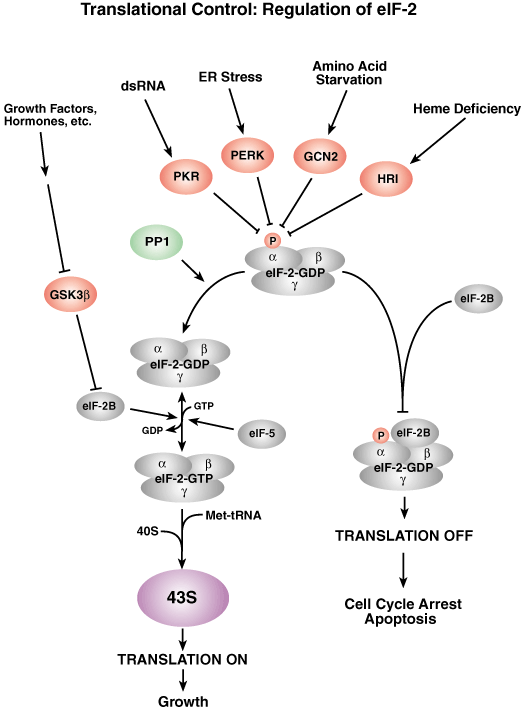
Protein phosphorylation plays an important role in the control of translation by eukaryotic initiation factor-2 (eIF-2). eIF-2 binds GTP and tRNAMeti and transfers the tRNAMeti to the 40S subunit, to form the 43S preinitiation complex. Later in the cycle, prior to elongation, the bound GTP is hydrolyzed , releasing eIF-2-GDP. For eIF-2 to promote another round of initiation, GDP must be exchanged for GTP, a reaction catalyzed by eIF-2B. Kinases activated by viral infection (PKR), endoplasmic reticulum stress (PERK/PEK), amino acid deprivation (GCN2), and hemin deficiency (HRI) can phosphorylate the a subunit of eIF-2. This phosphorylation stabilizes the eIF-2-GDP-eIF-2B complex, inhibiting the turnover of eIF-2B. eIF-2B is also inhibited by GSK-3b phosphorylation. These events result in a shut-down of cellular protein synthesis and can lead to apoptosisref1, ref2, ref3, ref4, ref5.
 Copyright © 2001-2014 Daniele Focosi.
All rights reserved
| Terms of use | Legal
notices

 Cite
this page!


|
|
|
|