Other diseases not transmissible to humans
: African
green monkey polyomavirus / lymphotropic papovavirus (LPV) :
a polyomavirus originally isolated from a B-lymphoblastic cell line of
an African green monkey; antigenically related viruses are widespread in
primates and may infect humans.
Macaca
Macacaarctaides
(stump-tailed macaque) : a nearly tailless, very hairy macaque with a naked
pink face, found at high altitudes in SE Asia
Macacafuscata
(Japanese macaque) is the northernmost primate other than man. Its social
organization has been extensively studied, and it has been found that there
are culturally transmitted behavioral differences among different troops.
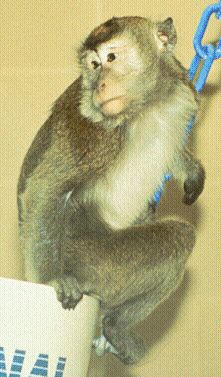
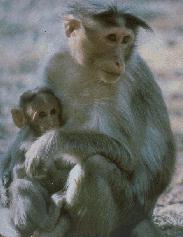
Macaca
mulatta(rhesus
monkey or macaque) of Southern Asia. It is yellowish brown
with a pale, naked face and a tail about half as long as the body. A large
male may reach a body length of 2 ft (60 cm). Rhesus monkeys live in social
groups of 25-60 individuals in forests and on rocky hillsides, ranging
to high altitudes. Omnivorous feeders, they often raid cultivated fields
and gardens. The rhesus monkey has been widely used in medical and other
scientific experiments; the Rh blood factor, found in humans as well as
monkeys, is named for it. Infectious diseases
: simian virus
40 (SV40),
Vesicular
stomatitis virus serotype Chandipura
Macaca
sylvanus (Barbary ape or macaque) : the single non-Asian macaque,
a large, tailless species of NW Africa, with one colony on the Rock of
Gibraltar; it is the only nonhuman primate found in Europe.
Gibbons swing through the air with the greatest of ease. On the ground
they do just fine on 2 legs, but their gait is much different from ours.
It looks like a playful run, a silly walkref.
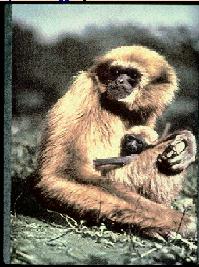
To get more specific, Vereecke and two colleagues introduced an 'instrumented
walkway' to the enclosure of 4 white-handed gibbons (Hylobates lar)
in a Belgian zoo. As the apes ambled over it, their every move was filmed
and every footfall recordedref.
Whereas humans and horses have 2 very distinct gaits,
walking and running, gibbons only rarely engage in a way of locomotion
that resembles our walk, where the legs are swung like pendulums. Instead,
at all speeds, they propel themselves in a springy, bouncy fashion closer
to our run. But unlike humans, they do not use their Achilles tendons as
the main spring. They might use their quadriceps muscles instead. Also
unlike a human, they never have both feet off the ground at the same time.
This 'aerial phase' (think of this lovely expression on your next jog)
should not be a requirement to call something a run. The apes are good
at bipedalism, even though the animals are much more often found swinging
from limb to limb. She wonders whether there is some fundamental aspect
of physiology that might make swinging animals adaptable to walking. Probably
there is a biomechanical overlap between bipedal and arboreal locomotion,
which might have something to say about the evolution of human bipedalism.
Others are a bit less impressed with the gibbon bouncy gait : the study
also shows that the gibbons' centre of mass tends to roil about during
this funny walk. I get the impression that maybe their bipedalism isn't
very energy-efficient at all. Still, perhaps there is some common energy-efficiency
pattern in all primates that are fundamentally adapted to arboreal environments,
but that can also stand up and walk.
simian enterovirus / ecmovirus : a species of viruses of the genus
Enterovirus, separable into 18 serotypes, that causes usually asymptomatic
infection in monkeys
Gorilla
Gorilla
gorilla beringei (mountain gorilla): poaching is the
biggest killer of , but respiratory diseases come a close 2nd, accounting
for about 1/4 of deaths, according to a major survey. Around 700 mountain
gorillas live in 2 separate populations, one in Uganda and the other in
a region that straddles Rwanda, the Democratic Republic of the Congo, and
Uganda. The animals are classed as critically endangered on the IUCN's
[International Union for the Conservation of Nature and Natural Resources]
red list, although they are the only great ape species whose numbers are
increasing. The Mountain
Gorilla Veterinary Project (MGVP), based in Ruhengeri, Rwanda, investigated
100 gorilla deaths dating back to 1968. The team found that 40 were due
to trauma, for which poaching is almost always the cause in adults. More
surprising was the detrimental effect of respiratory diseases, including
influenza A and parainfluenza viruses, which killed 24 of the animals.
In a bid to cut the risk of people passing these diseases on, eco-tourists
who trek to see the gorillas in the wild already have to stay at least
7 metres away, and keep their visits to no more than an hour. The populations
are closely monitored, and relatively well protected. "But their overall
numbers are small, and their situation is still pretty precarious," warns
team member Chris Wittier at North Carolina State University in Raleigref.
Primates of all species are susceptible to many human infectious diseases,
particularly respiratory infections, because of the ease of transmission.
Respiratory viruses can be passed in both directions. For example, the
pathogen now known as human respiratory syncytial virus was initially isolated
from a captive animal and was designated chimpanzee coryza virus. The 7
meter distance is announced but not observed. We were certainly closer
than that much of the time. But what is magic about 7 meters? Although
the tourists are asked not to go if they are ill, some persons go anyway.
Unless someone is sneezing or coughing or obviously ill, there is no way
for the local guide to know who is sick. What is the evidence that
the influenza A viruses or the parainfluenza viruses came from humans?
Gorillas certainly have their own respiratory viral pathogens. Even if
someone is sick and is closer than 7 meters, what is the risk for transmission
from a human with a viral infection? CDC uses 3 feet as a guideline for
droplet transmission. Aerosol transmission is unlikely outdoors. Even if
one were concerned about aerosol transmission, one airplane study of tuberculosis
suggested that the risk is small > 2 rows from the index case. It would
be interesting to know which deaths occurred in which years, since the
deaths go back to 1968. Without commenting specifically on the risk of
gorillas being infected by human visitors, it is probably misleading to
extrapolate from studies on the transmission of TB and other droplet spread
infections in pressurized civilian passenger aircraft. These aircraft typically
distribute air in the passenger compartment in a laminar flow pattern,
effectively limiting distribution, unlike the situation in a near contact
with a gorillaref.
A synopsis on the matter of transmission of human pathogens to mountain
gorilla's (Ape Tourism and Human Diseases: How close should we get?)
can be found here.
It is an 86 page document that deals comprehensively with the risk of spread
of human disease to apes and, among other things, tabulates known information
on the susceptibility of apes to human viruses and vice versa. The content
is too detailed to summarize adequately here, and interested readers should
refer to the original text. For many years, the regulation distance to
be maintained between gorillas and tourists (and researchers) was 5 meters.
In 1999, Jaco Homsy, MD, MPH, carried out a Critical Review of the Rules
and Regulations Governing Park Management and Tourism for the Wild Mountain
Gorilla, Gorilla gorilla beringei. One of the recommendations resulting
from this study was that this distance should be increased to 7 meters.
the original abstract to which the media stories refer may be accessed
via the Wildlife Disease Association conference website under the title
"Causes
of death for mountain gorillas (Gorilla beringei beringei and G.
b. undecided) from 1968-2004: an aid to conservation programs."
Following this link will download a large pdf file containing numerous
abstracts presented at the conference. The individual abstract may be downloaded
directly from the Morris
Animal Foundation's website (follow the link for Mountain Gorilla Update).
Not only is it irrelevant to use data derived from transmission in an airplane
environment as a basis for comparison for human-gorilla transmission in
the wild, but it is also misleading. To be sure, the impact level of transmission
of a human pathogen to a gorilla is not comparable to that of a human-human
transmission, for the simple fact that most humans can survive or be treated
for respiratory infections, and gorillas cannot. Droplets are heavier particles
than aerosols, and small aerosol particles can remain in the air and travel
over a greater distance than larger respiratory droplets. Airborne organisms
such as influenza, VZVref
and measles virusref
can remain stable long enough in the open for very light wind to transport
particles over great distancesref1,
ref2,
ref (Cox 1995). Influenza can be transmitted at ranges of 15 to 20
meters (WHO 1999). Measles outbreaks have been devastating in the past
among mountain gorillasref.
These observations have been confirmed by most recent evidence on atmospheric
and airborne spread of SARS and foot-and-mouth disease viruses following
the outbreaks of 2003 and 2004. Indeed a number of studies have shown that
virus-laden aerosols may spread from a common source (and even a single
source) to various locations at considerable distances (up to 50 meters!)
from the sourceref1,
ref2,
ref3.
In short, to state that airborne transmission is unlikely outdoors is simply
incorrect. The 7 meter distance recommendations for gorilla tourism took
a number of factors into consideration, based on both controlled environment
data and the wide fluctuations that characterize 1 hour long encounters
with gorillas in the wild. However, in light of the new evidence coming
from SARS studies, and if one considers that 1) the distance rule is most
difficult to enforce given the highly dynamic nature of a gorilla encounter
and 2) the transmission risk associated with a shorter distance may greatly
compound the transmission risk associated with other factors such as visit
duration, stress, and the possibility of undeclared sickness by a tourist,
7 meters may grossly underestimate the actual transmission risk generated
by the thousands of tourist-hours and days of human exposure that gorillas
are subjected to. Finally, it is critical to remember that respiratory
diseases are but one of a number of human-related factors threatening the
existence of mountain gorillas. If we want to maximize our chances of success
at saving this species, the only sensible attitude is one of maximum safety
and restraint. This is the very essence of gorilla tourism rules. Even
from a purely commercial point of view, gorilla tourism can flourish only
if gorillas flourish, hence the need to ensure first and foremost the health
and expansion of the mountain gorilla population.
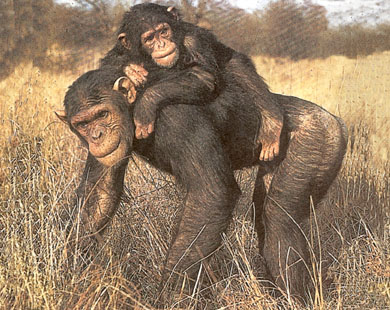
a combination of natural and man-made threats is killing gorillas and chimpanzees
in Central Africa, and experts say $30 million is needed for special programs
to save some of mankind's closest relatives from disappearing. An action
plan drafted by > 70 primatologists and other experts who met in Brazzaville,
Republic of Congo, in May 2005 designates 12 areas for emergency programs
intended to increase security against illegal hunting, protect great apes
and tropical forests from logging, and slow the spread of the Ebola virus
in the region. Called the Regional Action Plan for Conservation of Chimpanzees
and Gorillas in Western Equatorial Africa, the document seeks a multilateral
response to the threats to populations of the western lowland gorilla (Gorilla
gorilla gorilla) and the central African chimpanzee (Pan troglodytes
troglodytes) that share the same habitat in 6 countries. The plan represents
an urgent appeal to the international community for immediate action, before
the damage is irreversible. While the experts were unable to establish
precise population figures for the gorillas and chimpanzees, they determined
that recent Ebola outbreaks, bushmeat hunting and logging have almost wiped
out some populations. The action plan noted that apes reproduce slowly,
with limited capacity to recover from decimated populations. Protecting
gorillas and chimps is not just important in its own right. These animals
are also flagship species, important symbols for vast areas of forest that
are among the richest on Earth. Protecting them protects many other species
as well. The continuing spread of the Ebola virus through the region is
a particular threat, with devastating effects on ape populations. Ebola
spreads through contact with blood and other body fluids, putting bushmeat
hunters and others who might handle carcasses of infected animals at risk.
The action plan designated 12 sites in 5 countries - Cameroon, Gabon, Congo,
Central African Republic, and Equatorial Guinea - that require immediate
help. 7 "exceptional sites" have ape populations exceeding 2,000 in a large
area (8,232 to 41,900 km2), while 5 "important sites" have ape
populations of 500 to 2000 individuals in a site covering 1,219 to 9,011
km2. 2 other areas labelled "priority survey sites" have known
ape populations that require additional study to assess the numbers and
determine boundaries to promote ape conservation. New types of collaborations
are going to be needed, as the fate of apes in Central Africa relies not
only on addressing the typical issues of poaching and habitat destruction,
but also the problems of the rapid spread of disease. According to the
action plan, a series of programs needed to halt declines in ape populations
will cost just under $30 million. The measures include anti-poaching activities,
improved monitoring and response to Ebola outbreaks, increased training,
and tourism development. As dire as the threats are to the survival of
great apes, it's important for the world to know that this is not a lost
cause. It will take a tremendous amount of work and dedication from a variety
of conservation groups, government agencies and donors, but we still have
a chance to save these animals
A 2004 outbreak of Ebola virus in Democratic Republic of Congo killed 97%
of gorillas in Odzala-Kokoua National Park who lived in groups and 77%
of solitary malesref
A new Bacillus anthracis
found in wild chimpanzees and a gorilla from West and Central Africa :
anthrax infection caused the sudden deaths of 6 wild chimpanzees in the
Tai National Park, Cote d'Ivoire in 2001/2002 and in 3 chimpanzees and
one gorilla found dead > 1000 mi to the east, at the northern periphery
of the Dja Reserve, Cameroon 2004/2005. In order to characterize the B.
anthracis isolates from a totally new habitat that were responsible
for the death of wild great apes that died in Cote d'Ivoire and Cameroon,
we performed VNTR analyses on DNA isolated from tissue samples and bones
of these great apes. Surprisingly, for the isolates from both outbreaks,
3 of the 6 genomic VNTRs were clearly different from those of any previously
described strain, as is evident from the phylogenetic tree analysis. The
strain from Cote d'Ivoire, named B. anthracis CI (Cote d'Ivoire),
and the strain from Cameroon, named B. anthracis CA (Cameroon) are
clearly distinct from group A and group B strains. They establish a separate
branch with a new "forest anthrax cluster" termed "F," suggesting that
B.
anthracis is a far less homogeneous species than is currently believed.
No differences were found among the 6 cases from Cote d'Ivoire, and also
the 4 anthrax isolates from the 3 chimpanzees and the gorilla from Cameroon
were identical. The detection of 2 closely related strains forming an unrecognized
highly divergent group of B. anthracis at 2 different locations
> 1000 mi apart was highly unexpected and implies distribution through
Western and Central Africa. The presented genetic data suggest that both
"classic" and the "forest anthrax" strains have a common ancestor with
B.
cereus, and that the forest strains diverged before the other
B.
anthracis strains acquired the characteristic
B. anthracis-specific
chromosomal insertions. From the data obtained, it is not possible
to determine whether the plasmid pXO1 was already present in the CI and
CA strains prior to divergence from the common
B. anthracis ancestor,
or whether the pXO1 plasmid was acquired independently in B. anthracis
group F and "classic" B. anthracis. However, the recent description
of a pathogenic B. cereus strain containing a circular plasmid showing
99.6% similarity to the B. anthracis pXO1 demonstrates that plasmid
acquisition has occurred more than once within B. cereus. We must
reconsider a number of viewpoints on the emergence of this pathogen and
its maintenance in the various African ecosystems. One of the problems
is that it is been essentially impossible to obtain archival cultures of
B.
anthracis directly from the West African countries. Therefore nothing
is known of the molecular epidemiology of this pathogen in this region.
What we do know is derived from South & East African cultures, from
an essentially savannah system with animal species to matchref.
A survey of primate IQ has cemented apes' reputation as our most intelligent
cousins. An analysis of a slew of studies designed to spot smartness has
concluded that orang-utans and chimps are the chief eggheads, with monkeys
and lemurs trailing in their intellectual wake. The study has produced
a league table of overall cognitive ability among primates. Previous research
had attempted to compare different primates' abilities at specific tasks,
but no one had ever combined this data into an overall measure of intelligence.
The researchers compiled results from dozens of problem-solving puzzles
given to different types of primates by researchers. These included tests
of ability to navigate mazes, to untangle a jumble of differently coloured
threads to find food, and to spot the odd-one-out in a series of images.
They ranked each species and calculated the overall average intelligence
of each. Orang-utans emerged at the top of the heap, just edging out chimpanzees.
Both species share a prodigious ability to use tools and impart traditional
wisdom to their young. Orang-utans are more patient and deliberative. And
they're the master escape artists from zoos. The results reinforce the
pecking order of apes at the top, followed by Old World monkeys such as
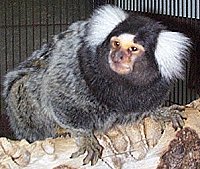
macaques, and New World monkeys such as marmosets. We can have quite a
bit of confidence that great apes do a whole lot better than other animals.
Orang utans are more patient and deliberative. And they're the master escape
artists from zoos. Overall, intelligence seems to be correlated with absolute
brain size, rather than brain size relative to body size, or the relative
sizes of different brain regions. Previous theories had suggested that
a critical factor may be the size of the brain's neocortex, a region that
seems to vary in size depending on the size of the social groups in which
an animal lives, and that might therefore reflect cognitive skills. One
surprise is the third place achieved by spider monkeys (Ateles),
which marginally beat gorillas. It's not a significant difference, nor
does he know why this might be. It's perhaps to be expected that the smartest
species are those that are closest to our own branch of the evolutionary
tree. The result underlines the fact that humans sprang from a group that
already possessed formidable cognitive powers, which were then honed still
further in our own evolutionary development. What seems certain is that
humans are the masters of intelligence. Although several of the tests given
to the primates — such as the ability to unlearn and relearn arbitrary
rules — are similar to those used to identify developmentally impaired
humans, a normal adult would ace every test. It seems unlikely, however,
that anyone will ever pit man against even the smartest of primates. You
generally don't set humans tests that don't involve language. If you sat
them in front of a computer and gave them a grape every time they did something
right they'd probably walk out of the room (Deaner R. O., van Schaik C.
P.& Johnson V. Evol. Psychol., 4. 149 - 1496 (2006)).