
☇ ☄
Seemed to become each thing it saw
— I get hooked on a new idea, I always give in to imagining.
Artistic production developed on digital interfaces, with interaction between humans and artificial intelligence (AI), articulates inputs and outputs (Flusser, 2002) by reflex, challenging and expanding already known ways of doing things. As a result, the forms of reception, especially when we engage and transport ourselves into dynamics imagined by artists, we enter a state of openness to the unknown. This openness can be seen, by analogy, as an entry into a hospitable or sometimes inhospitable atmosphere.
In light of Derrida's reflections, ‘hospitality’ emerges as a tool for addressing ethical and political issues involving borders and encounters with the other—the different, the strange, the foreign, the animal, the non-human. Our home is a dynamic, complex place, as we make it not only for our rest and protection (Bachelard, 2005), but also to invite and share. As hosts, hospitality — understood as the ability to welcome and care for others — is sometimes constrained by fear. Perhaps true hospitality only exists in art, when the artwork is received as “(...) the unknown, anonymous other, and that I give place to them, that I let them come, that I let them arrive, and take place in the place I offer them, without asking them either reciprocity (entering into a pact) or even their names” (Derrida at. Koepnick, 2021, p.7-8). When we open ourselves to receive art, art invites us to celebrate a pact, making room for the unexpected.
The processing speed of the computer, used as a creative device, allows for unique temporal experiences that prompt us to think about the time involved in the artistic process and aesthetic experience. In this context, where everything seems to repeat itself only to be replaced shortly thereafter, we find ourselves subject to the logic of new forms of production and planned obsolescence. However, involvement with speed and the multiple emerging possibilities also seems to offer something new. There is a paradox: the fascination with novelty is softened by the interface(s), so that users feel comfortable letting go of perceptual barriers and simply being absorbed by what is offered to them.
Even though we are aware of the increasingly inhospitable landscapes caused by climate change, which are a consequence of the choices we have made (Krenak, 2019), we live in excess: of noise, opinions, buildings, images, products, trends. — How long has it been like this? Context transforms our way of seeing, but we need time to really look, because, as Cardoso wrote: “the gaze does not accumulate or encompass, but seeks; it does not drift over a flat surface, but digs, fixes, and pierces, aiming at the cracks in this unstable and slippery world that instigates and provokes its enterprise of inspection and interrogation at every moment.” (Cardoso, 1989, p. 349).
The invocation of slowness could be presented against excess and the dulling of the senses. It is increasingly easy and fast to produce images and sounds (automation). However, if creative potential is developed in the doing, when we are affected and imbued by the process, how can we play against the device (Flusser, 2002) today? How can we receive the vibrations of the moment while still preserving our own rhythm? We aspire to a return to social sensibilities and networked communities, and for humans to not behave like the planet's rude guests, but to have "co-responsibility for the places where we live" (Krenak, 2019, p. 47).
We still don't know what will come, we will know better tomorrow. However, we can already imagine. We invite artists who are incorporating AI in their creative process and who critically reflect on the contemporary context to imagine and explore notions of hospitality and non-hospitality, the boundaries between randomness, causality, and contingency, and to problematize the fleeting and aesthetic involvement to which we are subjected daily.
References
BACHELARD, Gaston. A poética do espaço. São Paulo: Martins Fontes, 2005.
CARDOSO, Sérgio. "O olhar viajante (do etnólogo)." In: O olhar. São Paulo: Companhia das Letras, 1989.
FLUSSER, Vilém. Filosofia da caixa preta. São Paulo: Relume Dumará, 2002.
KOEPNICK, Lutz. Resonant matter: sound, art, and the promise of hospitality. Nova York: Bloomsbury Publishing, 2021.
KRENAK, Ailton. Ideias para adiar o mundo. 1. ed. São Paulo: Companhia das Letras, 2019.
⚇
Curators: Elaine Tedesco and Marina Polidoro
☇
Undergraduate student: Luíza Schütz (Pibic-CNPq)
Catalog available (PT/EN): https://www.ufrgs.br/verter/parecia_tornar-se/catalogo.pdf
Information:
Alessandra Bochio and Felipe Merker Castellani
Soplones
Net art
2025
alessandra.bochio@ufrgs.br
www.felipemerkercastellani.net


Alexandre De Nadal
Simulacrando
Net art
2025
@alexandredenadal


Alice Siqueira
whoami_mirror
Interactive digital art (photography, real-time webcam video, digital manipulation, and glitch art).
2025
alicesiqueira.art@gmail.com


Andressa Cantergiani
The Intruder
Video with Artificial Intelligence
2025
www.andressacantergiani.art.br


Calixto Bento
When something vanishes in the air, just like that
Video/AI
2025
@calixtobento


Daiana Schröpel
Brief report on the new biotic forms of Ilha das Moscas and some considerations on the floral aquatic bird, by Daiana Schröpel [IAAIAI/Diffusion Sector]
Digital publication based on drawings, photographs, text and audio
2025
dschropel@outlook.com


Fernando Codevilla and Juliana Vizzotto
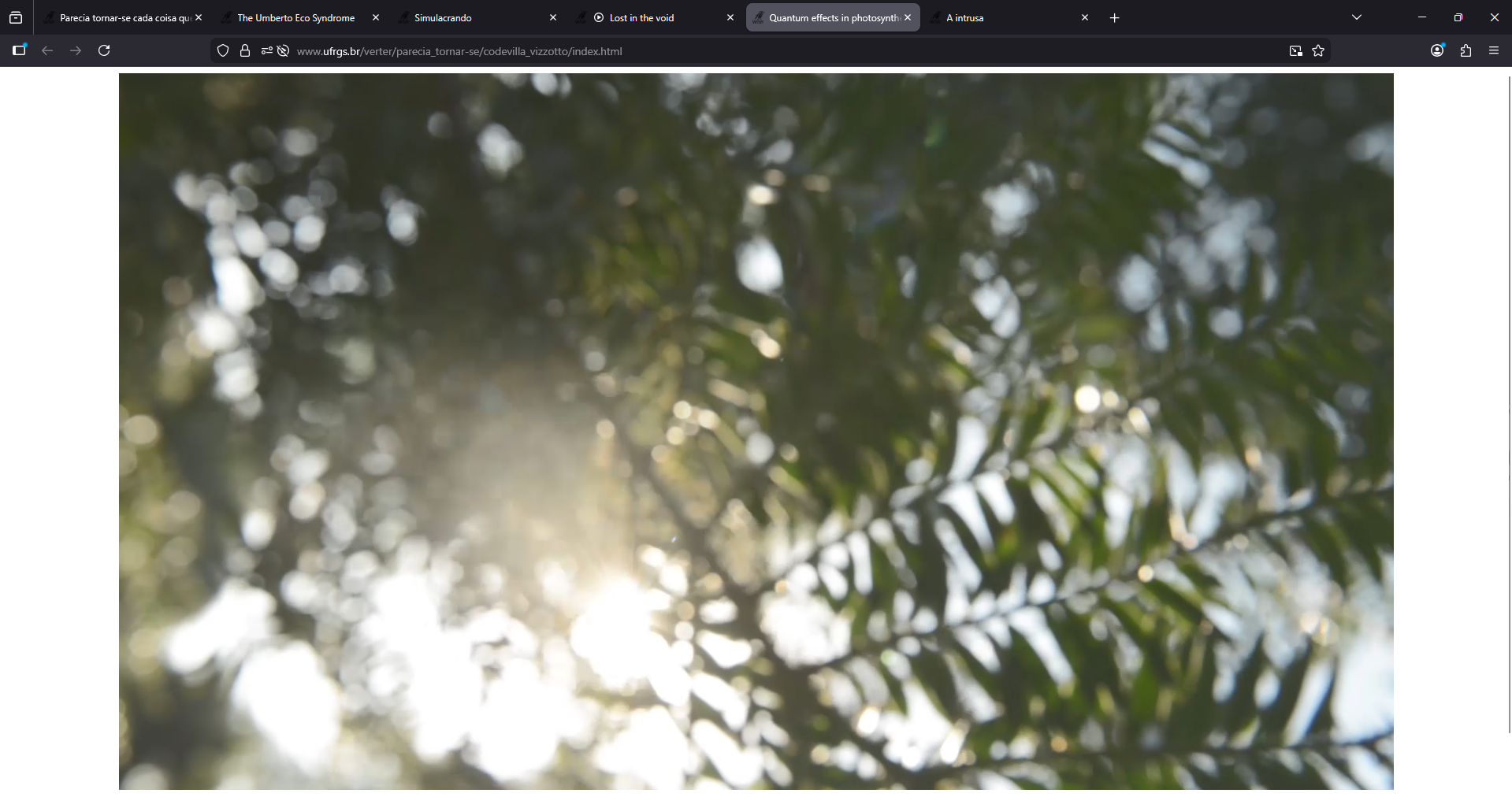
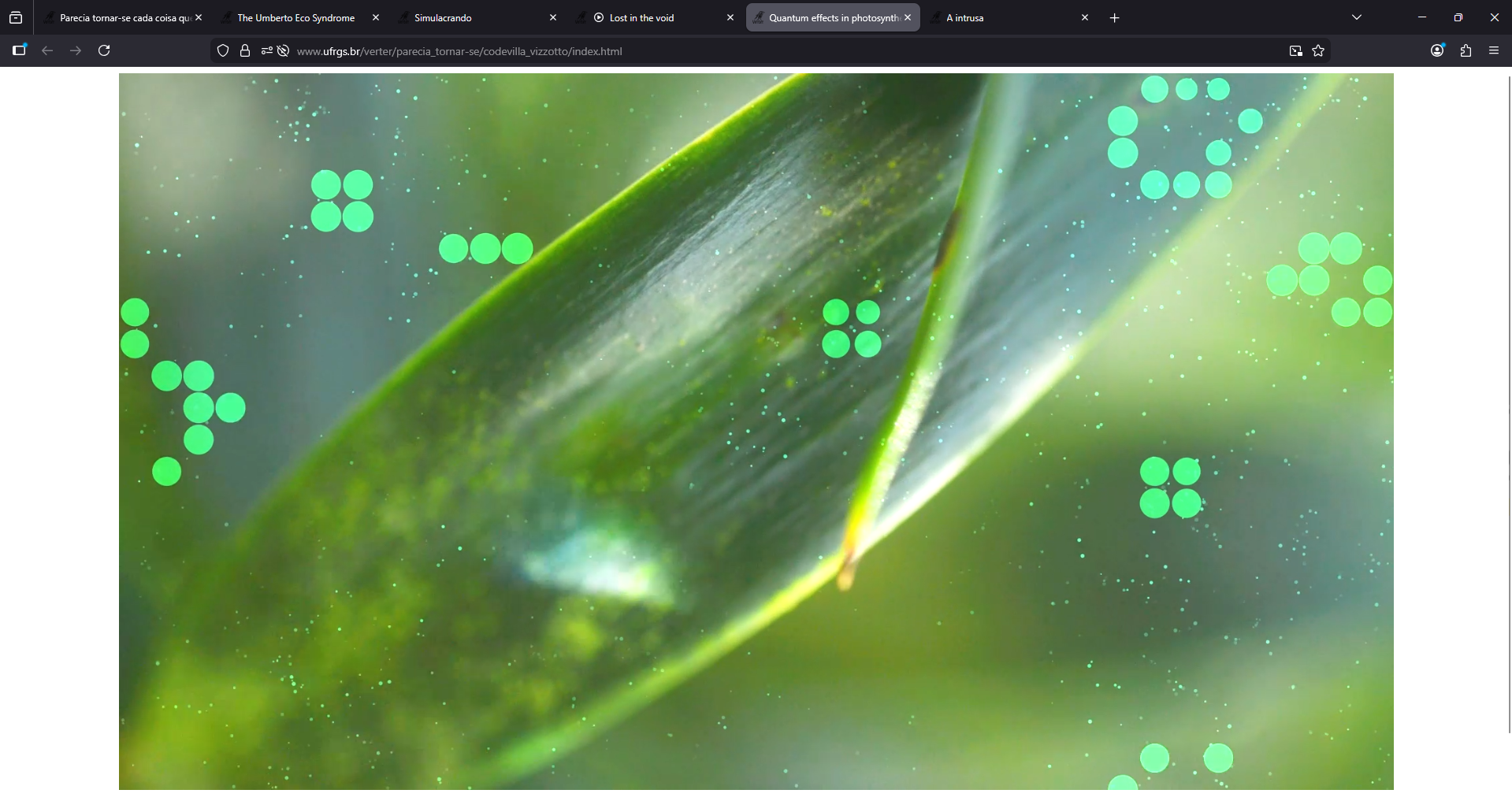
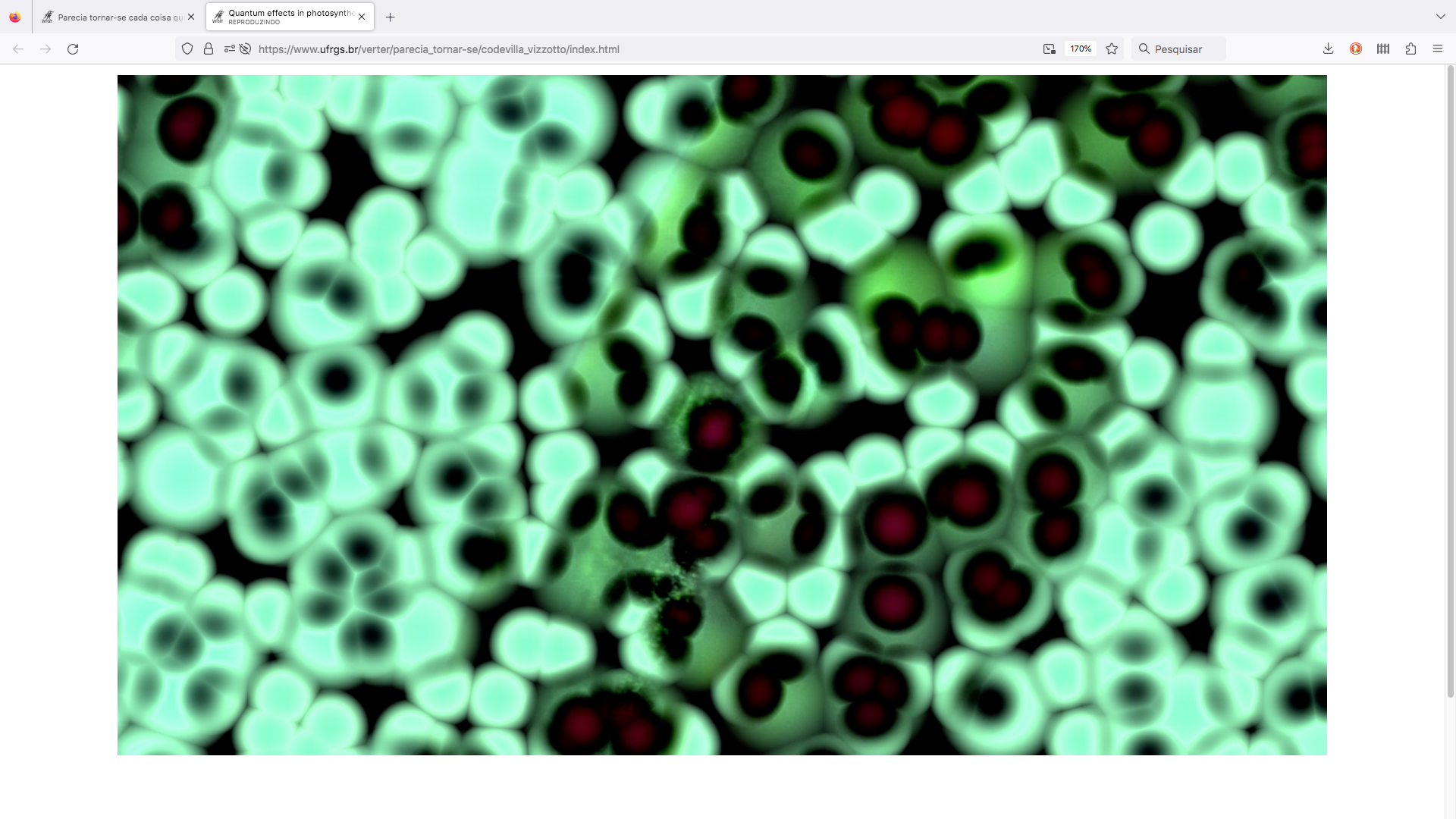
Quantum effects in photosynthesis
video and generative art, 2'25"
2025
www.fernandocodevilla.com
Klaus W. Eisenlohr
The Umberto Eco Syndrome
8 digital video episodes made from images generated with Stable Diffusion, texts generated with Chat-GPT and music generated with Stable Audio
2025
www.richfilm.de


Marluana Fernandes
Lost in the void
AI-powered motion image manipulation
2025
marluanafernandes@hotmail.com


Maximílian Rodrigues
House on the Edge.mov
Video generated with artificial intelligence
2025
@maxi.mrodrigues


↻
On top
work of
Luíza Schütz and Pedro Stelmach
Shapeshifter
Net Art
2025