
Eco-evolutionary processes responsible for the diversification, diversity, community assembly and population structuring of neotropical vertebrates
Our research is oriented toward answering the following questions: Why are there so many and diverse species in the tropics? What is the role of historical and contemporary processes in the diversification and niche evolution of neotropical vertebrates? What is the effect of habitat loss and fragmentation on the maintenance of tropical biodiversity over time? We focus mostly on Neotropical mammals and birds (but also amphibians, marine turtles and bees!) to understand patterns of diversity and diversification and the processes behind those patterns. It is under this umbrella program that our team develops its research. The main associated projects are:
Geographic variation in neotropical bats: eco-evolutionary processes behind acoustic diversification and community assembly patterns
In this project, developed in partnership with UCR and with a wide range of collaborators across the neotropic, we aim to investigate if geographic variation on echolocation calls of Neotropical non-Phyllostomid bats is a response to climate-induced difference and to elucidate the patterns of acoustic divergence in Neotropical bats between different acoustic ambience (climatic regions) and its correlation with phylogeny.

Southern Mammals
Rio Grande do Sul is extremely rich in wild species of the Mammalia, particularly the Carnivora, being the Brazilian state with the highest diversity of felids. Using a large array of camera traps set at several regions of the state, in partnership with FZB/RS, PUCRS, UA, Pró-Carnívoros and WildCRU, this project aims at evaluating the diversity, population density and behavioural patterns of species of medium and large terrestrial mammals.

Macroecological patterns and processes of the diversity of bat ectoparasites
In this project, developed in partnership with UNESC and UÉvora, we aim at describing the interaction networks between ectoparasites and bats in the neotropic and analyse responses of possible extinctions between the two groups. Also we will tst whether host attributes – at the population level and at the individual level – explain the probability of colonization of the population by new species of parasites or the individual’s parasitic load, respectively.

Niche evolution and species diversification: lessons from New World bats
This project is focused on assessing the role of both abiotic and biotic niche components in the evolution of the niche and in determining how evolutionary niche rates are related to bat species diversification and, in particular, to species extinction rates. This project is developed in partnership with SBU and UA.
Aerial insectivorous bat assemblages of the Brazilian Cerrado, Pantanal and Pampa
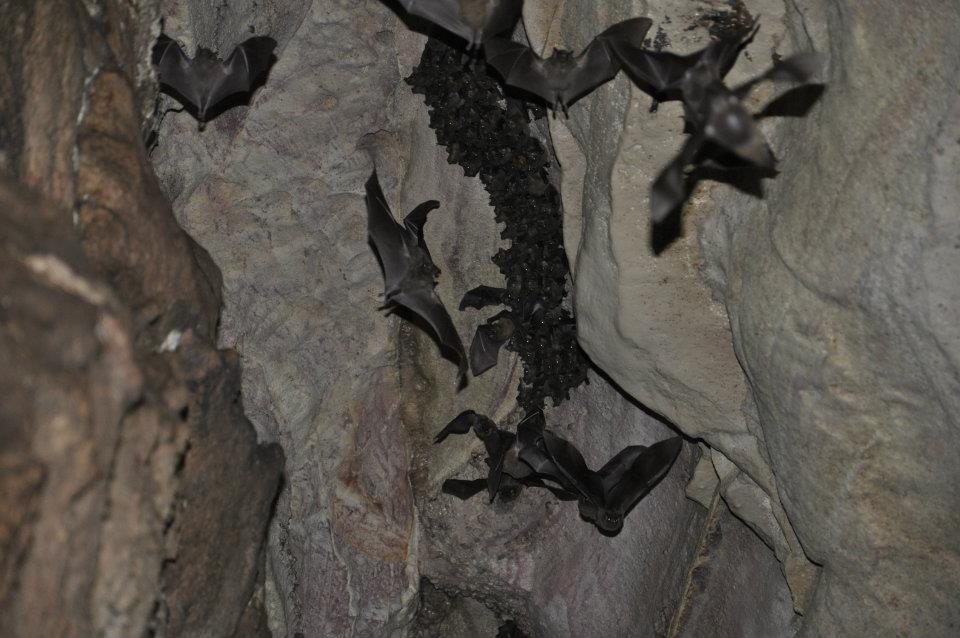
Using acoustic methods, we aim to understand how landscape and vegetation structure influence bat species composition, foraging activity and assemblage structure. We aim to evaluate the effects of habitat changes on the composition, structure and functionality of bats assemblages and eventually to identify priority areas for bat conservation in these three Brazilian biomes characterized by open physiognomies. We have long been working in the Brazilian Cerrado and Pantanal and, in 2019, we started our work in the Brazilian Pampa, the least known and protected of all the biomes in the country. Here, we will model species’ occupancy according to changes in land-use, resulting mainly from agriculture and livestock production. Our study will contribute to a better understanding of the range and distribution patterns of aerial insectivorous bats and towards the definition of important areas for the conservation of bats in this neglected region. We also intend to develop guidelines for the acoustic monitoring of bats in open areas and for the sustainable use of agricultural land for biodiversity conservation. We will continuously support the Brazilian ultrasound database with our recordings, supporting the future identification of bats. We are also developing an outreach project especially dedicated to the Pampa bats. Find out more here.

Morphological evolution in the Phyllostomidae
Phyllostomidae, the most ecological and morphological diversified family of all mammals, has undergone a multitude of selective regimes shifts. This project aims to estimate the evolution of shape, through geometric morphometrics techniques, in cranial and post-cranial elements in phyllostomid radiaton, within the context of adaptive landscape, reconstruction of ancestral states and morphological integration. This project is developed in partnership with URI and AMNH.

Bird conservation in the Atlantic Forest: present and future of deforestation and climate change
Climate change is one of the greatest threats to global biodiversity as it induces loss of diversity at different scales. Birds are good ecological models for assessing impacts on biodiversity, as they have a close relationship with habitat and can be used to identify priority habitats, including within protected areas. In this project, in partnership with Birdlife International, we investigate how birds of the ever-threatened Atlantic Forest biome are affected by climate change through a multi-scale approach: modeling the distribution of species on an ecoregional scale to determine gaps in territorial protection instruments; analyzing the population dynamics of species in the south of the biome in order to detect trends of population decline; evaluating the probability of habitat occupancy from behavioral variables and modeling how climate change can influence individual bird attributes.

Genetic consequences of habitat heterogeneity on tropical bats: the influence of ecology and evolutionary history
Differences in vegetation composition and discontinuities in landscape can limit dispersal in animals. Knowledge on the ecological and evolutionary characteristics influencing gene flow in bats is scarce and under-represents the ecological richness of the Chiroptera. Together with UA and UFMS we aim at understanding how habitat heterogeneity affects bat assemblages and the genetic structure of neotropical bat populations. We will also assess how landscape characteristics impacts neutral and adaptive genetic diversity in species with distinct ecological, physiological, morphological and evolutionary traits.

Mustelidae: unveiling their ecological role in ecosystem conservation
Mustelids are of particular relevance to biodiversity conservation because they generally occupy the top of the food chains and live in a variety of habitats. Little is known, however, about the ecology of Neotropical species and their role in the maintenance and structuring of ecological networks. In this project, in partnership with UA and UFRGS, we seek to evaluate spatio-temporal use of habitat, demographic aspects and the development of field and lab methodologies for monitoring populations of the Mustelidae.

Looking on bright side of night: revealing the cryptic bat fauna of the Cerrado biodiversity hotspot
The Cerrado biome is a biodiversity hotspot highly impacted by recent land-cover changes. Bats are known to play critical roles on Cerrado ecosystem services, but monitoring of bat assemblages is still insufficient and little is known about the cryptic diversity of this group. Together with UA, UnB, UFG and UFRJ we aim at unveiling bat cryptic diversity in Cerrado by incorporating genetic analyses using mitochondrial and nuclear DNA markers, as well as more traditional taxonomic methodologies increasing congruence in species delimitation.

 English
 Portuguese