Highlights
Influence of temperature and pressure on preparing Ga nanowire arrays by press-based nanoinfiltration
Nanoscale Advances 8, 123-134 (2026)
Alberto A. Mendonça, Leonardo Tomiatti, Kleber R. Pirota and Fanny Béron
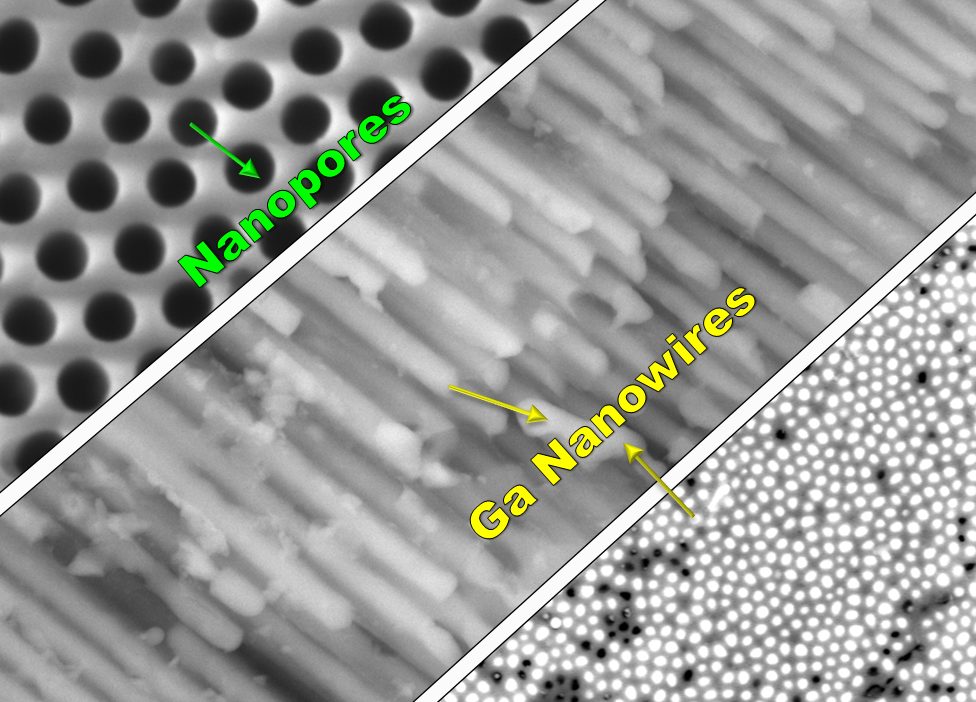
This work, performed at the Laboratório de Materiais e Baixas Temperaturas (LMBT) at UNICAMP, under supervision of Prof. Fanny Béron and collaboration of Prof. Kleber Pirota, explores the fabrication of gallium (Ga) nanowire arrays using a press-based nanoinfiltration (PBNI) method in nanoporous anodic aluminun (AAO) templates. The main goal is to address limitations of conventional nanowire growth techniques, such as high cost, complexity, and limited scalability. Gallium is chosen due to its low melting point and potential for metastable phase formation under confinement. Liquid Ga was infiltrated into AAO templates (~150 nm pores, 80 µm length) under controlled temperatures (35?55 °C) and applied loads (0.3?1.2 ton), with morphology analyzed by scanning electronic microscopy (SEM). The results show that optimal conditions occur near the melting point and at intermediate pressures, achieving filling factors up to ~80% and long nanowires. Higher temperatures and pressures reduce efficiency,
and classical models do not fully explain the behavior. The method is
fast, reproducible, and scalable, with potential applications in superconducting and nanoscale devices. Overall, the study demonstrates a fast, scalable, and reproducible method for producing high-density nanowire arrays, with potential applications in superconductivity, sensing, and nanodevices.
Correspondence: fberon@ifi.unicamp.br