Highlights
Dramatic suppression of antiferromagnetic ordering in CeIn3 nanowires
Nanoscale Advances, 2026, 8, 3340
Maria H. Carvalho, Davi Zau, Arneil P. Reyes, Rong Cong, Stephen D. House, Henrique B. Pizzi, Ana M. Caffer, Derick S. Passos, Rodolfo C. Santos, Gabriel S. Freitas, Kleber R. Pirota, Ricardo R. Urbano and Pascoal G. Pagliuso
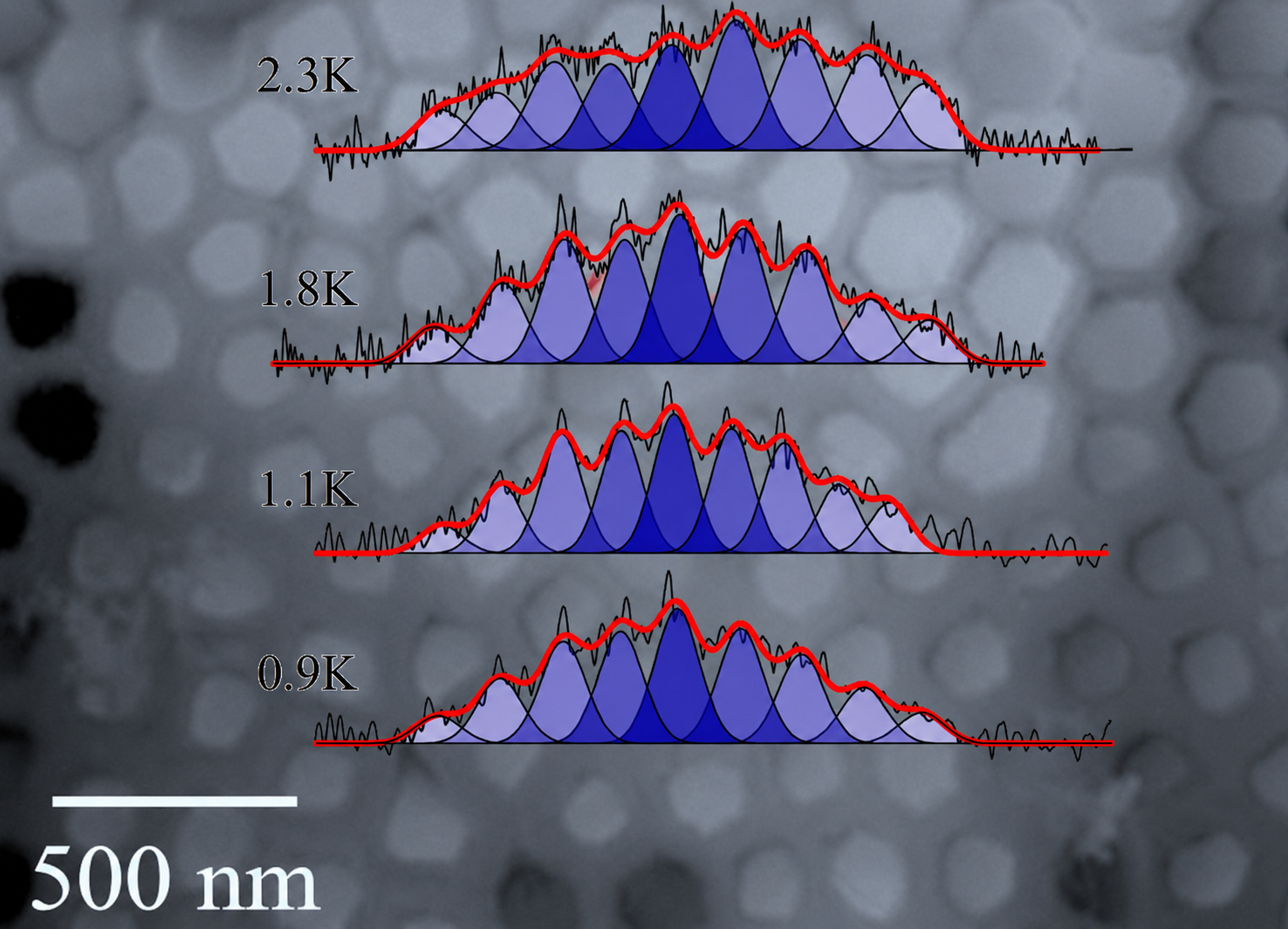
This work with participation of Kleber R. Pirota, Ricardo R. Urbano and Pascoal G. Pagliuso, from UNICAMP, have demonstrated that transforming the heavy-fermion compound CeIn₃ into nanowires dramatically modifies its magnetic ground state. Using the Metallic-Flux Nanonucleation method, the team produced CeIn₃ nanowires with an average diameter of approximately 175 nm and characterized them through electron microscopy, magnetic susceptibility, heat-capacity measurements, and nuclear magnetic resonance. The results show that the antiferromagnetic ordering temperature is reduced from about 10.1 K in bulk crystals to only 2.3 K in the nanowires. NMR measurements further revealed a fivefold reduction in the quadrupole frequency, indicating substantial changes in the local electronic and crystalline environment. Modeling suggests that nanoscale confinement and structural disorder weaken magnetic exchange interactions, modify crystalline-electric-field levels, and may enhance Kondo screening and magnetic frustration. These findings establish nanostructuring as a powerful route for controlling competing interactions in strongly correlated materials, opening new opportunities to investigate quantum criticality and emergent phases without requiring high pressure or chemical substitution.
Correspondence: n.munevar@correounivalle.edu.co