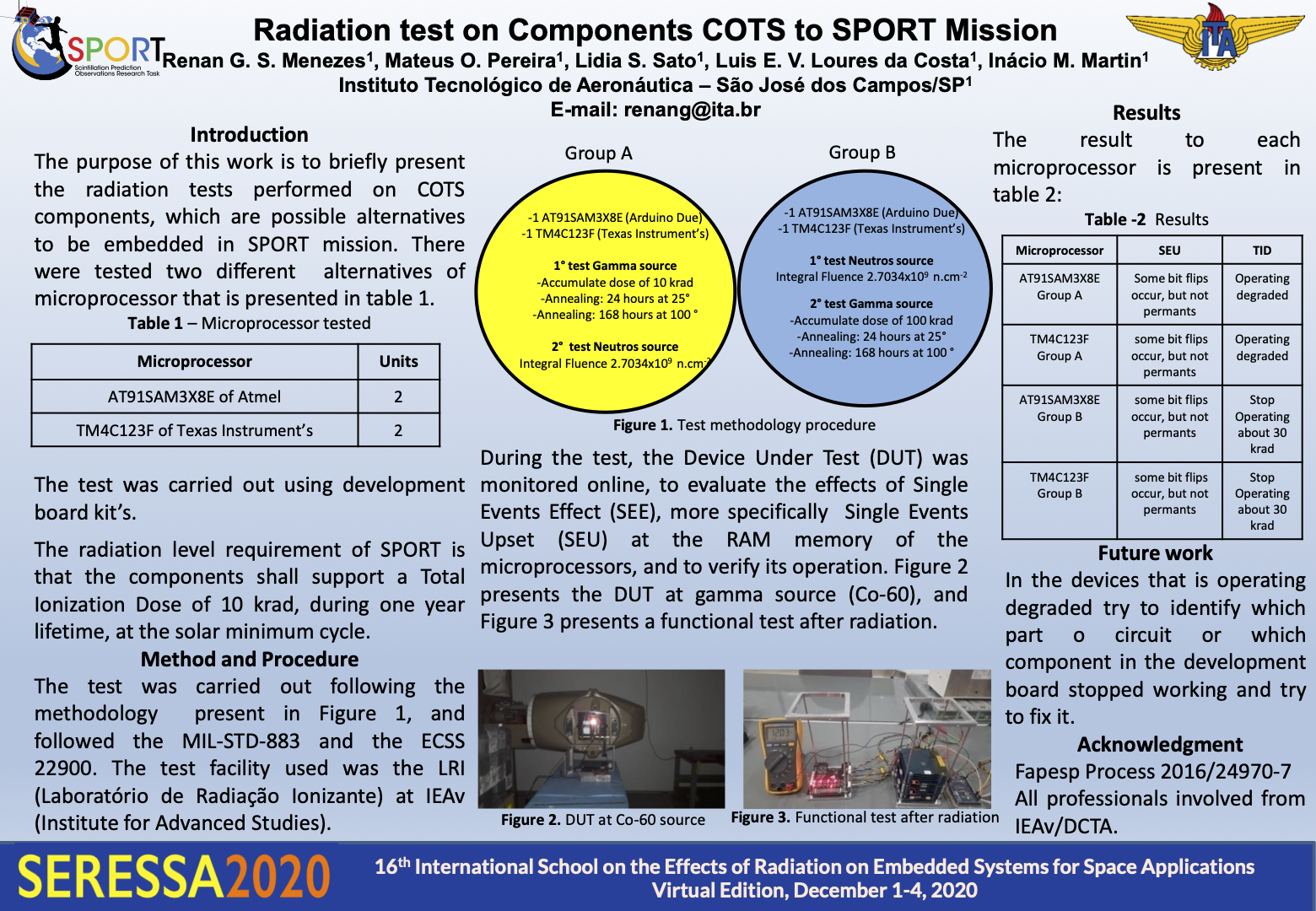
Space-based observations have transformed our understanding of Earth and has been used to different applications. In the last years particularly, small satellites have caught the attention of the space community due to the rapid development and low to moderate budget. This happens mainly due to the use of COTS components, the possibility to be launched in groups called “swarms,” which allows a lower launch cost. However, satellites operate in a very rigorous and inhospitable environment, due to several factors such as high vacuum, high temperature variation and ionizing radiation. In regard of the ionizing radiation, satellites in Earth orbit are exposed to significant amounts of high-energy electromagnetic radiation, charged particles, X and gamma radiation and neutrons flux mostly coming from the Sun. The effects of ionizing radiation on the electronic components can be summarized in two contributions: Total Ionizing Dose (TID), and Single Events Effects (SEE). These two effects are distinct, as are the mitigation requirements and techniques associated with them. The SPORT project is a CubeSat made by an international collaborative work among institutes in Brazil and United States to investigate the space weather. From Brazil, the ITA Space Center is responsible for developing the spacecraft bus that includes, the satellite structure, the thermal subsystem, the Electrical Power Subsystem (EPS), the Attitude Determination and Control Subsystem (ADCS), the Communication Subsystem - Telemetry. Tracking, and Command (TT&C), and the On-Board Data Handling Subsystem (OBDH). In the SPORT mission there is a peculiarity in which the On-Board Data Handling Subsystem (OBDH) has three on-board computers, something that is not very common in CubeSats. One of the on-board computers is responsible for the management of the Attitude Determination and Control subsystem and housekeeping of spacecraft, the other one is responsible for the management of the payload, and a third computer is necessary for the management, storage and communication of a X-band radio transmitter, responsible to send the science data to the ground station. Because of the large amount of science data the most common microprocessor used in computers with flight heritage was not capable to handle this task, therefore, it was necessary to use a more powerful microprocessor to process the science data of SPORT mission. However, this new computer would imply the use of a component that does not have a flight heritage, which may increase the risk level of the mission. So, it was necessary to carry out a radiation analysis and tests to check out the dose levels and the sensitivity to radiation of candidate components, in order to select the best one that meets the mission requirements. Two alternative microprocessor was tested, the first one was the Atmel microprocessor the AT91SAM3X8E, in which it was tested with the Arduino Due development board kit, and the second one microprocessor was that of Texas Instrument`s which was the TM4C123F through a development board created in the laboratory. The tests carried out were aimed at characterizing the effects of Total Ionizing Dose (TID) by means of a Co-60 source that emits gamma rays, and to observe the sensitivity of these components to Single Events Effects (SEE) through neutrons sources. The objective of this work is to present the results of the tests carried out so far, and the future work which include try to identify which part of circuit or which component in the development board stopped work and try to fix it. Beyond it,a future test more representative with the complete systems close as possible of that one which will flight in the SPORT mission is considered.