Arquivo mensais:February 2017

Goliath catfish spawning in the far western Amazon confirmed by the distribution of mature adults, drifting larvae and migrating juveniles

Ronaldo B. Barthem, Michael Goulding, Rosseval Leite, Carlos Cañas, Bruce Forsberg, Eduardo Venticinque, Paulo Petry, Mauro L. de B. Ribeiro, Junior Chuctayaresearchgate logo & Armando Mercado

We mapped the inferred long-distance migrations of four species of Amazonian goliath catfishes (Brachyplatystoma rousseauxii, B. platynemum, B. juruense and B. vaillantii) based on the presence of individuals with mature gonads and conducted statistical analysis of the expected long-distance downstream migrations of their larvae and juveniles. By linking the distribution of larval, juvenile and mature adult size classes across the Amazon, the results showed: (i) that the main spawning regions of these goliath catfish species are in the western Amazon; (ii) at least three species—B. rousseauxii, B. platynemum, and B. juruense—spawn partially or mainly as far upstream as the Andes; (iii) the main spawning area of B. rousseauxii is in or near the Andes; and (iv) the life history migration distances of B. rousseauxii are the longest strictly freshwater fish migrations in the world. These results provide an empirical baseline for tagging experiments, life histories extrapolated from otolith microchemistry interpretations and other methods to establish goliath catfish migratory routes, their seasonal timing and possible return (homing) to western headwater tributaries where they were born.

Article: http://www.nature.com/articles/srep41784

Figure 1(A) B. vaillantii (piramutaba in Portuguese, pirabutón in Spanish); (B) B. rousseauxii (dourada in Portuguese, dorado in Spanish); (C) B. platynemum (babão in Portuguese, mota flemosa in Spanish); (D) B. juruense (zebra in Portuguese, zebra in Spanish); (E) Dorado migrations exploited by fishermen. The Santo Antônio Dam on the Madeira River now drowns the Teotônio Rapids (shown here) where B. rousseauxii (species in photo) and B. platynemum were previously exploited and easily detected when migrating. Photos by M. Goulding.

Figure 2

(a) Sites investigated by the authors and others from published data. (b–e) Locations of mature goliath catfishes by species. Figure was created by authors with ArcGIS for Desktop Advanced 10.2, MapPublisher 9.6 tool inside Adobe Illustrator CC, and Adobe Illustrator CC, 2.0.

News that spoke about the article :

Tech Times: Dorado Catfish Holds Record For World’s Longest Freshwater Fish Migration

The Guardian: Extraordinary migration of giant Amazon catfish revealed

EurekAlert! : Scientists confirm dorado catfish as all-time distance champion of freshwater migrations

Phys.org: Scientists confirm dorado catfish as all-time distance champion of freshwater migrations

LiveScience: Giant Amazonian Catfish Is a Record-Breaking Traveler

Newswise: Scientists Confirm Dorado Catfish as All-Time Distance Champion of Freshwater Migrations

Mongabay:  Giant catfish clocks longest ever freshwater migration

Species New to Science: [Ichthyology • 2017] Goliath Catfish (Brachyplatystoma spp., Pimelodidae) Spawning in the far western Amazon confirmed by the Distribution of Mature Adults, Drifting Larvae and Migrating Juveniles

Gizmag Emerging Technology Magazine: Dorado catfish is a freshwater endurance champ

Mongabay.com News : Giant catfish clocks longest ever freshwater migration

Latest Items from TreeHugger: Meet the extraordinary catfish that travels the width of South America

PARABÉNS Junior Chuctaya, NOVO MESTRE DO LABORATÓRIO DE ICTIOLOGIA!!

Mais um mestre formado pelo laboratório de Ictiologia da UFRGS. Hoje, 22 de fevereiro de 2017 foi a defesa de mestrado de Junior Chuctaya, que fez a Revisão taxonômica das espécies do gênero Odontostilbe Cope 1870 (Characidae: Cheirodontinae) da Bacia do Rio da Prata.

Área de Concentração: Biología Comparada

Orientador: Prof. Dr. Luiz Roberto Malabarba

Abanca foi composta por 

Dr Fernando Camargo Jerep :  professor da Universidade Estadual de Londrina

Dr. Vinícius de Araújo Bertaco : Pesquisador do Museu de Ciências Naturais da Fundação Zoobotânica do Rio Grande do Sul, curador da coleção científica de peixes.

Dr. Carlos Alberto Santos de Lucena: Curador II no Museu de Ciências e Tecnologia PUCRS.

Parabéns Mestre Junior.


Muito obrigado Dr. Stanley H. Weitzman

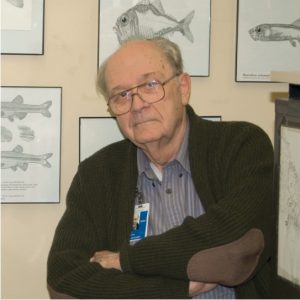
Fig 1: Dr. Stanley Weitzman (6 de março de 1927 – 16 de fevereiro do 2017) (foto: Boletín-SBI 2014)

By Junior Chuctaya

Hoje compartilhamos o reconhecimento de um dos pesquisadores mais influentes da ictiologia continental, o Dr. Stanley Weitzman, que infelizmente veio a falecer em 16 de fevereiro do 2017. Nos últimos anos Dr. Weitzman atuou como pesquisador da Divisão de Peixes do Natural Museum of Natural History, Smithsonian Institution. Sempre esteve disposto a ajudar a todos os pesquisador que visitavam o Smithsonian.

Ele começou seus estudos com peixes quando era estudante na Universidade da Califórnia, Berkeley e posteriormente continuou na Universidade de Stanford. Em 2014 a SBI, em seu Boletim 108 ( http://www.sbi.bio.br/images/sbi/boletim-docs/2013/dezembro_108.pdf), realizou uma importante entrevista, onde o Dr. Weitzman conta suas experiências de vida e como começou a estudar os peixes de América do Sul e outras experiências pessoais.

Fig 2: Dr. Stanley Weitzman, no Smithsonian Institute, em Washington, foto tirada na década de 1970. (Boletín -SBI 2014)

O Dr. Weitzman, colaborando com o Dr. Myers, descreveu sua primeira espécies em 1954, Corydoras cochui Myers & Weitzman 1954. Esse foi o início de uma incrível carreira na taxonomia de peixes, chegando a descrever 77 espécies (3 delas sinonimizadas), sempre junto com a colaboração de sua esposa, também ictióloga, que descreveu 2 espécies, Jupiaba scologaster (Weitzman & Vari 1986) e Hyphessobrycon elachys Weitzman 1985. Ambos pesquisadores publicaram perto de 300 artigos, muitos destes citados nos mais diferentes trabalhos da atualidade. A curiosidade de Dr. Weitzman levou-o a trabalhar com peixes de diferentes países do mundo, destacando Brasil, Venezuela, Colômbia, Peru, Equador, Panamá, Guiana, Bolívia e China. Weitzman gostava muito dos Characiformes, durante toda sua vida descreveu espécies de diferentes ordenes:  Characiformes, Siluriformes, Cyprinodontiformes, Cypriniformes e Stomiiformes, distribuídos em 12 famílias, destacando Characidae e Callichthydae. A curva de espécies acumulados representando as espécies descritas pelo Dr. Weitzman nunca chegou a se estabilizar. Se ele continuasse trabalhando, com certeza continuaria descrevendo muitas novas espécies.

Fig 3. a) Curva acumulada de espécies descritas pelo Dr. Weitzman 1954-2013. b) Espécies descritas por ano em colaboração com diferentes pesquisadores.
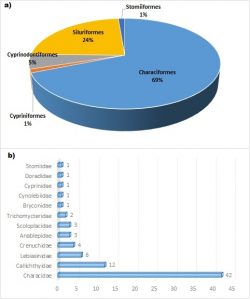
Fig 4. a) Porcentagem de espécies descritas por ordem b) Número de espécies descritas por família pelo Dr. Weitzman
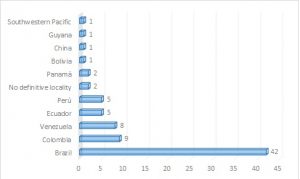
Fig 5. Número de espécies descritas por país pelo Dr. Weitzman

Durante toda sua trajetória o Dr. Weitzman foi reconhecido por diferentes pesquisadores, nomeando as espécies descritas com seu nome:

  • Poecilocharax weitzmani Géry 1965
  • Corydoras weitzmani Nijssen 1971
  • Maurolicus weitzmani Parin & Kobyliansky 1993
  • Microcharacidium weitzmani Buckup 1993
  • Jenynsia weitzmani Ghedotti, Meisner & Lucinda 2001
  • Lophiobrycon weitzmani Castro, Ribeiro, Benine & Melo 2003
  • Hyphessobrycon weitzmanorum Lima & Moreira 2003
  • Knodus weitzmani (Menezes, Netto-Ferreira & Ferreira 2009)

O Brasil foi uns dos lugares preferidos pelo Dr. Weitzman, descrevendo 42 espécies. Nele trabalhou principalmente com pesquisadores de MZUSP, como os Doutores Naércio Menezes e Heraldo Britzki, e com pesquisadores do laboratório de ictiologia da UFRGS, principalmente com o Prof. Luiz Malabarba. Sempre se caracterizou por estar disponível para receber e ajudar na formação de muitos pesquisadores do Brasil e do mundo. Muitos pesquisadores destacam sua grande personalidade, seu desejo de compartilhar todos os conhecimentos e seus desenhos de peixes. Definitivamente foi e será uma grande perda para a Ictiologia do mundo, sempre será lembrado em cada trabalho de taxonomia, sistemática, etc… revisando os ossos dos peixes segundo Weitzman 1964, fazendo medições segundo Fink e Weitzman 1974, testando hipóteses de relações filogenéticas segundo os diferentes trabalhos de Weitzman et al. Sempre será lembrado por sua participação no Primeiro Simpósio de Sistemática e Filogenia no Brasil em 1997.

Fig 6. a) Naércio Menezes, Marylin Weitzman, Stanley Weitzman, Carlos Lucena, Margarete Lucena, numa expedição de campo aos rios do litoral de Santa Catarina, na década de 1980. b) Marylin Weitzman e Stanley Weitzman (no meio, em pé), durante o International Symposium on Phylogeny and Classification of Neotropical Fishes, Porto Alegre, 1997, foto: Boletin-SBI 2014)

Muito obrigado Dr. Weitzman, eu não cheguei a conhecê-lo pessoalmente, mas escutando os colegas falar de você, lendo seus trabalhos, é como se sua personalidade ficasse presente, permitindo conhecê-lo indiretamente.
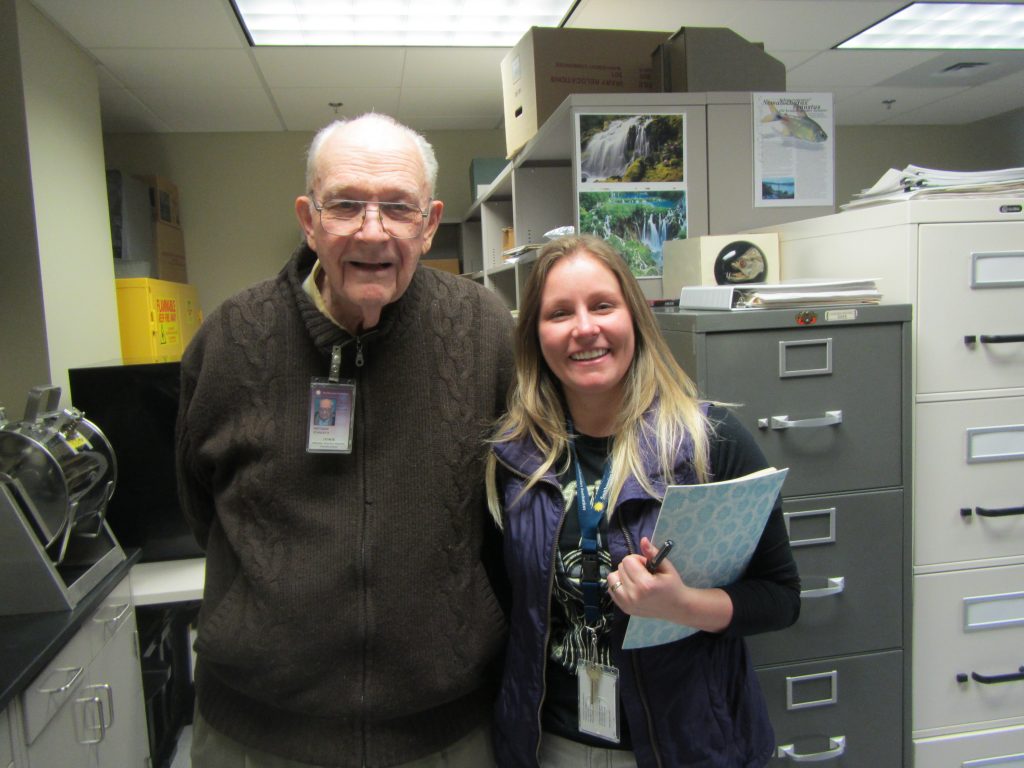
Fig7. a) Alice Hirschmann e Dr. Weitzman no Smithsonian Institute, em Washington. b) Vinicius Bertaco, Dr. Weitzman e Luiz R. Malabarba em Smithsonian Institute. Fotos: Alice Hirschmann (a) e Vinicius Bertaco (b).

Especies descritas por Stanley H. Weitzman 1954-2013

       Ano       Espécies  

  • 1954      Corydoras cochui Myers & Weitzman 1954
  • 1956      Leptodoras praelongus (Myers & Weitzman 1956)
  • 1956      Hyphessobrycon cardinalis Myers & Weitzman 1956                                           sinônimos sênior: Paracheirodon axelrodi (Schultz 1956)
  • 1957      Thayeria boehlkei Weitzman 1957
  • 1960      Brycon whitei Myers & Weitzman 1960
  • 1960      Corydoras habrosus Weitzman 1960
  • 1960      Corydoras reynoldsi Myers & Weitzman 1960
  • 1960      Pyrrhulina spilota Weitzman 1960
  • 1960      Corydoras sychri Weitzman 1960
  • 1961      Corydoras concolor Weitzman 1961
  • 1963      Corydoras pastazensis Weitzman 1963.
  • 1964      Corydoras semiaquilus Weitzman 1964
  • 1965      Astronesthes psychrolutes (Gibbs & Weitzman 1965)
  • 1966      Malacoglanis gelatinosus Myers & Weitzman 1966
  • 1966      Aphyocypris lini (Weitzman & Chan 1966)
  • 1966      Sarcoglanis simplex Myers & Weitzman 1966
  • 1967      Terranatos dolichopterus (Weitzman & Wourms 1967)
  • 1970      Corydoras pastazensis orcesi Weitzman & Nijssen 1970                                         sinônimos sênior: Corydoras pastazensis Weitzman 1963
  • 1970      Chrysobrycon myersi (Weitzman & Thomerson 1970)
  • 1970      Corydoras atropersonatus Weitzman & Nijssen 1970
  • 1970      Corydoras orphnopterus Weitzman & Nijssen 1970
  • 1970      Aspidoras pauciradiatus (Weitzman & Nijssen 1970)
  • 1970      Corydoras simulatus Weitzman & Nijssen 1970
  • 1971      Nematobrycon lacortei Weitzman & Fink 1971
  • 1974      Odontostilbe dialeptura (Fink & Weitzman 1974)
  • 1974      Odontostilbe mitoptera (Fink & Weitzman 1974)
  • 1975      Nannostomus marilynae Weitzman & Cobb 1975
  • 1976      Ammocryptocharax elegans Weitzman & Kanazawa 1976
  • 1977      Hyphessobrycon diancistrus Weitzman 1977
  • 1977      Hyphessobrycon socolofi Weitzman 1977
  • 1977      Odontocharacidium aphanes (Weitzman & Kanazawa 1977)
  • 1978      Elachocharax geryi Weitzman & Kanazawa 1978
  • 1978      Nannostomus britskii Weitzman 1978
  • 1978      Nannostomus limatus Weitzman 1978
  • 1978      Nannostomus nitidus Weitzman 1978
  • 1981      Rachoviscus graciliceps Weitzman & Cruz 1981
  • 1985      Xenurobrycon heterodon Weitzman & Fink 1985
  • 1985      Xenurobrycon pteropus Weitzman & Fink 1985
  • 1986      Elachocharax mitopterus Weitzman 1986
  • 1986      Nematocharax venustus Weitzman, Menezes & Britski 1986
  • 1987      Nannostomus anduzei Fernandez & Weitzman 1987
  • 1987      Priocharax ariel Weitzman & Vari 1987
  • 1987      Priocharax pygmaeus Weitzman & Vari 1987
  • 1987      Xenurobrycon polyancistrus Weitzman 1987
  • 1989      Scoloplax distolothrix Schaefer, Weitzman & Britski 1989
  • 1989      Scoloplax dolicholophia Schaefer, Weitzman & Britski 1989
  • 1989      Scoloplax empousa Schaefer, Weitzman & Britski 1989
  • 1990      Mimagoniates rheocharis Menezes & Weitzman 1990
  • 1990      Mimagoniates sylvicola Menezes & Weitzman 1990
  • 1994      Ptychocharax rhyacophila Weitzman, Fink, Machado-Allison & Royero L. 1994.
  • 1995      Jenynsia eirmostigma Ghedotti & Weitzman 1995
  • 1995      Tyttocharax tambopatensis Weitzman & Ortega 1995
  • 1995      Jenynsia unitaenia Ghedotti & Weitzman 1995
  • 1996      Jenynsia sanctaecatarinae Ghedotti & Weitzman 1996
  • 1997      Hyphessobrycon epicharis Weitzman & Palmer 1997
  • 1999      Acinocheirodon melanogramma Malabarba & Weitzman 1999
  • 1999      Spintherobolus ankoseion Weitzman & Malabarba 1999
  • 1999      Spintherobolus leptoura Weitzman & Malabarba 1999
  • 2000      Kolpotocheirodon theloura Malabarba & Weitzman 2000
  • 2000      Skiotocharax meizon Presswell, Weitzman & Bergquist 2000
  • 2003      Cyanocharax macropinna Malabarba & Weitzman 2003                                           sinônimos sênior:  Diapoma uruguayensis (Messner 1962)
  • 2003      Diapoma alegretense (Malabarba & Weitzman 2003)
  • 2003      Diapoma dicropotamicus (Malabarba & Weitzman 2003)
  • 2003      Diapoma itaimbe (Malabarba & Weitzman 2003)
  • 2003      Diapoma lepiclastus (Malabarba, Weitzman & Casciotta 2003)
  • 2003      Diapoma tipiaia (Malabarba & Weitzman 2003)
  • 2003      Planaltina britskii Menezes, Weitzman & Burns 2003
  • 2003      Planaltina glandipedis Menezes, Weitzman & Burns 2003
  • 2004      Kolpotocheirodon figueiredoi Malabarba, Lima & Weitzman 2004
  • 2005      Knodus tanaothoros (Weitzman, Menezes, Evers & Burns 2005)
  • 2008      Amazonspinther dalmata Bührnheim, Carvalho, Malabarba & Weitzman 2008.
  • 2009      Glandulocauda caerulea Menezes & Weitzman 2009
  • 2009      Mimagoniates pulcher Menezes & Weitzman 2009
  • 2011      Diapoma pyrrhopteryx Menezes & Weitzman 2011
  • 2011      Diapoma thauma Menezes & Weitzman 2011
  • 2013      Monotocheirodon drilos Menezes, Weitzman & Quagio-Grassiotto 2013
  • 2013      Monotocheirodon kontos Menezes, Weitzman & Quagio-Grassiotto 2013

Especies descritas por Marilyn Weitzman

  • 1985      Hyphessobrycon elachys Weitzman 1985
  • 1986      Jupiaba scologaster (Weitzman & Vari 1986)

 

Dietary differentiation in relation to mouth and tooth morphology of a neotropical characid fish community

Karine Orlandi Bonato, Edward D. Burress,  Clarice Bernhardt Fialho

Abstract

The relationship between diet and mouth and tooth morphology among eleven characid species is evaluated herein. Specifically, we tested for: (1) significant differences among the diets and (2) corresponding variation of mouth and tooth morphology. Fishes were collected bimonthly during 2012 and 2013 using electrofishing techniques in the Alto Jacuí sub-basin. A total of 1525 stomachs were analyzed representing eleven species of characid fishes. A Permutational Multivariate Analysis of Variance (PERMANOVA) analysis showed significant interspecific differences among the diets, and Similarity Percentage (SIMPER) analysis indicated that the main food items that contributed to this differentiation were variation in the relative consumption of terrestrial and aquatic plants, terrestrial and unidentified aquatic insect, and adult Hymenoptera. Lastly, Constrained Principal Analysis on Coordinates (CAP) analyses showed that several morphological features were associated with dietary patterns. For example, sub-terminal mouth positions were correlated with the ingestion of benthic items (i.e., aquatic insects and organic matter). Large mouths were associated with species that consume large items such as Decapoda (e.g., Aegla) and fish. Species that showed a minor variation in tooth morphology along the outer row of the premaxilla, as well as those that have fewer teeth on the maxilla, consumed high proportions of plants and terrestrial insects. Species with intermediate and high numbers of cusps in the maxilla teeth tended to consume aquatic insects. Here, we demonstrated that eleven species of characid fishes had different diets and that those diets were correlated to a specific mouth and tooth morphology. Therefore, diet and oral morphology likely co-evolved such that divergence in trophic-related morphology likely facilitated dietary differentiation among characid fishes.

Artigo completo:  http://www.sciencedirect.com/science/article/pii/S0044523117300037

Fig: Ordination of the Characidae species in the Alto Jacuí sub-basin, state of Rio Grande do Sul, Brazil, produced by the first two axes of the Constrained Principal Analysis on Coordinates (CAP1 and CAP2) applied to the correlation of six morphological tooth features and items ingested by the species. Morphological features: PM = mouth position, SM = mouth size, NTOR = number of teeth in outer row, NTIR = number of teeth in inner row, NCM = number of cusps on maxilla, NTM = number of teeth on maxilla. Items categories: ai = unidentified aquatic insects, ti = unidentified terrestrial insects, oa = other aquatic invertebrates, ot = other terrestrial invertebrates, mi = microcrustaceans, tp = terrestrial plants, ap = aquatic plants, al = algae, se = sediment, mo = organic matter, ta = Testae Amoebae, de = detritus, fi = fish.


Alunos e professores do Laboratório de Ictiologia da UFRGS apresentam seus resultados de pesquisas no ENCONTRO BRASILEIRO DE ICTIOLOGIA, EBI 2017 – XXII – Porto Seguro.

Do 29 de Janeiro até 03 de fevereiro foi realizado EBI 2017, com a participação de aproximadamente 900 pesquisadores de diferentes nacionalidades. Alunos e professores do laboratório de ictiologia da UFRGS, apresentaram seus resultados de pesquisas em formato pôster e oral. Oito trabalhos em formato pôster destacando temas como descrição de espécies novas, parasites de peixes, diversidade, ecologia alimentar entre outros. Além, foram apresentados Seis trabalhos em formato oral com temas de biologia alimentar, descrição de espécies novas, influências ontogênicas na alimentação de peixes, evolução e biogeografia, e novas metodologias para o estudo de peixes pequenos. Todos estes resultados preliminares serão parte de artigos proximamente publicados.

Poster:

  • UMA NOVA ESPÉCIE DO GÊNERO ITUGLANIS COSTA & BOCKMANN, 1993 DA BACIA DO RIO URUGUAI (SILURIFORMES: TRICHOMYCTERIDAE). Laura Modesti Donin, Juliano Ferrer.
  • NOVA ESPECIE DE Heptapterus Bleeker 1858 (SILURIFORMES: HEPTAPTERIDAE) DA BACIA DO RIO URUGUAI.  Dario R. Faustino-Fuster, Luiz R. Malabarba, Flavio A. Bockmann
  • COMPOSIÇÃO E ESTRUTURA DA ICTIOFAUNA DO RIO CORRIENTES (LORETO, PERU).   Dario R. Faustino-Fuster, Vanessa Meza-Vargas, Enrique Pareja, Jorge Garnillo
  • DIVERSIDADE DE MONOGENEA (PLATYHELMINTHES) EM BRÂNQUIAS DE DUAS ESPÉCIES SIMPÁTRICAS DE OLIGOSARCUS (CHARACIFORMES: CHARACIDAE), RIO GRANDE DO SUL, BRASIL.  Emília Welter Wendt, Suzana B. Amato
  • ESTRUTURAÇÃO POPULACIONAL DE RHINOXENUS ARIENTINUS (PLATYHELMINTHES: MONOGENEA) PARASITANDO NARINAS DE LEPORINUS OBTUSIDENS (CHARACIFORMES: ANOSTOMIDAE) NO LAGO GUAÍBA, RIO GRANDE DO SUL, BRASIL.  Emília Welter Wendt, Cassandra M. Monteiro, Suzana B. Amato
  • PEIXES DE RIACHOS NEOTROPICAIS DE PEQUENA ORDEM DA SUB-BACIA HIDROGRÁFICA DO RIO IJUÍ, RIO GRANDE DO SUL, BRASIL.  Laísa Wociechoski Cavalheiro, Clarice Bernhardt Fialho P.
  • DUAS NOVAS ESPÉCIES DE BAGRES SUL AMERICANOS DO GÊNERO GLANIDIUM (SILURIFORMES: AUCHENIPTERIDAE: CENTROMOCHLINAE) NO SISTEMA DA LAGOA DOS PATOS, AO SUL DO BRASIL.  Luisa Maria Sarmento Soares Filho, Bárbara Borges Calegari, Ronaldo Fernando Martins Pinheiro, Luiz Roberto Malabarba.
  • FOOD WEB ANALYSIS OF FLOODPLAIN LAKES WITH SPATIAL HETEROGENEITY FROM THE AMPIYACU RIVER, PERUVIAN AMAZON BASIN.  Leonardo Capitani,  Junior Chuctaya

Oral :

  • BIOLOGIA ALIMENTAR DO PEIXE CHARACIDIUM PTEROSTICTUM GOMES 1947 NA SUB-BACIA HIDROGRÁFICA DO RIO IJUÍ, RIO GRANDE DO SUL, BRASIL.  Amanda Antunes De Souza Santos, Laísa Wociechoski Cavalheiro, Clarice Bernhardt Fialho.
  • AS INFLUÊNCIAS ONTOGENÉTICAS NA ALIMENTAÇÃO DO LAMBARI Astyanax paris Azpelicueta, Almirón & Casciotta 2002 (TELEOSTEI: CHARACIDAE) NA SUB-BACIA HIDROGRÁFICA DO RIO IJUÍ, RIO GRANDE DO SUL, BRASIL. Laísa Wociechoski Cavalheiro, Clarice Bernhardt Fialho.
  • ANÁLISE TAXONÔMICA INTEGRATIVA DAS ESPÉCIES DO GÊNERO ITUGLANIS COSTA & BOCKMANN, 1993 NAS DRENAGENS DO EXTREMO SUL DO BRASIL. Laura Modesti Donin, Juliano Ferrer, Rafael Costa Angrizani, Luiz Roberto Malabarba.
  • EVOLUÇÃO E BIOGEOGRAFIA DE SCOLOPLACIDADE NA REGIÃO NEOTROPICAL (SILURIFORMES, LORICARIOIDEA). Marcelo Salles Rocha, Joyce Ieda Galvão, Tiago Carvalho, Lúcia Rapp Py-Daniel
  • PEIXES RAROS E O USO DA TOMOGRAFIA COMPUTADORIZADA DE ALTA RESOLUÇÃO NO ESTUDO DA DIVERSIDADE DE ASPREDINIDAE (ACTINOPTERYGII: SILURIFORMES). Tiago Pinto Carvalho.
  • REVISÃO TAXONÔMICA DO GÊNERO ODONTOSTILBE COPE 1870 (CHARACIDAE: CHEIRODONTINAE) DA BACIA DO RIO DA PRATA. Junior Chuctaya , Luiz Roberto Malabarba


Life history of Gymnotus refugio (Gymnotiformes; Gymnotidae): an endangered species of weakly electric fish

Aline Salvador Vanin, Julia Giora researchgate logo & Clarice Bernhardt Fialho researchgate logo

Abstract

The present study describes the life history of Gymnotus refugio, a species classified as Endangered in the last published list of threatened species of the Brazilian fauna. The study was conducted at a conservation unity that protect one of the last remaining semideciduous forests in the region. The reproductive period was estimated as occurring from the end of winter to the last summer months. Gymnotus refugio exibited fractional spawning, the lowest relative fecundity registered among the Gymnotifomes species studied at the present, and male parental care behavior. The analyses showed a seasonal pattern on the species diet, associating different food categories to winter, autumn, and spring. According to food items analysis and estimated intestinal quotient, G. refugio was classified as invertivorous, feeding mainly on autochthonous insects. The results obtained herein suggest that the position of G. refugio as an Endangered species might be influenced by its territoriality, habitat specificity, parental care behavior, and low fecundity, reinforcing the importance of swampy forest environment conservation as the only means of the species maintenance.

Artigo completo: http://link.springer.com/article/10.1007/s10641-016-0556-z


https://static-content.springer.com/image/art%3A10.1007%2Fs10641-016-0556-z/MediaObjects/10641_2016_556_Fig3_HTML.gif

Fig. Histological sections of Gymnotus refugio ovaries in different gonadal maturation phases. (a) Immature. (b) Early developing. (c) Mid developing. (d) Late developing. * oogonias, pg primary growth oocytes, ca cortical alveolar oocytes, vtg1 primary vitellogenic oocytes, vtg2 secundary vitellogenic oocytes, vtg3 tertiray vitellogenic oocytes