Arquivo mensais:December 2017

(English) Ending the year 2017: The Use of Ultraviolet Light as a Non-destructive Method for Revealing Fragments of Lost Pigmentation in Faded Alcohol-preserved Collection Specimens

Desculpe-nos, mas este texto está apenas disponível em English. For the sake of viewer convenience, the content is shown below in the alternative language. You may click the link to switch the active language.

Andre L. Netto-Ferreira*researchgate logo  &  Kyle R. Luckenbill#

* Laboratory of Ichthyology, Department of Zoology, Federal University of Rio Grande do Sul, Porto Alegre, Brazil. Museu Paraense Emílio Goeldi, Avenida Perimetral, 1901, 66077-530, Belém, PA, Brazil

# Department of Ichthyology, The Academy of Natural Sciences, 1900 Benjamin Franklin Parkway, 19103-1195 Philadelphia, PA, USA

ABSTRACT.

A method for visualizing previously pigmented areas of the body with the employment of black-light spectrum bulbs is described. Under ultraviolet (UV) light, fish musculature fluoresces, whereas melanophores absorb incident light, revealing nearly lost contrast between once strongly and poorly pigmented areas of the body that has faded over time. Although a yet unknown extent of melanophore preservation is necessary to expose such contrast, the method was successful on a partially faded holotype of Characidium fasciadorsale Fowler, a nearly completely faded holotype of Characidium etheostoma Cope, and most remarkably for the blackened, previously mold-infested and nearly destroyed holotype of Holotaxis laetus Cope. In the latter case, the method also allowed better recognition of scale pockets on the skin.

Link: http://www.bioone.org/doi/abs/10.1635/053.165.0112

Recently preserved specimen of Characidium zebra ANSP 167824 50 mm SL: A. under regular illumination; B. under regular plus black light illumination; C. under black light as single source of illumination.

Fig. 3. Holotype of Characidium etheostoma ANSP 8152, 37.1 mm SL: A. under regular illumination; B. under regular plus black light illumination; C. under black light as single source of illumination.

O laboratório de Ictiologia da UFRGS tem o prazer de dar boas-vindas ao novo professor do Departamento de Zoologia, o Dr. André Luiz Netto-Ferreira.

O Dr. André Luiz Netto-Ferreira é um pesquisador que tem contribuído significativamente para o conhecimento Ictiofauna Neotropical. Temos certeza de que sua experiência em ensino, pesquisa e orientação impactará de forma positiva toda a comunidade ictiológica, agora como parte do grupo de pesquisa do laboratório de Ictiologia da UFRGS

Sinceramente, os membros do laboratório esperam oferecer-lhe a melhor parceria e colaboração em esta nova etapa de sua vida profissional. 

La imagen puede contener: 1 persona, sentado e interior

La imagen puede contener: 1 persona

Population Genetic Structure of Cnesterodon decemmaculatus (Poeciliidae): A Freshwater Look at the Pampa Biome in Southern South America

Aline M. C. Ramos-Fregonezi , Luiz Malabarba researchgate logoand Nelson J. R. Fagundes

The Pampas is a Neotropical biome formed primarily by low altitude grasslands and encompasses the southernmost portion of Brazil, Uruguay, and part of Argentina. Despite the high level of endemism, and its significant environmental heterogeneity, Pampean species are underrepresented in phylogeographic studies, especially aquatic organisms. The Pampean hydrological system resulted from a long history of tectonism, climate, and sea level changes since the Neogene. In this study, we examined the population genetic structure of Cnesterodon decemmaculatus, a freshwater fish species that occurs throughout most of the Pampa biome. We characterized mitochondrial and autosomal genetic lineages in populations sampled from Southern Brazil and Uruguay to investigate (1) the correspondence between current drainage systems and evolutionary lineages, (2) the demographic history for each genetic lineage, and (3) the temporal depth of these lineages. Overall, we found that the major evolutionary lineages in this species are strongly related to the main Pampean drainage systems, even though stream capture events may have affected the distribution of genetic lineages among drainages. There was evidence for recent population growth in the lineages occupying drainages closest to the shore, which may indicate the effect of quaternary sea-level changes. In general, divergence time estimates among evolutionary lineages were shallow, ranging from 20,000 to 800,000 years before present, indicating a geologically recent history for this group, as previously reported in other Pampean species. A Bayesian phylogeographical reconstruction suggested that an ancestral lineage probably colonized the Uruguay River Basin, and then expanded throughout the Pampas. This evolutionary scenario may represent useful starting models for other freshwater species having a similar distribution.

Link: https://www.frontiersin.org/articles/10.3389/fgene.2017.00214/full?&utm_source=Email_to_authors_&utm_medium=Email&utm_content=T1_11.5e1_author&utm_campaign=Email_publication&field=&journalName=Frontiers_in_Genetics&id=307730

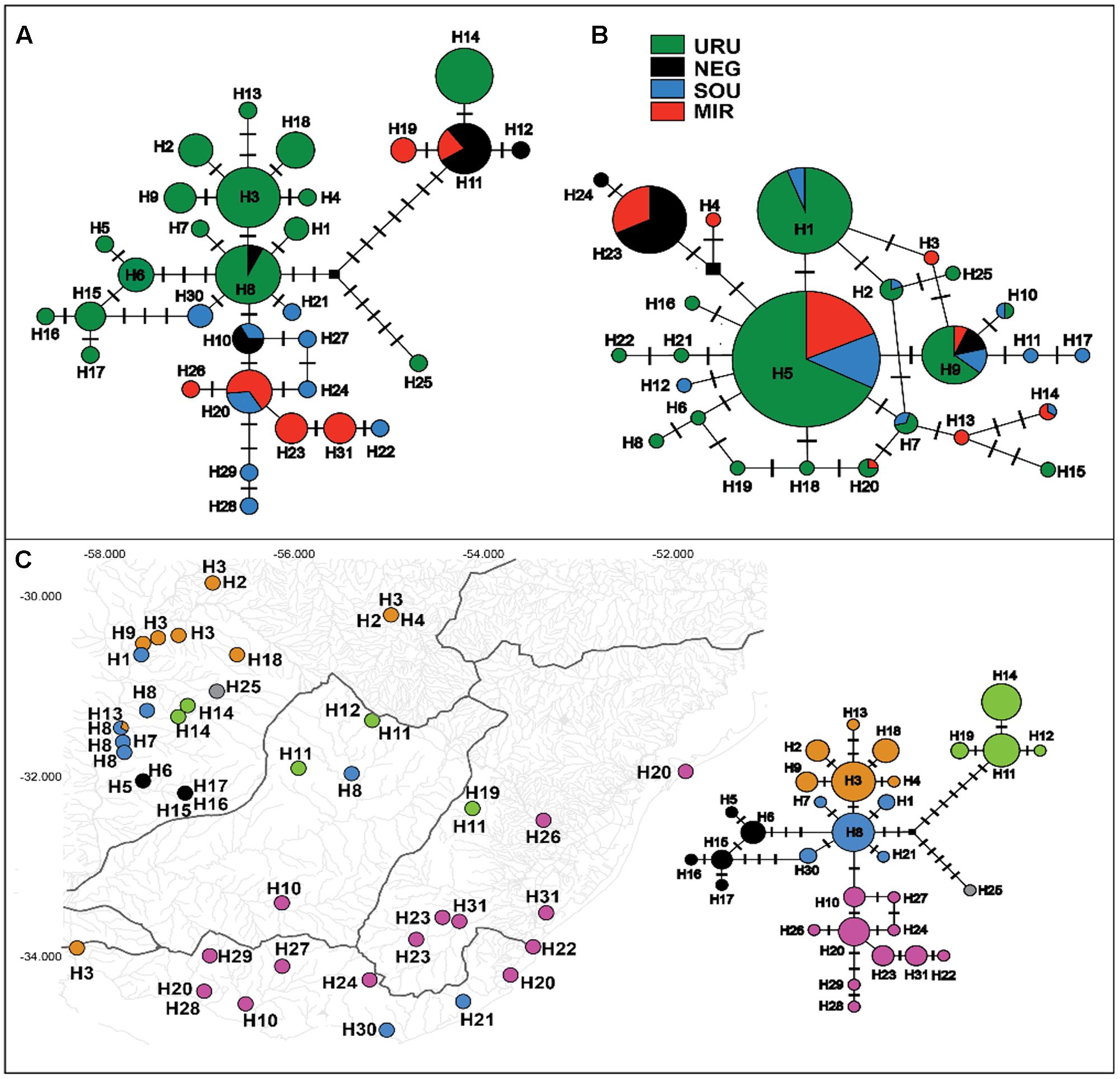
FIGURE 2. Median-joining networks for (A) mtDNA ND2 haplotypes, and (B) nDNA Myh6 haplotypes. Circles size are proportional to the observed frequency of each haplotype. Cross marks represent mutational differences between haplotypes. (C) Geographic location of each mtDNA haplotype. Different colors represent the six genetic groups identified in BAPS analysis.

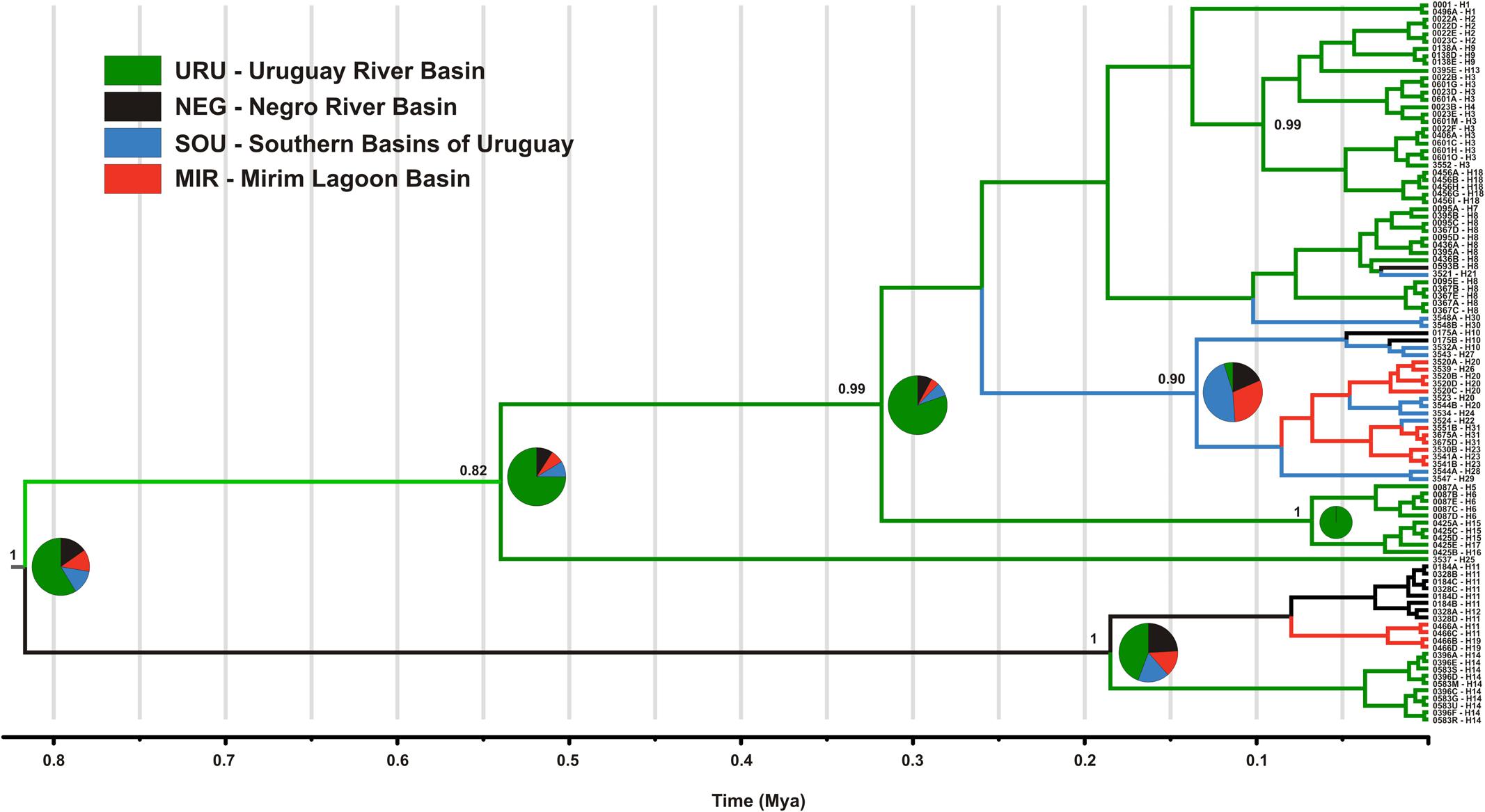
FIGURE 3. Maximum clade credibility tree among ND2 lineages found in Cnesterodon decemmaculatus individuals. Posterior probabilities (PP) are shown above the branches for selected nodes with PP > 0.8. Pie charts beside selected ancestral node represent the PP of ancestral location among each of the four populations according to the color scheme shown in the inlet.

PARABÉNS Rafael Costa Angrizani, NOVO DOUTOR DO LABORATÓRIO DE ICTIOLOGIA!!

Rafael Costa Angrizani defendeu na última sexta-feira, día 30 de novembro , sua tese de doutorado

DESVENDANDO RHAMDIA QUELEN  (QUOY & GAYMARD, 1824)

A banca esteve constituída pelo

                                                  Dr. Nelson Fagundes (UFRGS)

                                                  Dr. Tiago Pinto Carvalho (UFRGS)

                                                  Dr. André Luiz Netto Ferreira (UFPA)

                                         Orientado pelo Prof. Dr. Luiz Roberto Malabarba