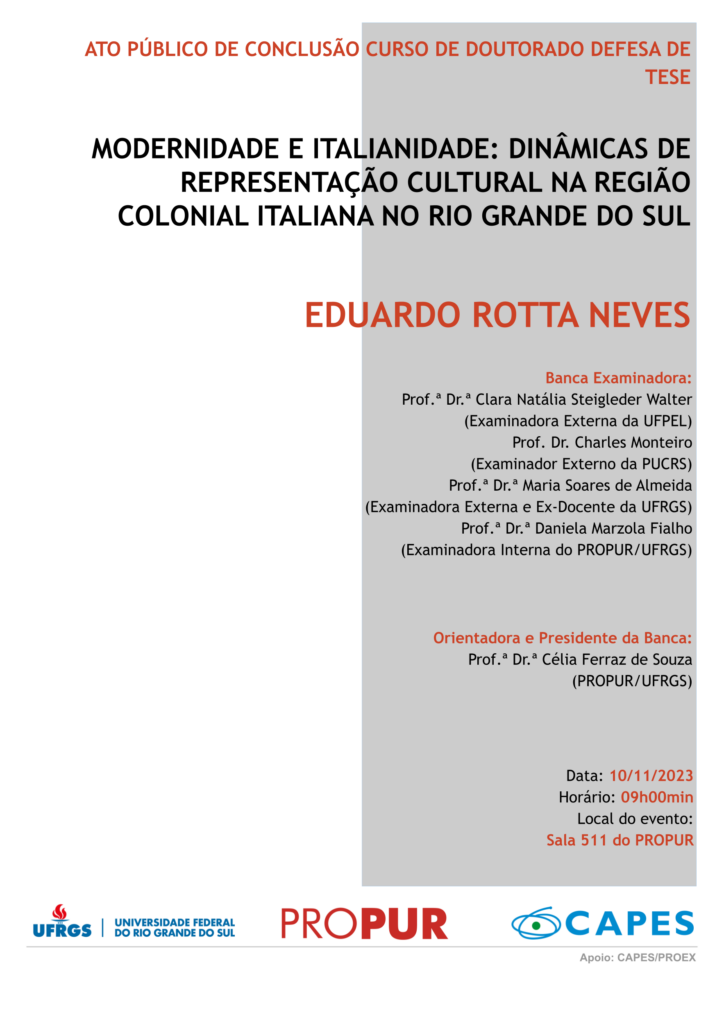
DEFESA DE TESE: EDUARDO ROTTA NEVES
MODERNIDADE E ITALIANIDADE: DINÂMICAS DE REPRESENTAÇÃO CULTURAL NA REGIÃO COLONIAL ITALIANA NO RIO GRANDE DO SUL
EDUARDO ROTTA NEVES
Banca Examinadora
Prof.ª Dr.ª Clara Natália Steigleder Walter (Examinadora Externa da UFPEL)
Prof. Dr. Charles Monteiro (Examinador Externo da PUCRS)
Prof.ª Dr.ª Maria Soares de Almeida (Examinadora Externa e Ex-Docente da UFRGS)
Prof.ª Dr.ª Daniela Marzola Fialho (Examinadora Interna do PROPUR/UFRGS)
Orientadora e Presidente da Banca:
Prof.ª Dr.ª Célia Ferraz de Souza (PROPUR/UFRGS)
Data: 10/11/2023
Hora: 9h
Local: Sala 511 do PROPUR
RESUMO
No final do século XIX, o Brasil recebeu milhares de imigrantes italianos que partiam de um de um país recém unificado em busca de novas possibilidades e oportunidades de vida e trabalho. Muitos destes vieram ocupar as terras devolutas localizadas nas encostas montanhosas do hoje Estado do Rio Grande do Sul, concedidas pelo então governo imperial brasileiro para a colonização. Na bagagem, estes camponeses, em sua grande maioria, trouxeram conhecimento, tradições, hábitos, costumes, enfim, valores de uma cultura própria que passou a ser expressa sobre o território, mesclando-se com a cultura do país de destino, transformando o espaço em lugar, e este em referência de pertencimento e identificação. Enquanto se modifica, em função das rápidas mudanças sociais, econômicas e culturais decorrentes dos processos de industrialização e modernização, integrados ao contexto histórico da modernidade, o lugar também se valoriza e se reconhece mediante a preservação de seu patrimônio. É no lugar que a cultura adquire a sua dimensão simbólica e material, a memória se cristaliza e a identidade se consolida e se reafirma. Esta identidade peculiar, predominante sobre outras, que neste estudo, entende-se como “uma italianidade”, fruto da vivência de seus cidadãos em simbiose ao lugar habitado, se apresenta como marca de um território cuja história permanece consubstancialmente vinculada à cultura da imigração. Única em sua manifestação e representatividade, possui no país de origem, a Itália, uma referência, pois se insere em um contexto global, assumindo variadas formas de expressão vinculadas ao tempo e espaço onde se manifesta. A italianidade sempre esteve adaptada e integrada ao processo de modernização desta região, podendo ser identificada mediante a análise do seu extenso patrimônio cultural, material e imaterial, onde traços, marcas e símbolos de sua presença nele permanecem inscritos. Conhecer, conceituar e contextualizar a essência da cultura que caracteriza os ambientes urbanos e rurais de uma sociedade, reveste-se de fundamental importância para embasar a produção de estudos, dos mais diversos, nas distintas áreas do conhecimento e, principalmente, para as ações analíticas e propositivas de planejadores urbanos e regionais.
Palavras-chave: Imigração Italiana – Italianidade – Cultura – Patrimônio
ABSTRACT
At the end of the 19th century, Brazil received thousands of Italian immigrants who left a newly unified country in search of new possibilities and opportunities in life and work. Many of these came to occupy vacant lands located on the mountainous slopes of what is now the State of Rio Grande do Sul, granted by the then Brazilian imperial government for colonization. In their luggage, these peasants, the vast majority, brought knowledge, traditions, habits, customs, in short, values of their own culture that began to be expressed over the territory, mixing with the culture of the destination country, transforming the space in place, and this in reference to belonging and identification. While changing, due to the rapid social, economic and cultural changes resulting from the processes of industrialization and modernization, integrated into the historical context of modernity, the place is also valued and recognized through the preservation of its heritage. It is in the place that culture acquires its symbolic and material dimension, memory crystallizes and identity is consolidated and reaffirmed. This peculiar identity, predominant over others, which in this study is understood as “an italianity”, the result of the experience of its citizens in symbiosis with the place they inhabit, presents itself as a mark of a territory whose history remains substantially linked to the culture of immigration. Unique in its manifestation and representation, it has a reference in its country of origin, Italy, as it is part of a global context, assuming different forms of expression linked to the time and space where it manifests itself. Italianity has always been adapted and integrated into the modernization process of this region, and can be identified through the analysis of its extensive cultural, material and immaterial heritage, where traces, marks and symbols of its presence remain inscribed in it. Knowing, conceptualizing and contextualizing the essence of culture that characterizes the urban and rural environments of a society is of fundamental importance to support the production of studies, of the most diverse, in different areas of knowledge and, mainly, for analytical actions and proposals from urban and regional planners.
Keywords: Italian Immigration – Italianity – Culture – Heritage