ASTM D570 - Standard Test Method for Water Absorption of Plastics
Determination of the relative water absorption rate for plastic samples by immersion. Applicable to any type of plastic material in different formats.
Measured property:
- Percentage of absorbed water
ASTM D5229 - Standard Test Method for Moisture Absorption Properties and Equilibrium Conditioning of Polymer Matrix Composite Materials
Method for the determination of moisture absorption or desorption properties through the thickness of single phase Fickian solid materials, bent or unbent. Applied to samples of laminated polymer matrix composite materials, as well as other materials that meet the requirements.
Measured property:
- Rate of absorption/desorption
- Percent change in mass of absorption/desorption
For the ASTM D570 standard, samples of different types must have specific dimensions:
- Moulded: discs 50.8mm in diameter and 3.2mm thick.
- ISO standard sample: 60mm x 60mm x 1mm.
- Laminated sample: 76,2mm length and 25,4mm width.
- Rods: 25,4mm long in diameters smaller than 25,4mm.
- Tubes: 25.4mm long in internal diameters less than 76mm.
For ASTM D5229, the samples should have a mass of 5g or more. For geometry, the ratio of length to thickness, in millimeters, should be equal or greater than 100.

ASTM D792 - Standard Test Methods for Density and Specific Gravity (Relative Density) of Plastics by Displacement
Determination of the relative density of solid polymeric materials by immersion. Samples may be in the form of sheets, tubes, rods or any moulded form, provided they have compatible dimensions.
Measured property:
- Relative density
- Density
ASTM D2734 - Standard Test Methods for Void Content of Reinforced Plastics
Determination of the void index of reinforced plastics. The voids content can significantly affect some mechanical properties and determines the quality of the composite
Each sample should have a mass between 1g and 50g, with a minimum thickness of 1mm for each gram of mass and a minimum volume of 1cm³. The sample to be analysed should not be chemically affected by water. For samples in layers, the density should be determined separately for each layer or, in order to obtain an average relative density of the sample, determined with the layers together.

ASTM D2584 - Standard Test Method for Ignition Loss of Cured Reinforced Resins
Method for determining the loss on ignition of a cured reinforced resin sample. It is also possible to examine the fibre aquitecture of pultruded structural shapes.
Measured property:
- Percentage loss on ignition
Sample should weigh approximately 5g, with a maximum size of 2.5cm x 2.5cm x Thickness.

ASTM D3171 - Standard Test Methods for Constituent Content of Composite Materials
Determination of the constituent index of composite materials. The determination of the reinforcement or matrix content should be done for the analytical modelling of the composite material properties.
Measured property:
- Reinforcement index (weight/volume percentage)
- Matrix index (weight/volume percentage)
- Matrix density
The sample should have a minimum mass of 0.5g per constituent volume or 1g if a void ratio is also determined. In general, the sample should follow the size and quantity recommendations of ASTM D792.

ASTM G151 - Standard Practice for Exposing Nonmetallic Materials in Accelerated Test Devices that Use Laboratory Light Sources
Method describing standard procedures for exposure of non-metallic materials in accelerated ageing devices using artificial light sources of different types.
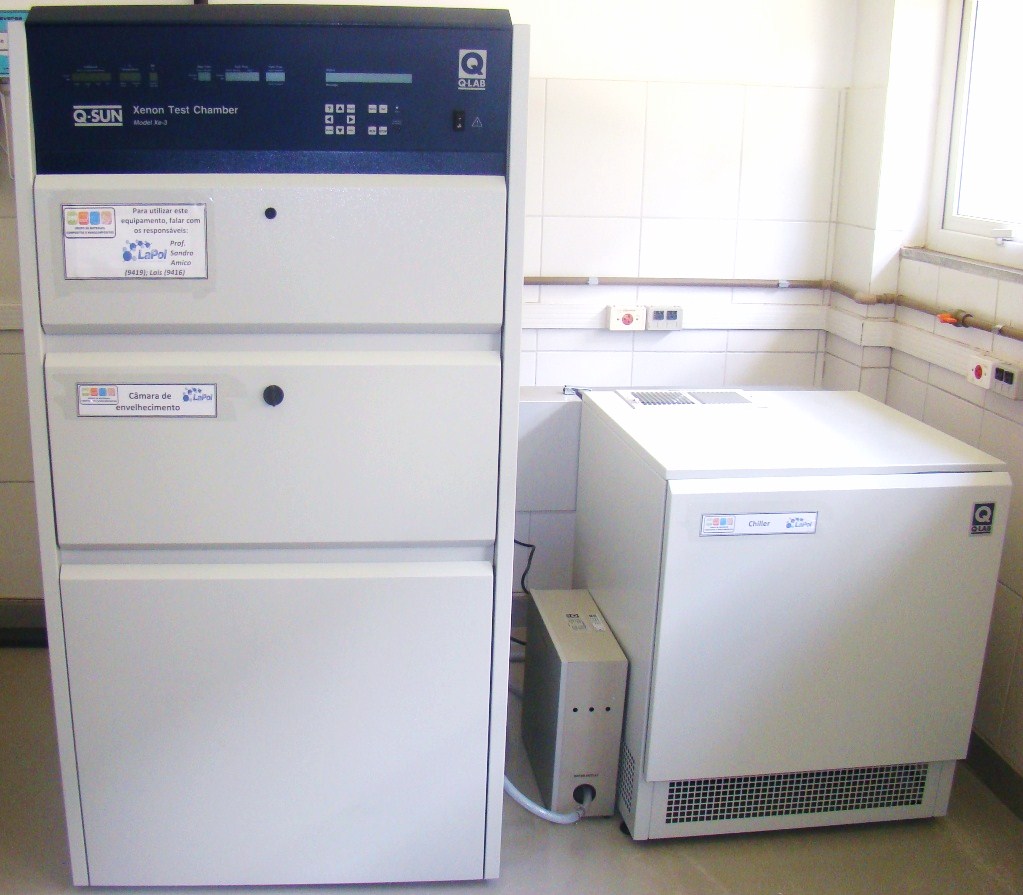
ASTM G155 - Standard Practice for Operating Xenon Arc Light Apparatus for Exposure of Non-Metallic Materials
Method describing standard procedures for the use of accelerated ageing devices with xenon light source and water spray, to simulate ageing effects from sun and rain exposure.
The geometry and specification of the samples vary, being in accordance with the standard of the test to be carried out after the exposure period.