Culture | Researchers and institutions aim to revive the life trajectory of the multifaceted black, homosexual and carnival iconic artist
*By Alexandre Briozo Gomes Filho
*First published February 16th, 2023
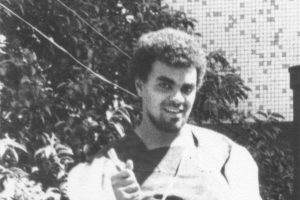
*Photo: Flávio Dutra/UJ
The awareness that “the stage that is given to some is denied to others” intensifies as the line to blackness or homosexuality is crossed, and even more when these two social markers intermingle in one person. Djalma do Alegrete (1931-1994) is one of those cases of the retrieval of the trajectory of black personalities who have been increasingly present in Brazilian society since the Racial Quotas Law has made it possible for the black community to address its demands inside and outside the academia.
With an art inspired in the Afro-Brazilian heritage, Djalma was a painter, scenographer, poet, actor, director of carnival parades, costume designer, and teacher, achieving notability with his portraits. In the latter field, Djalma improved his art style with the renowned João Fahrion, enhanced his painting skills with Aldo Locatelli, and his technique with the famous Ado Malagoli. His education and academic background, however, were not enough to guarantee the recognition of his work, for there were the circumstances of his skin color and sexual orientation: he was black and homosexual.
“If black people are not able to be inserted in spaces of power, such as in museum collections, direction of art institutions or even other sectors of the job market, it is because the image of these people has been associated with subordinate tasks for several centuries.” explains Izis Abreu, a master’s student in History, Theory and Criticism of Art at the Federal University of Rio Grande do Sul (UFRGS) and curator of Presença Negra (Black Presence), a recent exhibition held at the Art Museum of Rio Grande do Sul (MARGS) where Djalma’s works were displayed. According to Abreu, “this results in the creation of specific social places for these people.”
“Because he was a black man and a homosexual, Djalma suffered from a lack of opportunities and recognition.”
Izis Abreu
Djalma refused the subordinate role that prejudice sought to assign him. Instead, he made his own world of colors, traces, fabrics, loves, tragedies, and religion, in which he defiantly occupied his rightful space as an inherently unsubmissive person, engaged in a constant cognitive fight to liberate himself from the internalized subordination rooted in the colonial mindset imposed upon black people. In 1979, in an interview published by the alternative newspaper Lampião da Esquina, whose editorial line was focused on LGBT+ and black community topics, Djalma was described as “plastic artist, cross-dresser, showperson, former black sheep of the family, A.A., son of Xangô, with his religious initiation in Sara of Iansã, a priestess from Porto Alegre (who serves an African-derived religious entity).”
Born into a wealthy black family on June 4, 1931, in Alegrete, son to Dinorá Cunha dos Santos and Army Lieutenant Homero Alves dos Santos, brother to five biological siblings and two foster siblings, Djalma did not follow his parents’ wishes and was far from becoming an engineer. Fleeing from the family molds, he seemed to have been born with a mixed-with-fantasy blood that turns the abstract into art that can be seen, felt, touched, and transmitted.
According to a 1988 article in the newspaper O Globo, Djalma was the first black student to enter the Institute of Fine Arts at UFRGS. He became the first black man to graduate in this field in the state of Rio Grande do Sul. He also studied Journalism and got a degree in Didactics from the Institute of Philosophy and Human Sciences in the same institution.
He began teaching in São Lourenço do Sul as soon as he graduated in fine arts, where he suffered from the heavy discrimination of his students’ parents and other local residents for being black and homosexual. The persecution against him was so severe that he even became a target for physical assault, being pelted with stones. “I invited my former students from Porto Alegre to join me for a weekend in São Lourenço do Sul,” says Djalma in an interview for Correio da Manhã in July 1963. “They were celebrated with a cocktail party at a club. But because of my race, I had to wait at the entrance.”
Due to the strong racial segregation in the state, Djalma moved to Rio de Janeiro later in the same year, marking the beginning of his comings and goings between the two states.



Between the costumes and parade floats, the life of a man who inherited the rhythm of samba
Djalma do Alegrete gained national and international recognition when Ieda Maria Vargas showcased his stylized traditional costume, titled “Exaltação aos Pampas” (Exaltation to the Pampas), during the Miss Universe pageant in July 1963. The costume was a blend of masculine and feminine attire, drawing inspiration from the Farroupilha Revolution. It combined boots and bombachas (a typical loose-fitting trousers worn in the Pampas region), with a low-cut neckline, garnering criticism in Brazil while earning praise from abroad. Vargas won the contest that year, but Djalma was not invited to her visit to Porto Alegre’s City Hall. When he arrived at the entrance gates, security guards prevented him from entering.
Djalma was a longtime friend and groomsman of Dirney Alves Ribeiro, who recalls the wound that this event opened in the artist’s soul. “They told him that he modeled [the costume] professionally, and that he was done with it after that. He was not allowed to participate because he was black and homosexual,” Ribeiro says. And Ribeiro also said that, from that episode on, Djalma began to defy society. “He used to parade through Rua da Praia, half-naked, wearing women’s clothes. He was ahead of his time.”
In Ribeiro’s house, Djalma can be seen on almost every wall, through the realistic and stylized portraits he painted of that family. An organizing box holds most of the collection that the friend has of the artist’s works, along with letters sent over the years to him and to his wife, Lenir, whom Djalma admired as if she were his own female version.
Amidst the narrative of Djalma’s life, Ribeiro goes through letters, postcards, artwork, and photographs that chronicle his stories. He eventually narrowed his eyes as if to reach more distant memories, from the time when the two met at the Trevo de Ouro carnival block in 1966, where Djalma was a carnavalesco (a creative director of a samba school). In referring to the croquis, Ribeiro exalts the ingenuity of his friend: “His culture was enviable. He was a pioneer in doing this particular style of drawing, only he could paint this way”. On the sketches, created for the samba schools he collaborated with, the censorship of the Department of Political and Social Order (DOPS) is registered on the authorization stamps of the Federal Police Department in Rio Grande do Sul.
During the 21 years of the military dictatorship, Djalma do Alegrete fearlessly lived life on his own terms. Although gender and sexuality issues were not explicitly targeted by repressive policies, there was a stereotype association of these people with subversion, deeming them a threat to societal norms and values. Throughout history, the LGBTQIA+ community has often found in Carnival a space for free manifestation of their identities, which justifies Djalma’s passion for this cultural performance.
On July 23, 1963, the Correio da Manhã announced that the costume designer would leave Porto Alegre in August of that year due to the racism prevalent in the state. Djalma expressed his frustration to the newspaper, stating that “[r]acial segregation in Rio Grande do Sul is an undeniable reality. We are [pejoratively] called ‘that negro’ or ‘negrinho’ and I believe that’s why I don’t have opportunities in my own state.” Exhausted by the conservative atmosphere of Porto Alegre, the artist moved to Rio de Janeiro.
In the Marvelous City [as Rio de Janeiro is acclaimed in a famous Carnival March], Djalma worked with Carnival. In a heartfelt letter sent to Ribeiro and his wife, he exclaims, “I am overjoyed, soaring through space as if I were being reborn (thank God!!!).” However, in 1971, his prolonged stay in Porto Alegre was caused by an unresolved situation at work: the seamstresses didn’t finish the costumes on time and the administrators of Bloco das Vassourinhas were enraged. Afraid of that, he returned to seek refuge in his hometown. According to Ribeiro, “his family, despite having many restrictions regarding his sexuality, did not abandon him.”

A rescue from the systematic erasure of racialized and LGBTQIA+ people
“Djalma is one of the cases of racialized artists who have been made invisible in art history,” comments Abreu. “The academic field might know who he is, but the general public still doesn’t know him.” Curator of Presença Negra together with researcher Igor Simões, from the State University of Rio Grande do Sul (UERGS), the art historian says that the exhibition contributed to find new public to the artists presented and also to promote and stimulate the interest for research around artists who have been made invisible or even erased: “There are many names to be researched and recorded historiographically, all we have to do is look at them.”
With the growing frequency of discussions around racial agendas, the master’s student explains that this is due to an entire struggle of social movements for inclusion in academic spaces.
“From the moment that we, black people, transgender people, homosexuals, succeed in inserting ourselves in academic spaces, this generates interest. I am an example of this: I started pursuing a career in Art History gaining entrance through the quotas, but I didn’t see black artists in the curricula during the whole undergraduate program, so I started to question myself about this [invisibility]. My undergraduate thesis was about the retrieval of the trajectory and the production of a black and homosexual artist named Otacílio Camilo”
Izis Abreu
The systematic erasure of black and indigenous cultural backgrounds from the history of Rio Grande do Sul can be explained by the effort to make the state be seen from the experiences of people with European traditions and origins. Thus, elements of black culture began to be fought against, as when there was an attempt to build, in the mid-1990s and throughout the 2000s, a sambadrome in the capital, and there were protests from certain residents arguing that it would result in an increase in criminality.
Representation issues have been increasingly present in social debates, in commercials, in schools, and in workplaces. Abreu comments that racialized and LGBT+ artists are gradually gaining space in the artistic community, but she points out that “[t]here is an almost ‘imposed’ interest on the part of institutions to look at these artists.” She believes that it is necessary to go beyond the marketing symbolism and make changes in the institutions’ structures and administration.
“Even though artists are gaining some visibility and are being sought out by galleries, the institutional structure still doesn’t accommodate this diversity”
Izis Abreu
“Djalma had issues related to alcoholism, probably as a result of the violence he suffered throughout his life,” says the art historian. She emphasizes that the artist must be recognized for his production, and that this production needs to be valorized. In an interview to O Globo, in 1988, Djalma says: “Now, more than ever, I am aware that, despite the prestige I have achieved, I am an outcast for being homosexual and black.” Bypassing prejudice and claiming for himself, the artist was self-designated “the glorified outcast.”
In 1991, he held an individual exhibition at MARGS, “Preto é cor, negro é consciência” (Black is color, negro is consciousness), in which he promoted a retrospective of his paintings and the release of the book “Rio Grande do Sul: Aspectos da Negritude” (Blackness Aspects), a collection of texts by several authors about the trajectory of the black community in Rio Grande do Sul in all its aspects, with his own illustrations. Djalma do Alegrete died in 1994 at the Hospital Nossa Senhora da Conceição, in Porto Alegre.
When discussing the recognition that Djalma do Alegrete’s trajectory is now receiving, Ribeiro becomes emotional and his voice gets shaky: “He truly deserved this.” Ribeiro says that he has been contacted by museums interested in exhibiting Djalma’s works and also by researchers who are studying the artist’s life trajectory. Regarding the impact of Djalma’s reputation on the black community and the LGBTQIA+ community, the friend is resolute: “The retrieval of his trajectory is a rupture in the oppression that came from white people all these years.”


Translated into English by Pedro Henrique Marques Sieburger, undergraduate student enrolled in the course “Supervised Translation Training I (English)” of the Undergraduate Program in Language and Literature, under the supervision and translation revision of Professor Elizamari R. Becker (P.h.D.) – IL/UFRGS.
:: Read in portuguese:
Djalma do Alegrete: “o marginal glorificado” do Rio Grande do Sul