
Earth Sciences | Based on the analysis of rhynchosaur bones found in the center of Rio Grande do Sul, research reveals discoveries into the ecosystem from over 200 million years ago
*By Carolina Paz Comerlatto
*First published March 28, 2024
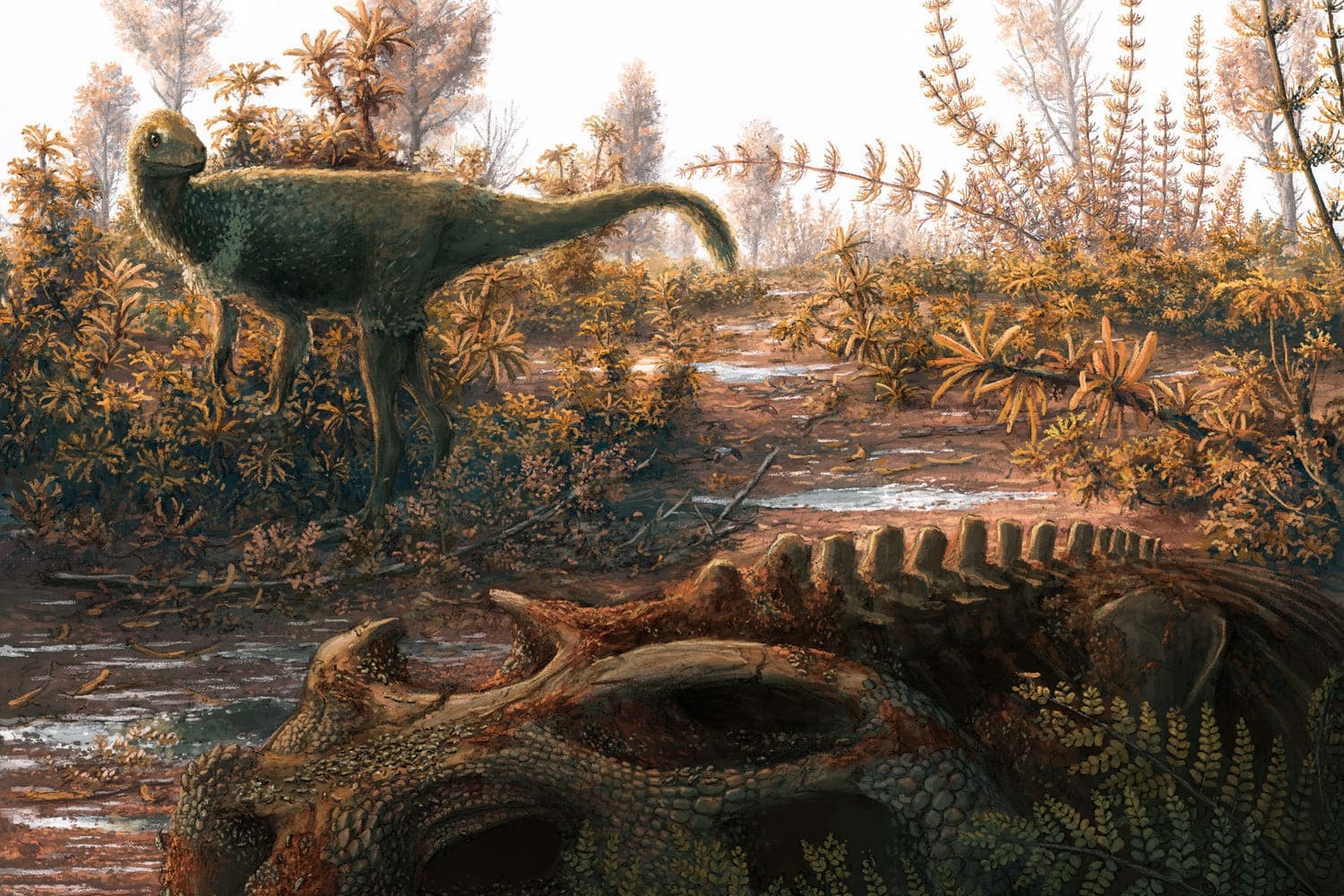
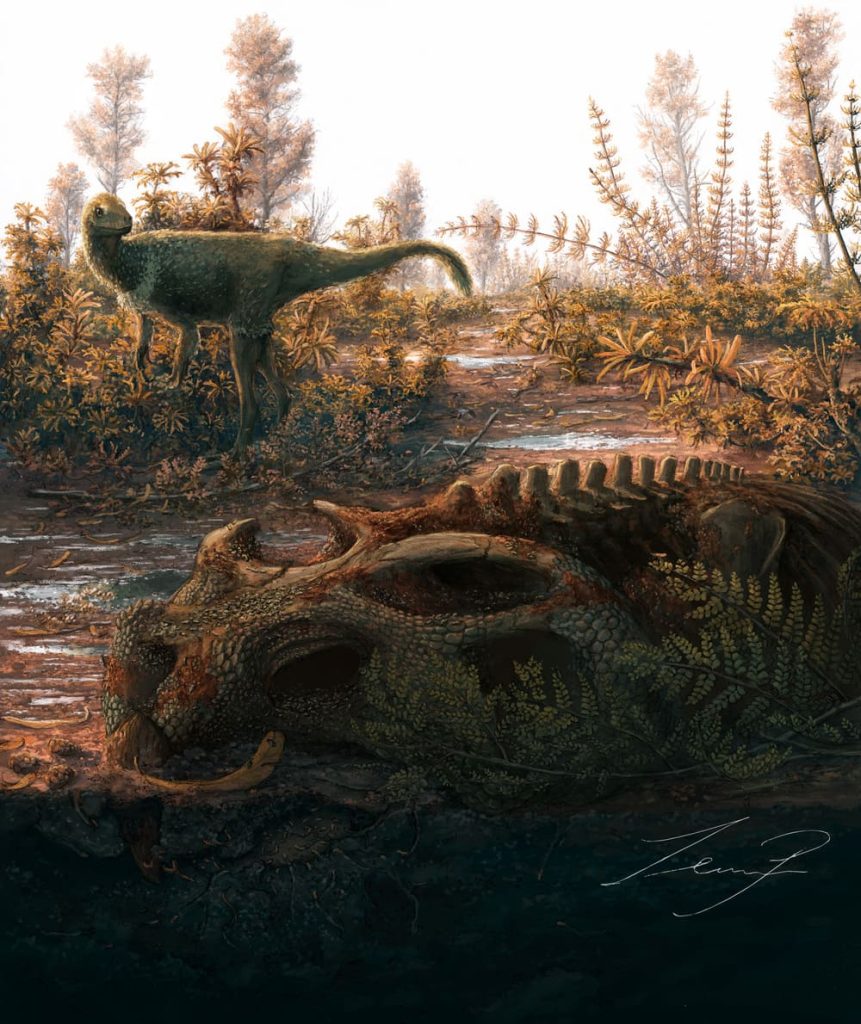
*Image: Depiction of insect behavior on a rhynchosaur carcass. (Illustration by Zeinner de Paula, commissioned by the author)
It was a long-standing passion that motivated Lucca Cunha, a PhD student in the Geosciences Program at UFRGS, to define the research topic for his master’s thesis. “I have loved dinosaurs since childhood – that very cliché thing”. Holding a degree in Geography from the same university, the researcher pursued, for his master’s training, a different path from the one expected for someone who had an undergraduate training in Geography: he chose to study paleontology.
Within the science that focuses on ancient beings, fossils are commonly classified into two large groups: body fossils, formed by the structures of organisms, such as bones and teeth, and ichnofossils, formed by traces of activity, such as footprints. The researcher has developed his study focusing on the second classification. Supervised by Professor Heitor Francischini, Lucca researched the traces of bioerosion in rhynchosaur bones from the Upper Triassic (the geological period during which the first dinosaurs appeared).

A unique research
Ichnology is the field of science that studies different types of traces left by living beings, such as footprints, marks, nests, and burrows. One area of ichnology that generally receives little attention is bioerosion: a hard substrate destroyed by the action of an organism. In Lucca’s research, the hypothesis developed was that the traces found came from insects. “We have deepened our investigation to understand what kind of action could have caused such traces, and what they all could mean for the study of the Triassic,” he explains.
According to Lucca, “The only way to know they (the insects) had been there is through their traces of activity”. This is because these animals are not preserved as body fossils, in other words, no remains of their bodies have been found. This study is relevant for the researcher since “it is the means to understand the role of these animals within those ecosystems”. Although studies of this geological era are widely represented by dinosaurs and larger animals, insects were also a very important part of life in Earth’s remote past.
Historical discoveries
During a field trip to the Buriol Paleontological Site (Sítio Buriol), Heitor collected fragments that would later serve as the basis for Lucca’s research. Located in São João de Polêsine, in the central region of Rio Grande do Sul, the geosite has great international scientific relevance, given its record of some of the oldest dinosaurs in the world. In 2021, the Guinness World Records recognized the oldest dinosaurs ever found are the ones discovered in Rio Grande do Sul.
After thoroughly examining 520 fragments, with the aid of a stereomicroscope and photographs, Lucca confirmed that 29 had bioerosion traces. As is the case in taxonomy, which names and classifies living beings, in ichnology traces also receive scientific names. This way, it becomes easier to compare and research the activity of organisms. One of the most important aspects of the research is that this is the oldest occurrence of two identified ichnogenera [a taxon based on the fossilized work of an organism]: Osteocallis and Amphifaoichnus.
The two classifications denote both different structural aspects and the way the traces have been produced. Osteocallis, for example, is a trace that would refer to a bone that, having undergone bioerosion, would have been exposed. Amphifaoichnus, on the other hand, would indicate an action occurring while the bone was buried.
In the study, Lucca wonders whether both could not have been carried out simultaneously underground, which could indicate a very ancient behavioral complexity of the target insects. He explains that, when a bone is in a subsurface condition, it is much more difficult for it to be destroyed. Therefore, “if insects attacked the buried bone, their significance in the preservation or destruction of the bones is far more substantial than we had imagined”.
A more accessible science
In order to make the study more tangible, the research also included the illustration of the paleoartist Zeinner de Paula. Although it is also a singular artistic expression, paleoart encompasses an enormous scientific rigor. According to the illustrator, approximately 90 hours were dedicated to creating the illustration for Lucca’s study — the process included a lot of research, drafts, and dialogues with the researcher. “Each brushstroke is intentional,” he says.
For Zeinner, the illustrations are the main way to “give science a face for the public”: “Sometimes I read 20, 30 different articles to synthesize them into a single landscape”. According to him, paleoart is a more accessible way of science communication, since it is capable of attracting even those who are not that familiar with scientific articles. “Many times (the articles) are in English and are not so accessible for a broader audience of non-speakers of English, so I see [paleoart] as a bridge for access,” the artist explains.
The research legacy
The study developed by Lucca is one of the first to delve deeply into the research on bone bioerosion by insects. According to him, when we see this matter addressed in other studies, it is usually treated as just another piece of information about general aspects of the research. Therefore, the hypothesis developed in the study managed to be more elaborated than those previously proposed.
In his doctoral training, Lucca continues to develop research on bone bioerosion. This time, those made by other types of organisms as well. As he explains, the study conducted for his master’s thesis leaves room for future research works to delve deeper into the topic, and explore beyond the most common aspects of this area. “From a scientific point of view, both are important for us to understand this entire context,” he concludes.
Translated into English by Letícia Wronski Todescatto, undergraduate student enrolled in the course “Supervised Translation Training II (English)” of the Undergraduate Program in Language and Literature, under the supervision and translation revision of Professor Elizamari R. Becker (P.h.D.) – IL/UFRGS.