
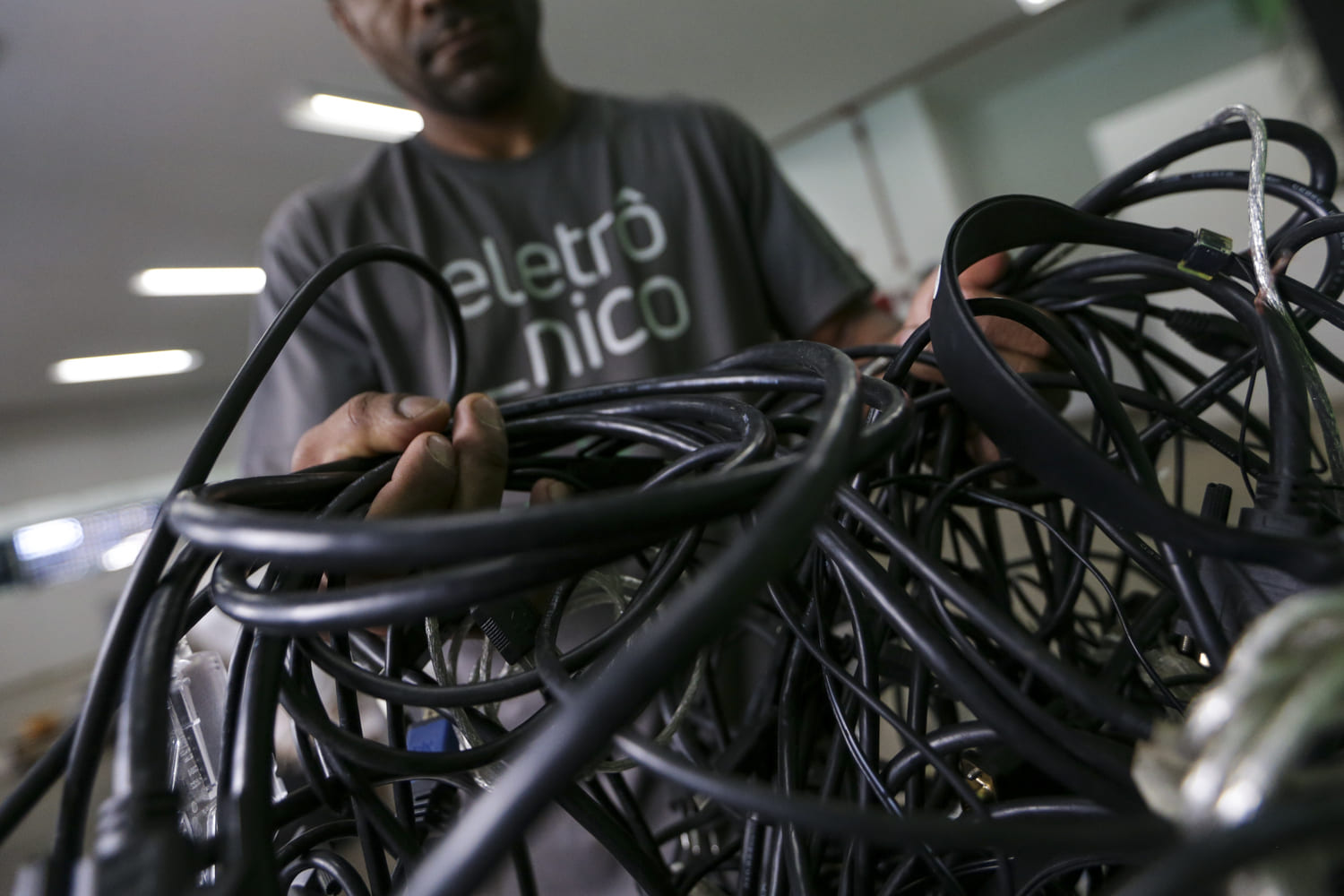
Sustainability | Components of electronic waste contain substances which are harmful to nature and human health — global annual production of such waste has already surpassed 50 million tons
*By Ronaldo Botelho
*First published March 28, 2024
*Photo: Marcelo Camargo/Agência Brasil
“We are […] trashing all places so fast that we’re undermining the planet’s very ability for people to live here.”
The above excerpt, taken from the documentary The Story of Stuff (2007), raises relevant concerns about the damage that modern society’s way of life is causing to the environment, and to humans themselves — whether through the misuse of natural resources or the levels, means, and methods of consumption and disposal.
The documentary, directed by U.S. environmentalist Annie Leonard, brings attention to a significant global issue arising from modern life: the disposal of electronic waste through devices, their parts, and accessories. This is an issue that spans economic, environmental, and health spheres.
Contamination of the environment and infiltration into the food chain are major concerns regarding electrical and electronic waste. Many native metals are essential to life, but can become toxic when accumulated in living organisms. Arsenic, cadmium, chromium, copper, nickel, lead, and mercury are the most common heavy metals that can pollute the environment.
The Global E-Waste Monitor 2020 report by the United Nations (UN) states that the annual global production of electronic and electrical waste reaches 53.6 million tons — an average of 7.3 kg per person. Out of this total, only 17.4% is recycled. The same study estimates that the global e-waste will reach 74 million tons annually by 2030.
“When I don’t dispose of electronics properly, where do they go? To a landfill, a garbage dump, or an empty lot. Then this kind of material will be available in the soil. Perhaps soon, it’ll be in the air or in the water… It will end up in a natural source. And by being available, it could cause harm,” observes Tainá Flores da Rosa, environmental engineer at the Hospital de Clínicas in Porto Alegre.
The Pan American Health Organization (PAHO) website reports that, in 2021 alone, about 12.9 million women worked in the informal waste sector, and more than 18 million children and adolescents, some as young as five years old, were actively engaged in the informal industrial sector, which includes waste management — a situation that potentially exposes these individuals to toxic electronic waste and puts them at risk.
Consumption and Changes
Electronics are deeply embedded in all levels of social relationships. They have become icons of convenience, speed, and comfort in modern life. However, advances in technology and their glamorization for mass consumption have turned such consumption and disposability into a silent and immeasurable problem.
The Belgian non-governmental organization The WEEE Forum revealed that, in 2022 alone, it is estimated that 5.3 billion mobile phones were discarded. Massive production will certainly translate into various impacts. Moreover, with technological advances in this sector and the consequent popularization of electronics, material replacement also creates contradictions.
“On one hand, there may be a reduction and change in the use of materials and habits, but on the other hand, waste increases, since new technologies reinvent themselves quickly,” evaluates Monica Concha Amin, Professor of Applied Economics at the Federal University of Health Sciences of Porto Alegre (UFCSPA).
Professor Amin points out that the immeasurable increase in production of these products will require new collective attention. “Communications and innovation are advancing to reach every corner. Places that used to be unknown until recently are starting to be invaded. Therefore, the challenges for public policies are enormous, both in the public and private sectors.”
The relationship between the benefits of an electronic product and the implications of its production and disposal is also revealed through environmental disasters. “The issue isn’t just how much I will consume and generate waste, but how much I’m consuming in terms of resources. We see this issue with Braskem’s salt mining [in Maceió, Alagoas] or Vale’s dam collapse [in Brumadinho, Minas Gerais]. Waste creates potential risks. Before we get to the waste, we need to mine it,” recalls da Rosa.

Habits and Policies
With the growing public awareness among consumers, it seems there is increasing recognition of the need to reduce the impacts of improper disposal of electronics. Alongside this, social movements have achieved important legislative victories in Brazil.
Brazil’s National Solid Waste Policy (PNRS), introduced in 2010, led to the signing of the reverse logistics sector agreement in 2019. This commitment aimed for Brazil to achieve at least 17% recycling of e-waste by 2025, with collection points in over 5,000 locations across 400 cities. The most recent data from the Ministry of Environment, from 2022, shows that the country had reached 3,400 collection points.
“Proper disposal ensures that this material won’t end up in the environment and that it won’t be available in the future,” notes da Rosa. As a corporate initiative, she provides an example of the sustainability policy at HCPA, involving a team of around 10,000 people — interns, staff, and residents. “We follow the partner company regarding licensing and documentation. We also work on internal education and serve as a source of knowledge, as people seek us to find out where to dispose of electronics.”
However, she reports that public authorities do not always make it easy for people to develop the habit of proper disposal.
“Collection points are set in very specific places, so if you don’t get informed about where they are, you won’t know where to drop them off. It’s easier to leave them in front of your house. This is what we sometimes see on the streets. So, this is one of our hindrances – we are short of collection points,” she states.
Marco Antônio Prola Salinas, Environmental Education Manager at the Municipal Urban Cleaning Department (DMLU) in Porto Alegre, explains that e-waste in the capital city is collected by a partner company, RS Recicla, accredited by the Brazilian Association of Electronics and Appliances (ABREE), which is responsible for collection, sorting, and disposal. “At the same time, we develop actions to raise awareness about the proper disposal of this waste, such as drive-thru collection events and information campaigns,” he states.
E-waste collection in Porto Alegre is done in two ways: by initiative of residents at seven points across the city — addresses can be checked on the RS Recicla website — or by scheduled collection for legal entities.
According to RS Recicla’s press office, once the material arrives at the company, it undergoes three processes: weighing, sorting, and dismantling. Then, it is separated and sent to the industry. After this step, the client receives a proof of disposal (CDF). Collection is available from Monday to Friday, 8 AM to 6 PM, and scheduling can be done via website, WhatsApp, or phone.
At UFRGS, the collection and disposal of electronic materials follow a multi-step protocol. It begins with a formal request by the responsible staff member. “At the Unit/Department, the unusable items (those no longer needed by the department) are sorted, following the Brazilian General Data Protection Law (LGPD), the Information Technology Asset Management Policy, and the Data Privacy Handbook,” explains Jacir da Silva Mendonça, director of the Department of Property and Central Warehouse. After listing the items in the Collection Request, the unit schedules the collection.
Regarding the disposal of these materials, the staff member clarifies that electronic “disposal” is done based on Law 14.479 of 12/21/2022, which established the National Policy for Electronic Disposal and Reconditioning. “The university sends a letter to the Ministry of Communications informing them of there is electronic waste available for disposal and providing them with a list for reuse. Once the Ministry receives this notification, they indicate a registered institution as a CRC (Computer Reconditioning Center) to receive the donated materials,” he adds.
One of the standout initiatives at the university for proper use of these products is the project, linked to the Computer Reconditioning Center. This project combines environmental, social, and economic approaches through internal and external partnerships.
A Step Further
Between the growing visibility of impacts and the local solutions found, experts generally agree that productive adaptations and innovative projects are necessary to raise environmental awareness on this issue. However, they also highlight other aspects of this endeavor.
“Today, we see big companies working to reduce waste. The buzzword is ESG: Environmental, Social, and Governance Sustainability. Conscious consumption movements — recycling, reduction, and reuse — generate jobs and improve people’s lives. These actions in local communities should be valued,” says da Rosa.
For Amin, it is important to recognize and appreciate practical efforts in recycling and reuse. “There should be incentives from the production, such as softer credit for these initiatives and increased training across various population groups,” she adds. On the other hand, the professor reminds us that the social aspect of solutions to this issue should not be overlooked.
“Sustainable product consumption should not be out of reach for certain groups in society. Promoting reuse is valuable, but it is also necessary to encourage products that don’t become obsolete so quickly,” Monica Concha Amin emphasizes.
Another perspective on this issue focuses on the responsibility of the entire supply chain: the equipment manufacturer, distributor, retailer, final consumer, and the public authorities responsible for collection and public cleaning. “Each one should do its part, bear part of the costs of collection and recycling of equipment. There are laws regulating this, but they are still not properly applied,” analyzes Luis Felipe Nascimento, coordinator of the Research Group on Sustainability and Innovation at the School of Administration at UFRGS.
Aware of the potential the university has to become a reference in this field, Luis Felipe believes it is important for the institution to have policies and structures in place for their implementation across all units. “It is important to remember that for the successful implementation of a policy, there has to be awareness-raising work and environmental education for all those involved,” he says. The professor also believes that the university is in a position to take on a more influential role in the process of collecting and disposing of electronics.
“The university could, at no cost, establish agreements with companies that collect non-inventoried electronic waste, such as setting up collection for mobile phones, personal computers, and other electronic devices,” he suggests. “It would be a way to encourage and facilitate the proper disposal of electronic equipment used by the academic community,” he proposes.
The Three Types of Obsolescence
The term “obsolescence” refers to the process of becoming obsolete, the state of something that is on the way of becoming outdated. This concept emerged between 1929 and 1930, against the backdrop of the Great Depression. It aimed to encourage a market model based on mass production and consumption in order to promote economic recovery of countries during that period.
In his work Made to Break: Technology and Obsolescence in America, Canadian author Giles Slade classifies obsolescence into three types:
Technological Obsolescence: Introduced in 1913, when vehicles began to incorporate electric starters, replacing hand cranks to start the engine. This type of obsolescence occurs when the manufacturer adds a new technology or functionality to the product, making consumers desire it for the new feature it presents.
Psychological, Progressive, or Dynamic Obsolescence: Occurs when the manufacturer changes the design or style of a product to manipulate the consumer into repeated purchases. According to Slade, this type of obsolescence began in 1923, when General Motors executives started making annual changes to vehicles to induce consumers to replace their cars with newer models featuring minor changes, even if their current car was still functional.
Planned Obsolescence: Occurs when the supplier deliberately manipulates the product to ensure it will fail after a certain period of time. In other words, the manufacturer uses engineering techniques to shorten the product lifespan, which leads the consumer to purchase a new one.
Translated into English by Jennifer Folharini Mesquita, undergraduate student enrolled in the course “Supervised Translation Training II (English)” of the Undergraduate Program in Language and Literature, under the supervision and translation revision of Professor Elizamari R. Becker (P.h.D.) – IL/UFRGS.