
Public health | Despite the crucial role played by these workers in the SUS, permanent qualification and improvement of working conditions continue to be challenges for the category
*By: Ronaldo Botelho
*First published: April 18, 2024
*Photo: Marcelo Pires/JU
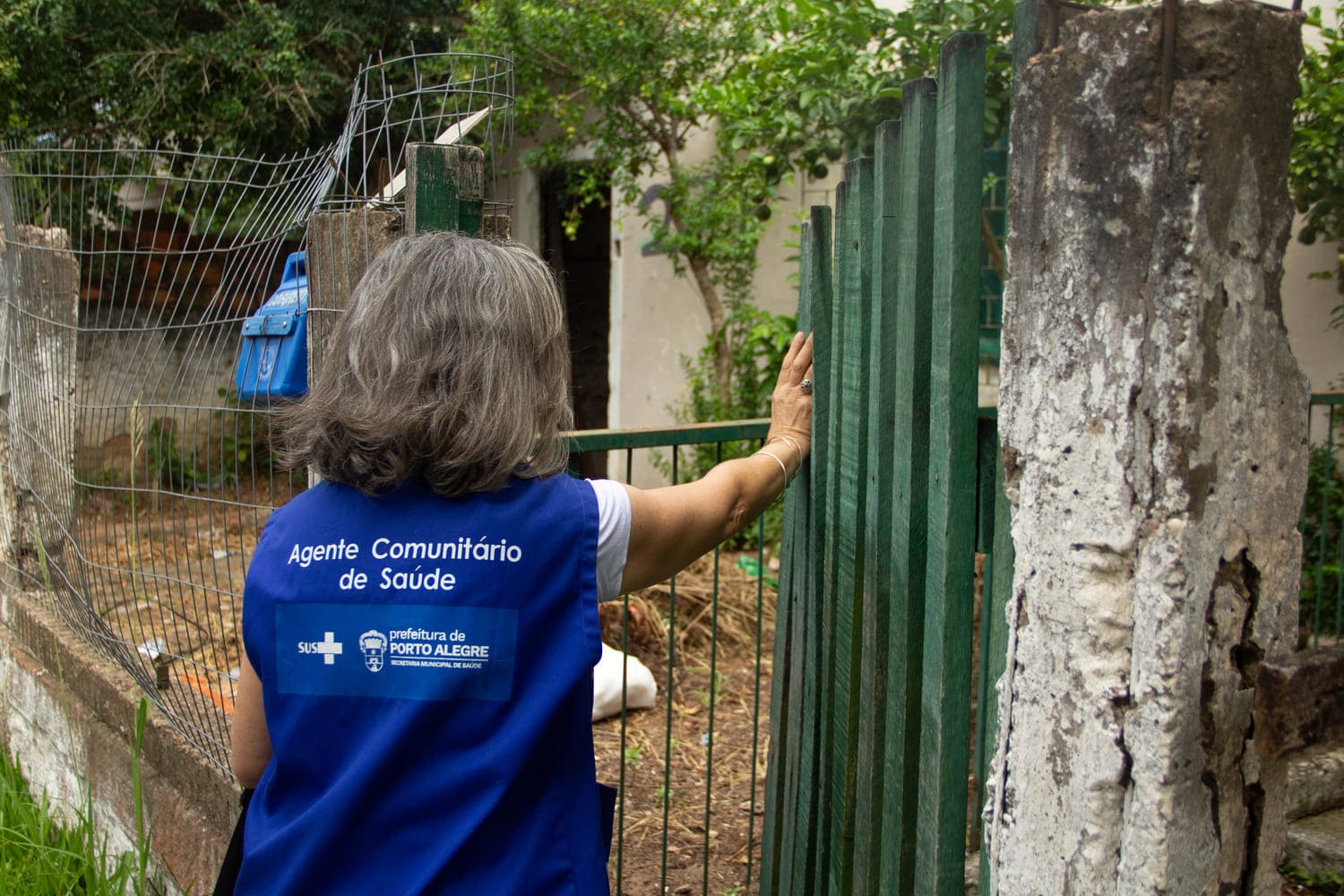
It is a typical Tuesday morning in March for the residents of Vila do Sossego, in the eastern zone of Porto Alegre. A group of recycling workers who live in the area were discussing issues of lack of recognition for their work by government sectors when a group of 10 health students and their professor approached. In front of the visitors, there is a professional in a blue vest.
“Folks, the students are getting acquainted with the community and our work here. This is the leader of the association; and this is a father, who lives apart and asks for news about his daughter who is hospitalized due to choking… here, we have the square where we get together for collective health actions…”
While mediating that interaction between the visitors and the community, Jovina da Silva Dornelles, community agent member of the Santa Cecília Health Unit (Equipe de Saúde da Família da Unidade de Saúde Santa Cecília – Santa Cecília US), juggles her responsibilities, which are already part of her daily routine there – she analyzes, calls, asks, responds, guides, and takes notes.
Familiar with the environment where she lives and has ties with family and neighbors, Jovina’s role is similar to that of a community leader in health matters. But her role goes beyond that. “The community trusts her, everything we need, we can count on her,” says Jeferson Flores, president of the Vila Sossego Association.
In addition to the relations with the community, the work of Community Health Agents (Agentes Comunitários de Saúde – ACSs) also involves other instances, before and after contact with the patients. Meetings, data entries, vaccination monitoring, treatment groups, in short, a wide range of activities that run the daily life of a health care unit.
On the morning that we were at the Santa Cecília US, there were rare times in which I saw Jovina in the small room with her team. “I like to keep moving between the reception and assistance to the medical team”, she said, as she walked through the unit.
The ease of this interaction among other professionals is supported by a relationship of mutual trust and recognition. “The Community Health Agent is a professional who plays an important role in the team’s composition. In the face of a health vulnerability situation, they have full access to raise this issue. Then, based on the information they bring, the patient’s care plan is developed”, explains Fernanda de Mello Chassot, technical advisor to the Primary Health Care Department of the Municipal Health Department of Porto Alegre (Secretaria Municipal de Saúde de Porto Alegre – SMS), responsible for the ACSs in the city.
The main characteristic of ACS’s work is addressing the urgency of local realities and everything that surrounds it. In addition to providing some assistance services, the ACS is responsible for observing and recording the patient’s condition at their household for subsequent diagnosis and medical care “(…) with the aim of expanding the assisted community’s access to actions and services related to citizenship, including information, health care, social promotion, and protection”, as stated in Law 11.350, dated October 5, 2006, which regulates the profession.
According to data from the Ministry of Health, by the end of last year, there were 278,000 community health agents in Brazil, working across the entire national territory. But the construction of this immense network traces back to a long journey.
From control to rights
While in previous decades the presence of the State agents in the communities was established compulsorily, invading residences and imposing procedures – as in the historical episode of the Vaccine Revolt, at the beginning of the 19th century –, at the current moment this relation is based in a logic of dialogue, elucidation, and empathy. In this strategy, the ACS is a valuable point of access.
“What delights me the most is being able to make a difference in someone’s life, even when the system is flawed. I always have a smile on my face, that is my calling card,” told us Jovina, as we walked through one of the areas where she works, a cluster of small houses in an alley squeezed against the imponent landscape of tall, modern buildings.

The scholars of Family and Community Medicine (Medicina de Família na Comunidade – MFC), and the UFRGS Multi-professional Health Residency (Residência Multiprofissional – RM) observed all the interactions silently and attentively. “This experience beyond the office is necessary to understand what lies behind the patient’s life,” said Adriana Barbieri, 29, one of the group members visiting the community.
As a reference unit partnered with the HCPA teaching hospital (Hospital de Clínicas de Porto Alegre), the Santa Cecília US has a different structure when compared to other 133 Primary Health Care Units (Unidades Básicas de Saúde – UBS) and Health Units (USs) of Porto Alegre, the latter being so named once they include a Family Health Team. “Since we are affiliated with the University and the HCPA, our ACSs are in high demand by health care teams to ‘introduce’ the community area, its vulnerabilities, and the work with families, both for the students and the local residents. There is no community-based activity that is carried out without the ACSs – in schools, homes, long-term care facilities, etc,” explains Claunara Schilling Mendonça, professor at the Faculty of Medical Sciences at UFRGS and coordinator of the Santa Cecília US.
Affection and sincerity
Yet, the public attended by the ACSs, like the Brazilian Unified Health System (Sistema Único de Saúde – SUS) in general, also includes neighborhoods with better structure. Even with more financial resources, patients have different family and life settings, resulting from the dispersion of children, or pure and simple neglect. The ACS Vanda Juçara dos Santos Blazina, 62, knows this very well – she works in the Juca Batista neighborhood and surrounding areas, in the southern zone of Porto Alegre, and she tends to an average of 150 families.
“The children grow up, get married, move out, go abroad and the elders stay alone. Most of them are women going through the ‘empty nest syndrome’,” she explains. With a degree in History and previous experience in health administration, Vanda says she likes her job, for which she says to count on her personal experience. “My mother had Alzheimer’s, and she passed away when she was 93 years old while living with me. It really moves me,” she states.
On a Thursday afternoon, we accompanied part of a home health assessment visit to one of the patients she regularly attends. While she guided us to the house, Vanda talked about the problems that are not seen, such as loneliness and depression, but that many patients face. “They live in nice houses, but some are faced with human suffering. Sometimes, the biggest suffering is that of the soul, of not having someone to talk with, argue with, to guide you and listen to you”. The health unit also maintains a mental health group in the area, which “ensures that the user does not end up just taking medication,” she explains.
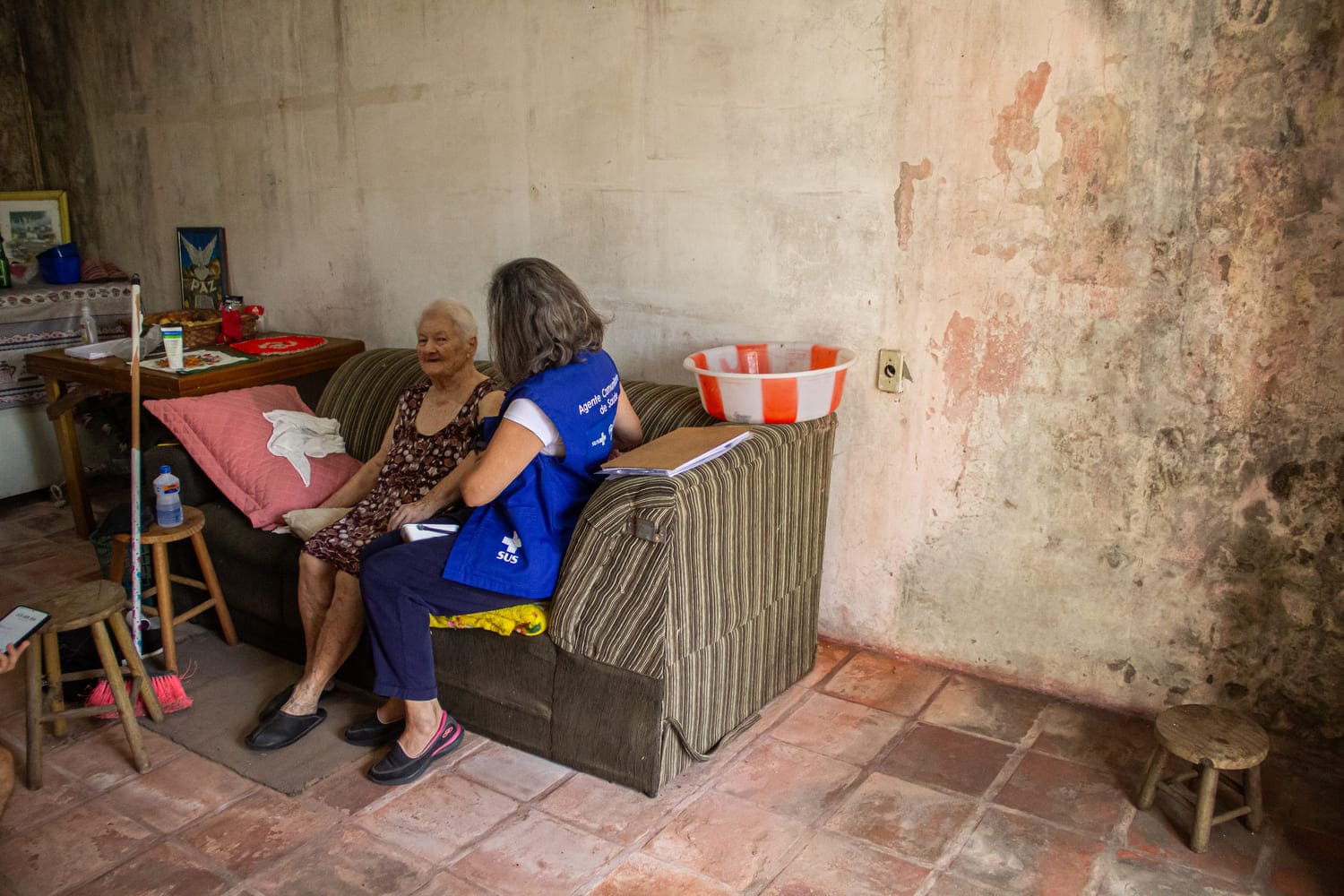
Teresinha Margarida Francines, 86 years old, with limited mobility and almost completely blind, is a patient whose health care we followed that afternoon. After arriving at Teresinha’s house, Vanda gets settled and starts her work, asking questions about the elder’s situation, examining her skin, talking to her granddaughter who accompanies her in administering her medication, measuring her blood pressure, and so on.
“The relationship of trust is normally easily established from the moment we listen with real attention and respect. I never make promises that I can’t keep. Soon enough empathy is established on both sides”
Vanda Juçara dos Santos Blazina
For her part, the patient talks about her life uninhibitedly – she talks about moving from the countryside to the capital city; from her youth to marriage; and about relationships with family members and neighbors. I seize an opportunity in the conversation to ask about her interactions with other people in general. “The only visit I really have is from a lady from the third house. I’m only keeping trustworthy people here,” she explains. After a few moments, we left the two of them to finish the treatment, which also included dressings and other care.
At the farewell, Vanda emphasizes the importance of sincerity in relationships with patients. “I never give opinions about diagnosis or recommend medications. I take the patient’s doubts about their treatment to the medical team or the nurse during the team meeting,” she affirms.

Challenges and achievements
Even though many achievements have already been consolidated in the profession, the ACSs continue to uphold important causes. According to Cláudia Canatta, president of the Association of Community Health Agents of Porto Alegre (Associação dos Agentes Comunitários de Saúde de Porto Alegre – AACS-POA), the main demands of the category in the capital include the payment of financial aids such as the Incentivo Financeiro da União and the Incentivo de Qualidade, the updating and correction of the Employment Record Book (Carteira de Trabalho), proof of social security contributions (National Social Security Institute – INSS), and improvements in the working conditions.
“The association was constituted at a moment when the category was unprotected and did not feel represented by the existing union at the time. We tried all possible alternatives for dialogue, and then determined, with the category, other forms of struggle”, states Cláudia, who also works as an ACS since 2004, in a team that tends to 1,100 families in the neighborhood of Jardim Floresta, in the northern zone of Porto Alegre.
However, according to Valdívia Gonçalves Lucas, president of the Union of Community Health Agents of Rio Grande do Sul (SINDAC-RS), at the state level, the career demands are focused on the fight for compliance with Law 11.350/2006 and Constitutional Amendment 120/22, ensuring a minimum wage, fair employment contracts, the payment of additional benefits [like the Incentivo Financeiro] annually, and a career plan.
“Outsourcing harms the work of the ACSs, it has ended the existing bond with the population. It is unsatisfactory, because staff rotation is constant, in some units, at each return visit the user is assisted by different teams”
Valdívia Gonçalves Lucas
At age 74, having been an ACS for 23 years, Valdívia is currently based at Tijuca US, in the Morro Santana neighborhood, East Region of Porto Alegre, where she has attended to 600 families. She is currently on leave to engage in union activities.
Nationally, the fights of the ACSs focus on two main issues: “Completion of the technical course and the regulation of special retirement through Constitutional Amendment 120/22”, says Ilda Angélica dos Santos Correia, president of the National Confederation of Community Health Agents and Endemic Disease Control Agents (CONACS).
The State Health Department, through its communications office, informs that community health agents are hired by the municipalities.
The management team of the Municipal Health Department of Porto Alegre, through its communications department, affirms that the Primary Health Care system in the capital understands the importance of the ACS professional. The department also reports that a Working Group (Grupo de Trabalho – GT) was formed to address sensitive issues to ACSs and ACEs (Endemic Disease Control Agents). According to the management team, the ACS is the professional who has been receiving the most training, and the municipality is currently conducting two selection processes. Regarding the financial incentive from the Union, the SMS notes that these funds can be used for improvements and acquisitions of supplies and materials.
Regarding the Quality Gratification and Incentive (GIQ) payment, the SMS states that when the positions of ACSs and ACEs were created in the city, the payment of this incentive was not foreseen. Since then, this issue has been raised in meetings of the Working Group and, more recently, brought to the attention of the Deputy Health Secretary, who requested the matter be forwarded for negotiations. As for the update and correction of the Employment Record Book, the SMS explains that, due to the transfer of ACS and ACE professionals from the now-defunct Municipal Institute of Family Health (IMESF) to the City Hall, these professionals were originally hired under the CLT (Consolidação das Leis do Trabalho, in Portuguese) regime (celetista). As a result, the Municipal Department of Administration and Assets (SMAP) is currently implementing the e-Social system for these workers.
Concerning the registration and proof of social security contributions (INSS), the SMS states that it is aware of the inconvenience caused by the non-completion of the e-Social implementation. The department also informs that a meeting was held between the INSS and SMAP, during which the most urgent cases were discussed, and notes that a new meeting will be scheduled for further discussions.
As for the improvements in the working conditions, such as location and equipment for registration, the SMS clarifies that the physical structure of the Health Units is very diverse and, for this reason, there is not a specific room for the ACSs in each US, but offices or rooms are available for carrying out their administrative activities. Finally, the department adds that palmtops used by the Brazilian Institute of Geography and Statistics (IBGE) census were purchased and that all USs and UBSs have Wi-Fi.
Technical qualification
Another area of demand is the professional qualification of ACSs, which is foreseen in SUS but had not yet been achieved at a technical level. In this regard, a recent advancement was the Technical Program for Community Health Agents (Curso Técnico em Agente Comunitário de Saúde), the first edition of which was held throughout 2022 as part of the Saúde com Agente (Health with Agents). This initiative, led by the Ministry of Health, was made possible by the involvement of UFRGS and the National Council of Municipal Health Departments (Conselho Nacional das Secretarias Municipais de Saúde – CONASEMS).
With a duration of 10 months and a course load of 1,275 hours, the course prepares students to conduct health diagnosis in communities, work in health promotion and prevention, collect and record data, and integrate planning and control of diseases and health risks within the community areas.
The planning of the first edition of the course, still during the pandemic, involved 14 health-related areas of the University, 11,000 tutors, and 236,000 registrations, with participation from almost 5,400 cities. “This happened during the pandemic, we had to ensure that 60% of the course was conducted in person and meet a strict deadline. Think about the logistics, that was our challenge. And we formulated the proposal,” celebrates Leandro Razier, General Coordinator of the project and Executive Vice President for Undergraduate Studies at UFRGS.
“We understand that this course must truly qualify people for the job, it has to bring the latest information from academia to the health agents”.
Leandro Raizer
For the President of CONACS, Angélica dos Santos Correia, the course is a beneficial initiative that will help us improve even further. “I would like to thank UFRGS for the way they have conducted the course, I believe that the second group of students in the project will be even better,” she considers.
Other territories and perspectives
“The unit is small and doesn’t have the support to handle the demand, which is very high. We always need to actively seek out patients who haven’t been to the UBS for a long time. What I enjoy most is making the patient satisfied. Qualification is very important, it helps in the work journey,” says Jucilene Brito Bitencourt, 46, who has worked as an ACS for 24 years. She is currently working in the Coroado neighborhood, in the east zone of Manaus (AM), a municipality that was awarded in the Previne Brasil 2023, a national program that measures the quality of Primary Care in the country.
“The main difficulties are not having the correct information, cars to transport patients to see specialists, and enough medication. But knowing about the trust and respect that each family holds for our work motivates us to do and give our best every day. The Saúde com Agente course was really important because it revives values of connection with the community,” says Marinalva de Oliveira Paiva, 53, who has worked as an ACS for 24 years, and a participant in the Saúde com Agente course. Currently, she assists 236 families in Corumbá de Goiás (GO).
“Our dialogue with administrators, both at the municipal level and with the Ministry of Health, has been centered on the urgent need for public recruitment processes to hire new ACSs. The uncovered areas cause significant harm for the UBS and for the people left unassisted,” notes Angélica dos Santos Correia, 55, who has worked as an ACS for 33 years, and is responsible for 120 families in the Boa Esperança neighborhood in Maracanaú (CE). She is also the President of CONACS.
“Close contact with the community gives me a sense of connection and purpose, while I help build a healthier and more resilient environment. The dynamic and challenging aspect of the profession is also captivating. I consider qualification important because it provides specific skills and necessary knowledge to offer quality assistance and care to the community,” says Dirce Aída Francisco Ribeiro de Melo, 59, 16 years as an ACS. She was a collaborator in the technical team in the construction of the Saúde com Agente project and currently assists 75 families in Kamaiurá and surrounding areas, in Unaí, a municipality in the northwest of the state of Minas Gerais.

Translated into English by Letícia Wronski Todescatto, undergraduate student enrolled in the course “Supervised Translation Training II (English)” of the Undergraduate Program in Language and Literature, under the supervision and translation revision of Professor Elizamari R. Becker (P.h.D.) – IL/UFRGS.