
Human Sciences | The main activities carried out at federal universities in the South of Brazil focus on education to overcome prejudice
*First published in March 10th, 2025
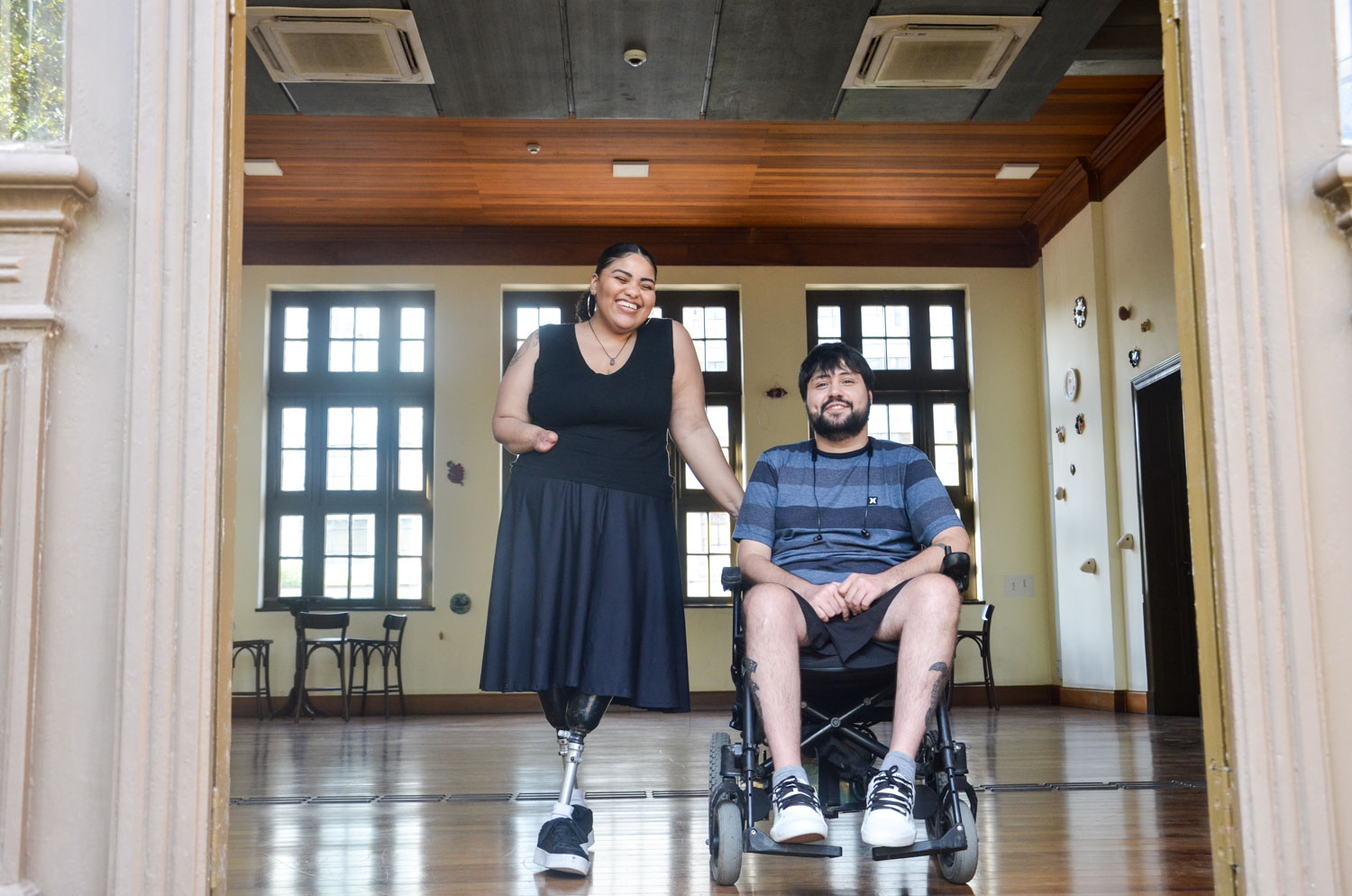
*Photo: Evelyn Gonçalves and Emanuel Estevão are students with reduced mobility and are assisted by Incluir, UFRGS accessibility center (Pietro Scopel/JU)
At university, accessibility centers assist students and staff members with visual, hearing, physical, intellectual, and psychosocial disabilities. These departments work to improve accessibility concerning spatial mobility, information, use of technological equipment, transportation and social engagement.
As part of her master’s research in Social Policy and Social Work at UFRGS, Fernanda Lanzarini analyzed the initiatives carried out by these accessibility centers at federal universities in southern Brazil. The results showed that the main challenge in the region is addressing ableism and discriminatory attitudes.
To understand how these centers help to include people with disabilities in higher education institutions (HEI), Lanzarini studied the accessibility centers’ activity reports of five southern Brazilian universities: Unila, UFFS, UFRGS, Unipampa and UFSM.
“Of eleven [southern federal] universities, only three have made these documents publicly available on their websites: UFRGS, Unipampa and UFSM”, points out Lanzarini. Unila and UFFS made the reports available upon request. The other universities did not answer, so they were not included in the analysis.
The accessibility centers focus on adapting University culture to Inclusive Education. In this context, workshops, outreach projects, discussion circles, seminars, and specialization courses are offered to professors, staff, and students
The Specialized Educational Support course is one of the 113 initiatives reported by UFSM’s accessibility center, the Office of Educational Initiatives (CAEd). Aiming at eliminating potential pedagogical barriers, this course offers the possibility of adapting other courses to the needs of students with disabilities, allowing them to fully participate in class.
At UFRGS, Incluir – the Inclusion and Accessibility Center – reported 55 initiatives aimed at educating the academic community. Among these, the Extension Project Mandatory and Accessible Readings produces audiobooks and adapts entrance exam books to screen reader users. Besides that, there are also workshops organized by UFRGS Staff Development School.
Research advisor and professor at the Institute of Psychology, Social Work, Health, and Human Communication at UFRGS, Adolfo Pizzinato comments that these actions represent a third stage in inclusive education. After having invested in infrastructure and technological equipment, it is time for the universities to have an educational adaptation.
“These [infrastructure and equipment] are the easiest challenges to address. Despite the financial costs to universities, a construction team and a targeted public call can solve these issues.”
Adolfo Pizzinato
All five centers reported infrastructural adaptations in the universities. These include accessible bathrooms, parking spots for people with reduced mobility, elevators and access ramps with handrails.

Additionally, measures to minimize technological barriers are also implemented in all universities that Lanzarini studied, with particular emphasis on Unipampa. The institution offers equipment such as Braille printers and typewriters, screen reader software, electronic magnifiers (for users with low vision), and adapted desks for wheelchair users.

Considering the sector’s demands, Lanzarini points out that not all accessibility centers had enough employees.
“Some centers have a larger and more diverse team of professionals, while others are understaffed.” –
Fernanda Lanzarini
Unila, Unipampa, and UFFS reported this issue. While UFRGS Incluir and the UFSM Office of Educational Initiatives have a staff of 30 each, the other universities mentioned above have six, five, and three staff members, respectively.
“Looking at the actions across different universities, we can observe a lot of creativity and important developments happening. But naturally, it is more effective where there are more professionals,” says Adolfo.
Lanzarini’s thesis is available at Lume – UFRGS Digital Repository.
Services offered by Incluir
UFRGS students and staff members with disabilities can request support from Incluir by emailing acompanhar.incluir@prae.ufrgs.br. Students should complete and submit the Serviços e Recursos de Acessibilidade Form (Accessibility Services and Resources Form in a free translation), which must be signed by their Undergraduate Commission or Graduate Program.
For more information, visit the student services catalog on TUA UFRGS or contact Incluir by phone at (51) 3308-4946 / (51) 3308-4734.”
Master’s thesis: Núcleos de acessibilidade em universidades federais da região sul do Brasil na defesa e efetivação da política nacional de educação especial na perspectiva da educação inclusiva (“Accessibility centers at federal universities in the southern region of Brazil in the defense and implementation of the national policy on special education from the perspective of inclusive education”, in a free translation)
Author: Fernanda Lanzarini da Cunha
Advisor: Adolfo Pizzinato
Postgraduate Program of Social Policy and Social Work – Institute of Psychology, Social Services, Health and Human Communication.
Translated into English by Laura Lameira Ekman, undergraduate student enrolled in the course “Supervised Translation Training I (English)” of the Undergraduate Program in Language and Literature, under the supervision and translation revision of Professor Rozane Rebechi (P.h.D.) – IL/UFRGS.
:: Read in portuguese
Núcleos de acessibilidade investem em medidas para a inclusão de pessoas com deficiência no ensino superior