

Research | With the increasing use of AI as a resource in scientific writing, experts highlight the importance of establishing ethical guidelines and best practices
*First published June 18th, 2025
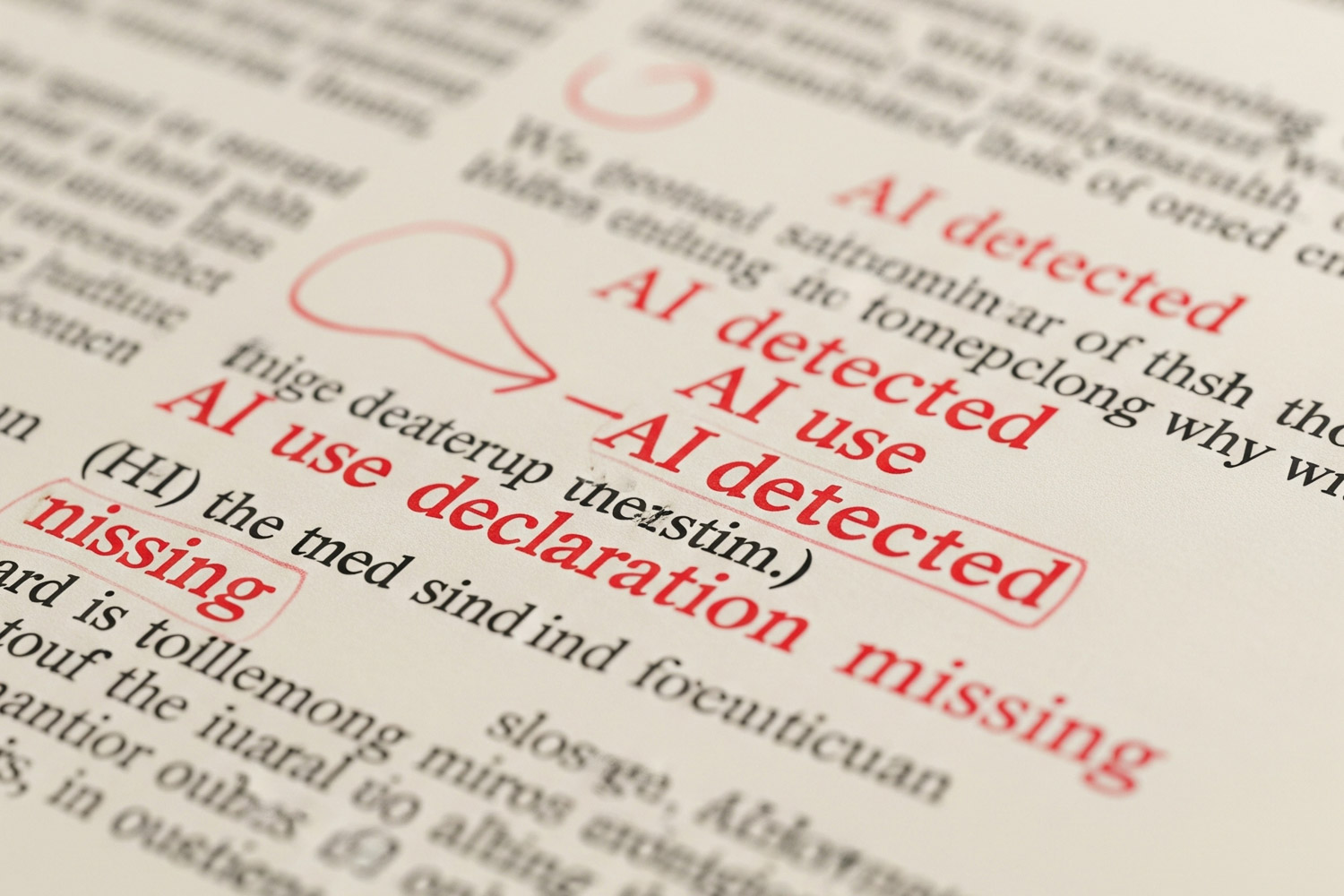
*Google Gemini-generated image, from a prompt suggested by Pietro Scopel
The use of Artificial Intelligence (AI) has become a central debate in the international scientific community. The growing use of generative tools such as ChatGPT, Gemini, and Copilot in the production of articles and other academic writing, as well as official documents, raises not only questions about authorship, but also concerns regarding the security, veracity, and reliability of the information produced by these tools.
Taking ethics and scientific integrity into account, organizations such as the Scientific Electronic Library Online (SciELO), a Brazil-based program that manages journal collections in more than 15 countries, already have their own recommendations for editors, authors, and peer reviewers. The User Guide to Artificial Intelligence Tools and Resources in Communicating Research on the SciELO Network was launched in 2023 during an event at the headquarters of the São Paulo Research Support Foundation (FAPESP), which addressed Open Science practices related to the IDEIA criteria: impact, diversity, equity, inclusion, and accessibility.
The SciELO Guide advises authors to disclose the sources used in the research and writing of their article or chapter. Therefore, any use or content generated by AI in the production of articles submitted to journals indexed in SciELO must be disclosed in the abstract and methods section, or wherever else is deemed necessary. Hiding this information is considered an ethical breach that violates the principles of transparency and honesty in research.
Regarding scientific editors, the SciELO guide recognizes that the use of AI tools and resources helps, for example, verify whether the manuscript aligns with the journal’s scope, summarize its content, attribute metadata and identify reviewers and duplicated images, among other uses. However, the publication highlights the editors’ responsibility to fight misinformation, recommending that, in addition to committing to good editorial practices, they seek to educate themselves in the use of AI.
Reviewers are advised not to submit manuscripts to services, tools or applications that could lead to privacy and content leaks. Because they analyze and validate scientific production, reviewers share with editors the responsibility to observe and maintain the scientific ethical principles recommended by the Committee on Publication Ethics (COPE). The study should have scientific and methodological validity and contribute to both its field of knowledge and society in general; the researchers must balance the risks and benefits of the research for the participants; procedures must be adopted to mitigate and/or minimize individual and collective risk and harm; and the compliance with regulatory, institutional, and/or legal requirements, related to the study’s ethical review, must be analyzed and verified.
Types of AI, Risks, and Possibilities
Márcio Dorn is a professor at the Institute of Informatics at UFRGS and a member of the Advisory Committee of Editorial Support to Scientific Journals (Comap), affiliated with the Pro-Rectory for Research (Propesq). He explains that the most commonly used AIs for academic production are discriminative and generative.
Generally speaking, discriminative AI models are used for data classification. Generative AI (Gen-AI), as the name suggests, produces new content, such as abstracts, titles, paragraphs, and article drafts, and can also be used for systematic literature reviews.
“AI may or may not help in the production of articles, but it should not replace the researcher”
Márcio Dorn
The use of Gen-AI in scientific writing can be risky. Among the problems highlighted by Dorn are plagiarism, academic misconduct, and neglect of critical thinking. Another risk are the so-called AI “hallucinations”: incorrect or misleading results that may be caused by insufficient data in machine training, incorrect assumptions, or biases in the data used to train the model.
When AI-generated results are uncritically incorporated, they produce biases that undermine scientific integrity. Dorn warns that these AI errors and inaccuracies are fed back into the system and can be replicated infinitely, affecting the credibility of science as a whole.
For Érico Amaral, a professor at the Federal University of the Pampa (Unipampa), generative AI can be compared to Google as a research tool. In this sense, the researcher emphasizes the role of educational institutions, especially universities, not only in regulating the ethical use of technology but also in understanding its design, advantages, and disadvantages.
“Instead of Googling things, people are now asking GPT, and these answers are coming much more readily. It’s important, however, to emphasize the importance of raising awareness about the use of this technology, which, although more powerful because it’s probabilistic, is also more prone to error.”
Érico Amaral
Impact on the Scientific Publishing Environment
SciELO’s recommendations are intended for journals in its collection; therefore, they do not have the scope of an institutional policy. However, those guidelines contribute to the development of institutional initiatives to regulate the use of AI, something that is already happening at some universities, such as UFRGS and Unipampa.
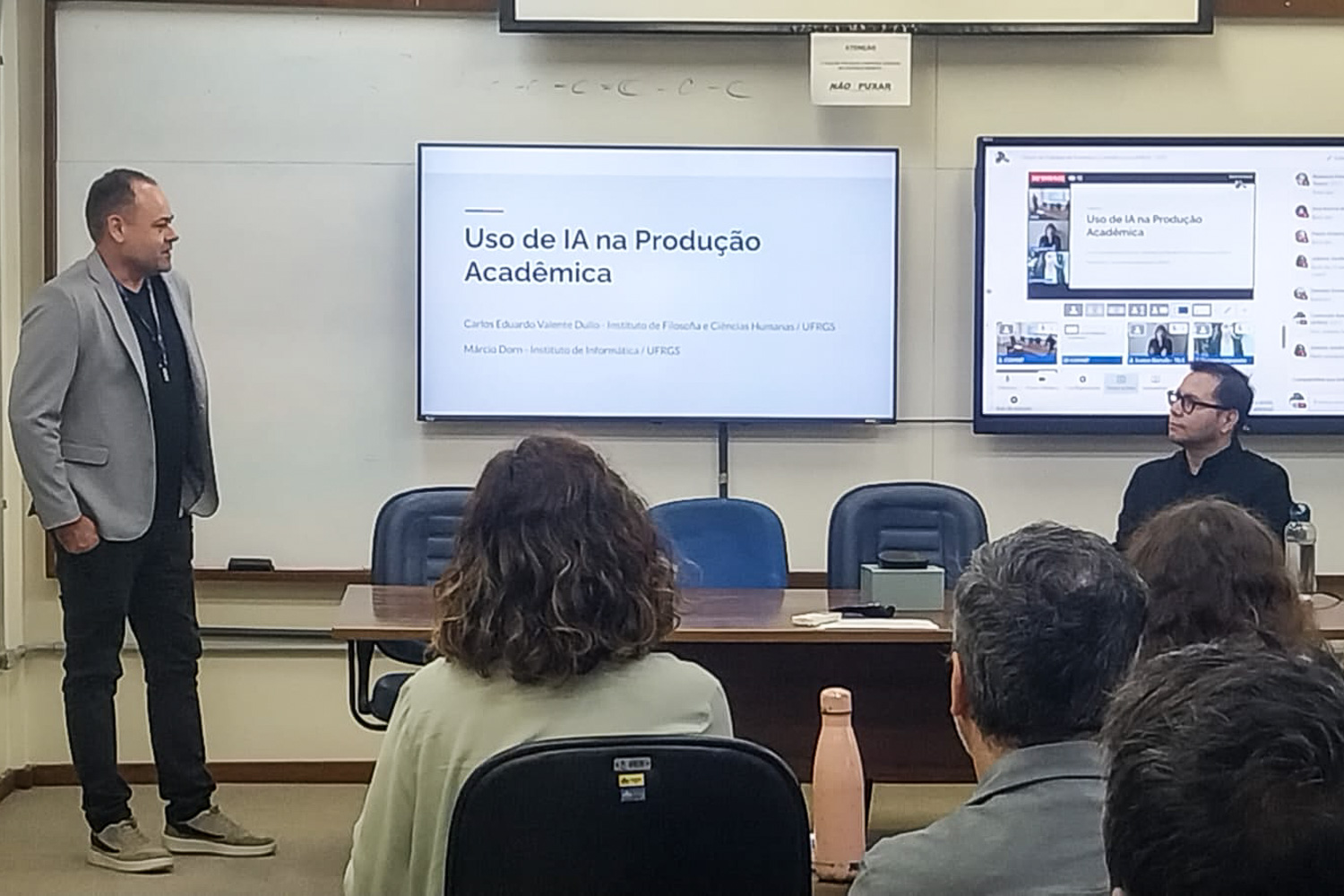
At UFRGS, Propesq addressed the topic at an Editors’ Forum held in May. At the event, Comap’s deputy coordinator, Eduardo Dullo, presented, along with Dorn, the work being done to create an AI policy for submissions to the university’s academic journals.
Among the points highlighted by Dullo are the possibility of sensitive data leaks and issues of authorship, credibility, and responsibility for checking AI-generated content used in scientific productions. For example, when an editor or reviewer uses AI to summarize a text received for review, they are, even if unintentionally, publicizing confidential data.
Dullo also draws attention to human responsibility. “Who is responsible for an AI-generated error or plagiarism in an article? The author,” he points out. For him, these are some of the ethical challenges that need to be regulated.
“If the use of AI is not regulated, we will be creating, not unlike fake news, fake science.”
Eduardo Dullo
The editors present at the Forum agree that the use of AI tools in academic production, and the swiftness of the academic process that its use seems to provide, is here to stay. However, they reflect that using AI ethically and in accordance with good scientific practices, rather than simplifying work, can complicate it even further. In other words, human critical thinking remains irreplaceable in the process of producing responsible science.
Establishing an Institutional Policy
At Unipampa, a research request from Information Technology professors Cristiano Galafassi, from the Itaqui Campus, and Érico Amaral, from the Bagé Campus, resulted in the creation of a multidisciplinary and multi-campus working group to draft the Institutional Governance Policy on Artificial Intelligence, currently being developed.
An internal survey to understand how students, faculty, and staff use or intend to use AI tools in their activities is currently underway. The responses will be analyzed to contribute not only to understanding the phenomenon but also to develop ethical, data security, and training guidelines.
In the initial phase of the research, Galafassi and Amaral encountered a lack of instruments and information to draw on. Therefore, they developed a framework for understanding the academic use of AI and shared it with Unipampa’s management. From this framework, the interdisciplinary working group was created.
Unipampa’s AI Institutional and Governance Policy project is currently contextualizing and formalizing concepts, as well as analyzing how they fit into the institution. The next step will be to discuss the Policy draft at each of the university’s ten campuses.
“We’ve already begun to notice problems related to students’ misuse of AI to solve problems without thinking, or without critical thinking. We’ve even had students file appeals claiming that the professor improperly failed their work. Therefore, we need to establish regulations and guidelines on this matter.”
Cristiano Galafassi
The policy’s widespread adoption is also an issue discussed by the researchers, who see this stage as equally important to the application of a new tool as the development and assimilation of methodologies. Amaral states that the plan is to submit the first draft to the working group for review and adjustments by August. “I believe that, by the end of the year, we will have the policy ready to be submitted to our university council. The next step for the policy to be truly implemented is the bureaucratic and administrative process,” he explains.
Translated into English by Júlia Salvato de Oliveira, undergraduate student enrolled in the course “Supervised Translation Training II (English)” of the Undergraduate Program in Language and Literature, under the supervision and translation revision of Professor Rozane Rebechi (P.h.D.) – IL/UFRGS.
:: Read in portuguese
Políticas institucionais buscam regulamentar o uso de inteligência artificial generativa na ciência