
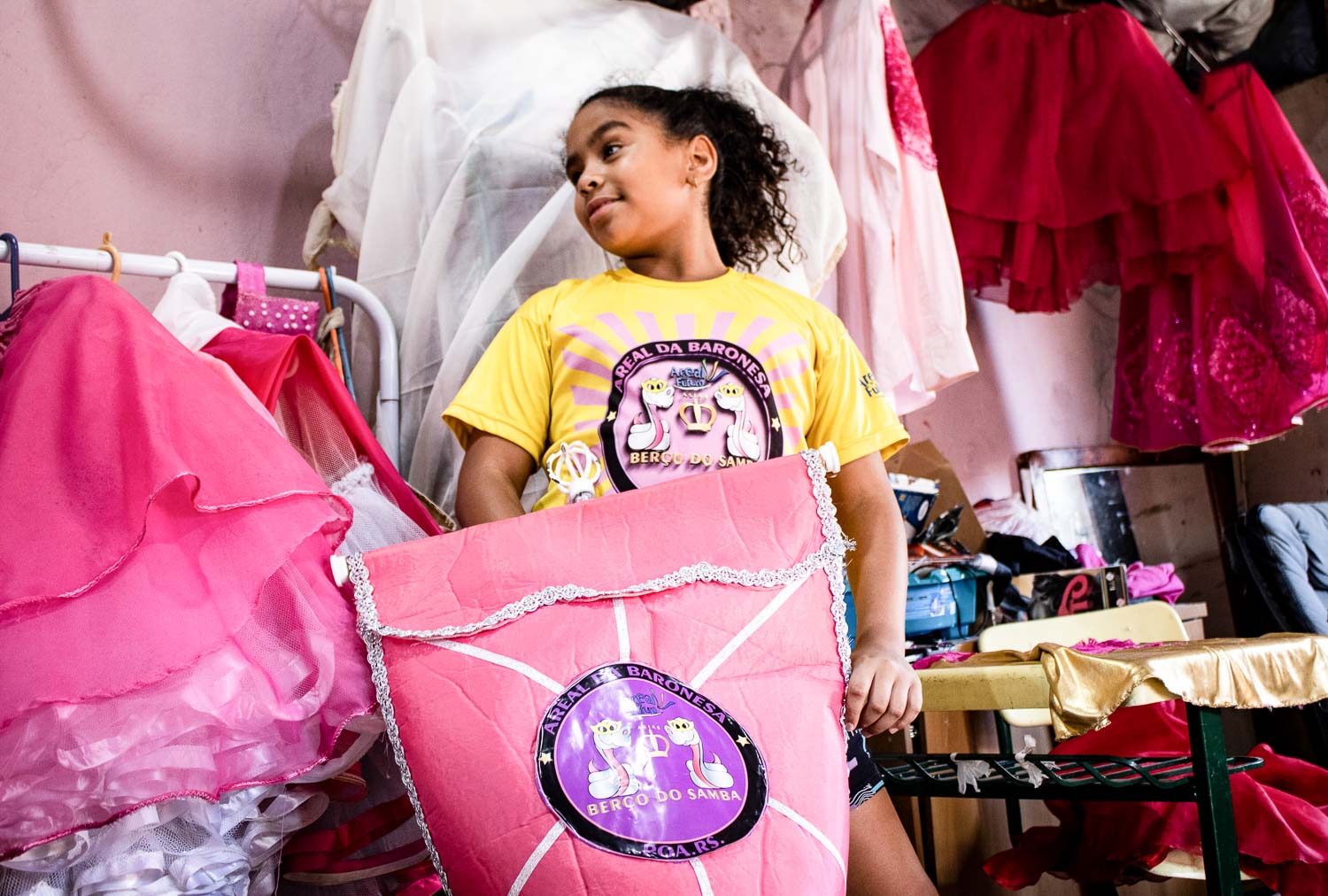
Carnival | Such initiatives, whether independent or in association with samba schools, maintain alive the carnival culture and provide opportunities for children and teenagers
*By Carolina Zanette Dill
*First published February 16th, 2023
*Photo: Ana Terra Firmino/JU – Antónia Astigarraga, flag-bearer of Areal do Futuro
Júlia Barbosa’s first steps as a child are closely intertwined with her first samba steps. It is possible to say that the girl, who is now 12 years old, carries the Carnival ancestry in her blood. She remembers that when she was about 4 years old, she lived with the carnival tradition perpetuated in her family and in the community where she still lives today, Areal da Baronesa. The region is an old black neighborhood in Porto Alegre, classified as an urban quilombo (a settlement founded by communities of escaped slaves) and traditionally known as the birthplace of Carnival in the capital of Rio Grande do Sul.
From 1994 to 2003, the group known as Academia do Samba Integração do Areal da Baronesa competed in the Carnival parade of Porto Alegre. However, when the festivities relocated to the Cultural Complex of Porto Seco in the city’s northern region, the former samba school made the decision to stay in their territory and forgo the invitation to participate in the parades. Since then, in a clear effort to reinvent itself, the group transformed into a Carnival bloco (a street band that promotes a street party), adopting a different approach: creating a full samba school, all composed exclusively of children and teenagers.
“We decided to carry on solely with the participation of children, determined to ensure that the Carnival tradition in our neighborhood doesn’t fade away,” explains Paulo Cézar Silveira, who, with his friends Cleusa Astigarraga, and Daniel Rolveu, created the bloco Areal do Futuro. Since its establishment, the project has been actively providing complimentary classes in percussion, wind instruments, flag-bearer couple dance, flag-bearer solo dance, and samba to the young people in the neighborhood. Furthermore, they have been organizing performances and exhibitions throughout Porto Alegre. “We witness the growth and progress of the children as they join us, observing their development over time. For them, the experiences of performing, using costumes, and engaging in diverse venues are priceless. They are artists,” comments Silveira.

Silveira and Rolveu take charge of the instrument classes, while Astigarraga leads the dance classes and oversees the costume-making process. However, their efforts extend beyond teaching instrumental or choreographic skills; they are committed to fostering a broader understanding of carnival culture. “When we are planning a street parade, we must decide on the theme, develop the storyline, and select the samba theme. This requires extensive research and a comprehensive understanding of the subject,” Astigarraga explains. She emphasizes the importance of considering the historical and cultural aspects that can be narrated and built upon through the organization’s activities. In the most recent edition of the bloco in 2020, the youngsters designed the parade around the influential figure of Mãe Ieda de Ogum, a symbol of Afro-Brazilian religiosity in the Cidade Baixa neighborhood.
Porto Alegre’s Carnival has its roots in the slums and is closely tied to African religions and black neighborhoods of the city. For Maurício Dorneles, who holds both a degree in History and a master’s in Education from UFRGS, the samba schools and Carnival blocos serve as spaces for marginalized individuals to reinvent themselves. “[…] They are reminiscent of terreiros (temples of Afro-Brazilian religions) or extensions of quilombos, as the historian Beatriz do Nascimento says. They are spaces of reinvention, and as such they boost awareness that is different from hegemonic knowledge,” points out the historian. Therefore, Carnival in these communities serves as a means of self-affirmation and preservation of local values.
“A community association arises, transforms itself and turns that space into a parade venue, a terreiro, where a diverse identity dimension is created, and such membership becomes a statement – of belonging to that family, to that community – and a gain a notoriety”
Maurício Dorneles


“There, I learned to have character. For me, Carnival means ‘dignity’.”
Júlia Barbosa
In terms of his technical and practical learning, Barbosa further explains, “I didn’t have a proper grasp of spinning or waving the flag. I had to really buckle down and take things more seriously.”
Matheus Astigarraga, a 15-year-old student, accompanies her as an escort. Despite being Cleusa’s grandson, his initial interest in learning from the workshops began as a playful participation at the age of 8 when he observed older kids dancing. For the teenager, the event is a journey of learning and love. “Carnival offers a wealth of knowledge in various aspects. It aids in shaping my character and personal growth,” the young boy says. “Barbosa and I began mastering ballet just a year ago, as we started attending classes and seeking guidance from more experienced couples,” he shares.

The pair also participates in the Mini Divas (Little Divas) project, created by Raquel Nunes, a former percussion band godmother of Imperadores do Samba. Inspired by a similar initiative by Beija Flor de Nilópolis, a samba school in Rio de Janeiro, Nunes decided to offer samba classes for children in 2018. The initiative started with only 6 children; today there are 65. Nunes, however, disassociated from her former samba school. As a result, she has formed new partnerships and the children of the project became members of the Bambas da Orgia, Imperatriz Dona Leopoldina, União da Vila do IAPI and Acadêmicos da Orgia samba schools. Thus, the project became a gateway for children to participate in the rehearsals and parades of the traditional schools of Porto Alegre.
The former drum corps queen believes that bringing children into the samba schools can be a way to offer new perspectives of reality and open new opportunities. “Many of our children live in communities, so Carnival is an escape valve. It becomes a place of fun, of joy, of meeting new families, making new friends,” he explains.
Therefore, she defends the need for a more attentive look at the children’s audience, aiming to instill the seeds of preservation and empowerment of popular culture. “It is during childhood that we can cultivate the essence of Carnival, nurturing a deep respect for the festival, the pavilion, and the samba. We must carry our history forward,” he emphasizes.
The project membership is for children aged 4 to 15 and it has in the rendering of Carnival as a tool for integration and socialization as its main goal. Nunes relies on the potential for the development of discipline, empowerment, empathy, humanity, and respect from early childhood by means of interaction between children and the dynamics of a samba school.
“Carnival is a way for us to express our happiness. It is a chance to make new friends, to cultivate popular culture, to learn, and to build knowledge”
Raquel Nunes
In this sense, researcher Maurício Dorneles observes in the samba schools, in the blocos (carnival blocks), and in the respective projects an educational dimension of sociability that is very dynamic and complex: “In any place where it is possible to gather a group of people supporting a flag, we will have countless constructions of knowledge or productions of entities. In such contexts, there are hierarchies, there is the coexistence of the whole community. Adults, young people, children, all living together in the same space, all with their own importance.” Hence, every individual involved in the project or samba school holds a distinct role and corresponding responsibility.
Furthermore, according to Dorneles, samba schools and blocos (carnival blocks) provide a platform for learning various artistic languages, encompassing singing, composing, playing instruments, dancing, cutting and sewing, tailoring, among others. “It is the human experience with life and with art. The production of life is not just that Cartesian thinking. It’s a moment to allow the body to concretely experience things,” he explains.
Along with Areal do Futuro and Mini Divas, other Carnival enthusiasts also look at the elements of the festival as an educational and socializing tool. David Wagner Goulart is an educator and creator of “Vem com a gente!” (Come with us!), a social project focused on teaching the percussion instruments of a drum set. He and his wife Rudielen da Silva started the activities in 2018, with no specific intention to see it related to Carnival. However, it happened naturally, after they received a series of invitations to participate in decentralized festivities in Porto Alegre.
Twenty-five young people aged 11 to 21, from the Passos das Pedras neighborhood, participate in the project. The premise is to develop a cultural understanding from the instruments. “The idea is to form citizens, to form people with humanistic values. The knowledge about the instruments comes as a consequence,” he points out. For him, activities geared towards children and teenagers have the potential to stimulate varied artistic skills, promoting the education of new managers, encouraging young students to become educators, and even renewing those who participate in the popular culture of Carnival. “I support the participation of children in the samba schools. The festivity gives children the opportunity to be protagonists,” concludes Goulart.

Translated into English by Pedro Henrique Marques Sieburger, undergraduate student enrolled in the course “Supervised Translation Training I (English)” of the Undergraduate Program in Language and Literature, under the supervision and translation revision of Professor Elizamari R. Becker (P.h.D.) – IL/UFRGS.