
Astronomy | Study Reveals New Extragalactic System Previously Hidden by dust within the Milky Way
*By Geovana Benites
*First published Apri 13th, 2023
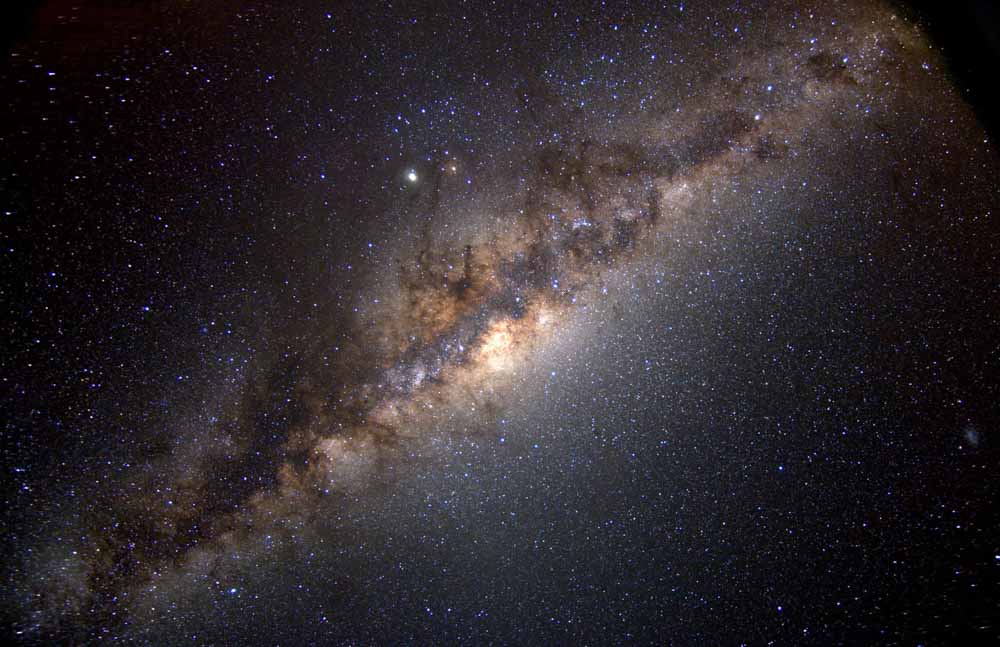
*Image: Nasa’s Science Mission Directorate
A cluster of galaxies is an astronomical structure composed of a set of galaxies that share the same gravitational center. Integrating studies in this field, a research study has discovered a cluster of 58 galaxies hidden behind the Milky Way in a zone of avoidance. The study, published in Astronomy & Astrophysics (A&A), was led by doctoral student Daniela Galdeano from the National University of San Juan (Argentina), and carried out in partnership with researchers from Chile and Brazil, including professor Rogério Riffel, faculty member of the Institute of Physics at UFRGS. The team anticipated that there would be galaxy clusters covered by the zone of avoidance of the Milky Way, however, only with the use of infrared spectroscopy could the existence of the cluster be confirmed.
Although there was an initial hypothesis, they still needed to find out how to prove it. Galdeano invited Rogério Riffel to take part in the team and carry out measurements using the technique of infrared spectroscopy. “What they needed was to determine if these galaxies are close enough to one another to interact gravitationally, that is, to be part of a cluster of galaxies, which would be an object that will ‘share’ the same gravitational center, and this can only be done with precision using spectroscopy,” he explains.
Galdeano and the team had made spectroscopic observations before (which measured the amount of radiation produced or absorbed by molecules or atomic species of interest) of the galaxies to understand how far away they were. But it was still necessary to identify the wavelengths of the lines of absorption or emission of radiation to calculate the redshift of the galaxy, that is, to measure the amount of radiation produced through the infrared.
After Riffel joined Galdeano’s research team, they selected sample galaxies to perform spectroscopy. Using this technique, Riffel identified the redshift of each of the five galaxies chosen for the measurements. With this, the researchers were able to conclude that the galaxies have a common gravitational center, forming this cluster.
A fog in the way
The big challenge was to discover whether there actually were galaxies concealed within the zone of avoidance. The cluster was found hidden behind the zone of dust close to the center of the Milky Way, where the light is blocked from the other side. Even though it is in a region that has “gaps” with less dust, the light that would allow an optical telescope to see the galaxies would be absorbed by the dust grains in the way, meaning that it would not be possible to see beyond the dust.
Riffel compares this scenario to the fog that we so often find during the winter in Rio Grande do Sul. “When there is fog in the vicinities of an airport, there are days when airplanes can’t take off, for example. There are days when we are afraid to cross the street because it is so dense. But what if we changed our glasses for temperature-vision glasses, with which you can see through an infrared spectrum? And that’s exactly what these [infrared] detectors do,” he explains.
“They were able to find this cluster by looking into a region of reduced visibility with the aid of an instrument that is less sensitive to dust and allows you to see through it”.
Rogério Riffel
For Riffel, “there is always a great scientific and cosmological value in finding objects like these. The study helps to expand the knowledge about the universe because it allows us to understand, for example, how clusters are formed”.
Collaborative research
Riffel also said that science is cooperation not competition, and for this reason he accepted Galdeano’s invitation to participate in the study. He adds that the research was proposed by Daniela Galdeano, a PHD student: the published article is based on part of her thesis, which resulted from her initiative in inviting other researchers to work with her. “The other researchers were able to take the work to a certain point, but they didn’t have experience with infrared spectroscopy, which was necessary for the next stage”, said Riffel.
“I think the important message, both for students and researchers, I can bring here is “don’t collect unanswered questions for too long.” It’s important to talk to other researchers because they might have a simpler solution to the problem you are facing.”
Rogério Riffel
For further research, Riffel reinforces the need to confirm whether all 58 galaxies are really members of the cluster by using infrared spectroscopy. He explains that these techniques are very expensive and time consuming for they are dependent on submission of a research proposal requesting observational time with a telescope. “I would make a proposal to observe a few more galaxies, ideally all 58 candidates, but that would take a lot of observing time. Then one would have to pick a few key galaxies from the group to observe if they are in fact clustered and which of them is a member of that cluster,” he adds.
Translated into English by Rafaela Alexandre de Oliveira, undergraduate student enrolled in the course “Supervised Translation Training I (English)” of the Undergraduate Program in Language and Literature, under the supervision and translation revision of Professor Elizamari R. Becker (P.h.D.) – IL/UFRGS.