
Communication | Research reflects about the imaginary built through aspects of obedience, solitude and affection in relation to domestic work
*By Geovana Benites
*First published March 16th, 2023
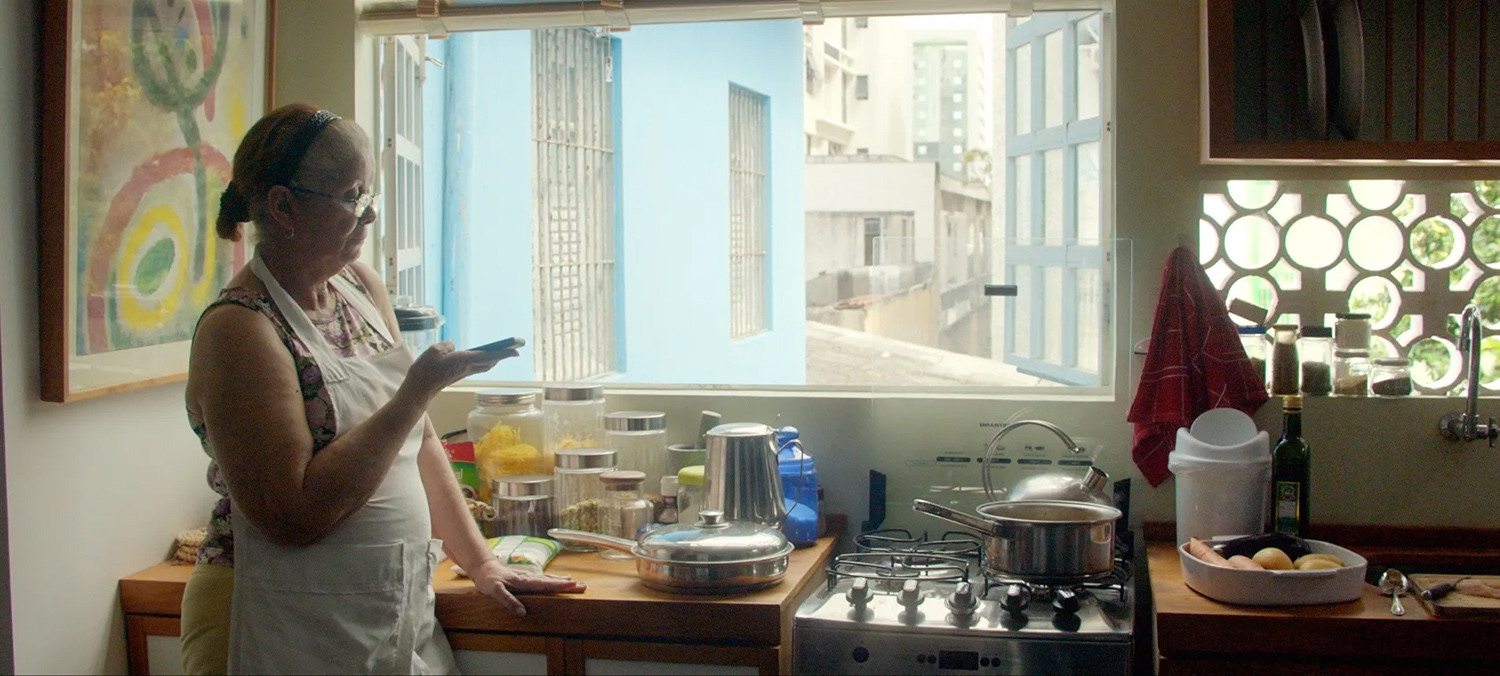
*Image: Zoraide Coleto plays Ladjane in the movie Aquarius (2016), directed by Kleber Mendonça Filho. She is a housekeeper who works in the house of the protagonist Clara, played by Sônia Braga (Reproduction)
Characters like Aunt Nastácia, from Sítio do Pica-pau Amarelo, and Val, from Que horas ela volta?, are representative of the role housekeepers play in Brazilian households, both in fiction and in real life. According to The Brazilian Institute of Geography and Statistics (IBGE), 5.7 million people work within the field of domestic work in Brazil. Based on this scenario, the researcher Kelly Demo Christ has been investigating, for her Master’s thesis in Communication, the social and symbolic contexts in which housekeepers are inserted in the Brazilian cinema.
The study, supervised by Professor Miriam de Souza Rossini, discussed plot aspects such as “starting point”, “obedience”, “disobedience”, “solitude” and “affection” in order to understand the role played by housekeepers.
The selected movies were produced after the 2000’s and had maids as secondary characters. Some of them were: Cronicamente inviável (2000), directed by Sérgio Bianchi; A partilha (2011), directed by Daniel Filho; Trabalhar cansa (2011), directed by Juliana Rojas and Marco Dutra; O som ao redor (2012) and Aquarius (2016), written and directed by Kleber Mendonça Filho; Casa grande (2015), directed by Fellipe Gamarano Barbosa; and Domingo (2018), directed by Clara Linhart and Fellipe Gamarano Barbosa. In order to make the analysis, Christ organized a cinematic corpus only with scenes in which the target-characters appear (the selected movie excerpts are available on her blog called Cinema de Porão).
Life imitates art and vice versa
When Christ was still taking her undergraduate program at the Federal University of Pelotas (UFPel), the theme “housekeepers on television” was already an interesting topic for her. The creation of the Proposed Amendment to the Constitution for domestic workers (PEC das Domésticas, in Portuguese) and the heated debates about this subject and other social problems made her think about the (in)visibility of these workers. “Sometimes they seem to be objectified as one more piece of the set, placed at the background, or often revealed as hands and arms, but rarely given faces,” says the researcher. “In the years of 2014 and 2015, movies started portraying them as protagonists, as it is the case of Que horas ela volta?, which impacted me a lot”.
Given the fact that only a few movies actually pictures housemaids as protagonists, Christ decided to widen her scope including feature films in which they are secondary characters. “If I were going to talk about domestic workers who are protagonists, I would mention one or two movies; secondary characters, on the other hand, would considerably increase sample choices, says Christ. Also, people usually don’t talk about the secondary ones as if they weren’t worth talking about, but I didn’t see it that way.”
According to Christ, secondary characters have much more to add to the symbolic representation of housekeepers in the movie industry than protagonists do. When they are protagonists, it is possible to understand all the character’s life context. This is not possible when they are secondary characters.
“When we are talking about setting, we also refer to architecture, physical spaces and the way our houses are built. A lot of times, there is a bedroom for the housekeeper located at the back of the house, as much apart from the rest of the house as if it were a type of “senzala” heritage. That is why I tackle both the social and the symbolic places precisely because of such ambiguity.”
Kelly Demo Christ
The places
Christ gathered scenes in which the characters appear and made a montage with them to analyze the housekeepers’ places and roles. The first category received the name of “starting point” because it had scenes from their first appearances in the movies. From then on, she noticed that there were a lot of scenes showing boss-employee interactions. “The way the bosses talked to their employees bothered me. It was either harsh or as silly as if they were asking a friend for a favor, and not an employee they have a professional relationship with,” she noticed. Then, Christ included such scenes in the category called “obedience” because of the recurrent times in which ‘power’ was noticeable in the narratives.
On the other hand, there was also “disobedience” as an aspect of the plot. The reason for this aspect was the times when the housekeepers used to “break” the protocols of interaction or behaved in ways far from the expected. Christ says that these are symbolic representations born from enslaving practices – common back in the Brazilian Colonial period – whose remnants are still found in contemporary film making. “It is very common for the Brazilian cinematography to have scenes where housekeepers do something “wrong” and hide it from their bosses,” says Christ. “One of the bosses gets out of the house, and the female housekeeper sleeps on the boss’ bed, wears her clothes, takes liberties with the boss’ husband, or leaves her chores unattended to go out and seek for fun, which is exactly what happens in the movie O som ao redor, for example.”
Another element that called Christ’s attention was the many scenes in which the housekeepers were seen alone. Even though the scene was being recorded with the protagonists – the families–, they only appeared quickly in the kitchen getting some food or working. Those scenes were classified as “solitude”. “Lots of these domestic workers leave their children at home completely on their own while they take care of other families’ children,” Christ explains.
On the other hand, there is also a category called “affection”, which contrasts with the “solitude” scenes and shows affective interactions between housekeepers and the families they work for which surpass the narrow limits of professionalism. “My intention in discussing closer daily interactions was finding out if there was affection between bosses or their children and maids,” says Christ. It is common in cinematography and reality for the employees to keep a personal attachment to their bosses because of their daily interaction.”
The Brazilian cinematography helps build symbolic representations about the character-types it offers to audiences. Either in the skin of protagonists or in the skin of secondary characters, housekeepers also play an important role in this aspect. Christ reflects about the increase of movies showing housekeepers as protagonists and beyond their professional life. This is the case for one of the protagonists of Marte Um (2022), directed by Gabriel Martins. She is a housekeeper, but whose story tells the audience much more than that.
Another matter observed from the montage analysis is that the housekeeper characters are built in diverse ways, even though most of them has some aspects in common, such as social class, gender and race. This finding converges with the reality of housework in Brazil, as women represent more than 92% of housekeepers, and more than 65% of them are Black women, according to the Brazilian National Household Sample Survey (PNAD/IBGE).
“I believe my research helps people look at these characters as more than just setting objects or people with no names. Many times, they are in the movies just as a symbol of the family’s status. This is crazy because they should have a name, a story, a path, just like all other characters,” concludes the researcher.
Translated into English by Vitória Ribeiro Leal, undergraduate student enrolled in the course “Supervised Translation Training I (English)” of the Undergraduate Program in Language and Literature, under the supervision and translation revision of Professor Elizamari R. Becker (P.h.D.) – IL/UFRGS.
:: Read in Portuguese:
Dissertação investiga os lugares sociais e simbólicos da empregada doméstica no cinema brasileiro