
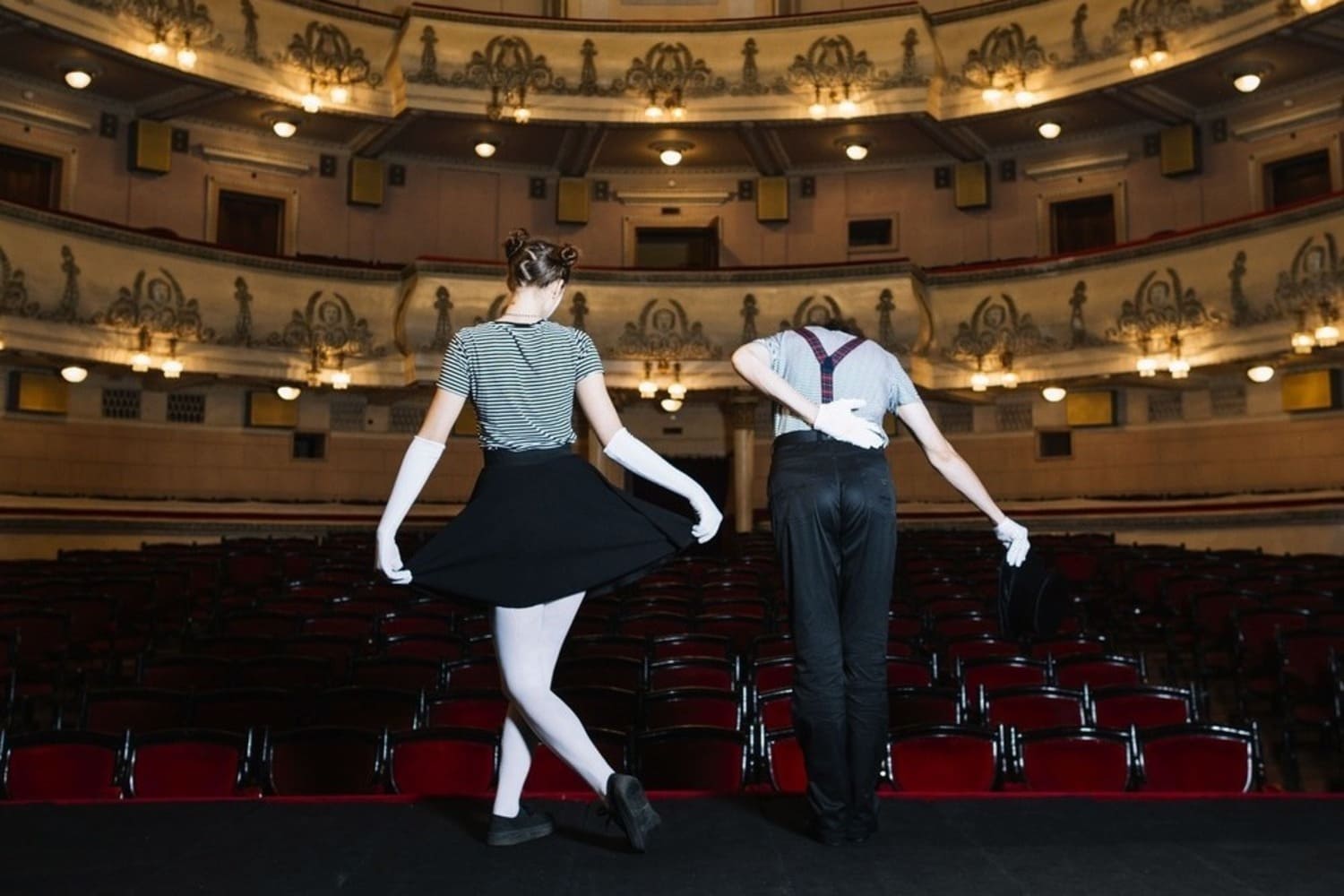
Performing Arts | Cultural incentive policies, festivals, the “S system” and box office are the main sources of revenue of the theatre groups analyzed
*By Alexandre Briozo Gomes Filho
*First published September 14, 2023
*Image: Designed by Freepik
In the last decade, the critical political changes in Brazil affected both the social and economic fields. Consequently, these changes reverberated through all the ramifications of the cultural sector. Regarding the Performing Arts, these changes were especially noticeable in theatrical shows, whose main source of subsistence consist of cultural policies through public notices and incentive laws. During this period, the theatrical scene in Porto Alegre witnessed the end of many theatre groups.
Starting from the question “who sustains the theatre?” and thinking about the remaining groups with uninterrupted activity from at least 20 years until 2019, a study from the Graduate Program of Performing Arts from UFRGS analyzed how the subsistence of these groups came about between 2010 and 2019. The author of the study, journalist and theatre critic Michele Rolim, supervised by professor Clóvis Dias Massa, used her experience as a reporter in the theatre industry during the time frame of the research to systematize financial data from an area that is still new to this kind of investigation.
In total, seven groups had their trajectories analyzed: Tribo de Atuadores Ói Nóis Aqui Traveiz; Cia. Caixa do Elefante Teatro de Bonecos; Cia. Teatro di Stravaganza; Grupo Oigalê; Cia. Gente Falante; Povo da Rua – teatrodegrupo and Cia. Lumbra. These groups have some factors in common, such as self-management, language investigation, maintenance, and stability in the artistic community. They’re also part of what researcher Heloísa Marina calls Minor Theatre, which understands the need for research and artistic language without the guidance of established standards and forms (such as musical ones), as well as the horizontal distribution of tasks and power within its organization, ignoring the direct commercial trade as its life goal and questioning the “star artist” concept.
Gathering data in a predominantly subjective field
“In Human Sciences research, we rarely focus on data,” says Rolim when specifying the quantitative-qualitative methodology of her research. One of the most heated debates in the academic field of Human Sciences is the predominance of the qualitative approach instead of the quantitative one. The first is based on subjective experiences while the second is based on numbers, metrics and mathematic calculations – which, for culture, is essential in the sense of proposing comprehensive cultural policies and better visualization of their results, as well as for research.
Finding data of payment and public notices – which should be in public domain, since they refer to public resources – was one of the challenges faced by the journalist. She had to resort to the Access to Information Law (LAI) so she could access them. “Many times, the data wasn’t online or easy to access, or even publicly disclosed,” she explains.
Besides resorting to LAI, Rolim also used alternative resources to get to the data in her study regarding the financing of the shows: she interviewed the previously mentioned groups, talked to theatre managers and used documents made available by the press. The data gathering led her to the conclusion that the financing of the shows can be represented by a pyramid – the base being the largest revenue source and the tip, the smallest. In an attempt to map how this service’s consumption occurs, Rolim was also able to determine the percentage of theatre occupation by spectators.
The study summarizes the steps of work of a theatre show in creation/conception, execution/display and fruition/response. “[These steps] happen, or should happen, supported by sources of revenue,” says Rolim. To get to this pyramid, the journalist selected the biggest performance of each group over the last decade. By detailing the trajectory of these shows, considering the steps of work, she learned that their main sources of revenue were public notices of incentive laws, festivals, the S system (which are mixed economies entities from the private sector that start with the letter S and carry out activities of public and social interest, like SESC and SESI) and box office.


“This market can’t be seen in a classic fashion, sustained by the law of supply and demand. It needs to be seen in a more systemic way, since its main revenue source comes from public policies and not box office.”
Michele Rolim
Unlike other markets with more active consumers and that demand a product or a service, the cultural market – despite also having its own customer profile – relies on government policies that create favorable conditions so that the shows can reach the public. However, this is not a formula that applies to all cases. The main source of revenue responsible for the out-of-state circulation of Porto Alegre’s analyzed groups, for example, are festivals and the S system (SESC and SESI).
The show must go on
Contrary to how it used to be in the last decade, and despite the recent end of the Coronavirus pandemic and the troubled election period, the current prospects for the subsistence of theatre shows are already better than before. In 2023 alone, the National Arts Foundation (FUNARTE) released more than ten public notices to foster the arts, highlighting cultural policies as the main source of investment in the area.
After her doctoral training period, Rolim will continue to write on her website, Agoracriticateatral.com.br, as she has been doing for the past eight years. Author of the book “What Do Curators of the Performing Arts Think”, the result of her masters’ research published by Cobogó, Michele Rolim wants to keep researching the field of Arts and following the same line of research of her doctoral dissertation but focusing on producing knowledge about cultural public policies.
Translated into English by Luísa de Figueiredo Dias, undergraduate student enrolled in the course “Supervised Translation Training II (English)” of the Undergraduate Program in Language and Literature, under the supervision and translation revision of Professor Elizamari R. Becker (P.h.D.) – IL/UFRGS.