
Sports | Records set in the 2022 finals of the Brazilian Women’s Football Championship show the public’s interest in the matches, but researchers point out the need for public policies to promote sports and reduce inequality
*By Maria Clara Centeno
*First published October 27, 2022
*Image: Carol Annes/Personal Archive
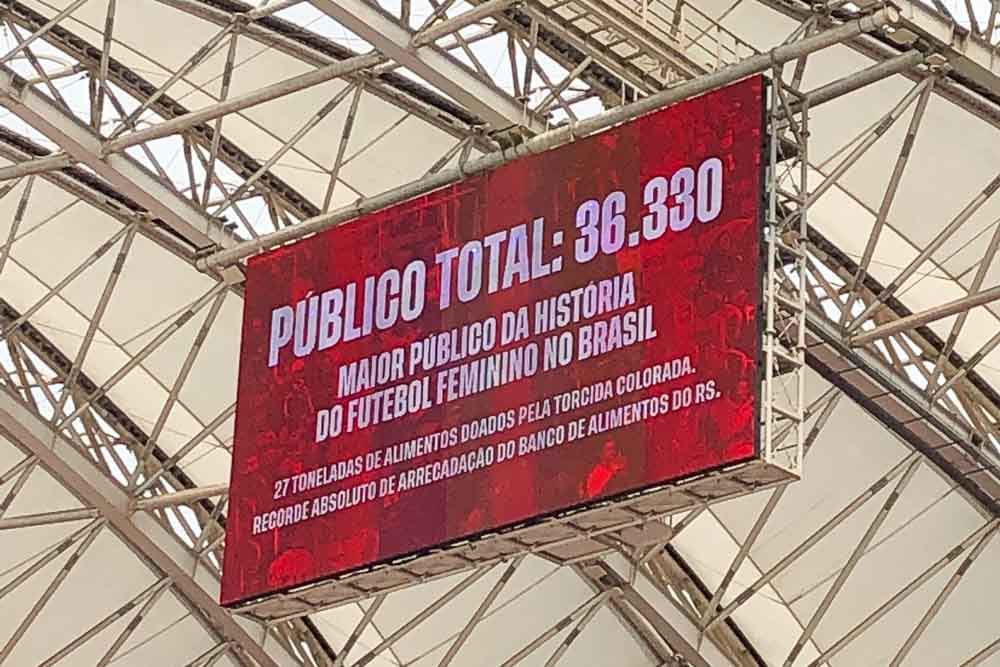
On September 18th 2022, 36.330 fans watched the match between Internacional and Corinthians in the Beira-Rio Stadium (located in Porto Alegre) — the first one in the 2022 finals of the Brazilian Women’s Football Championship. That was the highest attendance number in a women’s soccer match in Brazil until then. On the following Saturday, the day of the second encounter between the two teams, held in Neo Química Arena (located in São Paulo), a new record was established: 41.070 spectators.
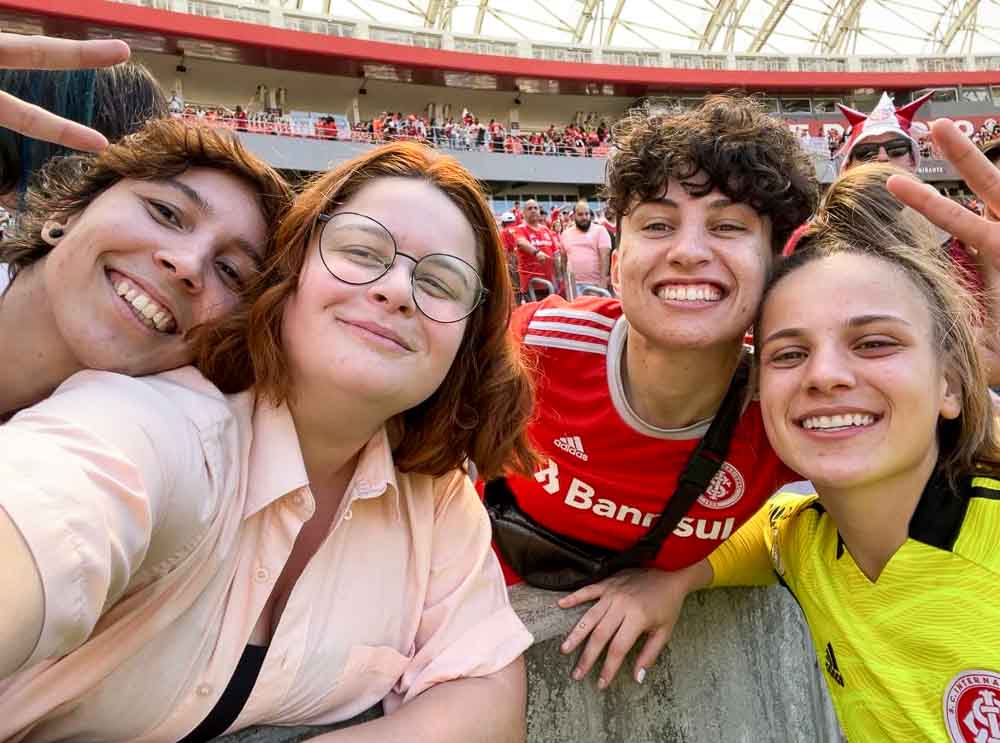
In Porto Alegre, the game ended in a 1-1 draw. At the stadium, the enthusiasm from both sides was visible: each cheered loudly at their team’s score, got excited over every match and sang songs to hype up the players. The public was diverse, with a notable number of women present.
Carolina Annes, a 25-year-old publicist, had been going to Internacional’s games (both women’s and men’s) since the beginning of that year. She was there with a group of girlfriends when the team competed with Corinthians in Porto Alegre. She says the atmosphere in a women’s football match is “friendlier” compared to men’s: “the idea is that, no matter what happens in the game, we are there to support the girls and I like that a lot.”
She also highlights how hard the Public Relation sector at Internacional works to bring more people to the game. Added to that, in her opinion, the ticket price — 1 Kilogram of non-perishable food — is also a huge contributor to boost attendance. As released by Internacional, 27 tons were donated, the greatest amount ever collected by Rio Grande do Sul’s Food Bank. In São Paulo, the tickets were priced and they generated a revenue of R$ 900,981.00, the biggest ever in a women’s football match in Brazil and in the whole Latin America.
Taiane Lima, a master’s student at the History Graduate Program at The Federal University of Santa Maria (UFSM) and a scholarship holder at the Reference Center for the Museum of Football (Centro de Referência do Museu do Futebol), fandom is to be credited with those record breakings. To her, the rivalries from men’s football tend to be transferred to women’s and this makes people more interested in the matches. Still, she points out that the two variations of the sports should not be compared, as each has their own characteristics, contexts and history.
Silvana Goellner, retired professor from The Physical Education, Physical Therapy and Dance School (ESEFID – Escola de Educação Física, Fisioterapia e Dança), says that sports rooters for women’s football are, first and foremost, football lovers in general. She points out the traditional organized fan groups that bring other fans to the games. Besides that, Taiane mentions the large number of children in these matches and explains that it is due to a lower rate of violence in comparison to men’s games, and also due to the time — the matches usually happen in the afternoon. The professor understands that these consecutive record breakings demonstrate an interest from the public in the sport. “They have deconstructed the very common notion that women’s football is uninteresting, poorly played, slow and no one enjoys watching or playing it,” she explains.
“Futebol de mulheres” (lit. women’s football) is what she calls it, as opposed to “futebol feminino” (lit. feminine football), the Portuguese term for the sport. She explains that matters of gender are not necessarily linked to biological bodies and gives examples, mentioning trans women and men: “Some people have a gender characteristic that is not the same as the one identified in their birth gender. In this sense, feminine isn’t only about women, we may also find cultural feminine characteristics in men’s bodies”. According to her, the expression used [de mulheres] (women’s) makes all women the protagonists of the sport, and breaks the idea that feminine is associated with “beauty and maternal femininity”.
“There are multiple ways of being a woman, so when I use the expression “futebol de mulheres” (women’s football) it is exactly meant to highlight their protagonism, that they are women who are making football happen.”
Silvana Goellner
To Silvana, “what was missing for women’s football was opportunity, so, as they started playing in big stadiums, we are seeing these record breakings”. Most games are not held in these big arenas, but in other places, like training centers, which makes it harder for the public to attend.
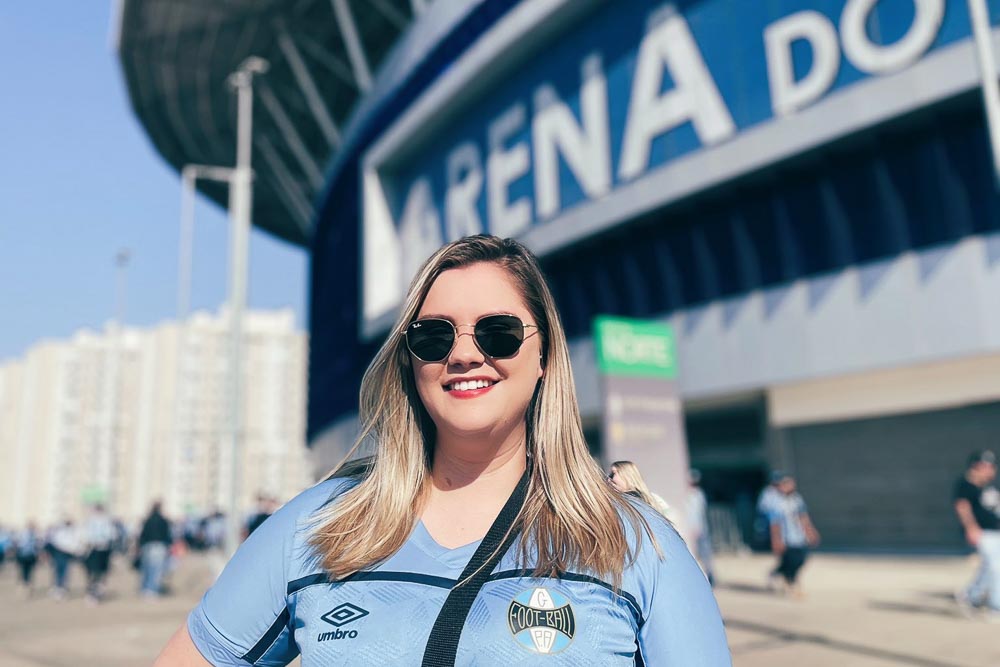
That’s the case for Marina da Rosa Staudt, journalist and administrator of @gremioffeminino on Instagram. She has been going to Grêmio’s women’s football games since 2018 and says that, lately, she hasn’t been attending the matches so frequently, because her beloved team plays at Estádio Vieirão, in Gravataí, 25 km from Arena, Gremio’s stadium. Besides the distance, the timing has also been a dealbreaker, as the games usually happen in the afternoon on weekdays.
History of women’s football in Brazil
“I think we are taking baby steps into a more effective restructuring of women’s football,” says Silvana. The sport was forbidden in Brazil by Article 54, Law Nº 3.199, in 1941: “Women will not be allowed to practice any sport incompatible with the conditions of their nature[…]”. The regulation came only 42 years after. So, legally, the sport is fairly new in Brazil, according to Silvana.
“The sport was regulated in 1983, but it went through highs and lows. When there are big events like the World Cup or the Olympics, women’s soccer gets a little more visibility, a little more investment, usually due to the national team’s success”
Silvana Goellner
Silvana sees the recent decisions made by FIFA, Conmebol (South American Confederation of Football) and CBF (Brazilian Confederation of Football) as “inducing policies”. In 2016, FIFA included the word “gender” in their rules and started to implement gender equality policies. In the same year, Conmebol determined that, in order to take part in the continental male competitions, all teams must have a female team starting in 2019. CBF has also implemented this rule for teams in the main division of the Brazilian football league.
Currently, the championships promoted by CBF are: Brazilian Women’s League A1, Brazilian Women’s League A2 and youth sports (U16, U17, U18, U20). The state federations promote competitions within their states, like the Gaúcho Women’s Championship, in the state of Rio Grande do Sul. Moreover, there are also the competitions that happen in the South American continent, promoted by Conmebol, like the Women’s Libertadores and the Women’s American Cup. Worldwide, there is the Women’s World Cup, organized by FIFA.
In order to give the sport conditions to develop, Silvana says that public promotion policies, promotion of youth sports and the establishment of specific departments for women’s football in confederations and federations are fundamental. Beyond that, she believes in the importance of women representativity in other areas related to the sport, such as in the press and in the referee boards.
(Photo: Carol Annes/ Personal Archive)
Translated into English by Guilherme Faller, undergraduate student enrolled in the course “Supervised Translation Training II (English)” of the Undergraduate Program in Language and Literature, under the supervision and translation revision of Professor Elizamari R. Becker (P.h.D.) – IL/UFRGS.