

Resistance | Members highlight the challenges of preserving the history of the oldest Black club in Brazil, founded sixteen years before the abolition of slavery
*By Leticia Pasuch
*First published November 17th, 2022
*Image: Gustavo Assarian
On December 31, 1872, the Beneficent and Cultural Society Floresta Aurora was founded by freed Black individuals who recognized the need to obtain resources, primarily to provide a decent resting place for deceased slaves. At the time, these individuals used to be buried in shallow graves that, after a few days, would be exposed by the wind or soaked by the rain; soon, the bodies would be visible and devoured by animals. The goal was also to assist the orphaned children and widows left behind by these enslaved individuals. Like other Black social clubs scattered throughout Brazil, the association is now known in the history of the Black movement as spaces for mutual assistance, support, sociability, and advocacy.
The first headquarters of the association was located between Aurora Street – now Cristóvão Colombo – and Barros Cassal, even before the Áurea Law, which, in 1888, officially ended slavery. At the time of its founding, there was still a significant proportion of enslaved Black people; thus, the club originated with the perspective of overseeing the abolitionist struggle and taking a stance regarding Black freedom, remarks José Rivair Macedo, a professor in the Department of History at UFRGS and one of the mediators of the event held in September at UFRGS celebrating the club’s 150 years.
In the post-abolition period, Floresta Aurora became a channel and reference point for people “of color,” as they were named at the time, to hold their meetings, albeit covertly. Although, by the turn of the 19th to the 20th century, there had already been mentions of the club in the Porto Alegre newspaper O Exemplo – well-known as the Black press of the time and with members among the Floresta Aurora ranks –, the club’s first official record dates back to 1917 when Floresta Aurora was presented as a beneficent and recreational society.
Since its foundation, the club has had a total of six headquarters located in different parts of the capital of Rio Grande do Sul. The second headquarters was on José do Patrocínio Street. Later, it was on Lima e Silva Street, which was highly frequented and remained there for years. The shortest-lived headquarters was in the Hípica neighborhood. Due to political reasons, there was a need to move to Curupaiti Street, in the Cristal neighborhood – reportedly at the peak of young groups and famous parties. Currently, the association is located on Afonso Lourenço Mariante Road, in Belém Velho neighborhood. With 200 meters of native forest, the club features a swimming pool, a sports court, a lounge, and an administrative area.
The initial addresses were in neighborhoods that are now considered upscale in the city, and over time, the club gradually moved to the outskirts. Besides complaints from neighbors due to noise and movement, real estate speculation also played a significant role in these changes. However, according to José Rivair, other explanations lie in systemic racism, gentrification, and segregation. “There’s a process, as with other Black spaces in Porto Alegre, of exclusion, but it has never managed to empty the club or prevent it from remaining in the prominent and proud position it holds,” he adds.
Paths of Affection
For Floresta Aurora members, the bonds forged in the club weave strong and enduring affections. This is what Maria Eunice da Silva, a lawyer who joined Floresta Aurora in 1977 at the invitation of her friend and former club president Antônio Carlos Côrtes, recounts. For many years, she was a council member in the Society, and she also served on the board. In 2010, she became the first – and, to this day, the only – female president of the club.
She assumed leadership during a difficult period for the Society when legal issues threatened the loss of its headquarters. “I felt responsible. ‘What if I lose this headquarters?’ I thought. But it was precisely during this tenure that I acquired this beautiful headquarters, it was glorious,” she says, referring to the current address in Belém Velho neighborhood.
Now a deliberative council member of the club, she always recalls what she heard from one of the club’s presidents: that the Black people who founded the society in 1872 couldn’t gather, yet they created the society; and that now, despite all the imposed difficulties, there is a freedom that did not exist then. “He used to say, ‘we have an obligation to our ancestors.’ We have a commitment to them to move forward; it’s an inheritance they left us.”
“I don’t see myself in any other society but Floresta Aurora. If freed Blacks fought and achieved, I, free and educated like many other Black people, must be there. I feel a lot of energy to carry on this work.”
Maria Eunice da Silva
José Flávio Rocha Silveira, honorary president of the association and one of the oldest members, affirms that his relationship with the club is one of passion. Coming from the Prontidão Satellite Association, he was invited to Floresta Aurora in the early 1960s. It was there that he met his wife, Valmira Teixeira Silveira, in 1967. “We had mutual friends, and one of them was the cupid, Sara, who was very close to me and her and started to mediate,” he recalls. They attended meetings and dances together and got married in 1975. They had four children and are nearing their 50th wedding anniversary today.
Social and Cultural Benchmark
A reference for the Black community, the club hosted many important people over the years, such as the former governor Alceu Collares, and it also honored personalities, like João Cândido, leader of the Revolt of the Whip. Former President Fernando Henrique Cardoso, while writing his thesis in 1961, visited the club as part of his research.
Over the years, both Floresta Aurora and other cultural entities have played a role beyond sheltering the Black community, reconstituting themselves to meet the members’ interests. Between 1963 and 1964, their youth members used to gather at the Esquina Democrática, located downtown. “We met there, but Floresta Aurora was always open for us to continue our conversations, schedule parties, do something for our youth community,” recalls Jaime Alves Núncia, a former club associate.
One of the main activities of society members was the Teatro Novo group, with a cast composed solely of Black individuals and that maintained partnerships with other Black societies. The plays always revolved around issues of Blackness – one of the most emblematic was Orfeu da Conceição, by Vinícius de Morais, performed at Theatro São Pedro. There were theatrical performances during the so-called “Week of the Black,” in reference to May 13, as well as displays of samba schools and performances of small plays. From Monday to Monday, the annex of the theater was occupied for rehearsals – even going beyond the allocated time. “The person responsible for closing the space always had to ‘chase us away’ to free the space,” recalls Jaime, who was actively involved in the group.
Jaime remembers hearing a journalist ask, on the last Friday of the theater presentation, where had all those Black people – who were not seen in Porto Alegre – been hiding. “They didn’t know that there were these Black people with so much theatrical ability to perform such a beautiful play. They said they wanted more,” he recalls. The group’s presentations appeared in reports of the newspapers Folha da Manhã and Folha da Tarde. The theater group lasted until 1972, but many relationships continue to this day. “It’s already been 60 years of friendship,” he reminisces.
Some members of the theater group were also head committee of the Palmares Group, which played a leading role in establishing Black Consciousness Week. Triggered by the discontentment with the May 13th date, the movement, comprised of politically educated individuals, was launched at the Clube Náutico Marcílio Dias, another Black social club in the capital city of Porto Alegre, during a time of significant political mobilization in the country.
Key figures in the Rio Grande do Sul Black movement were from the Floresta Aurora community. An example is Oliveira Silveira, a prominent participant in the movement, and Antônio Carlos Côrtes, who became the association’s president. “One can see how the history of the Floresta Aurora Society mirrors the history of the organization of the Black movement in Brazil and holds a position of prominence in this history of resistance,” notes José Rivair.

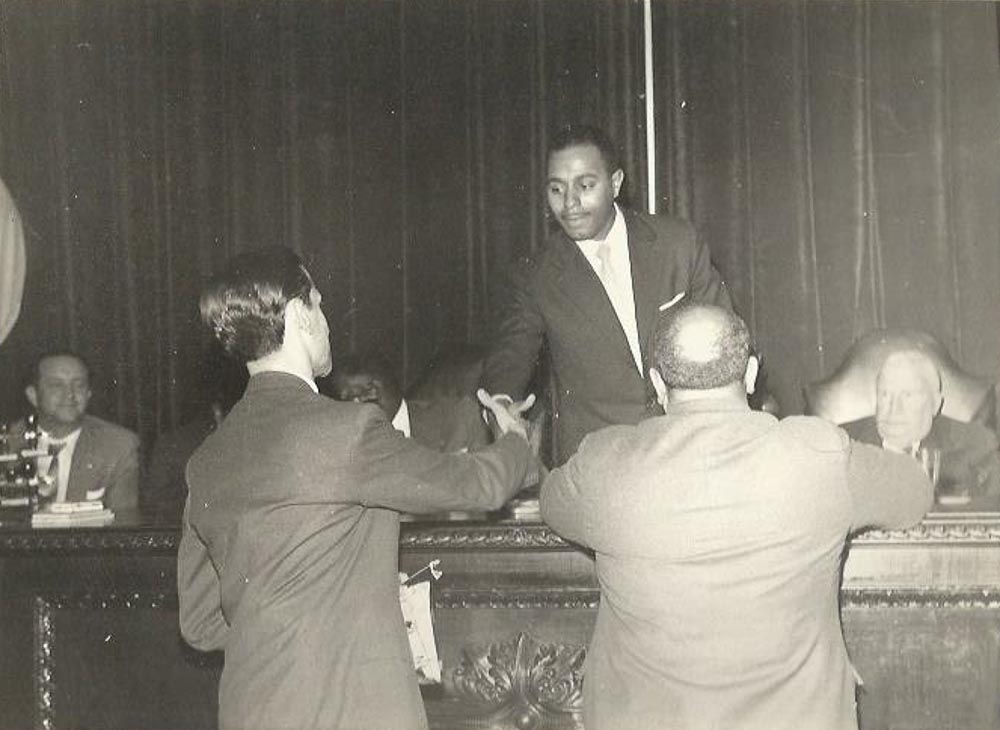

Dances and Sambas
The Society invested heavily in balls. These dance events, regularly attended even during the weekdays, filled the nights in a vibrant atmosphere. The Magia Negra group was the main attraction at the discos in the headquarters on Curupaiti Street in the 1970s, featuring predominantly Black Music. The days of celebration filled the house, the bar was in full swing, the workforce had to be reinforced, and invitations were highly sought after.
Debutante balls were also frequent. They were an occasion for integration with other Black communities, whose representatives were invited. At the headquarters, girls attended courses on modeling and etiquette for the occasion. Even the press appeared to cover the celebrated activity. “My oldest daughter, Flávia, debuted in the Floresta Aurora Society,” recalls José Flávio, proud that he escorted her to the ball. The attire for the day was formal. “I still have my tuxedo to this day,” he reminisces.
The famous “freshmen’s party” was also organized by the youth members to celebrate the arrival of freshmen at the university. There was a parade in the street that led to the society, culminating in a party.
Sociedade Floresta Aurora also holds an important chapter in the history of Porto Alegre’s Carnival. In 1967, the club participated in the foundation of the famous “Os Intocáveis” block, of which José Flávio was one of the founders. Its section paraded from João Pessoa Avenue to Loureiro da Silva. Many celebrities associated with Carnival in Rio Grande do Sul were linked to Floresta Aurora, such as the composer Wilson Ney.
Maria Eunice was the standard-bearer at the carnival street parades between 1980 and 1982, during the block’s last years of intense activity. It still endures today with active participation in the carnival parade organized in Atlântida Sul, in the municipality of Osório. “There was a hiatus due to the pandemic, but we’re already preparing to participate in next year’s celebration, which is still very much a family affair,” says José Flávio.
Past, Present, and Future
After so many years of history, the club still faces significant challenges. One is preserving its future by attracting new members, especially young people. “Our members today are older; there’s little movement from the youth,” says José Flávio. Another challenge is preserving the heritage: the members submitted a project for organizing, cataloging, and maintaining the collection to the State Department of Culture but their submission ended up on the reserve list due to a lack of resources. “As a member, I feel obliged to collaborate with its preservation,” says Nereidy Alves, a lawyer, cultural producer, and one of the project’s organizers.
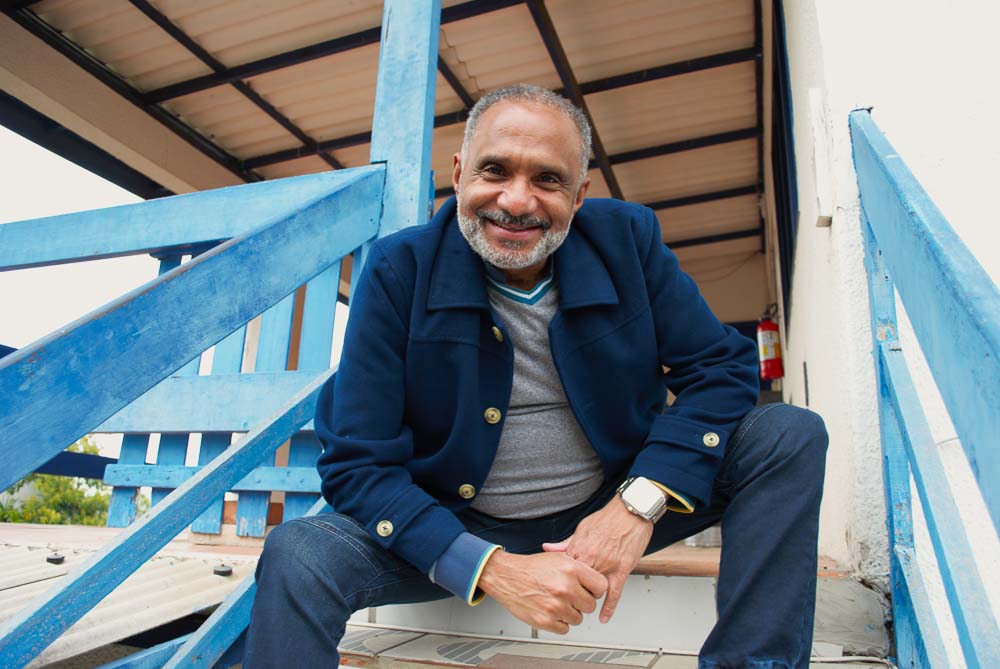
During the COVID-19 pandemic, Floresta Aurora Society kept its doors closed. Besides the loss of members, the number of associates decreased. “There was a time when we had only 150 members, but they paid regularly, month after month,” says Gilmar Afrausino, the current president of the society.
Despite all this, 2022 was a busy year for the institution. Along with the return to in-person activities, the agenda was filled with events to celebrate the 150th anniversary of the entity. One of the most important was held at UFRGS: the international seminar “Black Social Clubs: Experiences, Memories, History, and Heritage.” Held from September 27th to 29th at the Salão de Atos and on the 30th at the Society, it brought together researchers, club movement activists, and association attendees.
José Rivair was part of the cultural committee for the 150th anniversary and coordinated the seminar developed by the Department of Education and Social Development (DEDS) of the Division of Community Outreach (UFRGS) with the support of the Federal University of Pampa (UNIPAMPA). “An event as significant and important as the sesquicentennial of Floresta Aurora inevitably concerns us,” says the professor.
A memory book was also organized for the sesquicentennial. The record of one of the walls of the club’s headquarters illustrates the cover of the book, named “Floresta Aurora, 150 Years of History,” officially launched on November 11th at the Porto Alegre Book Fair.
Jaime is resolute in recalling what is celebrated in these 150 years. “It celebrates the festival of freedom,” he says. With a choked voice and teary eyes, Gilmar expresses respect for the founding generation. “I am the president, but I have to acknowledge that those people before me did a lot for Floresta. Many were slaves who gathered in the late afternoon to play music, and talk. And they founded it with the purpose of helping their fellows who were left without assistance. We must have a lot of respect, even if not everything is wonderful today,” he says.
“Floresta Aurora is a mirror for the Black society in Rio Grande do Sul and beyond. We are a reference, and we are also resistance. We know there’s a barrier to any Black entity that might stand out in the state.”
Gilmar Afrausino


Translated into English by Fernanda Tavares Pinto, undergraduate student enrolled in the course Supervised Translation Training II of the Undergraduate Program in Language and Literature, under the supervision and translation revision of Professor Elizamari R. Becker (P.h.D.) – IL/UFRGS.