
Social Science | Research analyzed articles published by UFRGS Journal between 2008 and 2019 to think out the public and organizational communication processes
*By Gabhriel Giordani
*First published September 29th, 2022
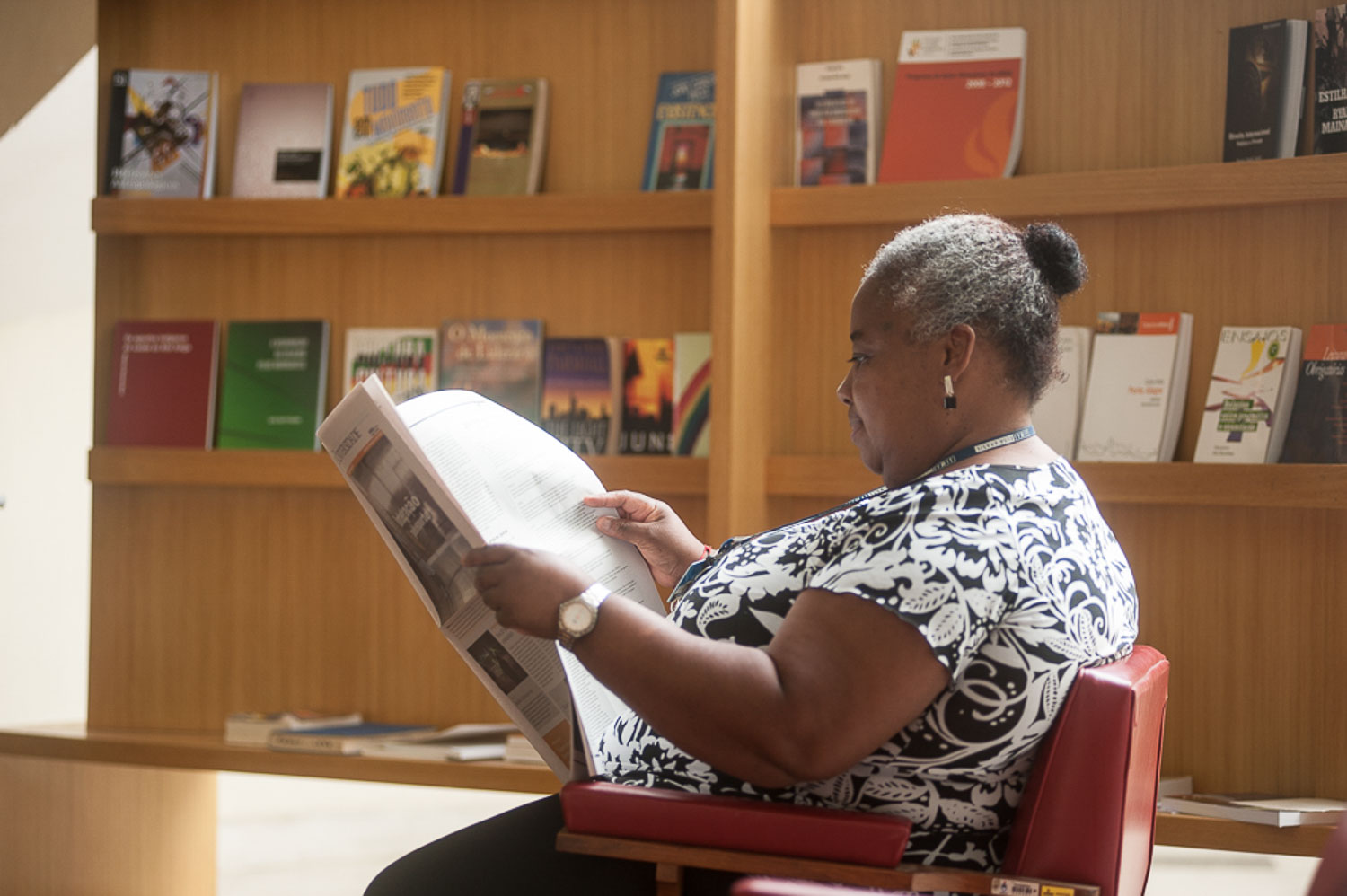
*Photo: Flávio Dutra/JU Archive
In her course completion work, Journalism student Isabel Link Gomes, from the Communication and Information undergraduate program, analyzed how the discourse adopted by the UFRGS Journal impacts the way the public – both internal and external – perceives the institution. To achieve her aim, Gomes classified the articles she studied into five categories: (1) “Institution of excellence”, (2) “Agent of transformation”; (3) “Professional trainer”; (4) “Organization in dialogue with the community”; and (5) “Organization under threat”. The analysis comprised 12 articles published in the printed version of the Journal between January 2008 to December 2019, using one month from each year.
Throughout the analysis, the author sought to identify the stories chosen by the Journal, as well as the similarity of characteristics between these stories. She also reflected on the processes of public and organizational communication involved in the publication’s activities. In the course of her work, Gomes looked at the editorial principles of the Journal, the themes it explored, and its relationship with the institution to which it is affiliated.
Gomes says that, regarding the selection of the texts to be studied, she was careful enough to always try to identify in which context the main stories of each issue were inserted, since some of them regarded external events that had an impact on the University – in other words, they were not actions or events promoted by UFRGS itself. “It was interesting to see how each story was covered and received special focus during that period [of funding cuts],” she explains.
Her findings point to the fact that the Journal aims to build among the public a specific image of the university, that is, that UFRGS is an institution of excellence, a space of intense connection with the society in which it operates. Gomes emphasizes that not all articles presented topics directly related to UFRGS, but even in those there were still elements that contributed to the construction of this image.
The categories of each issue
The categories “Institution of excellence” and “Agent of transformation” were identified in half of the 12 stories Gomes studied. This reinforces the idea that the institution is a space for problem-solving and decision-making. For the category “Professional trainer”, she identified 3 stories that recognized UFRGS as a center that produces professionals of excellence and with a clear aptitude for the area they studied. The fourth category, “Organization in dialogue with the community”, was identified in 3 stories. About the latter, Gomes points out the importance of the publication as a means of “accountability” to society, once again establishing a connection between academia and the community.
“There are essential activities being developed alongside communities of Porto Alegre and the metropolitan region, but few of us know they come from UFRGS. Even we, who study here, don’t know them. And if this is the case with us, what about people from outside the academia, who are precisely the ones truly contributing [to the funding]”.
Isabel Linck Gomes
“Who are these people? And why don’t they know that, somehow, UFRGS is the one helping them? I think the journal has always done what it can to show exactly that,” she adds.
Finally, the category “Organization under threat”, which aimed to understand how the publication brings to light the weak points of the institution, was found in 2 articles. In the first, the story was about budgetary cuts during Michel Temer’s 2017 presidential administration. The second story was an interview conducted in 2018 with Rui Oppermann and Jane Tutikian – President and Vice-President of UFRGS at the time –, in which they spoke about what could be expected from the relationship between the institution and the new president of Brazil, Jair Bolsonaro.
Gomes stresses how important it is that future research be developed to understand how readers perceive the discourse propagated by UFRGS Journal. “This would be a master’s or a doctoral research project, to establish a dialogue with this work, which was made with the limitations of a final paper,” she explains, since her work looked only to the Journal, and excluded its reception.
Period of formation
Gomes was an intern at UFRGS Journal throughout 2018. During this year, she was able to get an inside look at the Journal production process in a turbulent election year. She says that her research was the first to analyze how the editorial personnel behaved. At a time of political uncertainty and threats of public budgetary cuts to education, she says that the publication took a firm stance against many government decisions.
“I saw a newspaper playing an exemplary role in showing what was being done not only here, but at other federal universities as well”.
Isabel Link Gomes
“This defense of public education was something I took with me with great respect for UFRGS Journal. I knew that, from this experience, I would want to conduct a study about the Journal,” she concludes.
Translated into English by Isabel Cony, undergraduate student enrolled in the course “Supervised Translation Training II (English)” of the Undergraduate Program in Language and Literature, under the supervision and translation revision of Professor Elizamari R. Becker (P.h.D.) – IL/UFRGS.