

Ethnic-racial relations | A reflection of the organization of the Black population in the state, the anti-racist press dates to the 19th century with the periodical O Exemplo and extends to the notable experience of Tição magazine
*By Rodrigo Flores
*First published June 15th, 2023
*Image: Museum Collection/UFRGS
Porto Alegre, Sunday, December 11, 1892. “Our program is simple, and we can write it down in two words: the defense of our class and the improvement of our mediocre knowledge.” This was how O Exemplo was presented in its inaugural text, as the first black newspaper in Rio Grande do Sul. Despite the irony, the authors had their objectives and capabilities well defined: “We must show to society that we also have a brain that develops according to the number of subjects we study”, in resistance to the “doctrinaires who judge people by the color of their skin”.
The periodical featured articles such as “Brutality”, exposing police violence against the innocent population, accompanied by satirical poems. Its early editions are a mix of literary journalism with criticism and denunciation. The idea for the periodical originated in a barbershop on Rua da Praia, at Salão Cilixto (where a supermarket stands today), a place that served as a meeting point and a living space. The regulars, mostly Black men who already knew each other from other associations such as clubs and fraternities, discussed their position in society. “They realized that something was bothering them: despite the establishment of the Republic, the abolition of slavery, and a law declaring everyone was equal, racism still restricted the citizenship of educated and socially well-placed individuals,” says Melina Perussato, a professor at the Faculty of Education and coordinator of the Black Educator Press Project (PINE).
O Exemplo is considered the first sample of Black press in the state. While there may be previous periodicals that could make this claim, tracing their origins is no easy task. Mateus Marçal, who holds a master’s degree in Literary Theory and is a member of Pine, points out the difficulty of determining whether a work is by a Black author if there is no explicit social marker in the text or another source of information about authorship.
The Museum of Communication Hipólito José da Costa houses a collection of Black newspapers from the state. The oldest copy, dating back to 1886, predates the abolition of slavery during the empire. Known as O Judas, it is accompanied by other publications, many of which had brief lifespans, featuring provocative titles and acerbic content.
These newspapers did not emerge by chance, they were part of a historical context of Black associations dating back to the 18th century. Professor Perussato explains that for a long time, it was forbidden for Black people to gather or form any kind of association. The church was one of the few legal ways to do this. One of the earliest examples of such initiatives was the Irmandade do Rosário (Brotherhood of the Rosary), in Viamão, which stated in its 1756 engagement letter: ‘The Brothers of the Brotherhood of Our Lady of the Rosary is composed of both slaves and free people, and whites from the parish of Our Lady of the Conception of Viamão.”
A member of Pine, Estela Ferreira, who also holds a master’s degree in History, explains that with the abolition of slavery and the establishment of the Republic, Black social clubs began to emerge.
“They became a form of resistance and socialization for Black people. Through this socialization, they were able to strengthen bonds, share knowledge, and address issues that found their way into the Black press.”
Estela Ferreira
In this cultural melting pot, Black periodicals emerged from the efforts of individuals who had lived and interacted within these diverse spaces. “It is quite common to see the Black press organizing events in these clubs. These are spaces for socializing and creating bonds. The newspaper published what happened: the debates, the issues that would often be restricted to the physical space,” adds Ferreira.
Organization and proposal
Perussato explains that, in Brazilian society, race and class are intertwined; you cannot consider them in isolation. In the early 20th century, the newspaper O Exemplo closely aligned with the socialist workers’ movement, particularly with the dominant anarchist movement at the time. Prominent figures such as Tácito Pires, the first president of the Liga Operária Internacional (International Workers’ League), and Cristiano Fettermann, a significant anarchist figure from Porto Alegre, contributed to the newspaper. This shift marked an editorial transformation, making the newspaper’s objectives explicit: eradicating illiteracy and combating racism.
Initially, the idea was for the government to respond to the denunciations. However, the newspaper’s members soon realized that the state’s inaction was, in fact, its response. As a result, the newspaper embarked on more ambitious projects aimed at fostering social transformation. They initiated the creation of a night school project, staffed by ‘teachers from our community,’ to provide education for those who could not attend daytime classes. Additionally, the newspaper’s members proposed establishing an asylum for Black orphans who faced discrimination from existing institutions. While these projects never fully materialized, the newspaper maintained its unwavering editorial stance until the very end.
The final edition of O Exemplo was published on January 2, 1930. After 37 years of activity – with pauses, financial challenges, and printing difficulties, among other setbacks – the newspaper reached its end. Production costs were sustained through advertising and subscriptions, but the economic crisis of 1929 dealt a blow that could not be overcome. This marked the conclusion of the main Black journalism experiments in Rio Grande do Sul up to that point, leaving a void in the genre that would persist for nearly five decades.
Over time, society changes, and so do the methods of organization. Traditional clubs and fraternities, which once played pivotal roles, are gradually replaced by other forms of advocacy, such as labor unions and social movements. Consequently, communication is also modified. Back in the 1970s, during the period of dictatorship, the alternative press emerged nationwide, defying censorship.
Critical, satirical, and denunciatory newspapers and magazines sprang up as a form of resistance. In this cultural melting pot, inspired by movements like the Black Panthers in the US and the fight for African independence, especially in former Portuguese colonies, a collective of Black journalists and activists based in Porto Alegre decided to establish Tição magazine.


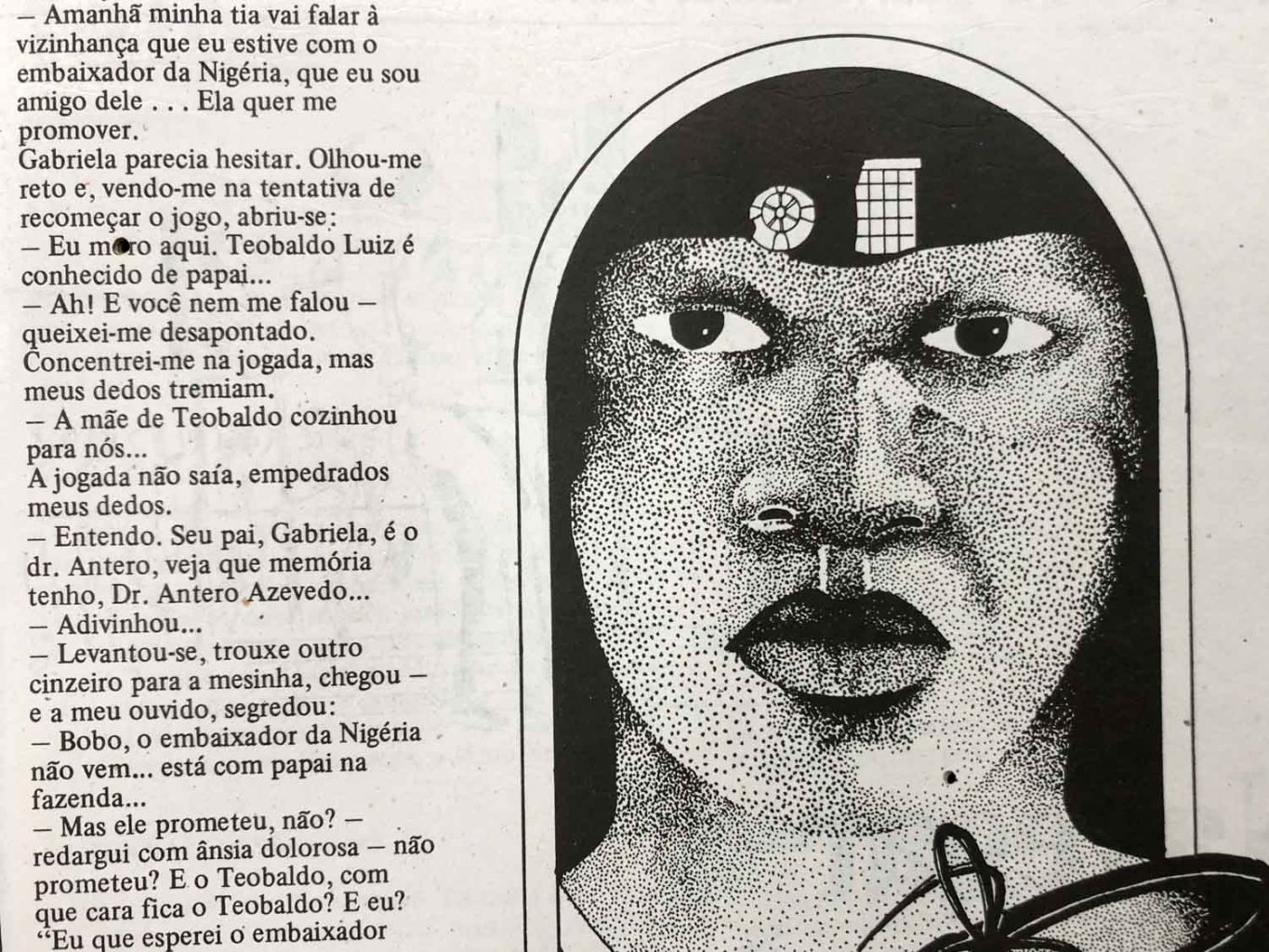
First image: Cover of Tição magazine.
Second image: Cover of the inaugural edition of Tição magazine.
Third image: An excerpt of an article published in Tição.
Relevance of the agendas
In March 1978, the inaugural editorial of the first edition stated: ‘TIÇÃO aims to engage with the Black community, not only in Porto Alegre, but across the nation, using straightforward language while striving to heighten racial, social, and cultural awareness’. The magazine was founded and published in Porto Alegre with two editions – the second in 1979 – and a third in newspaper format. It was a milestone in the Black press of Rio Grande do Sul.
Tição was founded by Emilio Chagas, Vera Daisy Barcellos, Jeanice Dias Ramos, and Jorge Freitas, all journalists. Ramos, who is currently the director of Sindjors (Union of Professional Journalists of Rio Grande do Sul), reminisces: “We aimed to unite all Black journalists in the state of Rio Grande do Sul.” The project attracted more participants when sociologist Edilson Nabarro and activist Walter Carneiro joined the editorial team. Oliveira Silveira, a poet and the founder of the Palmares Group, a movement dedicated to reasserting November 20 as Black Awareness Day, also joined them.
Chagas pointed out that the primary challenges included the magazine’s funding and distribution.
“It was a magazine published during the period of dictatorship, with a primary focus on addressing issues such as racism and the status of women. Very few people showed interest in reading it; only the Black community embraced its message. We financed the [publication] ourselves and distributed it in newsstands, bars, concerts, clubs, and even in the most remote corners of the city”.
Emilio Chagas
There were also practical challenges in journalistic production. “The agenda meetings were monumental, with many people coming together to make decisions,” Ramos recalls. Additionally, the magazine only released two editions, a year apart, and later one issue in newspaper format.
Despite its discontinuation, Tição lives on in our memories. “If you consider it, the agendas remain pertinent today, they are still in the collective consciousness of the Black population,” emphasizes Ramos. “We still receive letters to this day,” she adds, underscoring the need to “Bring Tição back!”
When we revisit these periodicals, what stands out is the enduring relevance of the subjects they addressed, namely the condemnation of racism, police brutality, and the marginalization of Black individuals from various spaces. The abolition of slavery did not eradicate the country’s chronic issue of inequality. What was written on paper does not mirror reality. These problems still permeate all facets of Brazilian society.
Translated into English by Pedro Henrique Marques Sieburger, undergraduate student enrolled in the course “Supervised Translation Training II (English)” of the Undergraduate Program in Language and Literature, under the supervision and translation revision of Professor Márcia Montenegro Velho (M.A.) – IL/UFRGS.