
Bioethics | Due to the technical advances, the improvement of practices involving in vitro techniques and computer simulations tends to reduce the living beings experimentation need. Until then, strict legislation and the action of commissions and committees seek to ensure adequate care and the minimization of suffering
*By Simone Dias Marques
*First published August 3rd 2023
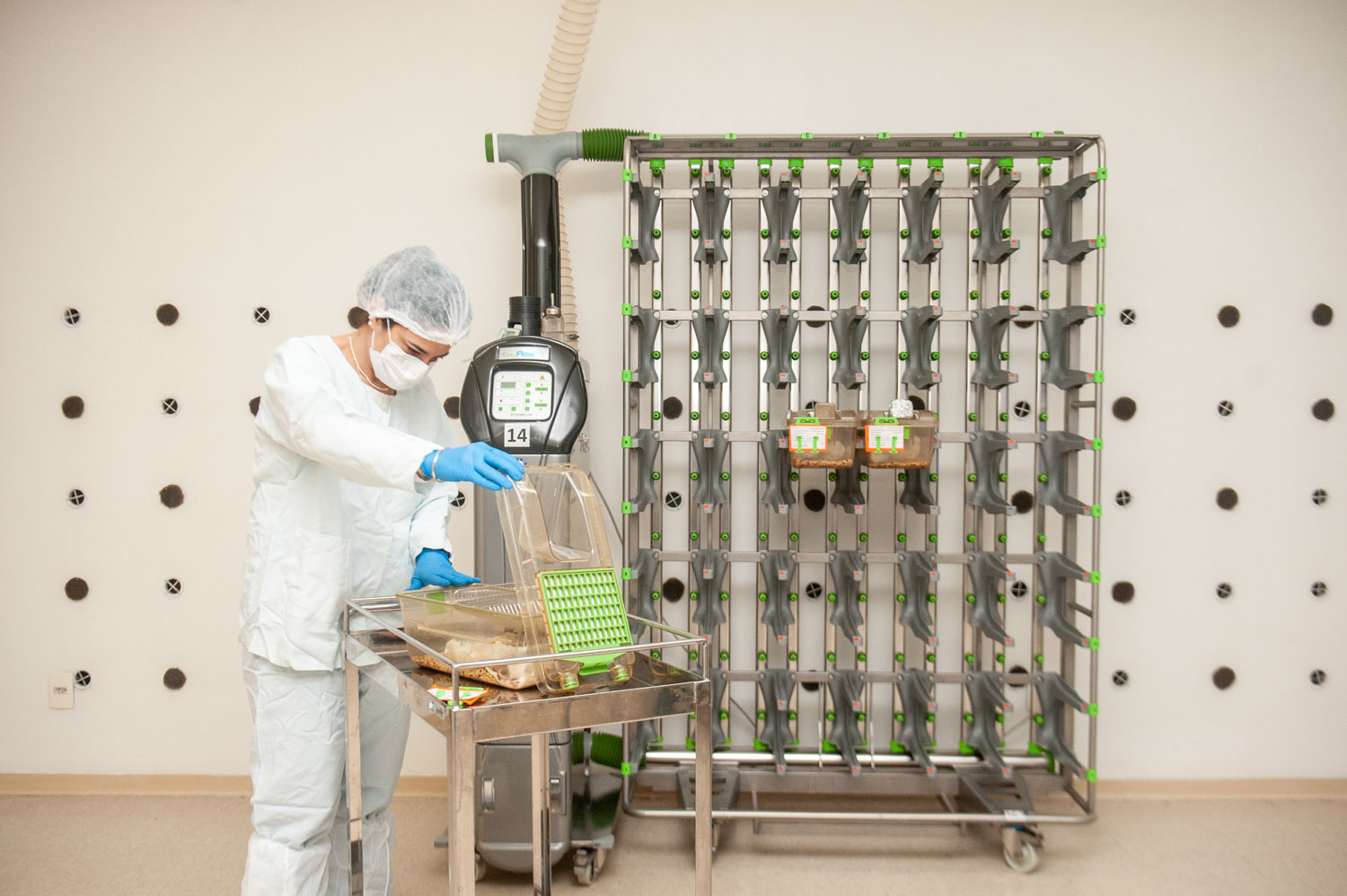
*Photo: Fernanda Bastos de Mello, veterinarian and technical responsible for CREAL (Center of Reproduction and Experimentation of the Laboratory’s Animals), at UFRGS, she analyzes mice used in research work. The access to this area requires the use of PPE (Personal Protective Equipment) and environmental quality control procedures (Flávio Dutra/JU)
The use of animals for research and tests has declined substantially over the past two decades, mainly due to the increased use of alternative models. But the ethical controversies still involve scientific, philosophical, moral, legal and complex questions. JU (The Journal of The University) listened to UFRGS scientists and dignitaries ahead of the divisions responsible for these practices, providing us with a current overview about the advances that could change this situation in the future.
According to the People for the Ethical Treatment of Animals (PETA) and the Humane Society International (HSI), it is estimated that nowadays more than 115 million animals worldwide die in laboratory experiments every year.
But, because only a small number of countries collects and publishes data on the use of animals for testing and research, this exact number is unknown.
For example, in the United States, up to 90% of animals used in laboratories (rats, mice, birds, fish, amphibians, reptiles, and invertebrates) are excluded from these official statistics, what means that the numbers published by the US Department of Agriculture are underestimated.
In Brazil, the guidelines for the use of animals for scientific research purposes are established by the Arouca Law (Law nr. 11,794/2008). Inspired by international principles of animal welfare and ethics in experimentations, this legislation establishes that the use of animals in research experimentation must be justified by their scientific relevance and can only be carried out when there are no viable alternatives.
Furthermore, the Brazilian law imposes additional requirements, such as prior authorization of competent entities, creation of ethics committees in research responsible for the evaluation of experimental protocols and effective actions to minimize pain, stress, and discomfort for the animals.
The organ in charge of setting standards and guidelines for the ethical use of animals in scientific research in Brazil is the National Council Control of Animal Experimentation (CONCEA), under the Ministry of Science, Technology and Innovations. By the Normative Resolution Nr. 1/2013, CONCEA outlines the rules and procedures to be followed, including euthanasia, as well as a series of direction research guidelines involving animals.
These guidelines, regulations and conditions detail the functioning of the ethics committees in every research unit in the country and expect severe punishments in case of non-compliance, with fines and even definitive bans. At the same time, the use of alternative methods is encouraged whenever possible, promoting the search for scientific advancement in favor of a more ethical and efficient scenario.
But after all, given the undisputable technological progress, to what extent the tests in animals are still necessary? Is it possible to develop methods that could dismiss the use of living beings for human benefit?
Why do we still use animals in research?
Currently, the basic biomedical research is being developed using mainly small mammals (rodents, dogs, cats, and pigs). This is because the physiological systems in these species bear much in common to ours.
“Today, despite the huge knowledge advancements, animal experimentation is still indispensable in many areas, such as in the pre-clinical phases of drug and vaccine development. The reason to keep it is that safety, toxicology, carcinogenesis and prevention of adverse effects studies depend on the interaction of different physiological systems only made possible in live animals (in alive condition),” explains the professor of the Biochemistry department at UFRGS Carlos Alexandre Netto, neuroscientist and member of the Brazilian Academy of Sciences.
Netto highlights that animal welfare is absolutely the key to the success of scientific research, as stress and pain cause physiological responses that compromise the reliability and reproducibility of results. This is the case in neuroscience research areas, which cannot be exempted from animal experimentation.
“All brain functions depend on the complex interaction of different neural pathways that are only present in alive condition,” explains the professor.
According to him, the most recent areas of interest carry research on transgenerational effects (such as the conditions present during the gestational period that can affect the development of the individual in the long run), metabolic programming (such as conditions during gestation and lactation that affect the offspring’s further adult metabolism) and epigenetics – all of them have a fundamental condition in its animal experimentation.
This is also José Roberto Goldim’s point of view. He is a professor of Bioethics at the Graduate Program in Medicine at UFRGS and vice-president of the Brazilian Society of Bioethics. “Research using animals is still fundamental for scientific advances because, otherwise, only in vitro practices or the use of mathematical models would be the options. Sometimes, due to complexity, research does not fit into such models, and we need to use an animal model to reach as close as possible to the effects in humans, especially in neuroscience and cognition,” he explains.
Professor José Antonio Poli de Figueiredo, Executive Vice-President for Research at UFRGS, who was part of the committee that formulated one of the most important international guidelines for the use of animals in research in the area of endodontics (PRIASE 2021), states that the use of animals for research tests prevents products and drugs to cause harm to people, to other animals and to the environment.
“It is important to emphasize that this type of research should only be carried out when there is no other way to investigate relevant scientific questions.”
José Antonio Poli de Figueiredo
As happens in other research institutions, lab animals at UFRGS, especially rodents and other mammals, are sacrificed at the end of the experiment. They receive a lethal dose of anesthetic, following the principles required by CONCEA. Netto admits that there may be criticism, but he also emphasizes that the ethics committee imposes strict practices and that the institution respects the applicable laws.
Choosing criteria of the types of animals used in research
In basic science, laboratories provide the opportunity to create controlled situations that allow the study of specific functions. For example, in neuroscience, if a scientist seeks to understand certain memory functions, it is possible to carry out research utilizing simpler in alive models, such as molluscs or zebrafishes, which have a reduced number of neurons and synapses. For later investigations, rats and mice can be used, whose nervous system is quite complex and widely known. Finally, the researcher can analyze even more complex animal systems, such as that in monkeys.
The choice of animal species depends on the set of values that the scientist seeks to understand and on the available infrastructure at the research institution.
For in vitro studies, that is, those developed in biological tissues or isolated cells, and that are dependent on laboratory manipulation, mice or rats are generally used. But the range of available models is quite wide, as nature preserves molecules and biological mechanisms that have evolved over time, which is the case of neuronal plasticity, for example.
“The process through which neurons communicate with each other is the same in insects and in humans, which explains why an insecticide is toxic to animals and people. The neuronal plasticity, that is, the capacity of neurons to change as a result of experience (one of the foundations of learning and memory), is also preserved. This phenomenon was validated with a Nobel Prize in 2000 granted to Eric Kandel, who elucidated the grounds of plasticity using a marine mollusc,” describes Netto.
How is the research using animals at UFRGS
At the University, there is a series of strict procedures under the responsibility of institutional ethics bodies that control the use of animals in research procedures. Here they are:
Ethics Committee for the Use of Animals (CEUA – Comissão de Ética no Uso de Animais): responsible for authorizing and supervising animal experimentation in research. This is a requirement established by the Arouca Law (2008), which created the National Council for Animal Control and Experimentation – CONCEA), and by the resolutions of CONCEA/MCTI. The basic observed principle is that animals cannot be subjected to situations of pain, suffering or stress in no stage of the research. It is up to the CEUA to adjust the benefit and relevance of the research to the manipulation the animal will be subjected. This principle is based on the 3Rs Concept, defined by scientists in the mid-20th century: Replacement (replacing the use of animals for alternative methods whenever possible); Reduction (reducing as much as possible the quantity of animals used); Refinement (mitigating pain and stress in all experimental stages).
Reproduction and Experimentation Center of Laboratory Animals (CREAL): Responsible for careful management and structure quality in order to cause as little harm as possible to the animals, contributing to the best results in the research. It is an auxiliary body of the Institute of Basic Health Sciences (ICBS) and its functions are to raise and provide animals for biomedical experimentation, upkeep animals during tests and provide technical advice to researchers.


What is the CEUA?
The UFRGS Ethics Committee on the Use of Animals (CEUA – Comitê de Ética no Uso de Animais) plays a key role in the ethical evaluation of scientific research involving animals. CEUA is formed by 18 titular members and their substitutes, including biologists, veterinary doctors, professors and researchers from different areas of expertise, as well as ad hoc representative consultant of the Animal Protection Society. CEUA takes strict procedures to ensure ethics in the use of animals in research.
Its main objective is to ensure that research projects comply with ethical guidelines and national and international regulations. To achieve this objective, the committee takes an approach based on current legislation and on the discussion among its members during biweekly meetings. The procedures adopted involve constant monitoring of the legislation updating and the analysis of reports at regular meetings.
Furthermore, CEUA incorporates the principles of the 3Rs in research using animals. Therefore, it always assesses the real need for experimentation, the possibility of reviewing the sampling calculation and the pertinence of all procedures taken.
Regarding the animals’ wellness, the conditions of accommodation are defined according to the animal species used in the research. Such conditions must follow the five no-subordination conditions established to ensure the animal wellness: no-subordination to hunger or thirst, to discomfort, to pain, injury or illness, to fear or distress, and to privation of freedom to express their natural behavior, including appropriate environmental progress to the needs of the species.
With regard to the qualification of researchers, the regulation establishes specific requirements. The unified form to request authorization to use animals in experimentation anticipates the professional experience declaration related to the species requested.
From May 31st 2023 on, the Normative Resolution Nr. 49 set mandatory the training in ethics and practice for every researcher involved in animal manipulation. This confirmation of training must be presented to CEUA as part of the approval process.
How the Ethics Committee for the Use of Animals works
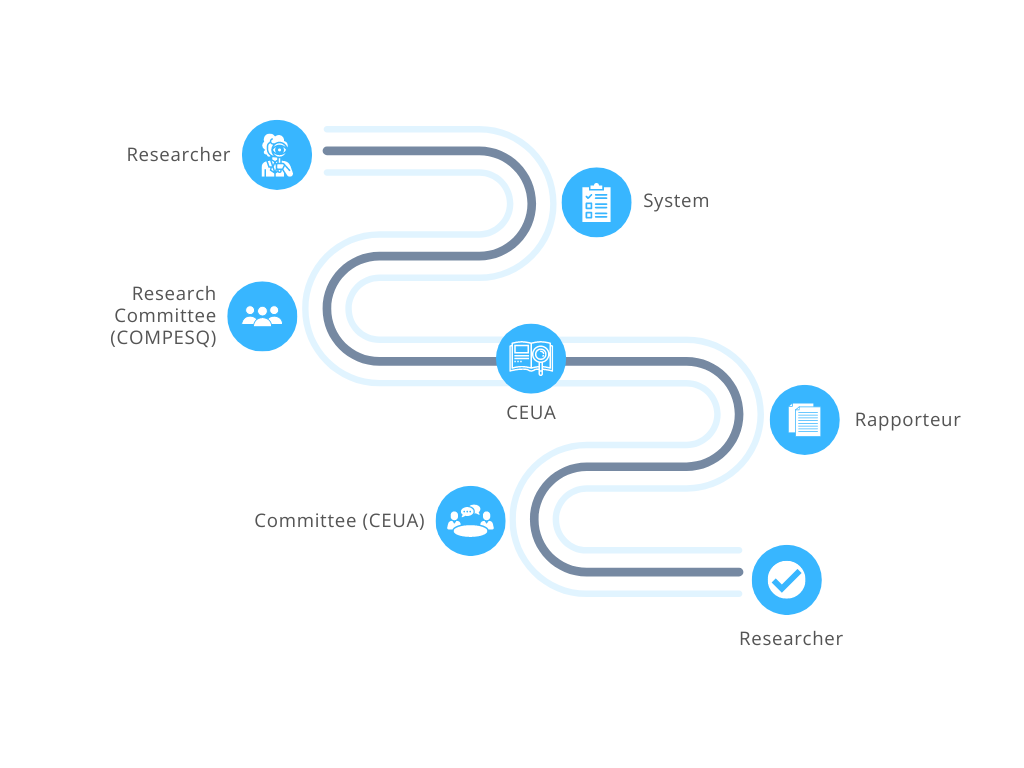
The procedural proposals follow the following scheme:
1. The projects are sent by the researcher via the system to the respective Research Committee (COMPESQ), together with the use of animals in research request form and other relevant documents.
2. After the approval by COMPESQ, the research projects are forwarded by COMPESQ to CEUA.
3. The CEUA secretariat tabulates the received projects following their respective titles and researchers.
4. The CEUA coordination appoints rapporteurs for each project. The rapporteur evaluates the project and writes a substantiated statement considering the relevant legislation to the requested species.
5. The evaluation is presented by the rapporteur in the CEUA biweekly meeting, for which the preliminary conclusion may be: diligence, approval, rejection, or archiving.
6. The committee re-evaluates the case and collectively decides to approve the project. At the end of the meeting, the submission is finalized in the system by the rapporteur and forwarded to the researcher.
Cosmetic testing – the controversial Revlon case
Research on both animals and humans have always been a very controversial matter. In an emblematic case that occurred in 1980, Henry Spira – one of the most important 20th century defenders of animal rights – reported Revlon for using rabbits in toxicity testing purposes. After trying to convince the company to conduct research about alternative methods for the investigation of toxicity, he had a full-page add published in The New York Times with the following sentence: “How many rabbits does Revlon blind in the name of beauty?

From 1986 onwards, the cosmetic industries began to stop the tests using live animals. In 1989, both Avon and Revlon stopped using animals in their product research. Today, several cosmetics companies use a seal to identify that their products have not used animals in their production testing.
Around the world, 42 countries already prohibit tests on animals for cosmetic purposes, including India, Norway, Switzerland, South Korea, Australia, Colombia, Mexico and those belonging to the European Union. In Brazil, the Federal District and 12 states already have laws that prohibit such tests: São Paulo, Rio de Janeiro, Mato Grosso do Sul, Minas Gerais, Amazonas, Pará, Santa Catarina, Paraná, Pernambuco, Espírito Santo, Acre and Paraíba. The proposed bill 70/2014 seeks to prohibit tests on animals in the cosmetics industry at federal level, covering all states of the country.
Professor Goldim admits that research with cosmetics was truly cruel and unacceptable. “The making of these tests used to be a regulatory requirement for to release of cosmetics for the use of people. As a result of ethical dilemmas, the industry itself has developed models, such as the synthetic cornea that allows researchers to draw the same safety conclusions without using animals.”
According to him, by implementing the pattern of 3Rs, everything changed.
“This concept was a milestone in the adequacy of using animals in research. Since then, many advancements have been made in the sense of reevaluating research practices and developing a new culture of respect for animals.
José Roberto Goldim
Euthanasia: guidelines, dilemmas, and controversies
In research using animals, there are ethical, moral, and also humanitarian debates, as those who carry out the practice can develop the so-called “Fatigue for feeling compassion”, especially due to the euthanasia procedure at the end of the experiment – which generates many controversies.
According to the American Veterinary Medical Association, it is “a biological, psychological and social exhaustion syndrome that can affect individuals who develop a relationship, as a medical caregiver, with their patients (human or animal)”, but the condition affects more the community of laboratory animal workers, ranging from cage cleaners to veterinarians.
According to a research published in the Journal of the American Association for Laboratory Animal Science, and published in Science magazine, nine out of 10 professionals who take care of animals in laboratories may suffer from fatigue as a result of compassion, as caregivers feel deeply connected to these creatures, such as rabbits, dogs, cats and monkeys.
In Brazil, the practice of euthanasia –merciful death, without suffering – in animals used in research is legal and has its procedures specified by CONCEA, through Normative Resolution Nr. 37/2022 of the Ministry of Science, Technology, Innovations and Communications (MCTIC), standardized by the Federal Council of Veterinary Medicine (CFMV).
The guidelines clarify a range of questions, including the essential elements of an appropriate protocol, such as the consideration of behavioral characteristics of each species and the participation of veterinary doctors that have technical, ethical and humanitarian training.
CONCEA also establishes the need to define a “humane endpoint” in the institution’s scientific or educational activities, described as “the moment that the closure is anticipated to prevent, relieve, stop animal pain, discomfort and suffering.
The text details the conditions necessary for carrying out euthanasia, both from the point of view of the animal and the executor, in addition to providing an extensive list of recommended methods according to each animal group. Essential cares are also described in order to apply the procedures properly.
What about the future? Professors Poli, Netto and Goldim are unanimous: the scenario tends to a reduction of the animal experiments due to the discovery of alternative methods that should, little by little, replace in alive tests. Poli’s opinion indicates that the trend is to use 3D models that mimetize living tissue.
“Cytotoxicity models can replace most tests involving laboratory animals. However, this can only be possible when the models prove that they can analyze all the existing variants in biological events. I will be the first to celebrate when this condition becomes feasible. Despite decades of research, it breaks my heart to cause suffering or death to any living being.”
José Antonio Poli de Figueiredo
With an optimistic perspective in relation to the trends, Goldim points out that the current challenge for bioethics and ethics in research and science is to have an integrated thinking into the ecosystem as a whole: “We can no longer think of human beings isolated from their environment, from animals, plants, and other elements that surround us. It is essential to have this integrative and comprehensive perspective. Utopias exist as a stimulus to think about other possible realities of perceiving and acting.
Pros and cons of using animals in research
PROS
Scientific and medical advancements: it contributes to the development of new treatments and medicines that benefit both humans and animals.
Strict legislation: The Arouca Law (Law 11.794/2008) establishes clarified guidelines about using animals in research, requiring ethical measures, the relieving of suffer and the application of alternative methods whenever possible.
Benefits to animals: Veterinary studies and research on domestic animals can help develop more effective treatments for their quality of life.
CONS
Ethical matters: Concerns related to the animals’ suffering and wellness; animals should not be exploited for human benefit; the practice seen as inherently immoral.
Limited results: Some critics state that the results are not always straightly transferable to humans due to physiological and biological differences, restricting the relevance of these studies.
Technological choices: In vitro research, use of models in cultures of human cells and tissues, computer simulations, organ chips are considered more ethical methods by the animal rights defenders.
Translated into English by Paulina da Costa Amaral, undergraduate student enrolled in the course “Supervised Translation Training II (English)” of the Undergraduate Program in Language and Literature, under the supervision and translation revision of Professor Elizamari R. Becker (P.h.D.) – IL/UFRGS.