Contemporaneity | Researchers reflect on the relevance of seeking problematic aspects in sources from the ancient Orient that fuel discussions about contemporary issues, especially when this is done from the Global South
*By Pedro Henrique Tubiana Pereira
*First published September 28th, 2023
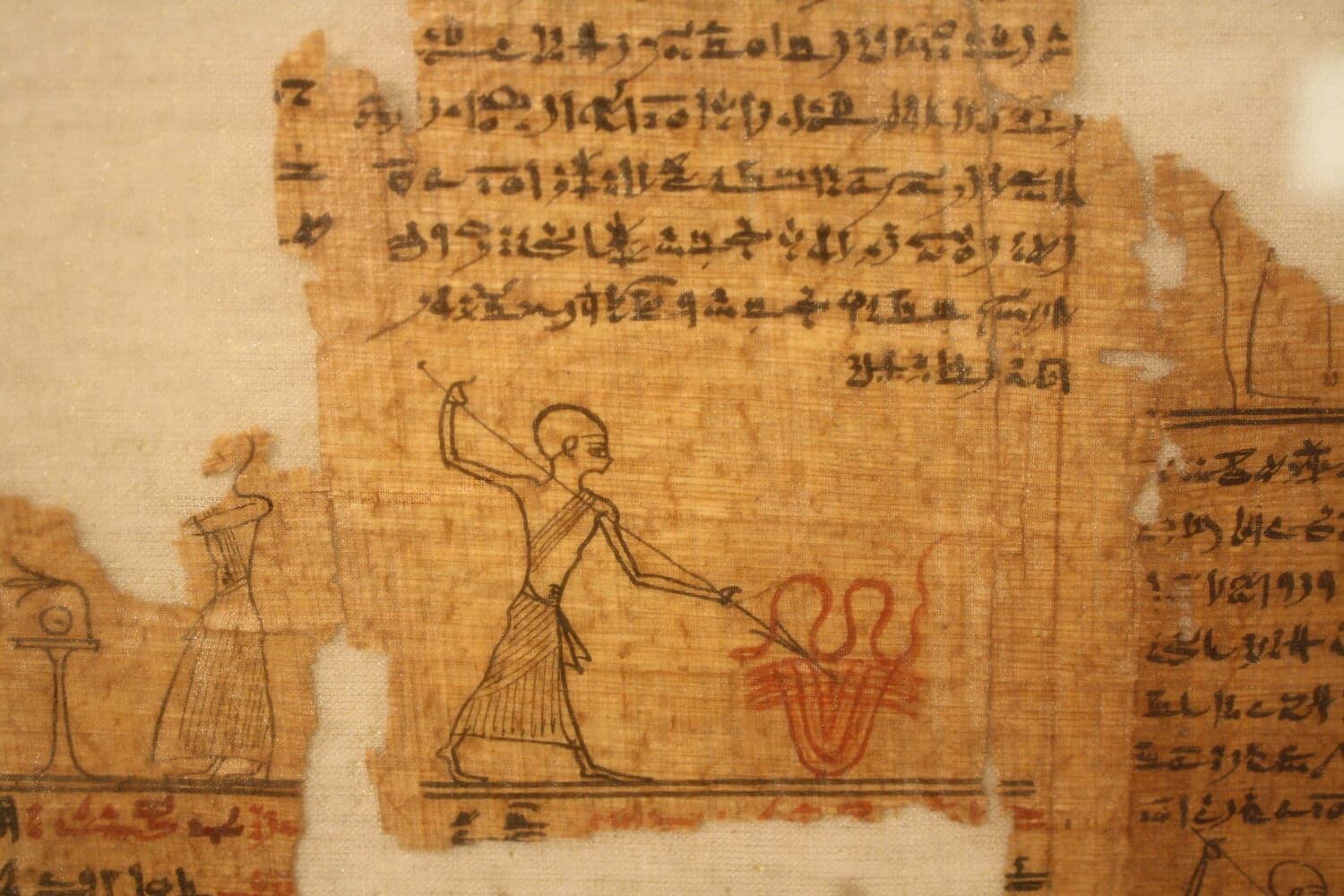
*Written on papyrus showing part of the ‘Book of the Dead,’ an ancient Egyptian text used in the early New Kingdom (Credit: Mark Cartwright)
"Theyarranged death and life,
Of death, they did not reveal the day."
– He who saw the abyss: The Epic of Gilgamesh
The poem that tells us about the myth of Gilgamesh is the oldest known literary record to date. It is believed to have been written around 2000 BCE – that is, “Before Common Era” – on clay tablets which were discovered between 1872 CE and 2014 CE. This material predates Homer and biblical texts, narrating a series of events and beliefs that have accompanied humanity to the present day, such as the creation of man from clay, the existence of a great flood, and even mourning the death of a very close friend. A death that shakes even a god-hero like Gilgamesh, who, upon losing his companion, becomes aware of the ephemeral nature of the world and himself. And he weeps.
Despite the temporal and even geographical distance, these characters and mythologies resonate with contemporary life and human experiences. Gilgamesh and the people who wrote about him experienced grief in 2000 BCE in Sumeria, in the Ancient Near East. And so we have ever since. Nowadays, over four millennia later, on the other side of the Atlantic, people undergo similar experiences to those of the god-hero.

The Contemporary Gaze
Another common experience between contemporaneity and the Ancient Near East is political engagement. The Code of Hammurabi is one of the readings from the Mesopotamian world that deeply moves Katia Pozzer, an Assyriologist and coordinator of the Laboratory of Studies in the Ancient Near East (LEAO) at UFRGS. Katia teaches courses in Art History, History, and in the Graduate Program in History. In the epilogue of the Code of Hammurabi, she remarks that the king in question delivers a politically eloquent speech. This always leads her to jest: ‘I want to vote for Hammurabi!’ Clearly, within the realm of research, the ideological nuances of the discourse are analyzed. Just as today, the nuances of contemporary speeches are scrutinized, which, much like Hammurabi’s, aim to captivate, instill fear, and provoke some sort of popular reaction.”
These assimilations help to shape a contemporary perspective regarding studies of the Ancient Near East. Katia Pozzer also coordinates the research project ‘Gender, Representation, and Symbolism in Mesopotamian Art,’ through which she investigates ancient sources, such as representations of bodies on cylinder seals, in comparison with contemporary ideas and issues. ‘Discussing gender and sexuality representation, which is a contemporary theme that affects and challenges people, which is important and part of the fight against prejudice, is made possible by also engaging with these ancient documents. Perhaps a contribution we can make is precisely breaking the idea of the naturalness of prejudice. The idea that things have always been this way, so they should remain so,’ states the professor.
“When you propose questions that are contemporary, it’s legitimate to inquire into ancient sources. You’re connected to the world you live in; it’s not dilettantism. You’re not studying something from the past just because you want to know more about it, but because these questions relate to our lives today. To mine, to yours, to the world we live in.”
Katia Pozzer
Leandro Ranieri is part of the Laboratory of the Ancient Near East (LAOP) at the University of São Paulo (USP) and researches the history of the body, gestures, and bodily senses in antiquity. When asked if there’s something that distinguishes the reading of the Ancient Near East done in Brazil from that done in the hegemonic pole (Global North), Leandro responds: “Sometimes we pay attention to certain things that other researchers don’t. I think the most emblematic case is that of the image of women. There are women in the scenes of palace reliefs, but what is their role? What are they doing there? This place of women in the sources is something that was neglected for a long time.”
The researcher also comments that not only the culture of these countries but also the historical formation in academia are different from ours.
“We have theoretical trends in the humanities that address postcolonial and decolonial studies – these things impact the way we deal not only with sources of material culture but also with written sources.”
Leandro Ranieri
A New Generation
Ana Carolina Stobbe is an undergrad student in History at UFRGS and is a research member of LEAO. Approaching the end of her undergraduate studies, Ana intends to pursue research, particularly studying gender in Ancient Mesopotamia. It was at a Scientific Initiation Salon that she first heard of the cylinder seals of Ancient Mesopotamia. Since then, she has been certain that this would be one of her topics of research interest.
However, the student draws attention to the lack of translation into the Portuguese language for important bibliographies and the difficulty of training more Latin American researchers due to this. The fact that most Ancient Near East artifact collections are concentrated in the Global North also impacts the production of research from the perspective of the Global South: ‘We face many copyright issues, for example, if we want to publish a book and use images from museums […]. It ends up being expensive to make a publication feasible.'”
“Nevertheless, according to Ana, things are evolving into the formation of more Assyriologists, for instance. ‘We have professors who are very active here in Brazil.’ The student mentions three names, the only three professionals in Brazil trained in Akkadian: Professor Katia herself, who coordinates LEAO; Marcelo Rede and Carlos Gonçalves, who coordinate LAOP at USP.”
Transatlantic Silicon Tablets
Carlos Gonçalves notes that one of the main reasons affecting the pace of research in the Ancient Near East in Brazil, compared to the more established tradition in the Global North, is the absence of large museums in the country with significant ‘Near Eastern’ collections. ‘This significantly affects the way we work with the Ancient Near East. Our emphasis will never be on publishing new cuneiform texts. Museums (both in Europe and the United States) still have a lot of unpublished material. It’s operationally easier to publish an unpublished cuneiform tablet in those places than in Brazil, due to access issues.’
However, modernity brought with it microchips, accompanying our own versions of ‘silicon tablets’ (computers or smartphones). This technology greatly aids the development of studies on the Ancient Near East in Brazil, either through access to sources in the collections of museums located in the Global North, such as the collection of the National Library of France, or through the dissemination of such studies in a more accessible language on social media platforms, much in the fashion of LEAO’s profile on Instagram, featuring posts from various researchers across Brazil on the subject.
The internet and the language used make the subject reach many more people who might become interested in studying what these artifacts mean and how they function from a contemporary perspective. At this rate, perhaps, the word ‘Assyriologist’ and its role will in time be as well-known to a broader audience as that of a Hellenist partner.
Translated into English by Fernanda Tavares Pinto, undergraduate student enrolled in the course Supervised Translation Training II of the Undergraduate Program in Language and Literature, under the supervision and translation revision of Professor Elizamari R. Becker (P.h.D.) – IL/UFRGS.
:: Read in portuguese
Acesso virtual a acervos situados em países do norte favorece o desenvolvimento de pesquisas sobre o Antigo Oriente no Brasil