
Language and Literature | Once restricted to the 19th century press, the writer’s publications were retrieved and compiled in a master’s thesis
*By Alexandre Briozo Gomes Filho
*First published July 20th, 2023
*Image: AI Generator – Fotor (Marcelo Pires/JU)
"What time currently imposes on the woman is the letting go of prejudice, the fighting, always painful, for existence, the taking on the heights where men rule and from where they repel her. But whatever war is waged against her, feminism will win, because it was born not out of vanity, but out of the necessity that forces it to triumph."

Júlia Lopes de Almeida, “Para a morte!” [To the death], in “Livro das Donas e Donzelas” [The Book of Maidens and Damsels]
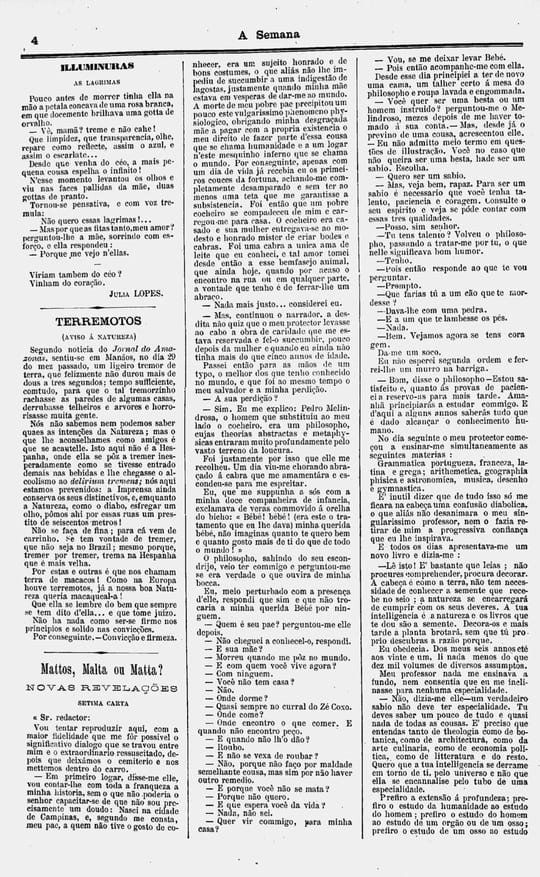
In the last two decades, the number of authors and artists from minority backgrounds who have had their work rescued by the academy has grown. This is a consequence of the rise of discussions around the places occupied by minority groups in society and the demand for greater inclusion and visibility of these groups in the socio-political-cultural sphere. Aligned with this movement, Guilherme Barp’s master’s thesis within the Graduate Program in Language and Literature of UFRGS sought to “return” Júlia Lopes de Almeida (1862-1934) to Brazilian literature by retrieving short stories written by the author that, at the time of their first publication, were restricted to the press. The study “rescued” 20 short stories, which are available for reading in the second half of the thesis and will be collected and published in a physical book.
“There is no way to talk about female writers of the 19th century without talking about Júlia Lopes de Almeida, since she was the biggest female writer of the period,” Barp says. His studies on nineteenth-century women writers began as an undergraduate of Language and Literature, when he conducted research within the Scientific Initiation Scholarship Program for 4 years. During his master’s training, which was supervised by Professor and PhD in Literature Science Cinara Antunes Vieira, Barp searched the Brazilian Digital Newspaper Library for texts written by Almeida in editions of newspapers and magazines to which she collaborated.
Júlia Valentina da Silveira Lopes de Almeida was the sole women among the founders of the Brazilian Academy of Letters (ABL, in the Portuguese acronym), a literary institution that aims to cultivate the Brazilian Portuguese language and the Brazilian Literature. The writer can also be considered a woman ahead of her time: she advocated for the abolition of slavery, formal education for women, divorce, and civil rights – the divorce, for example, would only be made legal and added to the Brazilian Constitution in 1977. Her works, which comprise novels, short stories, theater plays and novelettes, amount to more than 20. However, despite her influence on the literary and intellectual milieu at the time, as the idea of the ABL progressed and became a reality, Almeida was marginalized in the institution. “Nineteenth-century female writers were erased just for being women. They were tolerated, not respected,” explains Barp.
Getting around memoricide
According to Barp, studies that aim to retrieve literature made by women have been carried out since the 1980s, but there has been little examination regarding how they are conducted and what trends and methodologies they follow. His master’s thesis is divided in two parts: a bibliographic and a document review. Regarding the first, Barp searched into gender studies – or women studies – and into literature to analyze how this type of research has been carried out within the national context throughout the years. In Brazil, studies on this subject analyze forgotten women’s literature from the end of the 19th century to present day.
According to the researcher, there are three ways to retrieve an author’s work: through re-editing the author’s works, which was his aim in his thesis; through bibliographic supplementation, by reviewing the writers’ biographies in search of documents and information – since oblivion is not only about their works, but also about their lives; and, finally, through Comparative Literature Theory, which can be used in later studies, once the activity of retrieving the writers’ works has been achieved.
The term memoricide refers to the erasure of the memory of a person or group, and reflects the reality of women writers even back in the 19th century. The concept was discussed by the Professor at the Federal University of Minas Gerais, Constância Lima Duarte. Barp says that Almeida, among the forgotten female writers, can be considered one of the most remembered, and explains: “She was such an important author at the time that her name couldn’t be erased”.
For the second part of his thesis, Barp searched newspapers of the time available in the Brazilian Digital Newspaper Library for Almeida’s short stories. The researcher investigated the period of 1880 to 1890 and was able to collect 20 short stories that were previously restricted to the press of the time. According to him, there is more content to retrieve, such as the stories produced between the beginning of the 20th century and 1934, when the author died. “There’s still a lot to be done if anyone is willing,” he says.
Contemporary society wins the day
From realism, through symbolism and modernism, to contemporary literature, Brazilian women’s literature has been gaining notoriety. Authors such as Cora Coralina, Clarice Lispector, Carolina Maria de Jesus, and Conceição Evaristo became the very face of literature in the Brazilian imaginary. This new paradigm gave way to new terms, structures, perspectives, vindications, and uneasiness.
“I believe that a large part of contemporary women’s literature owes a great deal to the Brazilian writers of the 19th century, who were able to pave the way to discussions that are being held today in contemporary women’s literature”.
Guilherme Barp
After over six years studying nineteenth-century women writers, Barp says he intends to stick to the same theme in his PhD. To proceed with the publishing of the collected short stories, he is now waiting to hear back from the Institute of Language and Literature of UFRGS, which opened a call for submissions. He expects to publish a book in partnership with the University. He believes that, since the research was developed along with the institution, it would be interesting if the edition were also published by it. “However, if that’s not possible, I’ve already received offers from other publishers in Porto Alegre to edit the material and publish it,” he says.
Translated into English by Isabel Cony, undergraduate student enrolled in the course “Supervised Translation Training II (English)” of the Undergraduate Program in Language and Literature, under the supervision and translation revision of Professor Elizamari R. Becker (P.h.D.) – IL/UFRGS.
:: Read in portuguese
Resgate de contos de Júlia Lopes de Almeida é ato de devolução da autora à literatura