
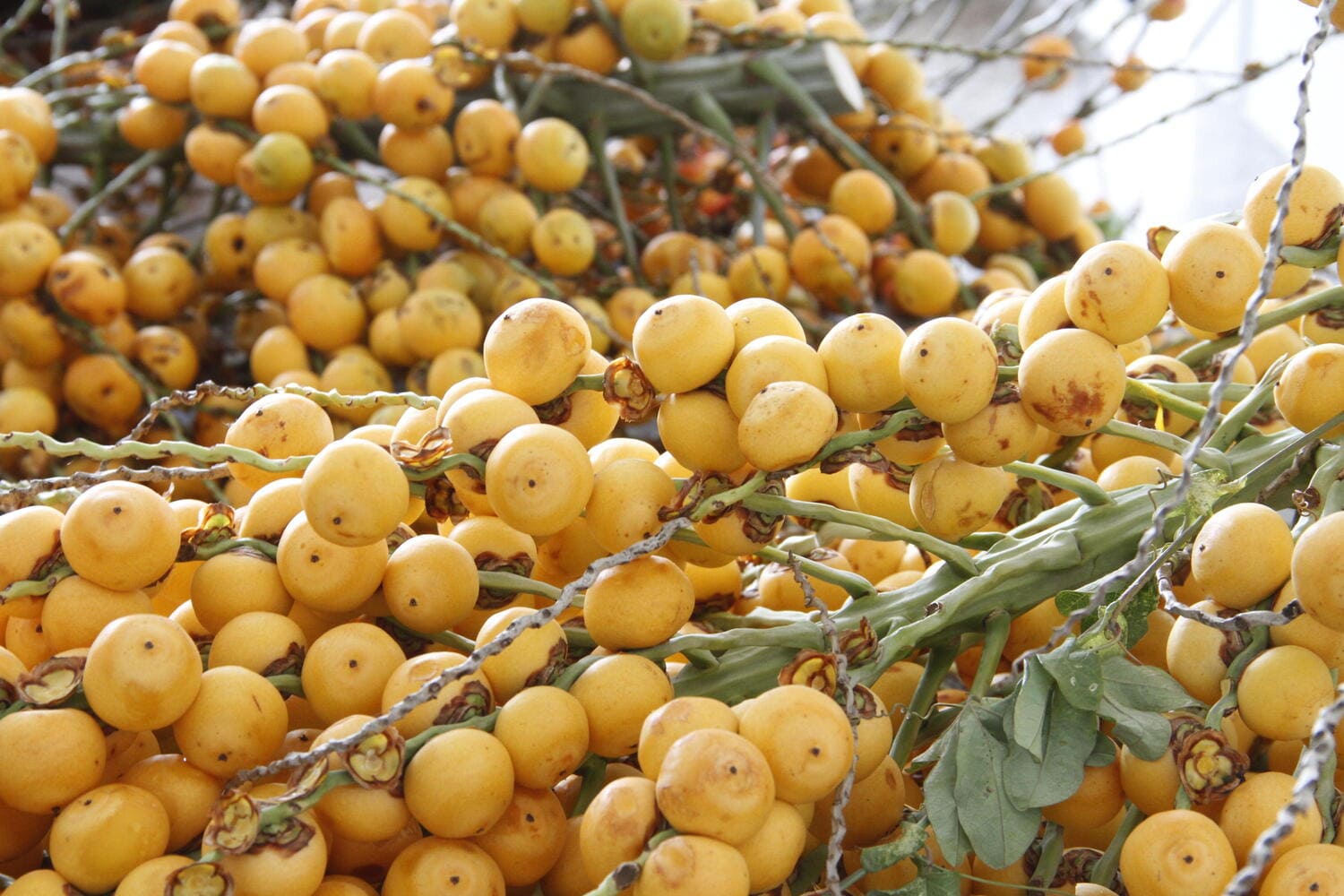
Local community biodiversity | With the re-signification of the use of the fruit and the rescue of historical knowledge, relationships with butiá orchards can generate income, provide health benefits, and preserve the ecosystem
*By Rafaela Bobsin
*First published December 7, 2023
*Photo: Paulo Lanzetta/Embrapa
Every Gaúcho must have heard the saying “Me caiu os butiá do bolso” (My butiás fell out of my pocket) at least once in their lives. This popular saying is used in Rio Grande do Sul in situations where people feel surprised or indignant. What many people don’t know is that, beyond the saying, butiá is a fruit widely used in homemade cachaça production. Although it is a native fruit, it is not easily found in markets, and almost all nine species of palm trees are endangered.
Most people don’t have the habit of consuming butiá and do not understand why the fruit is so important to the point of being in such a well-known regional saying. For others, however, butiá is more than just a fruit; it can be part of family history, a source of income, or even a subject of study with great potential.
Joseane dos Santos is part of the Chácara da Cruz quilombo in Tapes. Although Joseane does not live in the quilombo, her family has a strong connection to the place. The history of this quilombo is linked to a craft culture that uses the butiá leaves. When the community was formed, one of the main sources of income for its members used to be the production of ropes, braids, mattresses, and car seat upholstery made of butiá leaves. The men of the quilombo collected the raw material for the women to produce the crafts and sell them at the city port. Joseane states that “butiá used to mean the world” because the community was illiterate, and the palm tree helped everyone survive: it was through the income from this craft that they were able to save money and buy the land that belongs to the quilombo.
Currently, the production of these crafts no longer exists. The area where the butiá orchards are located has been occupied by the new owner, and Tapes has undergone major economic changes, with the region now focusing on rice and soybean production. Joseane reports that many people who used to produce items from the butiá leaves are no longer alive or do not talk about it; there is an unhealed wound regarding the land, which has been subject of legal disputes. The use of butiá in the quilombo is limited to internal consumption with some recipes and preserves, but the fruit is part of the local history and its members.
Crafting with butiá straw has also been a income and barter for many women in the Torres region. In August 2023, the craft was declared an Intangible Cultural Heritage of Rio Grande do Sul. The safeguarding process was initiated by the non-governmental organization Instituto Curicaca in the 2000s; the registration process for patrimonialization began in 2015. Patrícia Bohrer, coordinator of People, Education, and Culture at Instituto Curicaca, states that this craft is now being brought out of the invisibility to which it had been relegated in recent years.
The survey on the craft production was conducted through interviews with women whose livelihood depended on butiá braids. Many of them used the income from these crafts to buy school supplies for their children, fabrics for clothes, or to pay for leisure activities. This process was in the course of being lost – younger generations are not interested in learning; butiá trees are becoming extinct, and market interest in the product consumption has changed. However, with patrimonialization, there has been a resurgence of this knowledge that was undeniably important for several generations. Patrícia adds that “its intangibility is precisely what touches our hearts and provokes a desire for continued transmission.”

Preservation: Isolation of Areas or Seeking Ways of Use?
The registration of the craft was not the only work of Instituto Curicaca in the northern coastal region of Rio Grande do Sul. The Institute operates between Torres and Osório, trying to understand the relationships, losses, and possibilities of using butiá, although activities are concentrated in Torres, where there have always been more sociocultural interactions with the fruit. These interactions were noted in reports about the importance that butiá once had for the region.
Professor Gabriela Coelho from the Graduate Program in Rural Development (PGDR) at UFRGS explains that there is a relationship between biological diversity and cultural diversity. The first consists of the various species that exist in different environments, while the second involves groups that relate more closely to biodiversity—indigenous peoples, quilombolas, quebradeiras de coco [coconut shell breakers], and other communities. This intrinsic relationship is socio-biodiversity. “These species also have a very significant cultural meaning, and many of these groups are responsible for the distribution of these species throughout the national territory,” says Gabriela.
Alexandre Krob, technical coordinator of Instituto Curicaca, reports the monitoring of the remaining butiás of the Butia catarinensis type in the northern coastal region of Rio Grande do Sul through visits to the sites and satellite observation. If between 2008 and 2010 there were about 120 hectares of butiá orchards, last year almost 15% of this population was lost. Thus, the Institute started a project to restore this ecosystem, aiming to preserve the existing species and plant new ones.
Replanting the butiá orchards is not a simple task. These palm trees do not grow easily, and most of the remaining individuals are centuries old. Butiá takes up to three years to germinate, and not all seeds complete this cycle. According to Bruna Barato, a Ph.D. student in Botany at UFRGS, butiás need a certain temperature elevation over a definite period to start developing, and climate changes hinder the plant’s germination. Additionally, the seeds need to break through two barriers: the seed itself and the small fruit where it is located.

Instituto Curicaca’s initiative is partnered with Farm, a well-known clothing brand, and the Seed Laboratory of the State Department of Agriculture, Livestock, Sustainable Production, and Irrigation. To obtain the seedlings that will be planted, the institute brings the seeds to the laboratory, which performs a process to break the dormancy period, accelerating germination. The seeds that germinate remain in a research station for one or two years until they are ready to be planted in the field. Some of these seedlings will go to conservation areas, while others will be allocated to private properties. On these properties, it will be possible to use the fruits and leaves, and one of the goals is for people to return to using everything that butiá can offer in an appropriate way.
Instituto Curicaca also operated in the Quaraí region in the western border of the state. Alexandre explains that the loss of butiás in Torres is more related to urbanization, while in Quaraí, the problem is livestock expansion. In addition to the germination issues, the butiás in the region have also faced cattle feeding on and stepping over the seedlings. In such cases, biodiversity islands have been implemented, keeping the cattle away f-or some time until the species may recover and become stronger.
Gabriela comments that there are different ways of preservation. One is environmental preservation, which permanently isolates areas and prevents significant circulation of people; in such cases, constant monitoring is necessary. Another perspective is conservation through use, which understands that the more involved people get and the deeper bonds they create with a particular ecosystem, the more they will collaborate for its preservation. In this sense, there are two paths: one is exhaustion – understanding how much can be extracted without harming the species; the other is expertise – recognizing that some peoples know how to interact without harming these species, an experience which encourages these populations’ contact with nature.
The Route to the Butiá’s orchards /Red Palmar is a network of people interested in preserving orchard ecosystems through use. Currently, there are people part of the Route in Brazil, Uruguay, and Argentina, connecting 66 cities. This network connects different groups—public, private, and non-governmental institutions, researchers, farmers, etc.—sharing knowledge, rescuing, and re-signifying the uses of butiá. Through the Route, various scientific studies, workshops, and seminars have been conducted, leaflets and other advertising materials have been produced and distributed, along with the rescue of threatened butiá trees.
Butiá in the Kitchen
One of the productions of the Route to the Butiá’s orchards is the book Butiá para todos os gostos (Butiá for All Tastes), with at least 150 recipes, both sweet and savory, based on the fruit. In addition to recipes, the book features images of the fruits, palm trees, flowers, leaves, and prepared delicacies. It is available for free access on the Route’s website.
Exploring the potential of endangered fruits and promoting knowledge about their nutritional properties was also the goal of the Biodiversity for Food and Nutrition (BFN) project, carried out in partnership with several institutions worldwide, including UFRGS. Vanuska Lima, coordinator of the project in southern Brazil and professor of the Graduate Program in Food, Nutrition, and Health at UFRGS, says that BFN was responsible for conducting the nutritional analysis and creating recipes with butiá and 15 other native fruits.
At the Institute of Food Science and Technology (ICTA) at UFRGS, the chemical composition and macro and micronutrients of the selected fruits were analyzed. Studies found that butiá is rich in vitamin C and carotenoids. These carotenoids have antioxidant functions in the body, and their subfractions help with vision and reduce the risk of cancer and cardiovascular diseases. Vanuska highlights that, as a native fruit of the region, the nutrients are at their best “performance,” and thus preference should be given to its consumption. The complete nutritional information of butiá can be found on the SiBBr platform.
Juliana Severo, a gastronomic technologist, was involved in the creation of recipes for BFN in partnership with the UFRGS Nutrition course. She recalls that several dishes were produced, which were tasted and evaluated by students and professors. “Some [recipes] were unanimously considered good, and others were unanimously considered not good.” Some of the recipes involving butiá were created in a recipe contest in Giruá, a city that hosts a fair about the fruit. Among the project’s results are recipes for sweet rice, biscuits, escondidinho, vegetable cake, and subtropical pizza—all prepared with butiá.
Bringing to market a beverage produced with native fruits and having a positive socio-environmental impact is the goal of Gasosa Biodiversa. The idea of Augusto Antunes André and Nilton Tavares took shape during an outreach program in Entrepreneurship for Socio-biodiversity, promoted by the Reference Circle in Agroecology, Local Community Biodiversity, Sovereignty, Food and Nutritional Security (AsSsAN CR). The product is currently being incubated by the Technological and Entrepreneurial Food and Agro-industrial Incubator (ITACA) at ICTA/UFRGS. The beverage already exists, but its production is currently on hold, awaiting resolution of bureaucratic issues. Augusto and Nilton emphasize the focus on organic and local community biodiversity. “There is no future without sustainable agriculture,” says Augusto.
While she was a post-doctoral researcher and collaborating professor at PGDR, Tatiana Miranda researched topics related to ethnoecology and conservation through use. She decided to move from theory to practice by venturing into the gastronomy field: in 2019, she began to conceptualize Cozinha Erva Doce, which she managed alongside her university routine. This year, the business gained a physical location. She now sells a pie with butiá jelly and homemade butiá cake. One of her goals is to allow people to discover the fruits and realize that it is feasible to use them in everyday life.
In production, Tatiana uses products from farmers aligned with her former research line, such as the Solidary Native Fruits Productive Chain. Working with the appreciation of local community biodiversity, the Solidary Chain connects farmers, agribusiness—responsible for processing the fruits—, marketing ventures, and technical and advisory assistance agents.
Coordinator of the Solidary Chain, Alvir Longhi explains that most producers are small farmers concerned with environmental conservation, contributing to the Chain in different scales. Some fruits are extracted from agroforests, while others were previously unused on properties, and the owners decided to give them a new purpose. Alvir notes the noticeable impact on the income generation of farmers: some have nearly 30% of their income from this production. For instance, one farmer was able to save enough money from selling unused fruits on her property to buy a new refrigerator.
Stories like those of Joseane, Tatiana, the craftswomen from Torres, and the farmers of the Solidary Chain demonstrate how butiá goes beyond a popular saying. It is no longer “falling out of pockets”; what falls are the palm trees that sustain them, which continue to be endangered by urbanization and unsustainable agribusinesses. Butiá, which was once the primary currency of exchange for many families, has been forgotten by many, but various initiatives are reapplying its uses with a much more respectful and preservationist approach.
Translated into English by Gustavo Flores Ramos, undergraduate student enrolled in the course “Supervised Translation Training I (English)” of the Undergraduate Program in Language and Literature, under the supervision and translation revision of Professor Elizamari R. Becker (P.h.D.) – IL/UFRGS.
:: Read in Portuguese
Mais que um dito popular: iniciativas buscam resgatar o papel do butiá, fruta nativa do RS
Comments are closed, but trackbacks and pingbacks are open.