
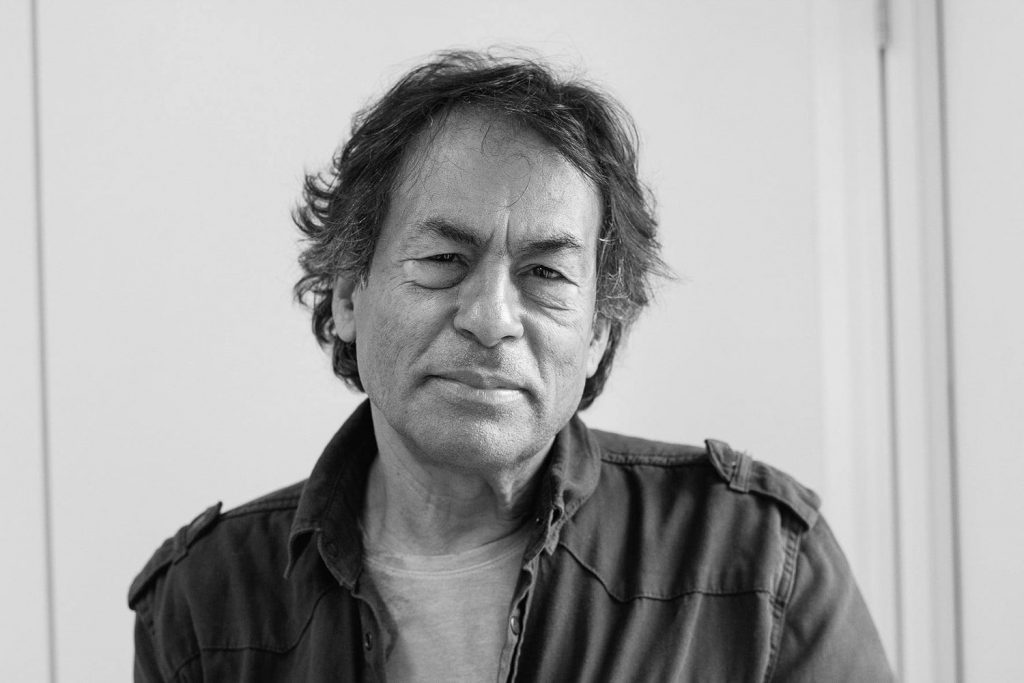
Interview | The indigenous writer and leader believes that the Earth is a living organism, and that if humanity continues at its predatory pace, it will enter the list of endangered species
*By Anna Ortega
*First published November 12, 2020
*Cover photo: Neto Gonçalves/Companhia das Letras
“We are experiencing the fever of the planet.” This is what Ailton Krenak claims and what, apparently, a significant portion of humanity is not realizing – or is simply denying. The increase in the temperature of the planet comes as a reaction; it shows that the Earth organism is reacting to the predatory and destructive actions of human beings, but we are so centered in ourselves that we are unable to perceive this mismatch. “We detached from the body of the Earth,” says Krenak. We divorced, believing we could live on our own terms. On one condition: extract, dominate, explore everything that comes from Gaia. We divorce ourselves from this organism that shelters us, but we are always usurping it.
Ailton Krenak’s trajectory has always been fundamental in the historical struggle of indigenous people and for the preservation of the Earth. In 1987, Krenak caused a commotion when he delivered a speech at the National Constituent Assembly during the drafting of the 1988 Brazilian Constitution. During the speech, he stood on a platform, in front of those who threatened the rights of geographic and cultural territories of indigenous traditions. He painted his face with the black ink of the jenipapo as a form of protest against the setbacks and attacks on his rights and those of his relatives.
After so many years, Ailton Krenak’s voice continues to be urgent and echoing. In 2019, he wrote the book Ideas to Postpone the End of the World, one of the most acclaimed books in the country in 2019. In its 88 pages, the author proposes a new form of consumption and existence, guided by a cosmic vision of the world. Closer to nature, less eager for money, power, and dominance. In 2020, he released Life is Not Useful, a compilation of interviews and lives given by Krenak during the pandemic period and transformed into text. In the book, he highlights the idea of the deep disconnection of humans from the Earth organism, provoking reflections on the centrality of the human species and the way we are relating to the planet.
Krenak was born in the region known as Vale do Rio Doce, where the Krenak Indigenous Land is located and where, some years ago, a mining tailings dam called Fundão, controlled by Samarco Mineração, broke. According to Ailton, The crime “nullified” the local river. The river, which he considered to be his grandfather, is now gone. It was killed by yet another human and corporate act of destruction. Today, Ailton Krenak continues to live close to where the dam breached. During a video call interview, a truck from Vale passed by where the activist was. You could hear the beep-beep of the water truck, which, according to him, is a daily routine.
What humanity are we today?
We are a complex and diverse humanity. It has those qualities that we would sometimes like to be present around us: complexity and plurality. But this same humanity, precisely because it has a plural condition, does not constitute a community. We could say that today we are perplexed, because we cannot have a unity of purpose, and we are going through successive crises of all sorts – environmental, climate, economic. It is also a paradigm crisis.
Among these crises, we experienced the pandemic. In Life Is Not Useful, you highlight the fact that the coronavirus only sickens human beings. What can this tell us?
The Earth following its path is a possibility to challenge the centrality intended by human beings. It causes this centrality to be called into question. It is the idea of the Anthropocene, a theory that human actions have profoundly changed the functioning of the planet and that this would constitute a new geological era. So, if human beings’ perception about life here on this planet has become so atomized that we threaten other existences, the Earth can leave us behind and go its own way. Gaia is this living, intelligent organism that will not be subordinated to an anthropocentric logic. She dismisses us. This understanding seems like a magical, romantic idea, but many scientists consider the Gaia Theory [the idea that the Earth is a living organism] to be real. In fact, the events we are going through right now are indicative that this organism is reacting. “We are experiencing the fever of the planet.”
Gaia’s organism has a fever because we humans are the only ones who have the ability to affect this organism in a disorderly way. And we are threatening other lives, other existences, causing a fever in this organism. It is very didactic, it is not a complicated theory.
We are disrupting life on the planet, and the consequences of this can affect the idea of a common future – in the sense that we have no future with other beings. Humans may well end included in the endangered species list.
Human beings are so focused on themselves that when they see people connected with nature, they call it “alienation” – there are moments in Life is Not Useful where you talk about the river as a grandfather, about the mountains as grandparents. And about how this relationship with what is not human is viewed with suspicion by many individuals! What causes this feeling of strangeness?
It seems like this detachment of the human species from the great Earth organism of which we are a part of has happened throughout history, in different movements.
Perhaps the most significant one was agriculture, the event that made humans dominate such activity. Harari, the author of Sapiens, says that when Homo Sapiens discovered that they could master nature’s reproduction cycles, such as agriculture, they were somewhat convinced that they could separate themselves from Earth. Before, they had to climb trees, run with other primates, be aware of tigers and lions.
Avocado / We will comply with your act / We are also from the forest / Like the duck and the lion [song Refazenda, by Gilberto Gil, in a free translation]
This beautiful poem reminds us that we can live together with other beings. Indistinct life. Just life. But when in our human form – anthropomorphous –, when we perceive ourselves in such form, we begin to detach ourselves from Mother Earth. Human beings discriminate against their brothers, the other species. The other day I came across this expression: “specification”. It is when the idea of species begins to gain strength in the thought of the first humans. When they start to conceive the idea of species and decide to discriminate. Most likely, the structural racism we came up to in the 21st century, which goes through several layers of violence against the same body, tends to be constituted by a kind of Homo Sapiens 5.0. It got worse and worse until planet Earth developed a fever. But first, human beings had to worsen themselves to the point that they did not recognize themselves in the other, in other beings. And there are no others. There is only the human.
So, this excessive statement of the human being posed a dilemma, which is: how to recover contact, affection – with the mountains, with the rivers, with the forest? With a microorganism, which could even be this virus [coronavirus], which caused the time to stop, caused people’s lives to stop, that is the pandemic.
The pandemic event was seen mainly as a “terrible threat to humans”. Of course, humans are so comfortable in the dominant place that a virus destabilized this terrifying confidence. It broke that trust.
A possible gesture of being open to contact and knowing what was happening turned into a reaction to war. The most common term was “a war against the virus.” The scientists themselves said they were in a war. There was a hardening of the energy field to deal with this as a confrontation, as if it were apocalyptic. But there were not many gestures to ask: let’s get to know this invisible organism, which has the capacity to cause so much change? The only gesture towards the virus was/is to control it. Eradicate it. Eliminate it. The terms were/are precisely these.
I found it very interesting that the friendly people we know from the media suddenly became battle commanders. Then you look at it and think how quickly everyone becomes a general.
This warlike discourse that the search for the vaccine restored is as if we had a declaration that the enemy is inside the house. Well, there’s no outside the house. In the Earth’s organism, the planet’s biosphere has no externality. Companies often leave out of their accounts the damage they cause. I am on the banks of the Rio Doce, in the Krenak Indigenous Land, where our river has completed five years since it was annulled by mining mud. To my right is now passing a water truck.
[Beep-beep-beep-beep]
If I turn the camera over there, you’ll see a water truck. Do you hear the sound of its siren?
Yes, I listen
It’s like we’re in a refugee camp. But at home. You wake up in the morning with this thing. And this is a rural area, it’s an indigenous reserve.
[Beep-beep-beep-beep]
Last week, I gave an interview to a newspaper and said that our territory had become a “Rally of contractors”. It was an image that occurred to me because of these many trucks, machines, tractors, backhoes. You know those machines that are used to open dams and make highways? They’re in here. There is a collection of these machines, hired by Vale do Rio Doce, through the Renova foundation, supposedly to help us. [laughs]
And is there any dialogue with the Krenak people?
They [contractors] do not share the planning of the actions they do inside here with us. They invade us. The machines come in, turn everything upside down, and then they leave. Their engineers don’t talk to us, they don’t communicate. I keep feeling invaded within our own territory. That’s why I said we are living in a condition of domestic refugees.
All these predatory activities remind me of the depiction of progress you speak about. Progress as an arrow. Could you talk about that?
This great ecosystem of our Mother Earth has no externality. That’s why I mentioned mining. Of course, there are many activities that are considered important. Agriculture, for example. The activity that started our divorce with Earth, when humans thought they could dominate everything. But then there is another period that we call modernity, which adjusted the terms of this divorce, establishing a logic, a rationality that suggests that time is a prospect, an arrow.
And we humans are going to comprehend this arrow as a measure of success, of achievement, of entrepreneurship, where life is calculated and can be captured by stating that “time is money”. Now, this idea of time as a measure and life as something that can be controlled by a process that can be calculated monetarily, all this forced me to reflect on this detachment that we went through in relation to our Mother Earth.
A very numerous contingent of what we call the population of the planet, 7 billion or so people, live alienated or in alienating routines, to such an extent that in the morning they do not even look around to see where they are. They don’t look up to the sky to see if it is cloudy, or if it’s going to rain. Many do not even look at the sky at all, because they live in urban conditions and conditioning. They go in and out of boxes.
There is a man native to the South Pacific Islands who reflected on this humanity that lives in boxes. A book of his is called The Papalagui. It is the story of these humans who forgot that they can walk on the earth, move the earth, live on the earth and who then decided to live in boxes. The box is the dwelling, the means of transport. You transport yourself in a little box that may be a car, a plane, or the subway. As this author has always lived on an Island in the South Pacific and has always lived in the sense of the body in freedom, with the wind and the sea, he found it very scandalous when the missionary took him to Holland in the 1960s.
He found it scandalous. He had come from a village that allowed him, by contrast, to realize how people were going the wrong way. He noticed this about sixty years ago. At the same time the poet Drummond wrote the poem “The man and his travels”. It is a lovely poem by Drummond which shows his detachment from Mother Earth as if it served as a propulsion for him to fly from here to another place. And this human accomplished such a thing, sending the first missions to the Moon. Finally putting the flag on the moon. And the poem talks about it.
It shows the detachment of human beings from the Earth’s organism when the human begins to consider colonizing other planets. Even a child already includes in his universe of achievement the possibility of colonizing other worlds. And this can be worse than COVID-19, from the point of view of dystopia, because it installs in our being, in our heart, the desire not to be here.
It would be like a mother, one day in the morning, gathering her children, and she feels that her children are saying: we don’t want to be here with you. Earth is hearing this message from us. It is feeling it about us. And most of these children don’t care. They really want to go to Mars.
This year, four distinct nations invested to send missions into space. Two were from Europe, one from the United States, and one from the United Arab Emirates. Now, in a pandemic period, with so much lack of perspective, what is the purpose of investing billions to send stations to Jupiter, Mars, and the Moon? This is proof that humanity is divorcing from the body of the Earth. It’s a bit of a reach, okay? Let’s pretend that this Humanity exists. So, if the Earth has a fever, they won’t notice.
And this much detachment combined to the denialist discourse of authorities, including people who hold important positions in multilateral bodies and who have the courage to deny that there is climate change. There are authorities who rule the life of an entire country and deny it. So, living a morning in the heart of Pachamama, of the Earth, aware of this affiliation, is a comfort in the face of so much desolation from the environmental point of view, and also from the point of view of dreams, of thinking worlds.
The same way this arrow-progress has to hit somewhere, for a spaceship, to arrive is not enough, you also need to plant the flag. The question is not just about how to go to Mars, but how to dominate Mars. Why this desire for domination? Why does the desire to dominate come prior to the desire to know?
Some scholars have suggested that Homo Sapiens, the variant that gave birth to this humanity that we are part of, eliminated the other possible Homos, other relatives. I mean, Homo Sapiens is an exterminator [laughs]. It is. And it is competent at it. That horrifying idea to produce a Terminator in the movies is a metaphor for mankind. The human being is The Terminator in a certain sense.
Also because there is no future – it is only a mental construction. There is this morning. Between 8:40am and 10am, that allows us to breathe, look, and feel what is around us. And that is a gift. This future in which Homo Sapiens wants to plant a flag and dominate does not exist. That is an illusion.
In some traditions, this person would be invited to meditate, to empty their mind to experience a sense of being present, instead of searching for another place, running away to another place. Instead of looking for a place of dominance, it is necessary to empty that space and stay in the present. It is hard, but it is perhaps the most necessary exercise for this pandemic time.
It will allow us to conclude that once we are here and now, tomorrow does not matter. Tomorrow is not for sale. Because when you think you should do something tomorrow, you are already selling the tomorrow.
In Ideas to Postpone the End of the World, you talk about how it is very present, especially among indigenous peoples, the tradition of singing and dancing, of enjoying life. Many peoples resist to this logic of domination and progress by simply singing and dancing. What is the role of joy, of this body that dances and sings?
This singing and dancing has a sensitive quality that is not seeking anything. You don’t sing and dance for a reason. An image we could share is like a Dervish: he’s spinning, doing that dance of his, and he’s not going anywhere. He is centering, looking for an axis on which the very idea of time and space is emptied. It is a movement that dances to zero space and time. Like a spinning top. And it is not the search for something, because it may seem that this dance is seeking an ecstatic experience, like carnival. This is not the song and dance we’re talking about. It is also his, because it is a celebration and a party, but a produced one.
Here we are talking about singing and dancing to suspend the sky, to establish other subjectivities, other fields of subtle experience. It’s like meditation. It’s not like something that’s going to happen later. It is here and now.
What have you learned about dreaming and dreaming with your elders?
I learned from my elders that the dream is a vast institution. If a person is guided and introduced to this dream world, he/she will be able to live his/her whole life – even if he/she lives 100 years – without ever exhausting this field of subjectivity, of expansion. The dream is educational and promotes what we were talking about before – joy. It enriches the experience of life as an evolution, evolving from various stages, including the body. Because the experience of the body ceases to be only physical and becomes sensory. In the dream, it is your spirit that will sing and dance, even if your body is resting, sleeping. This sense of the dream opens up unique possibilities for each individual. Do not count on a dream manual. That does not exist. If someone wants to sell you a dream manual, don’t buy it.
You say that we “breathe and dream about the Earth”. What does the Earth dream about?
The dream of Earth is a metamorphosis in which stone becomes butterfly, wood becomes wind, steam becomes rain, and in which clouds rage in storm. All this fantastic movement of life is the dream of the Earth. It’s transformation, metamorphosis. There is an Italian writer called Emanuele Coccia who has been published only recently in Brazil and who wrote a book Metamorphosis. It is a book I consider very good reading because it gives us a script to understand this wonderful organism.
Life is an organism. The Earth is a materiality of this life. Our body, like that of an ant or a butterfly, is the materiality of life. Life passes through us and goes somewhere else. It doesn’t stand still anywhere. This dream of earth is this life. The wonderful life. And it has no end.
What Metamorphosis brings is a reading about Darwinism, about evolution, contrary to the common idea that the world was created – the creationist idea, the idea that the world was created and that humans were given the condominium of the world to prey on it. This is the Western narrative. But there are narratives from other peoples that may suggest that we had different evolutions and origins, that we came precisely from the dream of the Earth. This living dream of Earth.
Translated into English by Alex Porto Teixeira, undergraduate student enrolled in the course “Supervised Translation Training II (English)” of the Undergraduate Program in Language and Literature, under the supervision and translation revision of Professor Elizamari R. Becker (P.h.D.) – IL/UFRGS.
:: Read in Portuguese
Ailton Krenak: “A Terra pode nos deixar para trás e seguir o seu caminho”