Heritage | Interview with members of the Carnival group Afro-Sul/Ọdọmọde aims to treasure the legacy of the Afro-Brazilian cultural movement
*By Gabhriel Giordani
*First published February 16th, 2023
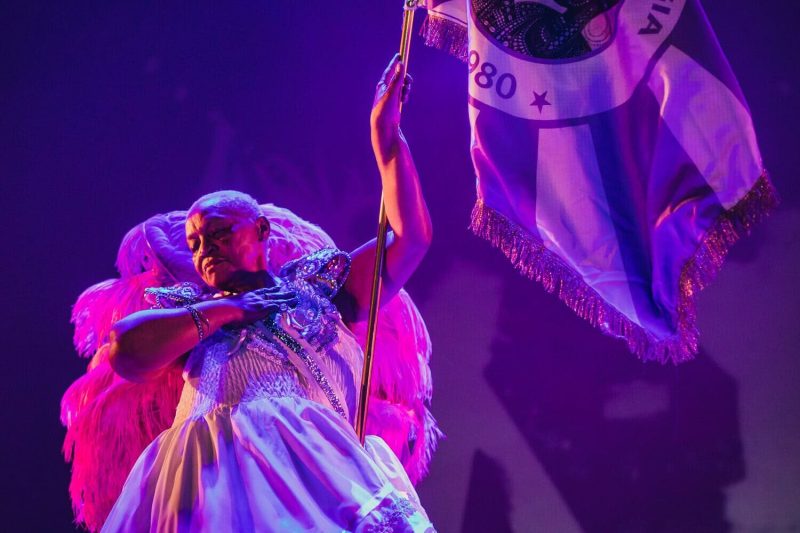
*Photo: Members of the Afro-Sul Music and Dance Group participated, before the pandemic, of the show
“Reminiscences – Memories of Our Time”. Performed at the Renascença Theater, in Porto Alegre,
the show was a manifesto in defense of popular demands. (Image: Maciel Goelzer/by Afro-Sul)
Carnival, a Brazilian social historical heritage, first took place in Porto Alegre in the 19th century. One of the main features of this highly rated event is the endeavor made by samba schools and racial and ethnic groups for the recognition black culture and identity deserve, and avoidance of the historical erasure caused by a predominantly white perspective.
Considering the importance of these stories, a Masters’ thesis from the Museology and Heritage Program from UFRGS sought to understand how the almost fifty-year-old Sociocultural Institute of Music and Dance Afro-Sul/Ọdọmọde contributed to the making of black cultural heritage in the city.
To do that, the researcher Natália Souza, supervised by Professor Giane Vargas, talked to nine members of the group – most of them women from the dance team that had already participated in the Afro-Sul wing. The conversation, named Wheel of Memories, intended to value this space as a center of cultural heritage reference of Porto Alegre.
The main goal of the researcher was to deepen the discussion that had started with her undergraduate thesis about the trajectory of Bloco Afro-Sul/Odọmọde, stressing the importance of the group’s presence on the streets on the Black Consciousness Day, November 20, since the group only performs on that day and not during the Carnival holiday.
The idea of performing exclusively on that day came from the merger with the extinct samba school Garotos da Orgia Orgy Boys, in English). After that, the group began seeing themselves as a place of sociocultural assistance services, especially for children and teenagers. The Afro-Sul/Ọdọmọde group goes beyond dance and music – it focuses less on the Carnival and more on strengthening the black identity.
In her undergraduate thesis, Souza realized the importance of the Afro-Sul’s support for and involvement in other samba schools during the Carnival, since some blocks from the group are part of multiple samba schools in the parades.
Organizing the reports from the Wheel of Memories
For her Masters’ thesis, the researcher moderated conversations – structured as open and informal debates – with members of the group. While analyzing their conversations, Souza separated them into categories such as “We become family”, “Ọdọmọde: it was in the Afro-South that I got to know me”, “For yourself and for your people, that’s what gives it meaning” and “Carnival, the great teacher”.
In the first category, the museologist emphasizes how these relationships go beyond the Carnival itself. In the second, she correlates the members’ stories about childhoods and personal trajectories. In the third, she stresses the aspects of the black consciousness, the building of collective memory, and the processes of identification and representation. In the last one, Souza analyzes the perspective of educational actions, both about the Carnival and the Afro-Sul’s performance in Porto Alegre.
The museologist stressed that her participation in the debates should be as minimal as possible, so the interactions between Afro-Sul’s members would prompt new memories from the group.
The questions to the participants were: “Tell me about you and your relationship with the Afro-Sul. What is your profession? What is your role in the Group or the Institution?”, “When and how did you get to the Afro-South?” and “What is Carnival to you/or what place does it have in your life? How has it been introduced to you?”.
“The most outstanding to me was precisely the piece that closes the analysis chapter and concludes that Carnival is a wonderful teacher,” Souza says. “We have several spaces of knowledge building, and of experiences; I see it as a pedagogical space,” she completes.
Because she is a white person talking about Afro-Brazilian culture, Souza points out that her work should be seen as a critical analysis of the whiteness and of the fact that there is a part of these groups’ history that is ‘unknown’. “I am looking at the same history from a different angle,” she says.
To validate this argument, she talks about the performance of Estação Primeira de Mangueira in 2019, when the school won the Rio de Janeiro’s Carnival parade with the song “Lullaby for grown-up people” that mentions multiple barely known historical characters from History books such as Dandara, Aleijadinho, and Acotirene.
“We have this idea that Porto Alegre is a white city with a white cultural narrative of European references, when, in fact, there are strong black and indigenous presences being silenced in the telling of history.”
Natália Souza
Souza says the research was done carefully, so it could have a large referential of black people on the subject to avoid a prevalent white perspective on it. “This Carnival with a samba school deconstructing this one-sided history made me think about the importance of black stories being told by black people,” she completes.
She also emphasizes that the reports from the members of Afro-Sul/Ọdọmọde, registered as memorialist around the Carnival, can compile an archive of this cultural event. According to her, subsequent studies will be based on this gathering of memories of the Porto Alegre’s Carnival.
To do so, the researcher says new solid references will be needed. Such as, for example, samba schools, blocks or memories of revelers. “The Carnival still exists in Porto Alegre, and it won’t cease to exist. But what it has been losing throughout the years are its Afro-black references,” Souza completes.
Translated into English by Luísa de Figueiredo Dias, undergraduate student enrolled in the course “Supervised Translation Training I (English)” of the Undergraduate Program in Language and Literature, under the supervision and translation revision of Professor Elizamari R. Becker (P.h.D.) – IL/UFRGS.
:: Read in portuguese
Representatividade negra no Carnaval de Porto Alegre: a luta contra a invisibilidade histórica