

Society | Teaching computation fundamentals in schools can help the development of critical sense and problem-solving capacity – this is how specialists highlight the importance of the functional use of technology
*By: Simone Dias Marques
*First published 30th, 2023
*Photo: Freepik
In the last decades, technologies have revolutionized the way we work, communicate, learn, and interact with the world around us. Nowadays, mostly everything we do is somehow connected with technology. This era we live in demands more than technical abilities, it requires the use of critical thinking, technologic social inclusion and problem-solving capacity. Excessive use of these technologies also raises awareness with regards to mental health.
To better understand the issues linked to the lack of digital literacy and the solutions to it, the University Journal has reached out to technology, psychiatry and education experts – including the pioneer in unplugged computational thinking, Christian Brackmann, who took part in the group that created the Common Curricular National Base (Base Nacional Comum Curricular – BNCC). Here, we explore implications, challenges, and opportunities of digital literacy and the teaching of computation as a fundamental aspect for education and life in society.
Beyond memorization
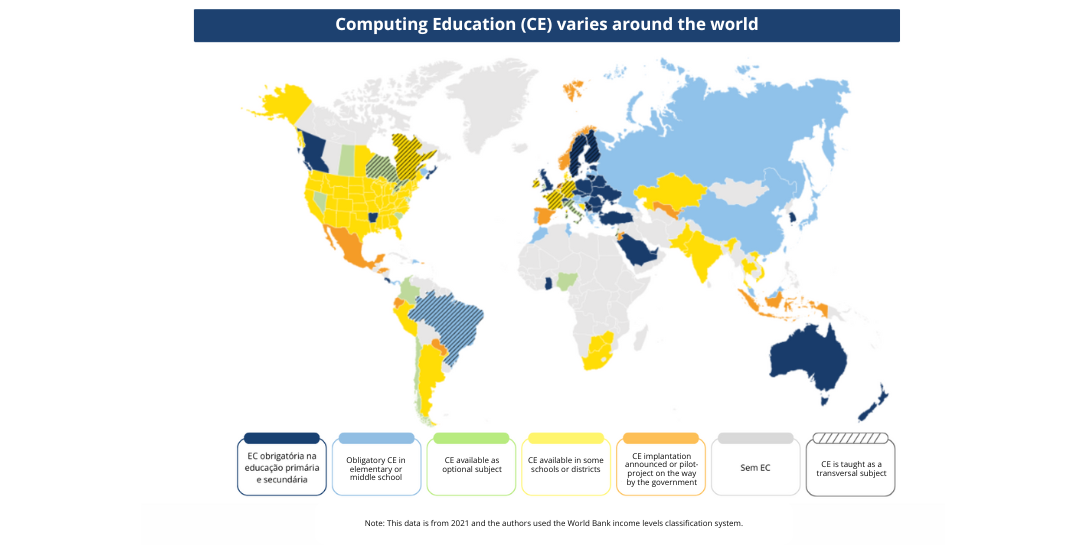
The National Council of Education (Conselho Nacional de Educação – CNE) is setting norms for Brazilian education digital literacy. Starting from November 2023, computation training will be obligatory in Brazil. The Common National Curricular Basis (A Base Nacional Comum Curricular – BNCC), instituted by resolution in 2017, will come into effect for elementary school and, gradually, also for high school.
The BNCC comprehensively incorporates the development of skills related to the responsible use of technologies, as it does with specific skills to better understand, create, and utilize communication and informational digital technologies in a critical, reflexive, and ethical way.
Christian Brackhamn, professor at the Federal Institute Farroupilha affirms that “these skills have to be discussed and implemented because they can be the difference between accessibility and exclusion”. He participated in the work group that created the Computation Norm in 2017. His pioneer doctoral dissertation in Brazil reflects on elementary school Computational Thinking from the point of view that takes it as a basic ability, just as reading and writing.
Such rationale requires a broad perspective on pedagogy. He says: “It doesn’t make sense, with the possibility of full-time access to information and data, to prioritize memorization, repetition, and the copy for the sake of the copy. On the contrary, it is vital to teach how to search and select the essential information, then to separate, break down, recognize patterns and to prepare the student to be able to, creatively and dynamically, face the problems in a specific scenario by making use of the critical thinking aided by a methodology that can help in the process of problem solving”.
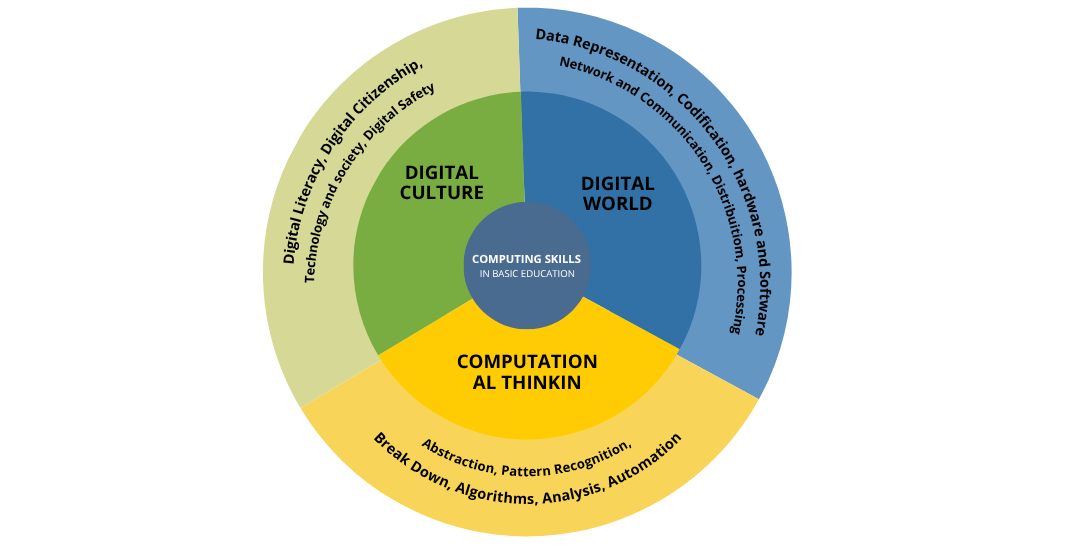
Christian states that digital literacy is just a part of basic education computation, and that it also covers digital culture, citizenship, technology, and society. “Digital culture is the use of technology with fluidity, and that also includes digital security, what means which information the child is filling out for social media in the classroom and how it can impact their lives.” According to him, technology fluidity is not just understanding how it works, but “knowing how to utilize this logic to create new solutions”.
The researcher explains that the Computation Norm is flexible. “It can begin with the training of elementary school teachers. That is up to the institution, with many possibilities. For example, in 2024, schools will be able to implement it starting from the first year; and after that, gradually, in subsequent years. These are implementation strategies to also take advantage of the school materials already utilized in previous years until the cycle is complete.”
Computation with just paper, pen, scissors, and pencil
Christian affirms that “nowadays, everything we do has something to do with a computer, a cellphone or another device. Beyond that, new professions have been requiring more and more knowledge to deal with computer programs, AI, and algorithms. If we don’t take that to basic education as soon as possible, the students will be left behind”.
He mentions a research made by Dell in 2018, which concludes that 85% of 2030 professions don’t even exist yet. “What are the professions the students will follow until then? In order to meet unknown future requirements, many things need to evolve besides schools, like the training of teachers in federal universities and institutes.
However, the conditions in Brazil are challenging and also need a change. Christian states that, referring the 2020 Basic Education School Census, 81,4% of Brazilian students go to public schools. Of these, 58% don’t have Internet in their classrooms; 53% of them have either a computer or a laptop and 5% don’t have electric power. “How are we supposed to work with these children?,” he asks.
These numbers made the researcher take the study of unplugged computation into consideration in his dissertation. “If I teach the students basic concepts of computation, using just paper, pen, scissors, and pencils, will it be possible to develop computational thinking by teaching ‘logic to solve problems’? The study shows it will.”
His research investigated children in the 5th grade in Brazil and Spain. As time progressed, he prepared workshops for the students, conducted tests before and after the workshop and, finally, another closing test. He evaluates that “it was possible to perceive a significant improvement in the computational development of the students”.
He understood that it is possible to teach computation completely offline, developing logic thinking to solve problems. “The students themselves have to be critical of what they are producing, interact with colleagues, as well as with the teacher for help, and then, repeat the cycle until they come to a conclusion. For example, if the algorithm created by the student has some kind of problem, they will have to find another way to solve it. Because tying your shoes is an algorithm; a cake recipe is an algorithm. It is the creation of a sequence of steps to solve a problem by breaking it down, by recognizing patterns, and by abstracting them. The whole process with just pen and paper, and such approach takes a new path into the digital culture as we know it, because computation is much more profound and critic.
If before the digital advent people would receive information passively, nowadays they ask questions and get answers, mostly after the arrival of massive Artificial Intelligence tools. Behind each information tool, however, there isn’t an “oracle”, if not algorithmic data. Christian affirms that there isn’t AI without these components, and that students need to figure out how to work with the technology.
“There is a model (ChatGPT, MidJourney, etc.), there is a specific algorithm database, and, through these inference algorithms, predictions – that we incorrectly call responses – emerge. Because of that, AI education is also at BNCC that will soon come into force at high school.
Christian Brackmann
According to the professor, AIs have the potential to both increase and decrease social inequalities. The solution to avoid disparity is free access: “The richer nations march on with more access and computational power, but the less developing countries don’t. Because of this, computation in basic level education is so important, to prepare these young people to this new scenario”.
Digital literacy is vital for citizenship, social inclusion, and job opportunities
Professor Crediné da Silva de Menezes, from the Graduate Program in Computing in Education (Programa de Pós-graduação em Informática na Educação – PGIE/UFRGS) and the Faculty of Education Basic Studies Department (Departamento de Estudos Básicos da Faculdade de Educação – FACED/UFRGS), shares the same belief. In the new emerging digital panorama, he reinforces that digital literacy is of extreme importance for citizenship, with efficient use of the communication tools and full access to the channels of information.
He guarantees that “more and more, social systems – like education, healthcare and culture – are migrating to the digital world. Any obstacle blocking citizens to fully integrate to this digital ecosystem makes them vulnerable, causing damage to their life quality. However, digital exclusion affects the elderly, the disabled, and the suburban communities more deeply. How to prepare these people to not be excluded from a world surrounded by technology?
To Crediné, it is not enough to know how to use a system. It is essential to have free access to the important tools for the exercise of social integration, like news, public services (healthcare, education, justice, jobs, banks, etc.). Accessibility in its fullness also includes training in the use of devices and digital systems, like software systems and devices, sites, social media, and internet platforms.
Beyond that, digital literacy can be the difference between having or not having a job nowadays. But, according to the professor, it is necessary to have a wider perspective on education. That means that just knowing how to operate these technologies is not sufficient to guarantee a job offer. In essence, the transformation of education will affect job efficiency.
Crediné explains that “the big problem with employability is in basic education. People with low education have limited job possibilities, now that automation is getting more present even in mechanical activities. On the other hand, digital literacy is fundamental for less mechanically heavy jobs. Because of that, it is crucial to know how to use digital tools to interact with different social systems and employ its potential in different situations, that is, developing skills that will give all they possibly can”.
He means to say that, in the digital context, with multimedia integration (data, texts, image, audio, virtual reality), it is of most importance to have a profound understanding over the use of these technological tools in an integrated as well as collective and in network.
“To know how to work in a team is essential, especially after the pandemic, which highlighted the potential of remote and collaborative work. The skill in the use of network production tools and the capacity to interact with non-human agents, like ChatGPT, must be included in the formation of new professionals, whether they belong to a technical or higher level education.”
Crediné de Menezes
In all the scenarios addressed here, digital literacy appears like a key factor so that all can fully take part in the social ecosystem and enjoy the benefits of this change, making use of the advances to build a better world. To build the bridge between digital literacy and education transformation it is necessary to prepare the teacher to act in this new environment.
Computational teaching versus digital literacy
The skills seen in BNCC can only be fully developed with the adequate formation of teachers for the instruction of the principles of Computation in Basic Education. This is the main objective of UFRGS’S Computation and Educational Robotics Degree Course conducted via Distance Education. The course’s Graduate Commission coordinator, Leila Ribeiro reflects: “this course’s objective is not to develop digital literacy, but to develop abilities that allow the students to comprehend and act with responsibility, autonomy and safety in the digital world. For that to happen, it is necessary to understand the principles of computation. In that way, they will naturally acquire digital literacy. The opposite, however, does not work the same way.”
Because of that, she insists on separating the concepts
“Digital literacy is important, but ideally, it should be a by-product of computation teaching, not an end in itself. We do not develop ‘critical thinking in technologies’, but ‘computational thinking’. Several countries around the world have started focusing on digital literacy and the use of computational tools, rather than fundamentals. Now they are having to review their curricular matrices, as technology cannot be understood without science”
Leila Ribeiro
Differences between digital literacy and education in computation
Education in computation: it teaches the Computer Science fundamentals, which allows one to better understand how the digital world and the digital technologies work, also allowing adequacy to new technologies
The teaching of digital technologies (digital literacy): it teaches how to use digital tools for many purposes, one of them to assist in education. Normally, this method focuses on specific tools and does not work on the principles behind said tool.
(source: Leila Ribeiro/COMGRAD/Curso de Licenciatura em Computação e Robótica Educativa/UFRGS)
Dysfunctional use of technology and mental health
If digital literacy is the education about technology to build critical thinking, on the other side, the absence of digital literacy can cause a series of problems regarding mental health that keep growing drastically, mostly among the new generations, including social isolation and even suicide.
Behavioral addictions combined to extensive use of technologies are the main investigation targets of the psychiatrist Thiago Henrique Roza, researcher at UFRGS’ Molecular Psychiatry Laboratory and also professor at the Federal University of Paraná.
Roza also studies the use of big data and machine learning in mental health and defends the hygienic use of technologies. In other words, just as we learn to brush our teeth after every meal or to manage sugar ingestion and keep a healthy diet, it is also necessary to keep a “healthy diet” when using technology: “That includes no screen periods, no social media, not even to check your messages. Keep the phone away”.
He says that digital illiteracy incites the occurrence of diverse harmful phenomena, amongst them, social and affective isolation that affects children, teenagers, and even adults, principally men in their late 30s to 40s. According to the psychiatrist, the proportion of people affected with depression, anxiety, and isolation is massive.
He alerts that “the newer generations are the ones that least interact in the real world”. He brings to the table a growing and alarming event that began in Japan and spread to the rest of the world, the hikikomori – there, more than half a million of young people (1,57% of the population) live without leaving their rooms for years.
Roza reports that “it isn’t just games and pornography. Nowadays we have “apartment hermits”, people that don’t leave their rooms and only talk with chatbots, avatars, and AI generated girls. These people literally fall in love with robots, they have issues creating real bonds, having real relationships and making friends. There are also cases of erectile dysfunction or premature ejaculation, of virgin grown men afraid of other human people ‘s rejection. But there is also suicide.
He explains: “In the mental health sphere, we see technological vices as a worrying factor, not to mention the medical difficulties to deal with it. Teenagers that grow up with technologies tend to see the world as a village and make unreal comparisons. That causes unhappiness towards reality, procrastination and social worthlessness. These technologies can drain us for not knowing how to deal with day-to-day difficulties”.
How can we escape that? For Roza, learning how to use these technologies with responsibility is essential. On the other hand, technology has also developed a major role in helping psychiatry, like the AI that can help to predict risks of suicide. According to him “the use of AI is still very imprecise due to lack of accuracy, but it is an encouraging possibility. Currently, in clinical practice (without the use of AI), the evaluation of suicidal risk by generalist medics is limited, for the task of assessing the suicidal ideation of a patient is, many times, carried out subjectively.
According to the study carried on by Ontario, a Province in Canada, approximately 67% of people that died because of suicide had consulted their medic of trust before the act. Beyond that, the suicidal risk evaluations had been performed in 87,1% of medical consultations. However, among those that died because of suicide, 39,8% had been classified by their medics as “without risk” and the other 50% as “with low risk”.
At the moment, internet and electronic gaming addiction is considered a dependency disorder – the World Health Organization (WHO) associates its occurrence to chemical dependency, with physical or mental consequences.
International Studies show the risks of excessive use of technology for mental health, relating them to signals of dissatisfaction with life, unhappiness and self-esteem issues, especially among teenagers. The relation between suicidal behavior and online activities, like Internet and social media surfing, is also an object of the current trend of research. In Brazil, more than half of the population can’t go a day without their cellphones, according to IBGE (Brazilian Institute of Geography and Statistics).
The challenge has a circular effect: digital literacy guarantees a critical and beneficial vision of technologies; it is necessary, however, to balance its use, which is an integral part of work, studies, leisure, and social interaction, considering the negative side effects on your mental and emotional health.
Translated into English by Artur Vasquez de Mello, undergraduate student enrolled in the course “Supervised Translation Training II (English)” of the Undergraduate Program in Language and Literature, under the supervision and translation revision of Professor Elizamari R. Becker (P.h.D.) – IL/UFRGS.