
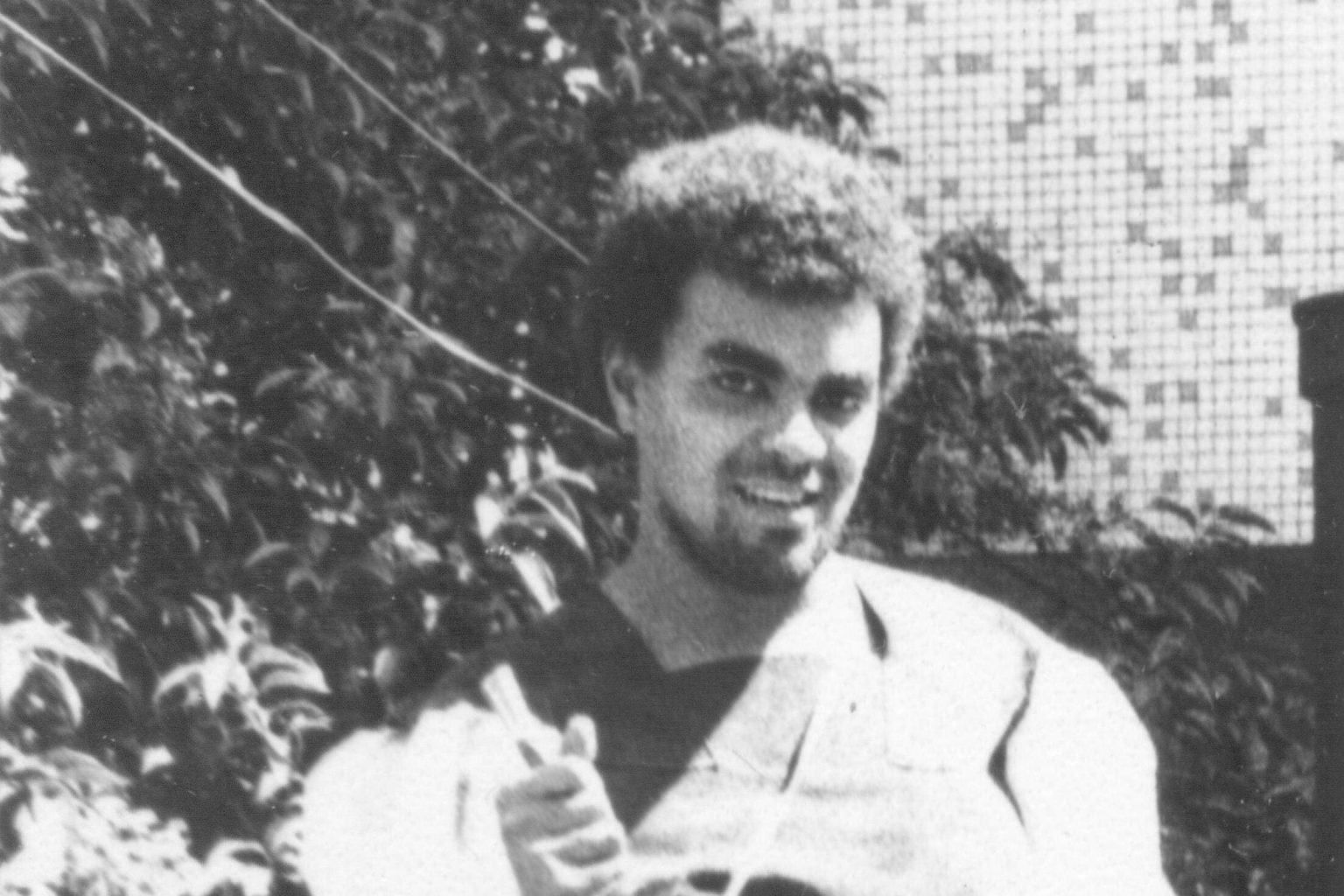
Scenic arts| Friends, family and stage partners recall the life and career of the actor, playwright, lighting designer, and director Hermes Mancilha, an important black representative for the dramaturgy of Porto Alegre
*By Pedro Henrique Tubiana Pereira
*First published November 16, 2023
*Photo: Hermes Mancilha, in a cutout picture of the cast from the play “Jato de Sangue”, from 1989 (Marcos Goldnadel)
On a sunny Sunday afternoon, the day of the week with the greatest amount of people passing by one of the most important parks in Porto Alegre, the image of the playwright Hermes Mancilha is brought out in front of the Redemption arc, notorious reference in this park, officially called Parque Farroupilha. The image is lifted by a theater group called Usina do Trabalho do Ator (UTA), on a staging inspired by a text from the author: “Zaze-Zaze, uma questão de fé”, adapted by the group to “Zaze-Zaze, uma festa para Vavó”.
The piece revolves around Vavó, a representation of the Brazilian black woman archetype. The narrative of the poor and old lady was used to dictating a melancholic tone to the original text, but UTA tried to bring optimism to the composition. Dedy Ricardo, member of UTA and professor for the Colégio de Aplicação at UFRGS explains: “We did not want to just talk about poverty, because we perceived a greatness of spirit, culture, life, and experience in the characters in the text.”
“The wish to honor Hermes, to honor black women; this play’s main character is a black woman”
Dedy Ricardo
Hermes’ Black Theater
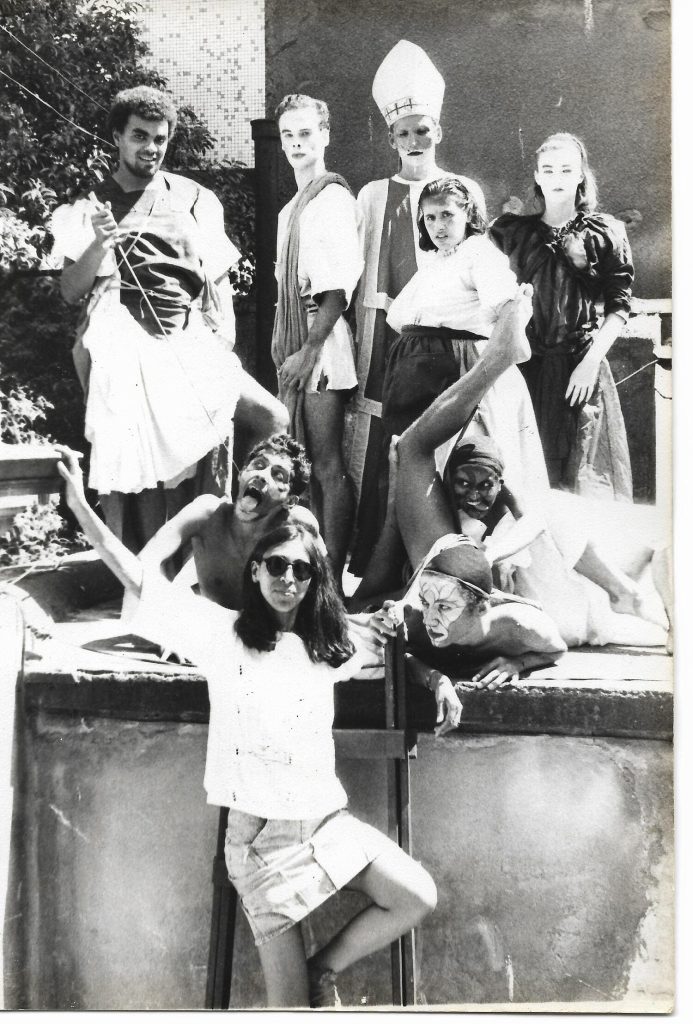
But after all, who is this enigmatic figure, honored on stage and upon whom the authorship of the staged text falls? Hermes Mancilha – or Hermes Hermeticus, as he used to sign his texts – was an important playwright that shook up the scene not only in Porto Alegre but also in the rest of the country.
Bearing the name of the Greek deity of communication, the actor, lighting designer, playwright, and director, Hermes was responsible for developing a very intricate black dramaturgy, making use of Greek myths and tragedies as a foundation for Afro-diasporic and distinctly Brazilian narratives.
Shirley Santos, long-term friend that inherited the material written by Hermes Mancilha, states that Ivo Bender, professor at the Department of Dramatic Arts (Departamento de Artes Dramáticas – DAD, in Portuguese) at UFRGS, was the one who gave Hermes the idea to call his own roots back in the writing of the text. In “Como a moça foi sacrificada pela sua família e como o rapaz a trouxe lá de baixo”, a play written for a college project, Hermes blackens Persephone’s tale, displacing it from the Mediterranean to a Brazilian community.
Despite having developed a very intricate black dramaturgy, a black cast was not always featured on stage. This fact is nothing more than a reflection of the predominantly white composition of both the student body and faculty in the Department of Dramatic Arts prior to the implementation of affirmative action policies at UFRGS.
Jessé Oliveira has been leading the theatre group Caixa Preta since its foundation in 2002. The group, composed of black people, does not solely work with Afro-diasporic narratives but also casts only black actors and actresses. Jessé also organized a cycle of dramatic readings in honor of Hermes Mancilha in 2018 during the period in which he directed the Casa de Cultura Mario Quintana (CCMQ). Jessé believes the adaptation of European tragedies to a more familiar black culture context has a fitting end: “Reinterpreting the classics is a form of rethinking what being universal is fact. What defines universal dramaturgy? Dealing with archetypes, human archetypes, human universality… Well, we, black people, are also humans, therefore we are also universal”.
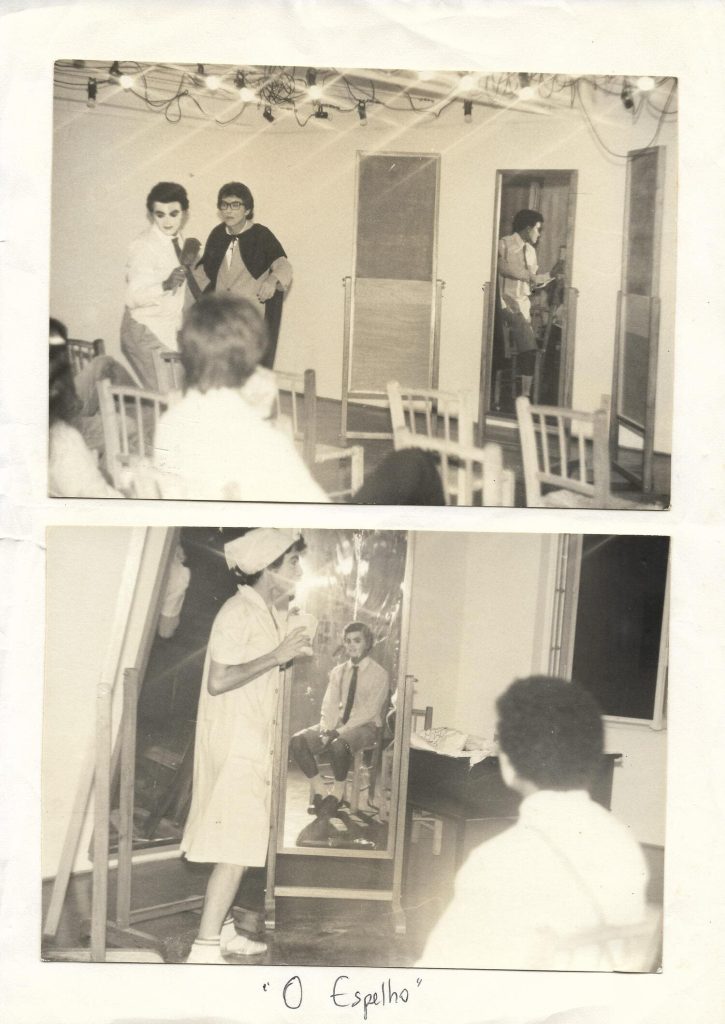
Photo: Getulio Amaral Margueri)
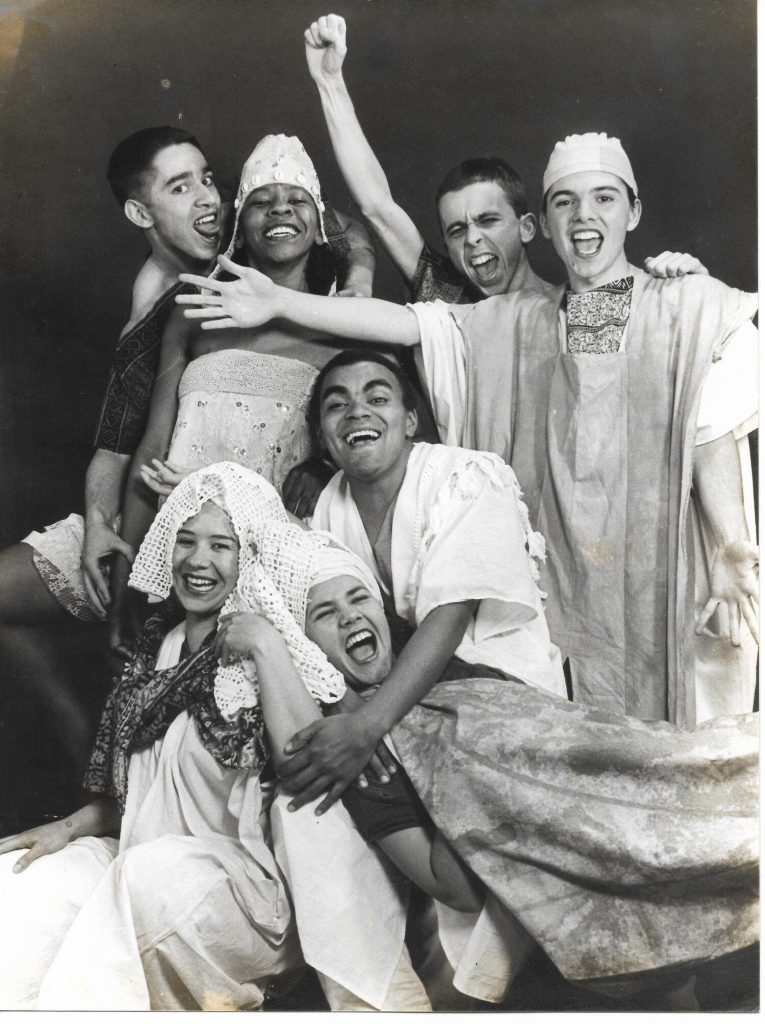
Photo: Irene Santos
The messenger and its message in motion
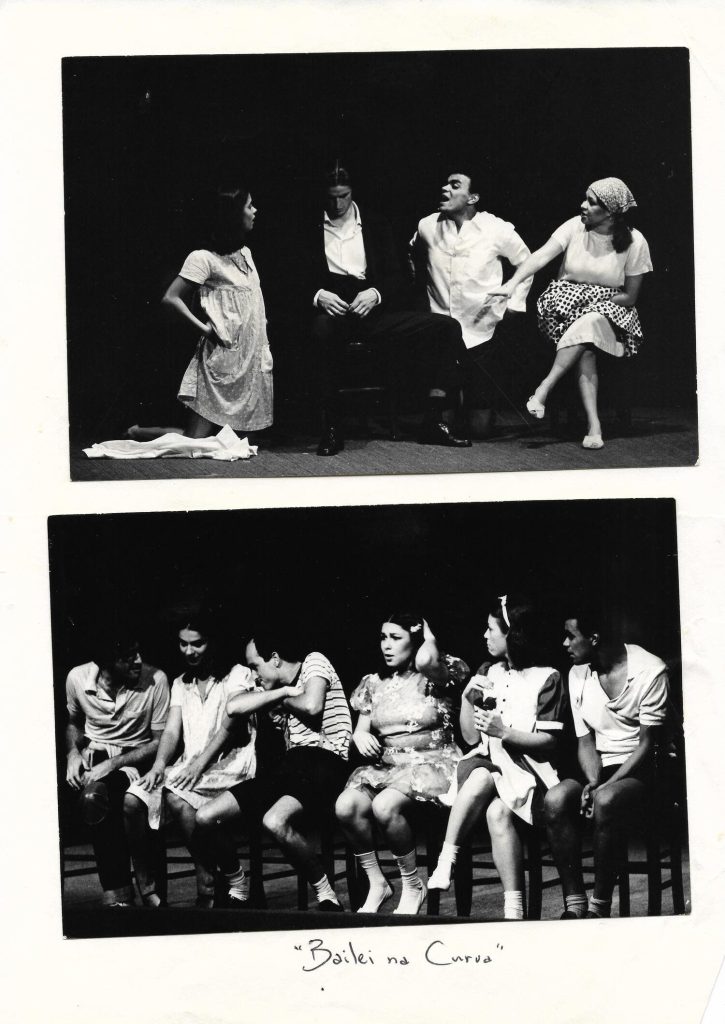
Júlio Conte and Hermes were co-workers who co-wrote the historic play “Bailei na Curva” (in direct translation, “I danced at the curve”, [idiomatic] which means losing control over something or inadvertently allowing something to slip from one’s grasp), a production that garnered acclaim across the state and country. Hermes was the only black actor in the cast. Julio discusses about Hermes’ character in Bailei, Pedro: “He is incorporated as an adopted child, what highly contributed to the play’s modern tone, which was no longer seen exclusively from the whiteness point of view, but from the point of view of an adopted black character, what means he experiences a situation of exclusion; and this character is precisely the ‘hero’ in the story”. Under Júlio’s direction, in the first decade of the XXI century, the CCMQ had one of its rooms named after Hermes.
It was also with Hermes Mancilha that Fernando Uchôa and other DAD students started an academic center specific for Theater students. Before that, Theater, Music and Visual Arts students were represented through only one academic directory, localized in the Arts Institute.
“Together we carried out a whole bureaucratic process to be able to formalize the existence of the Academic Center Dionysus, separating it from the other two arts, which stayed at the academic center inside the other building”, explained Fernando, who also added: “life, effervescence, and fight are the words that best describe Hermes. The first “Dionisíaca” – party organized by the Academic Center Dionysus that occupied the seven floors of the Institute of Arts (IA) building –, was, in homage to Fernando, the first party in Porto Alegre to distribute preservatives at the entrance.
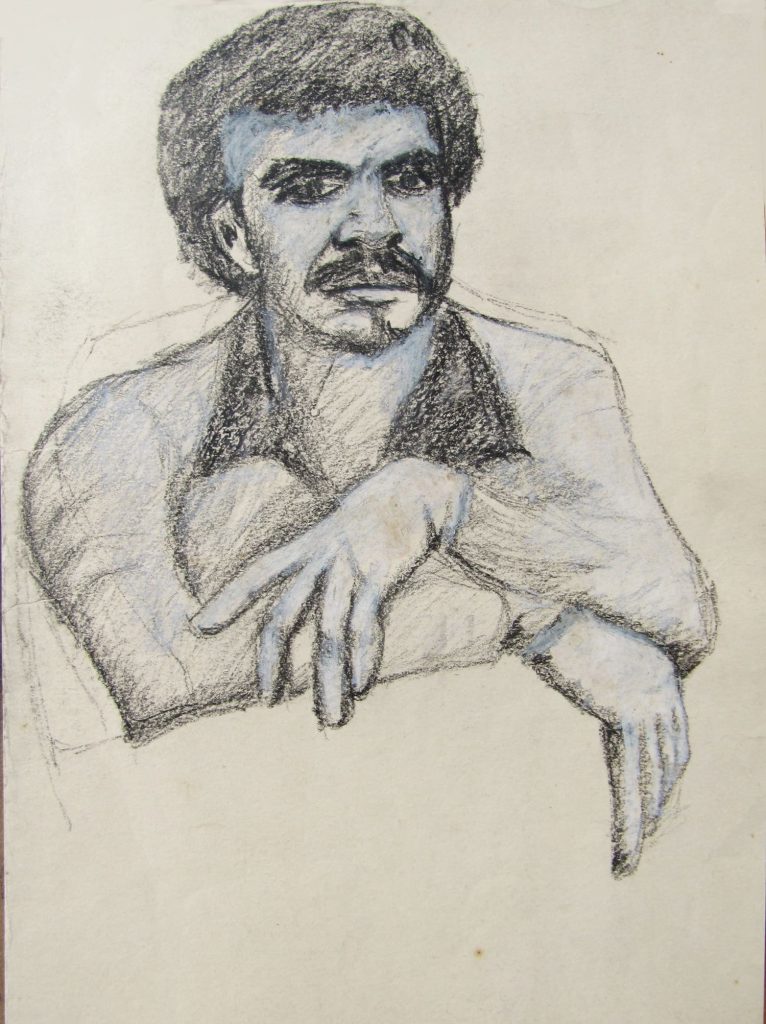
But it was not only through Dionisíaca that Hermes circulated across this other IA’s building. Visual Arts students at that time, like Fábio Valle, even had the chance to draw the figure of the playwright, who posed as a model for some classes at the Institute. Fabio says that he still has the image of a naked Hermes – roaming around in the corridors, covered only by a piece of cloth – fresh in his mind.
Hermes also extended his art and expertise to the Centro Humanístico Vida, a community center in the northeast region of Porto Alegre where he held theater workshops. Maria Isabel Gonçalves, a friend that he met in this project, reports a memorable moment: at some point, she decided to temporarily withdraw from Journalism school, and was Hermes the one to insist to his friend to keep on studying.
“Hermes was very esoteric; he used to apply eyeliner from time to time. We used to call him a half warlock. He was not very talkative; he would look at you and say strange things, that would later make sense”
Maria Isabel Gonçalves
Paulo Mancilha comments that his brother was the student who read the largest number of books in the school library they used to attend. Despite coming from a family with low purchasing power, Hermes got entrance into a federal university via an entrance exam. Paulo admired his brother’s resilience. Born in Camaquã, they grew up in Canoas, a metropolitan region of Porto Alegre. However, since he was very young, Paulo worked and attended school. And even though they were siblings, their storylines grew separate due to different agendas. About Hermes’ approximation to African-based religions, Paula says: “His “godmother” was a ialorixá; later in his adult life, he came to accomplish the “feitura”, the ritual to the orixá. He really liked it”.
The Hermetic riddles
For Júlio Conte, Hermes was like the Sphinx: “Decipher me or I devour you”. At the end of his days, he was getting sick, and little by little, he began to part ways with his friends, leaving them another one of his riddles –there were plenty of them. The riddle of death may be the least important compared to the magnitude and richness of the riddles about life proposed by the playwright. His enigmatic texts, presently kept by Shirley Santos, await some financial incentive so that, in a dignifying publication, they may reach the largest number of people.
In the recent interpretation of “Zaze-Zaze” staged by Usina do Trabalho do Ator, a popular saying, not present in the original text, is representative of Hermes’ work and the importance of keeping his memory alive: “Exu killed a bird yesterday with a stone he only threw today”. Time is not linear, and neither is the work of Hermes, even after his death. Hermes’ work and his legacy outlive him, and circulate in the past, present and future, searching for watchful eyes to decipher them.
Translated into English by Artur Vásquez de Mello, undergraduate student enrolled in the course “Supervised Translation Training I (English)” of the Undergraduate Program in Language and Literature, under the supervision and translation revision of Professor Elizamari R. Becker (P.h.D.) – IL/UFRGS.
:: Read in portuguese
Hermes Hermeticus: o mensageiro enigmático do Teatro