
Education | Teachers search for a personal way to implement an anti-racist pedagogy while emphasizing the need for deeper changes in the educational system
*By Isabela da Rosa Jardim
*First published March 30, 2023
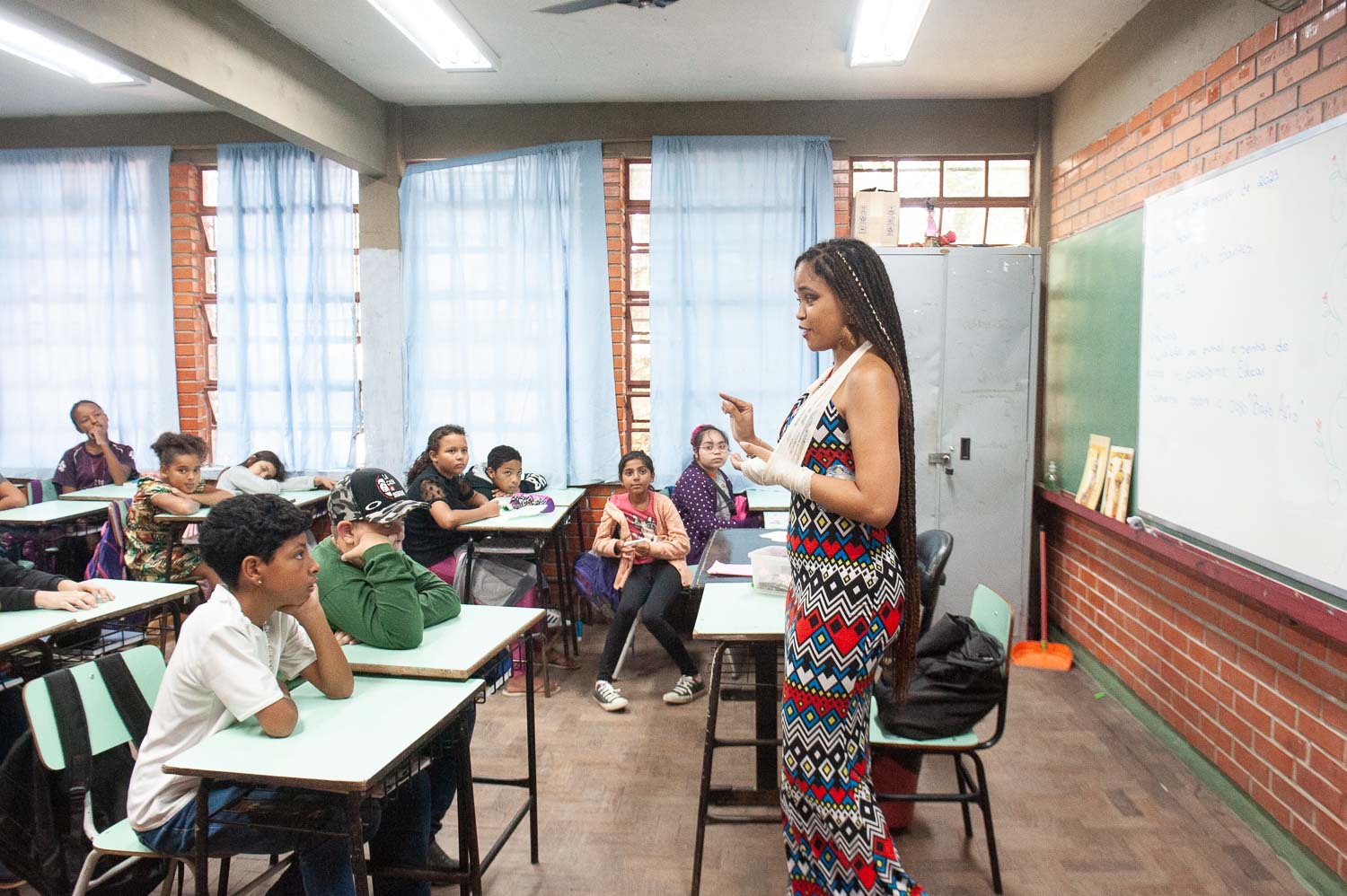
*Image: Flávio Dutra/JU – Teacher Perla Santos presents the project Nobreza Negra [Black Nobility] to her 5th-grade students at the Elementary School Lidovino Fanton, in the city of Porto Alegre
The LDB – Law on Brazilian Education Guidelines and Bases, approved in 1996, establishes the national parameters for basic education in Brazil. Since 2003, this law demands that all basic education schools include African and Afro-Brazilian culture and history in their curricula. In 2008, an addendum requires the history and culture of native peoples be also addressed by teachers. However, after years since the approval of these legislative guidelines, which aimed to fight religious intolerance and institutional racism, the reality in the Brazilian educational system does not comply with the law. There is still great resistance and even prejudice against some religious beliefs of African origin, and schools struggle to comply with the legislation due to a lack of budgetary resources and trained professionals to address these subjects with the students.
When Ana Paula Reis, Arts teacher, and doctorate student of Theater Arts at UFRGS, was assigned to teach Religious Education to her Middle School Art students, this was the scenario she faced. Aiming to fight the prejudice against students who follow religions of African origin and to promote a more diverse education, Reis decided to teach the history of all the religions practiced by her students. Her idea was to spark a friendly debate about the differences and similarities between their beliefs. During this work, Reis had to deal with discouragement from the school team, prejudice from fellow teachers, and a difficult reception from the families. Nevertheless, she kept her project and managed to create a respectful environment for her students where they could learn, feel more comfortable, and even bring elements of their beliefs into the classroom to share with their classmates.
Associate professor of the Department of Astronomy at UFRGS, Professor Alan Alves Brito reiterates that the difficulty in effectively implementing the legislation lies in the lack of appropriate teaching material, adequate training for teachers, and financing. Whilst Alves has obtained his degree in natural sciences, he decided to get more involved with the social issues that have been part of his daily life since he was a teenager. “I didn’t get to college by myself,” he says, alluding to his ancestry and his blackness. Alves also studies education for ethnic-racial relations.
To overcome obstacles regarding the fight against racism in education, Alves, alongside colleagues and students from UFRGS, decided to implement the program Zumbi Dandara dos Palmares [Zumbi Dandara from Palmares]. The initiative embraces the quilombola culture, which refers to the Afro-Brazilian residents of the quilombo settlements first established by enslaved people who escaped. The activities consist of research, debates, meetings, interventions, publications, documentaries and even teacher training to value quality quilombola education in several schools in the state of Rio Grande do Sul.
Visibility and representativeness
At Mário Quintana, seen as one of the most violent districts of the city of Porto Alegre, Letícia Gomes Farias elaborated her own initiative. Farias, who teaches at the Elementary School Deputado Victor Issler, decided to create a program to value the beliefs of students who followed religions of African origin. The idea came after observing the marginalization of these students during the end-of-the-year holidays. Since 2016, the Batucação Project, which consists of African music and dance presentations, won the students’ support and has been practiced regularly at the school.
Farias says that all activities are practiced with great responsibility and that the desire arose from the need to create a space of visibility for everyone. As she asserts, the Brazilian state is secular, “which means either the inexistence of religion manifestations in public spaces or the valorization of them all.”


Watch below a video of the Batucação Project, developed at the Elementary School Deputado Victor Issler, in the city of Porto Alegre:
Another example on the outskirts of Porto Alegre, the capital of Rio Grande do Sul, is an initiative of Perla Santos, a teacher who decided to create a game that would keep students’ attention in the classroom. Santos, who was looking for a way to explain the African diaspora to her elementary school students, noticed a growing interest in a card game called “bafo” in the classroom. She then developed an activity to combine the theme and the game. At that point in 2019, “Bafo Afro”, a card game with characters from African and Afro-Brazilian history, was created. Amazed by the stories of their own people and entertained by the game, the school’s students love it so much to the point they’ve encouraged Santos to develop other materials, such as notebook covers with African princesses, and to market her creations on social media.
Anti-racist education needs to be a collective process
Despite all the individual initiatives of public-school teachers who are concerned about anti-racist education, UFRGS professor Gladis Kaercher points out that there still must be a construction of more collective processes. According to her, these initiatives should involve school administration policies and specialized training on the subject. With this perspective in mind, Kaercher coordinates the UniAfro outreach program, which is currently in its 6th edition. The activity seeks to accomplish a practical impact on education through its own teaching materials and contributions to changes in the curriculum and in school management.
Actions such as those promoted by Kaercher, Farias, Santos, Brito, and Reis are isolated initiatives. They comprehend the result of efforts developed by the black movement to effectively implement the Law on Brazilian Education Guidelines and Bases and require the support of public policies to achieve deeper and more collective transformations in Brazil’s educational system. According to Kaercher, society’s demand for change and the need to overcome institutionalized racism have become increasingly urgent in the last decade. This leads her to believe that the next generations will be able to make more and more significant changes in this context.


Translated into English by Isabel Chiele Cony Marques dos Santos, undergraduate student enrolled in the course “Supervised Translation Training I (English)” of the Undergraduate Program in Language and Literature, under the supervision and translation revision of Professor Elizamari R. Becker (P.h.D.) – IL/UFRGS.
:: Read in Portuguese:
Iniciativas promovem ensino de cultura africana e afrobrasileira em escolas públicas