Diffusion | New technologies and their environments enhance access to science. However, content interaction, sensibility, and contextualization remain imperative to comprehend distinct knowledge, researchers evaluate
*By Ronaldo Botelho
*First published March 7th, 2024
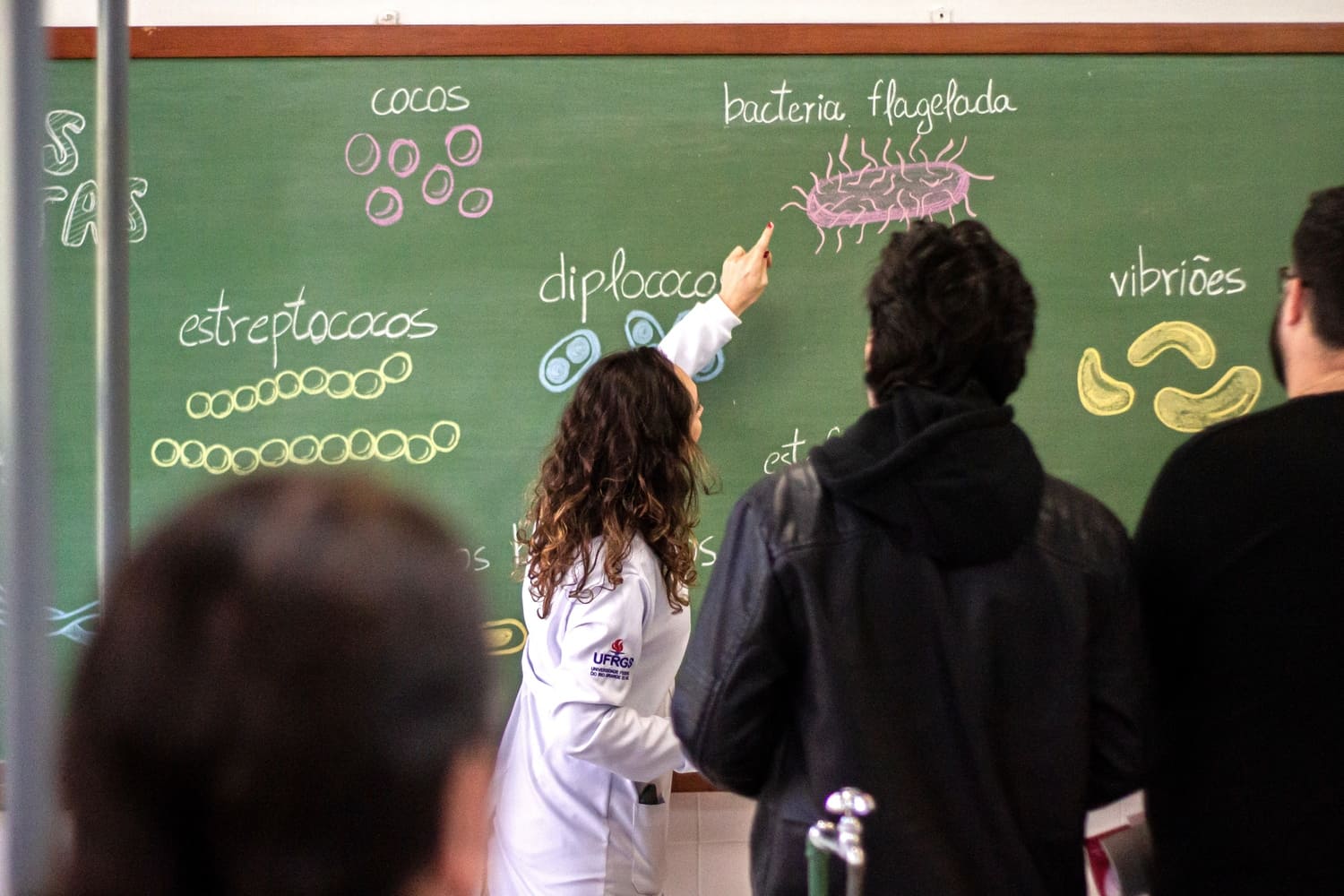
*Photo: Inside classroom, students have access to science in a technical way, however, they can still bring knowledge learned outside school environments, like those acquired from books and magazines, to help in their understanding (Photo: Marcelo Pires/JU)
“At the age of 10, when I was studying in a convent school, my father gave me a collectible sticker album called El Porqué de las cosas. It had more than 200 stickers that encompassed all science fields. I remember how it engaged the children in my community. I used to be a curious girl: that album sparked my interest in reading, I became very inquisitive about health and the like.”
This memory from researcher Elvira Alicia Aparicio Cordero about her first encounter with science in Jauja, her hometown in Peru’s countryside, is far from the truth regarding many urban children today, dominated by technology and virtual relationships. “The city barely had a phone landline and TV reception. People communicated through telegraph and radio,” recalls the researcher over four decades later. What still remains the same is the invitation to curiosity among young people as an important factor to spark interest in discovering how things work, and the relevancy of encouraging this through science diffusion initiatives.
However, while in recent years the spectrum, means, volume, and speed of information diffusion have rapidly transferred – thus changing the way science is accessed –, this doesn’t necessarily mean that academic knowledge has been popularized at an equivalent pace and quality. Relying on resources managed by the State, in which interests shift with each government, it is not uncommon that public policies for science diffusion, along with programs and projects in this sector, advance out of sync with local demands.

“Brazilian public schools, especially in differentiated education projects, such as quilombola and indigenous schools, faced structural problems regarding access to computers, internet, and digital culture,” notes Alan Alves Brito, professor for the Physics Institute, and an enthusiast on extending academic knowledge beyond university walls. “There is also a fundamental issue regarding initial and ongoing teacher training for computational and digital literacy,” he adds.
Access to technologies – and teacher training to utilize them –, however, is just one of many aspects surrounding the challenge of science diffusion. The school environment, rigid curriculum, limited use of textbooks, myths and prejudices in science, historical devaluation of some fields over others. This broad spectrum of conditions still presents itself to educators as both obstacles and opportunities in the endeavor of translating unusual knowledge into engaging and enjoyable learning experiences. Within the university context, outreach programs are one of these possible dimensions.
Access and Interests
Elvira’s journey is, in a sense, also an example of overcoming these contradictions. Now a naturalized Brazilian and a PhD in Physiology by UFRGS, she works in the Institutional Development Support Program for the Unified Health System of the Moinhos de Vento Hospital (PROADI-SUS – HMV). Before that, however, her academic path involved significant work with school communities.
In 2017, Elvira collaborated with her former postdoc colleague, professor Cristina Campos Carraro, in designing the project “Physiology in School, Science in Everyday Life”. The initiative has health science undergraduate and graduate students to give lectures in schools in the capital and metropolitan region. Topics covered include pregnancy, sexually transmitted diseases, mental health, vaccines, drugs, body care, among other subjects.
“Having attended students from public schools and closely seen their reality, this project contributed to my educational, professional, and social growth. It also helped me in learning the importance of caring for the body and knowing how it functions as a whole.”
Elvira Alicia Aparicio Cordero
Linked to UFRGS’ Graduate Program in Physiology, the project was paused in 2019 and resumed in 2022 under Cristina’s coordination, now as associate professor at the Cardiovascular Physiology Laboratory. With a team of three professors, six students from that program and a science diffusion scholarship holder, this work has already reached approximately 600 students from Porto Alegre public and private schools.
The Science in Society, Science in School Program – in the scholarship modalities BIPOP (Science Popularization) and BIENC (Science Teaching), encourages university programs coordinated by faculty members interested in developing action in this area, granting scholarships to undergraduate students. The teaching scholarship is aimed at activities in school environments, while the popularization scholarship targets actions in non-formal education spaces (museums, industries, parks, NGOs, etc.).
“These scholarships are within the undergraduate scientific research scope, always directed to the supervisor, but they can arise from student initiative, even at the beginning of their undergraduate training,” explains Bruna Bertoglio Lorenzoni, a technician in UFRGS’ Undergraduate Scientific Research Division of the Research Department, herself with a doctorate in Science Education.
Challenges building partnerships
Although regular activities are carried out in school environments, one of the difficulties in implementing actions regards identifying the demand. “We could assist many more schools, but this doesn’t happen due to communication obstacles. I search for schools’ phone numbers on the internet and call them. They then give me the principal’s or the coordinator’s phone number, but it’s often hard to reach them,” explains Professor Cristina.
Another challenge in establishing partnerships between schools and external scientific projects regards the content proposals. “Many of these projects do not offer adequate continuity with the school calendar or do not address the institution’s most urgent needs. This can lead to hindrance, mistrust, or even discontinuation by the school,” observes pedagogue Vanise Baptista, also a UFRGS staff member and author of the master’s thesis “The Popularization of Science from the Analysis of the Program ‘Science in Society, Science in School’ developed by the Federal University of Rio Grande do Sul.”
In her research, Vanise explores the possibility of “diffusing science through a bridge between the University and other institutions through non-formal knowledge dissemination, accompanied by a network of cultural, scientific, and educational resources, giving voice to each social group that adheres to the offered project,” she explains. The research covers the period between 2009 and 2013 during the validity of that program.
Under a governmental concept, the diffusion of science involves “the act of spreading and disseminating science to society as a whole, amid many social, environmental, economic, and technological challenges, among other issues” (MCTI). This definition is, however, also conceived from other perspectives. In their article “Popularization of Science: A Conceptual Review,” professors Marcelo Gomes Germano (UEPB) and Wojciech Andrzej Kulesza (UFPB) highlight, for example, this concept through the dimensions of popular education, idea transposition, and recreation.
Discourses and Hierarchies
From another perspective, Professor Alan Alves Brito highlights the stereotypes amidst science knowledge construction as a limiting factor for science comprehension in schools. “The discourse of the “scientific authority” is the dominant one in scientific experiences. There’s a predominance of the positivist bias of the sciences, always seen as neutral, objective, non-theoretical and non-historical. Personally, I believe that there must be dialogue among all sciences, which need to be committed to democracy in the deepest sense of the word.”
Professor Marília Forgearini Nunes, from the Faculty of Education, emphasizes that this contrasting image that separates scientific practice from what is done in school is due to several reasons, such as lack of infrastructure, lack of support for study and research and the perpetual traditional view of what it means to do science.
“The theory-practice relation, approached under the order of difference and not of complementarity, also reinforces the distance,” analyzes Marília, professor in the Department of Teaching and Curriculum, in the area of Elementary school didactics, reading and writing.
For her, there are traditional spaces in school – such as the school library and the sports court – that have potential for developing scientific learning and that should be more thoroughly explored.
“Scientific practice is still read under the exclusive perspective of activities associated with the natural sciences, and not with the actual [general] aspect of it that involves imagination, a method to approach a problem and a solution, a process that can be applied to any field of formalized knowledge or life.”
Marília Forgearini Nunes
Under the perspective of relations between school subjects and their visibility in the approach of scientific image, Alan highlights another issue, a certain hierarchy among fields. “Human and social sciences came into science history as minor or subsidiary sciences, which is absurd, as human and social sciences not only have their own theoretical, methodological, and epistemic particular structure, but are also fundamental in helping us interpret and describe scopes of reality,” he explains.
Recognizing this, the professor values the role of several fields in awakening scientific interest in learning. “There’s certainly a political project of power behind this hierarchization. Personally, I believe that there must be dialogue among all sciences, which need to be committed to democracy in the deepest sense of the word,” he concludes.

Textbooks, screens and practices
The rapid acceleration of new technologies as sources of entertainment, information, and consumption is transforming social relations and results in new patterns of education that affect the school environment directly. There, the textbook is sometimes underestimated or even deprived of its legitimate value as a valid working resource.
However, for Professor Marcos Roberto de Oliveira, from the Biochemistry Department at UFRGS, textbooks remain the most reliable source of knowledge for students in any field, even if it becomes necessary to consider other means.
“The textbooks are the initial guide in the journey and fulfill their role very well. However, in my field, the “famous” Biochemistry, it is known that they are not enough due to the complexity of the topics we cover there,” believes Marcos. Professor Alan, on the other hand, emphasizes the importance of textbooks as an accessible and democratic alternative.
“In many cases, the textbook is the only possibility. Despite any criticisms we may have over it, I consider Brazil’s National Program for Textbooks and Didactic Materials to be a successful public policy that should be strengthened,” Alan Alves Brito
Another question that emerges concerning the challenge of science diffusion is how to constructively interfere in this environment of new media. For professor Marília Forgearini, new media are not necessarily an obstacle to scientific practice. “Just as different means of communication had their moments of being considered obstacles, the cellphone is now in this position. Once again, we are challenged to understand how to use this communication tool that can also be important to scientific education,” she believes.
Professor Alan, on the other hand, sees the environments provided by technologies as instrumental possibilities for scientific production in schools. “Social media and digital technologies have amplified the voices of diverse people, and in these processes, more than ever, we need to deepen our understanding on how dialogue between scientists and non-scientists should occur, understanding that scientific and popular knowledge feed into each other,” he notes.
Indeed, the emergence of digital platforms as accessible, inexpensive, and extensive technologies has provided visibility to several creators and disseminators of content – commonly known as influencers – also opening new doors for science diffusion. In this regard, Brazilian physicist Larissa Santos, working in China, was featured prominently in a national magazine for her scientific diffusion work through her profile Bariogênese.
Bringing this to the current debate, Professor Alan believes that new media and their channels demand from educators a mediating role in interpreting the information accessed in the technological supports. “Teachers are fundamental in helping students “translate” information. The cell phone itself is an example of technology application made possible due to the development of science, which is not detached from the cultural industry,” he considers.
“The broader and more accessible the knowledge, and language conveying it, the better”
Marcos Roberto de Oliveira
Precisely about this aspect, Professor Marcos points out the consumerist nature of information in these fields. “Discussing metabolism became more about marketing than science, health maintenance, and disease prevention. It is important that students have indications of how close scientific knowledge is, and not distant, as we see in science fiction films,” he advises.
Learn more:
Science in Society, Science in Schools Program (in Portuguese, Programa Ciência na Sociedade Ciência na Escola) – an initiative by the Research Department that includes projects under the Undergraduate Research Scholarship for Popularization of Science (BIPOP – Bolsa de Iniciação à Popularização da Ciência) and Undergraduate Research Scholarship for Teaching Sciences (BIENC – Bolsa de Iniciação ao Ensino de Ciências) modalities.
Physiology in School, Science in Everyday Life– a project developed by the UFRGS Postgraduate Program in Physiology, offering lectures in public schools in Porto Alegre. Contact Professor Cristina Campos Carraro at cristinacamposcarraro@gmail.com.
Metabolism Channel – Dr. Marcos Roberto de Oliveira – tips, clarifications, and information on human metabolism and related topics.
Translated into English by Kethlyn Santos Machado, undergraduate student enrolled in the course “Supervised Translation Training I (English)” of the Undergraduate Program in Language and Literature, under the supervision and translation revision of Professor Elizamari R. Becker (PhD) – IL/UFRGS.