
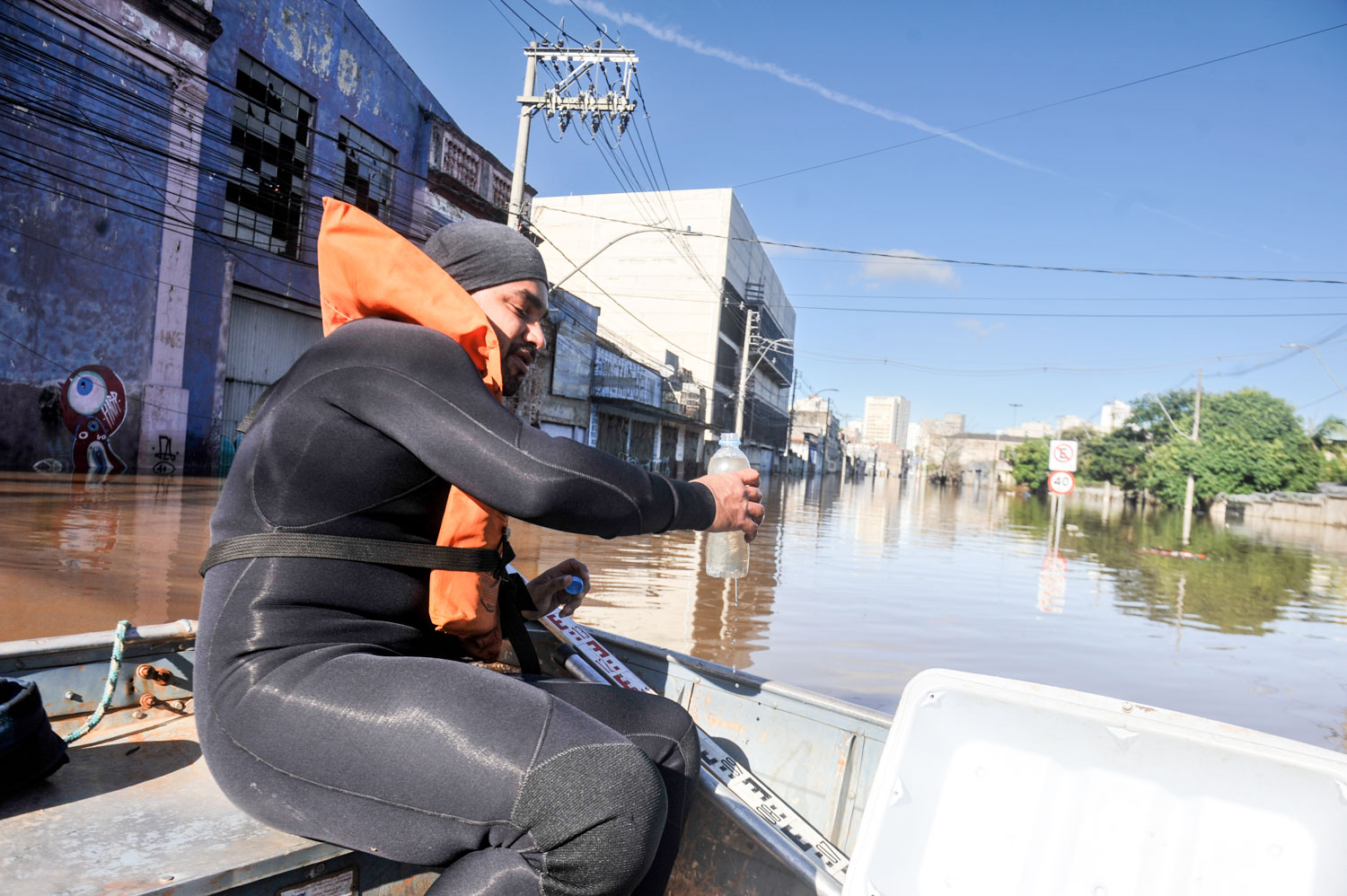
Research and Action | In addition to conducting studies and mapping hydrological and hydrodynamic conditions, researchers from the Institute are also involved in the rescue of people and animals stranded by the flooding
*By: Cristiane Miglioranza
*First published May 15, 2024
*Photo: IPH professor Maurício Paixão is part of the team collecting water samples (Credit: Flávio Dutra/JU)
Professors, technicians, and students from the Hydraulic Research Institute (IPH) at UFRGS are working intensively to collect and process water samples from various points along Lake Guaíba. In collaboration with other university laboratories, they are forming a network of partners to carry out physical-chemical analyses and tests for organic and pathogenic compounds in order to assess the quality of the floodwater.
The results will be made available on a map created by students using Google Maps, which already includes the flood extent and an overview of the protection system, highlighting locations such as shelters, pump houses, and water supply stations. “This is a collective effort involving intense, integrated, and coordinated work to deliver fast responses,” explains IPH professor Maurício Paixão.
Joining the network are the Institute of Basic Health Sciences (ICBS) and researchers from the Institute of Chemistry. The initiative is also awaiting a response from the State Center for Health Surveillance (CEVS), which may add to the ongoing efforts.
For at least five days, the team has been collecting samples from around 80 locations stretching from the Humaitá neighborhood to Lami, as well as five additional points on the opposite shore of Lake Guaíba. Each sampling point is recorded via GPS. Once the samples arrive at IPH, they are received by a team of graduate students from the Postgraduate Program in Water Resources and Environmental Sanitation (PPGRHSA).
During our visit to the IPH laboratory on the afternoon of Tuesday, May 14, doctoral student Marcos Ribeiro and master’s students Lucas Bohnenberger and Vinicius Soroka were working alongside technician Louidi Lauer. The team is supported by other graduate and undergraduate students from programs such as Water Resources Engineering and Environmental Engineering.

The idea to combine the rescue operations carried out by the IPH team with water sample collection came from Professor Salatiel Wohlmuth da Silva. The purpose of the analyses is to detect the presence of pathogens responsible for major waterborne diseases, such as cholera, typhoid fever, paratyphoid fever, amebiasis, schistosomiasis, hookworm, infectious hepatitis, poliomyelitis, enteroviruses, metro viruses, and leptospirosis, as well as emerging contaminants, including pesticides, pharmaceuticals, and heavy metals like lead, chromium, and mercury.
Drawing on an extensive data set — including records from previous floods in 1941, 1967, and 2023 — students, technicians, and professors are working in the Hydrometry Laboratory using watershed models and meteorological data to simulate both hydrological conditions (related to the water cycle) and hydrodynamic conditions (related to the water movement). They assess multiple scenarios, such as with or without wind and rainfall, and compare their findings to both American and European modeling standards.
“It’s a mapping of sensitive areas and the potential flood depths in the streets,” explains environmental engineer and PhD student in Water Resources, Leonardo Laipelt. With the support of current technologies, data quality is being significantly improved. “There is no historical record of flood events with the amount of data we have been collecting in the 2024 flood. Our goal is to provide data for a wide range of research and to support the development of public policy. Science exists for the benefit of society — it must serve everyone,” emphasizes Professor Maurício Paixão.
“The road ahead is long, and this is a wake-up call for the entire country. We must draw attention to the urgent need for increased public and private investment in institutions of excellence. If we’re able to do so much with limited resources, imagine what we could achieve with proper funding.”
Maurício Paixão
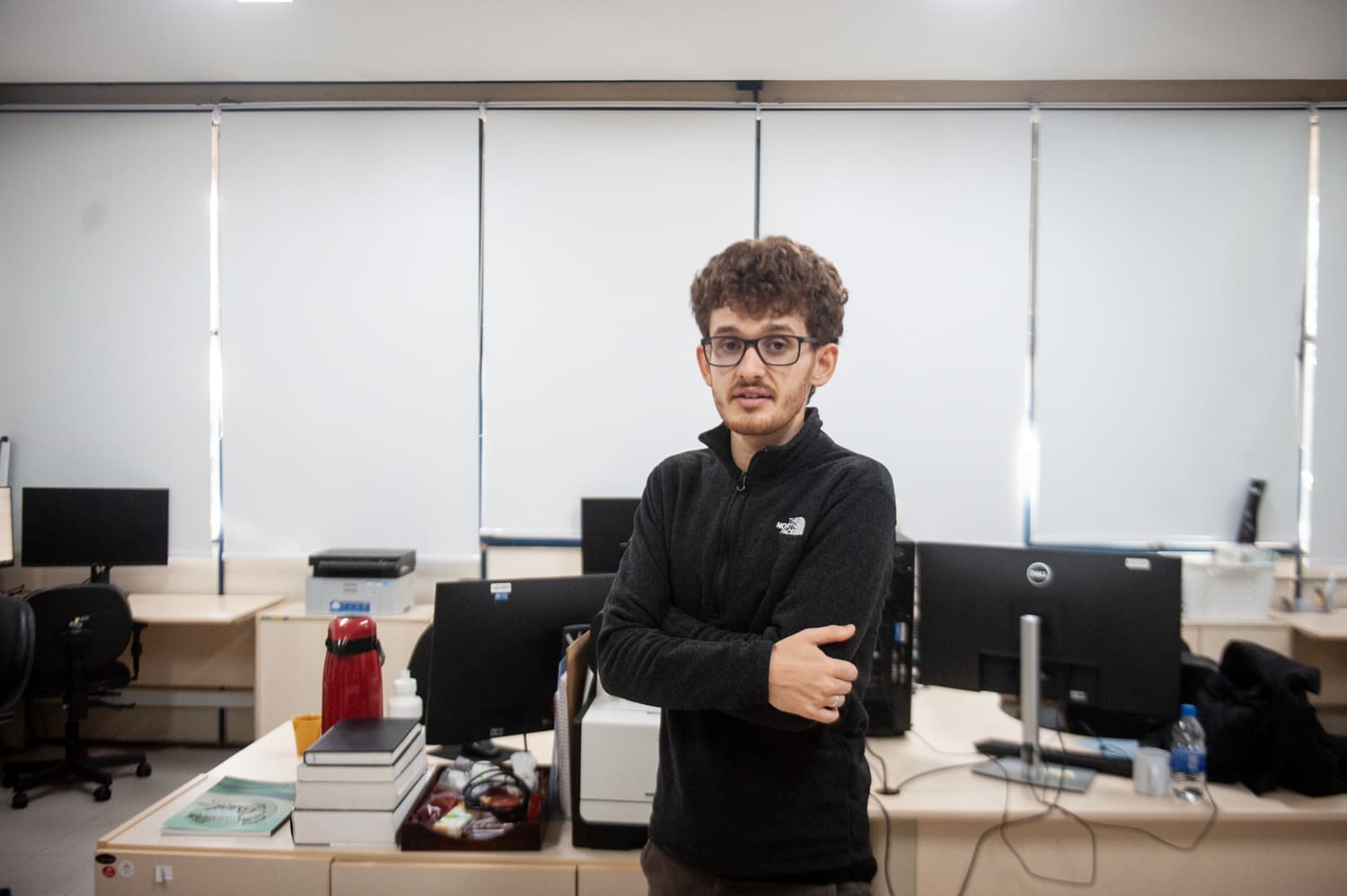
Rescue Operations
IPH Boats Initially Focused on Rescuing People and Animals Before Expanding to Water Sample Collection
At first, IPH boats were used exclusively to rescue people and animals from flooded areas. Soon, water sample collection was added to their mission. “We have trained technicians to be qualified to operate the boats — at one point, we were using three vessels simultaneously. This operation involves about 15 people from IPH and Frota, a group of contracted drivers who handle the support vehicles,” explains Professor Maurício Paixão.
In the early days of the disaster, rescue efforts were concentrated in the Humaitá neighborhood and the nearby islands. “We lost count of how many people we rescued, but we can say it was in the hundreds,” says technician Louidi Lauer. Each boat carried eight to ten people per trip. In animal rescues, that number was even higher. “We rescued dogs, cats, chickens — even a goat,” Lauer recalls.
Every outing included at least one local resident onboard. “This isn’t a river, it’s a city — so local knowledge is crucial. Only the residents know where obstacles like street signs, fences, or submerged cars might be,” Paixão notes.
Rescue requests reached the team through messages received at a command center set up inside the Bourbon supermarket on Assis Brasil Avenue. Showing one of the handwritten notes requesting help, Lauer adds: “These will be preserved in the IPH Museum.”
One of the most challenging rescues involved a person suspected of having a spinal fracture, who had to be transported on a rigid stretcher. The operation took three hours. “We had to remove windows and build makeshift supports to get them out safely,” Paixão recalls.
The researchers also witnessed the growing insecurity in the flooded neighborhoods. “Humaitá was becoming dangerous. We started hearing gunshots in the air during the first days. Eventually, we had to move around with National Security agents. Social issues adapt to the crisis,” explains Paixão.
Academic Unit
The Institute of Hydraulic Research (IPH) is located on the UFRGS Vale Campus and conducts teaching, research, and outreach activities in the fields of hydraulics, water resources, and the environment. Established in 1953, the institute was initially created to carry out research and consulting in the area of scale modeling for river and coastal hydraulic engineering projects, while also supporting engineering programs through its teaching laboratory.
In 1969, with the implementation of a graduate program supported by UNESCO, IPH expanded its scope to include community services. Today, the Institute houses 16 laboratories dedicated to research.
IPH is responsible for the Environmental Engineering and Water Resources Engineering undergraduate programs and offers courses related to water for more than 12 academic programs across UFRGS. At the graduate level, it offers master’s and doctoral programs in Water Resources and Environmental Sanitation. The Institute is recognized as a leading center in its field both in Brazil and Latin America and maintains international partnerships with institutions from nearly every continent.
Translated into English by Amanda Cavagnoli Andreotti, undergraduate student enrolled in the course “Supervised Translation Training I (English)” of the Undergraduate Program in Language and Literature, under the supervision and translation revision of Professor Elizamari R. Becker (P.h.D.) – IL/UFRGS.