
Education | In Brazil, the number of undergraduate students 60 years of age and older has increased, according to the Higher Education Census (CENSUP). Nowadays, the Higher Education in Brazil is composed of more than 40 thousand elderly people
*By Fernanda Simoneto Machado
*First published December 8th, 2022
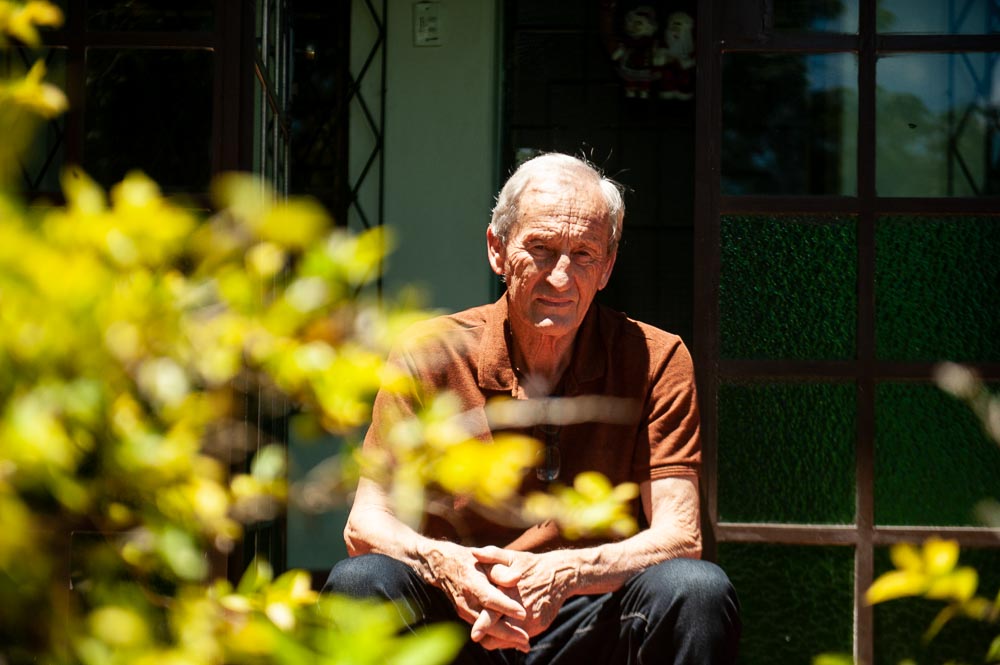
*Photo: Flávio Dutra/JU
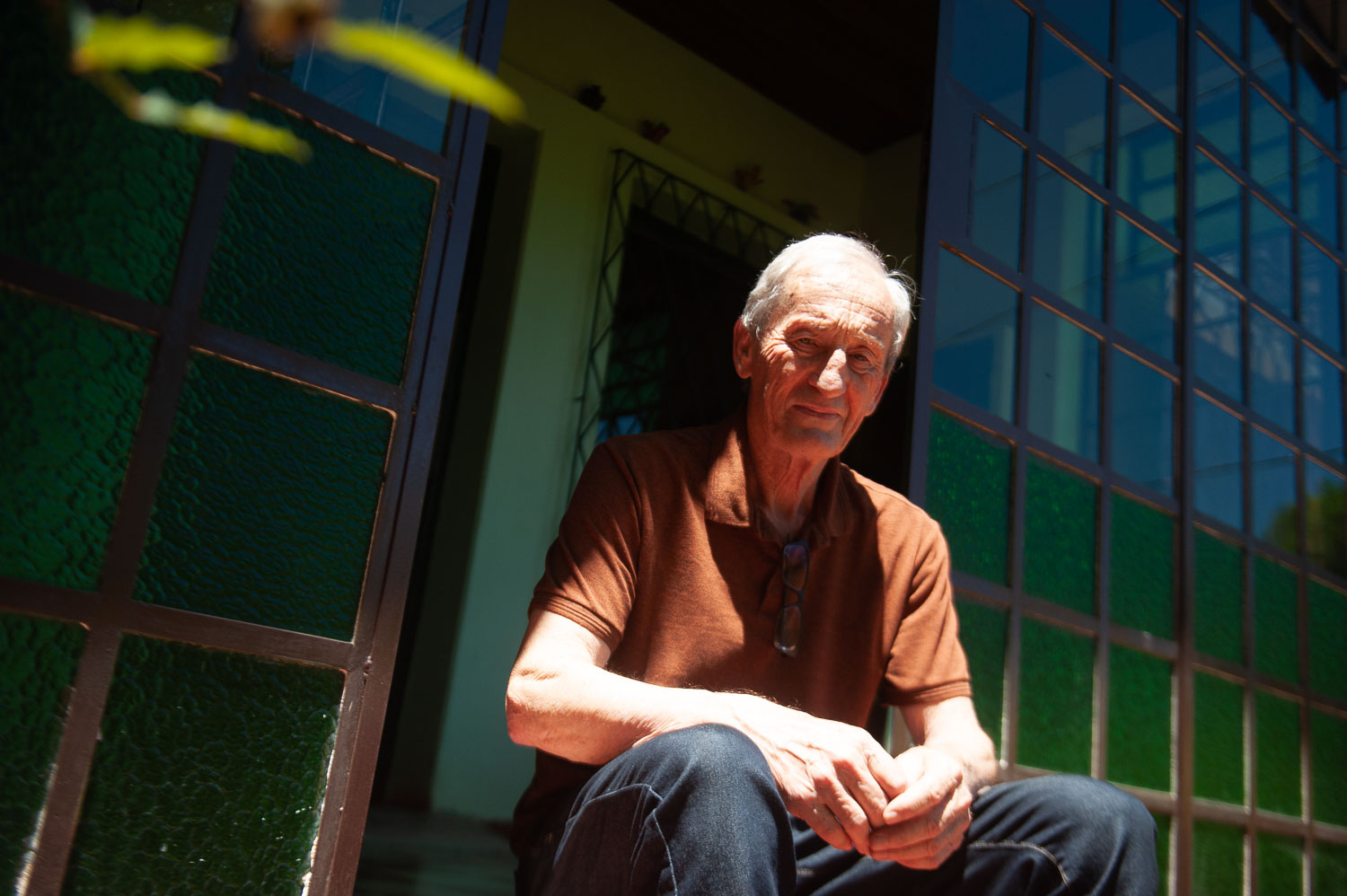
Hélio Vicente Fontana, who is 70, shows his excitement when talking about his undergraduate course. He started his Countryside Studies course in 2020 and he says fearlessly that “it is never too late to pursue happiness in school”. Vera Lúcia Pereira dos Santos, also known as Verinha, is 68 and a graduate from the Language and Literature, and Administration courses at UFRGS. After some time, she decided to come back to UFRGS and enrolled in Theater Arts, with emphasis on Dramatic Writing. “Those who no longer want to learn, have retired from life,” she says.
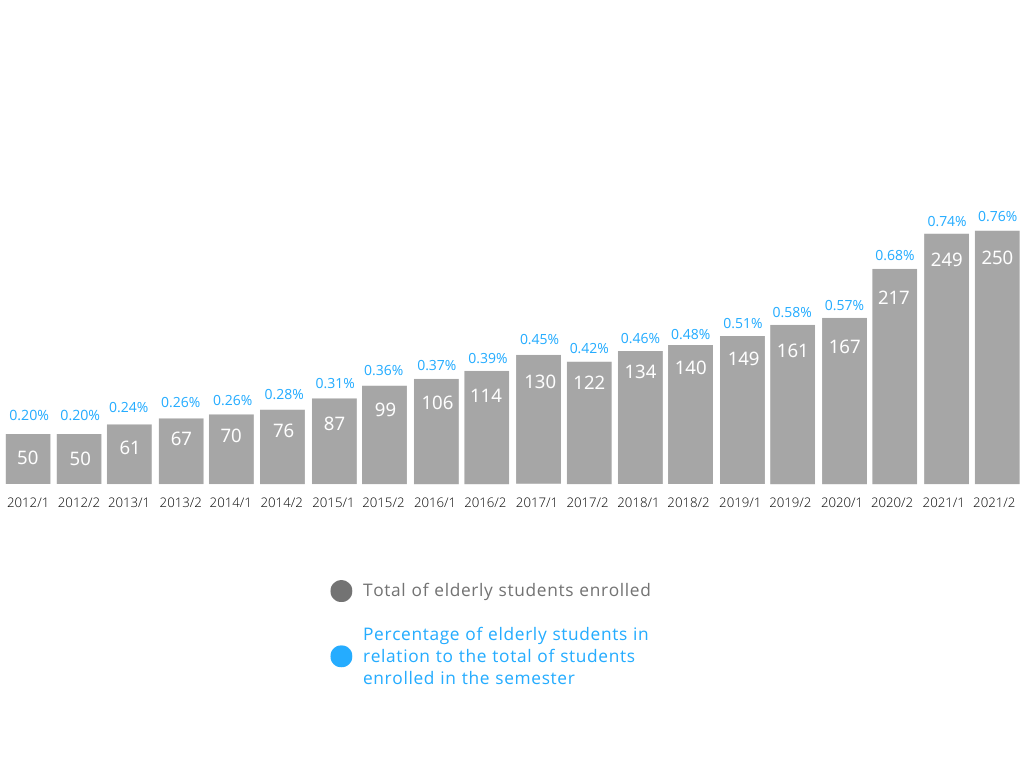
Hélio and Vera are two of the 250 students who are 60 years of age and over and have enrolled in the university in the second term of 2021, according to data from Jornal da Universidade; and the number is still increasing. In 2012, there were 50 elderly students at UFRGS. In 2015, the number was 87. In 2021, it was 250. Therefore, it was a percentage increase of 400% in comparison to 2012.
The scenario at UFRGS corresponds to the Brazilian numbers, as there are 43.722 elderly people enrolled in Brazil’s Higher Education, according to Higher Education Census (CENSUP) from 2021. This number represents an increase of 55% in comparison to the Census from 2012, when there were 28.041 elderly people enrolled in the Higher Education.
Quantity of elderly students enrolled in each semester at UFRGS (2012 to 2021) and the percentage comparing to the total of enrolled students
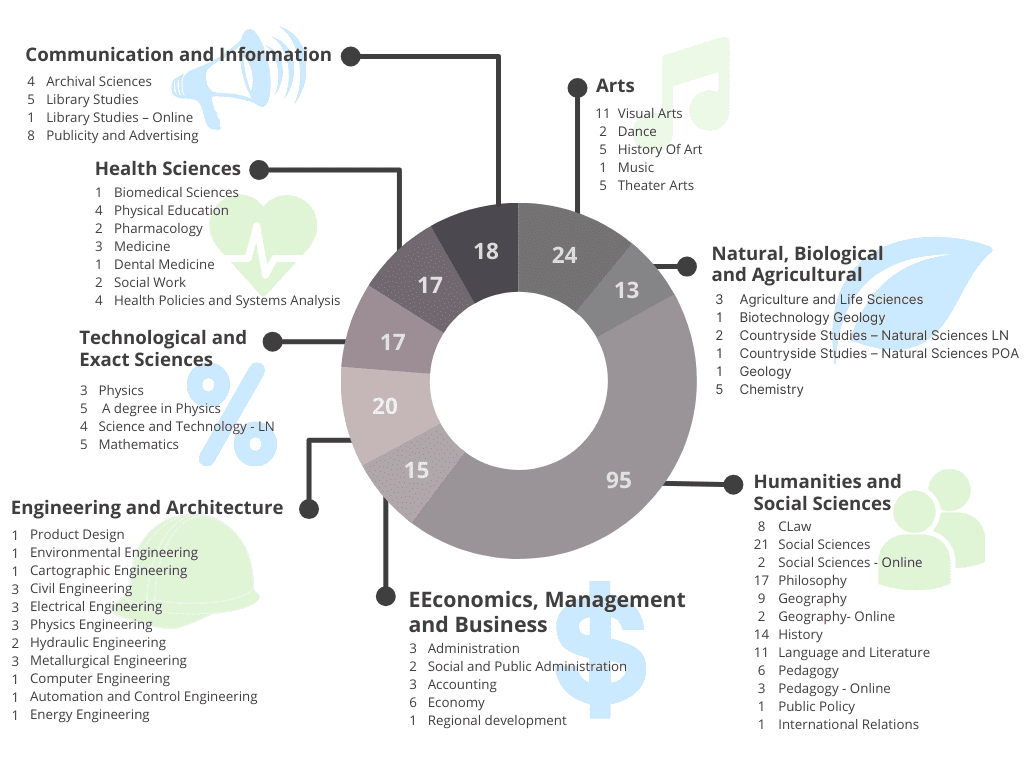
Elderly students enrolled at UFRGS in each undergraduate course in the second half of 2021
For Johannes Doll, who is a professor at Faculty of Education (Faced), UFRGS and a gerontology specialist, one of the key factors for understanding the attendance of elderly people at the university is the increase of life expectancy. “People get older with more willingness, physical and cognitively, than before”, he explains. Database from the Brazilian Institute of Geography and Statistics (IBGE) indicates that, in 2010, the Brazilian had a life expectancy of 73.9 years. In 2018, it rose to 76.6 years.
Pursuiting old dreams
“It felt as if I had started kindergarten”, says Hélio Fontana, when describing his feeling of getting into the University for the first time. He lives in Nova Tramandaí and had studied until elementary school because of financial problems and lack of incentive. In 2018, he finished high school through Ensino de Jovens e Adultos (Education of Young and Adult Students – EJA) and, in 2019, he took the Exame Nacional do Ensino Médio (ENEM), which is a Brazilian National Exam for university admission. In 2020, amidst the COVID-19 pandemic, he started his undergraduate course. “My age and the fact that I haven’t been at school for a long time make the smallest things even more valuable,” says Hélio about his return to the classroom.
Clésio de Nadal, who is 72, got a degree in Zootechnics in 1974 at UFRGS. In 2016, he went back to the University to study Law. “I have always been interested in Law, but did not have time to study because there were other family issues that stopped me from seeking for an undergraduate education,” says Clésio, who has already finished the courses and is just waiting for his diploma to be issued.
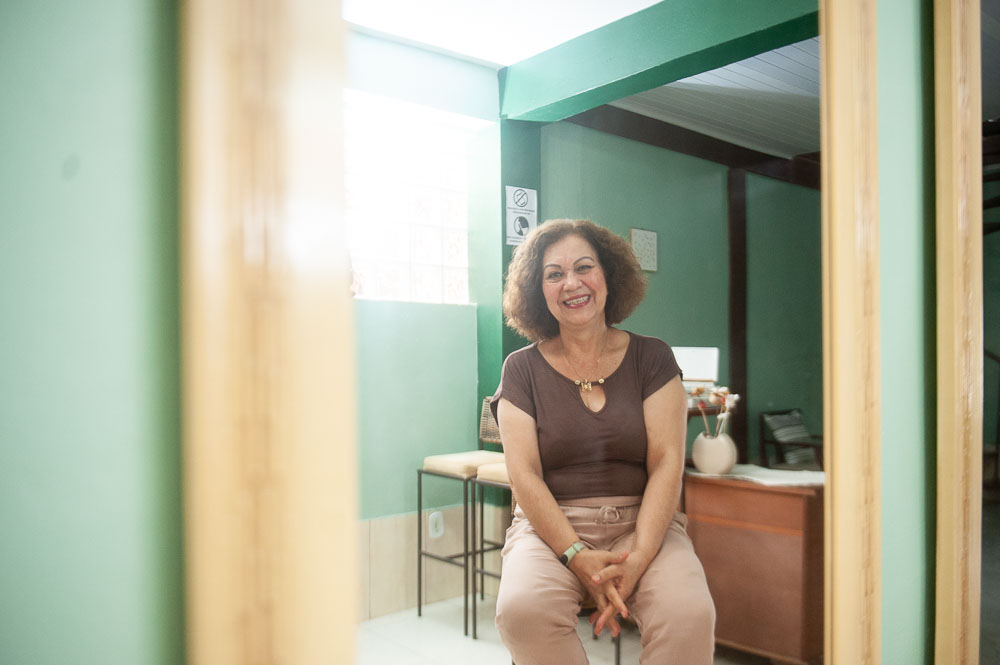
In 2016, Vera Lúcia Pereira dos Santos, who was 60 at the time, decided to go back to university. Back when she retired, when she was 58, she started to feel bothered because of the idle time. “I started to feel useless, she says. I’m retired and teaching English classes. What do I do? I need to fill this time gap. One day, I told my daughter, just for fun, “I want to go back to UFRGS”. It was one of the best things that has ever happened in my life, apart from my children’s birth!”
“I’m so happy because I’m learning. We shouldn’t stop searching for knowledge.”
Vera Lúcia Pereira dos Santos
Healthy ageing
For Matheus Roriz, assistant professor at the Faculty of Medical Sciences, specialized in Neurogeriatrics, there are five principles to a healthy ageing: balanced diet, healthy weight, physical activity, life purpose, and social relationships. “Studies about longevity worldwide have proved the importance of having a life purpose. It can be a family purpose, such as helping raise your grandchildren; going back to college, taking a long course; a religious purpose or even the purpose of visiting new countries,” he says.
For Johannes Doll, being in contact with new challenges and intellectual stimulus can help with the well-being of our brain activities. “Our brain is like our body: if we don’t use it, we lose it, and cognition works the same way. As far as an individual faces new challenges and demands, his/her brain also needs to be versatile and adaptive,” concludes Doll.
Intergenerationality
Despite the still small number of elderly students, which make only 0.8% of the total of students at UFRGS, those students contribute to the diversity of the class. Clésio de Nadal remembers how he felt regarding the socialization aspect when he started the course. “I didn’t have any problems. Of course, I felt like an alien, but this was OK, as there were two other aliens,” he says. The other two “aliens” were his friends who were the same age and entered the undergraduate program at the same time.
For the specialists contacted, the interaction between students from different generations is positive for everyone. “The contact between students from different generations is an enriching exchange of experiences for the students, the professor and the University,” says Roriz.
“Many benefits arise from intergenerational interaction. Firstly, it is stimulating. Working with younger people is very good for it promotes the interplay of different thinking and, consequently, requires neuroplasticity, like a cognitive training. The social relationships also help,” says Doll. “As for the younger people, it is also positive. Firstly, because they can relativize experiences, understanding that the time is longer than they imagine. Secondly, because they get out of their bubble and face other life situations,” he completes.
“The human being is a social being in essence. One of the problems in ageing is that, generally, your social relationships decrease. The tendency is for them to decrease, so the capable to establish an intergenerational relationship can be more socially positive and stimulating.”
Johannes Doll
Expansion
Even though there was an increase during the last few years, the number of elderly students in university is still small. One of the reasons is the low level of education of people who are 60 years and over. IBGE database from 2019 indicates that 18% of this age group is illiterate. On the other hand, racial inequality calls attention. There are 9.5% illiterate people among the white population, whereas there are 27.1% among Black and Mixed-race populations.
“It would be interesting to have an opening for the minorities who have neither been to the university before nor have built memories here,” says Doll.
Translated into English by Vitória Ribeiro Leal, undergraduate student enrolled in the course “Supervised Translation Training I (English)” of the Undergraduate Program in Language and Literature, under the supervision and translation revision of Professor Elizamari R. Becker (P.h.D.) – IL/UFRGS.
:: Read in portuguese
Número de alunos idosos na UFRGS cresceu 400% desde 2012