
Product design | Research seeks alternatives for the full use of the fruit, used for the production of the traditional chimarrão gourds of the region
*By Gabhriel Giordani
*First published January 26, 2023
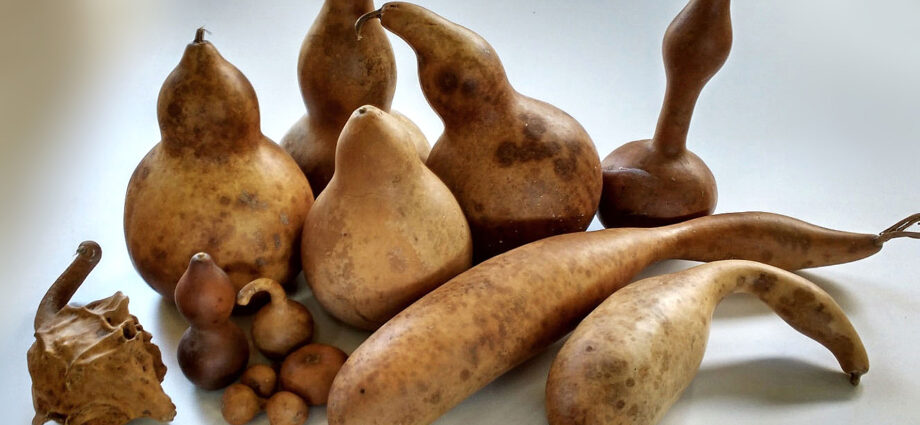
*Porongos have several forms, and the fruits that do not have the desired format to the production of the bottle gourds aren’t even harvested (Photo: Danieli Nejeliski)
Porongos (Lagenaria Siceraria) are grown on a large scale in the southern region of Brazil, Argentina, and Uruguay to the production of “chimarrão” gourds, which are used for a traditional tea that remains a strong cultural symbol of the south of Brazil. However, about 80% of the total volume of the fruit is discarded in the process. Aiming to reallocate this significant amount in the industrial environment, a PhD doctoral dissertation in Design at UFRGS (the Federal University of Rio Grande do Sul) studied new ways to enable the use of such waste, taking advantage of the technical and sensory attributes of the porongo.
The porongo is a material whose properties hold similarities to those of wood and cork, resources of plant origin whose production processes are already well established in the industrial environment. These materials are widely used in the industry to the production of particle boards (wood cells or other lignocellulosic materials, materials which consolidate under the joint action of heat and pressure).
The designer and author of the work, Danieli Nejeliski, collected porongos in the district of Arroio do Só, located in the countryside of Santa Maria (RS), and Frederico Westphalen (RS). “In Frederico Westphalen,” says the researcher, “if the porongos don’t have the desired shape for the bottle gourd, the producers don’t even harvest them. The fruit rots in the field, which is a huge waste”.
“We want to create an alternative source of income for workers ranging from farmers to other participants all the way to the end of the production chain of the gourds,” says the designer. “By the way, one of the reasons for the development of modular coatings is that products can be manufactured with basic woodworking equipment, what makes it accessible and adaptative to small businesses and woodworking studios”.
Production Process
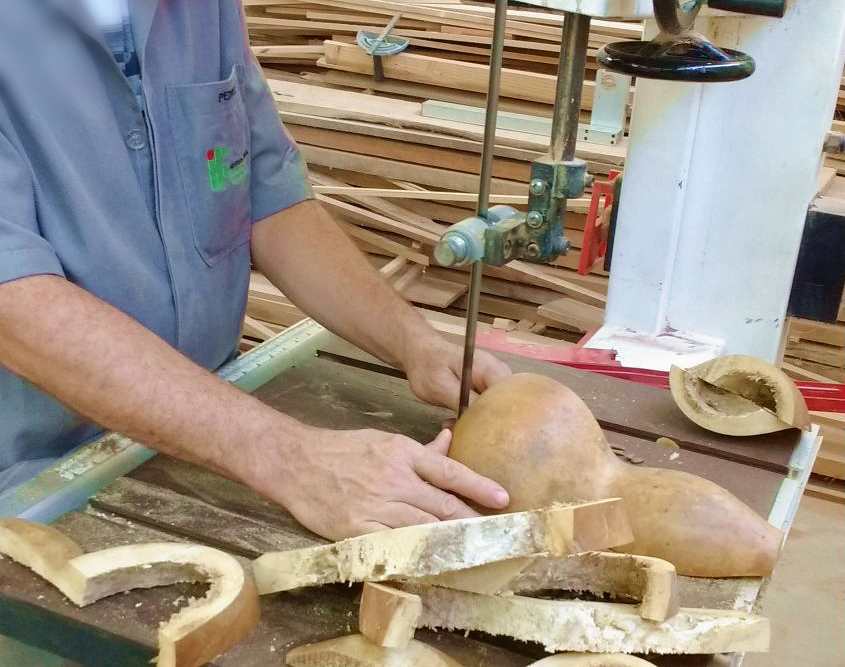
Supervised by Professor Lauren Duarte, faculty member of the Graduate Program in Design, Danieli focused on characterizing, optimizing, and applying modular coatings made with porongos. As a result, the researcher produced modules and multi-modules, from which patterns with different designs were created. These patterns have generated three-dimensional modular coatings, which can be applied to products such as furniture fronts, room partitions, and surface coatings.
Danieli worked in four stages with the particle boards: particle production, panel specifications, material dosing, and pressing cycle. From the tests performed, the panels composed of starch and glycerol showed better bonding between the particles and structure stability. Based on such findings, products with 70% porongo and 30% starch and glycerol were manufactured.
“It is important to highlight the production with a starch and glycerin matrix because these components do not use any type of polymeric resin. Thus, the original characteristics of the material are maintained – biodegradable and synthetics-free”.
Danieli Nejeliski

The materials had similar sensory properties to those found in cork junction. Regarding the physical properties obtained, the objects fell into the category of low density, high moisture content, and increased water absorption, which are common characteristics of panels produced with agricultural waste.

The researcher points out that, for this process to reach the market, it would be essential to have more academic and governmental incentives, in addition to the formation of partnerships involving players like universities, manufacturers, farmers, and other stakeholders. “The point is to put [the work] into practice. I say not only in relation to my research, but in relation to many works in the area of Design, especially this part that I follow,” Danieli concludes.
Danieli assures, however, that she will continue studying the subject. She reports that the UFRGS Product Design Program already has a joinery service, which will help her in the next steps: work on her prototypes and improve them.
Translated into English by Alex Porto Teixeira, undergraduate student enrolled in the course “Supervised Translation Training I (English)” of the Undergraduate Program in Language and Literature, under the supervision and translation revision of Professor Elizamari R. Becker (P.h.D.) – IL/UFRGS.
:: Read in Portuguese
Tese de doutorado propõe reaproveitamento de resíduos de porongos em painéis modulares