
Academic life | Engaging students in class activities and fostering a sense of belonging can contribute to reducing dropout rates in higher education
*By Rafaela Bobsin
*First published August 24th, 2023
*Photo: Flávio Dutra/JU
Upon reaching higher education, students face a different reality from the one experienced before: a new study environment, new classmates, teachers, spaces and organizations that are different from those of basic education. For many people, adapting to this new context and staying in college can be a major challenge. According to the Technical Summary of the Higher Education Census 2021, most dropouts occur in the first two years. Dropout is influenced by multiple factors, making it challenging to pinpoint a single cause and, consequently, to find comprehensive solutions.
According to the researcher Leonardo Heidemann, coordinator of the Undergraduate Physics Commission at UFRGS, dropouts are commonly attributed to infrastructure difficulties – lack of money, housing, etc. – and repetitive failures. However, studies indicate that there are other influencing factors, such as the transition from primary to higher education, the lack of a sense of belonging to the chosen program or to the university, the misunderstanding of how the undergraduate curriculum can make the student the professional they want to be and, also, broken expectations. He points out that it is very important that managers assign introductory courses to welcoming teachers who do not neglect classroom interactions, as it is in the initial phase that students establish relationships with other classmates and with the undergraduate program itself, a scenario that can define whether they continue or drop out.
Different sectors at UFRGS are working to understand, predict and propose solutions to help students stay in the university. These activities range from collecting data to understand which students are at risk of dropping out, to setting up mentoring among students to encourage them to stay and help with their studies.
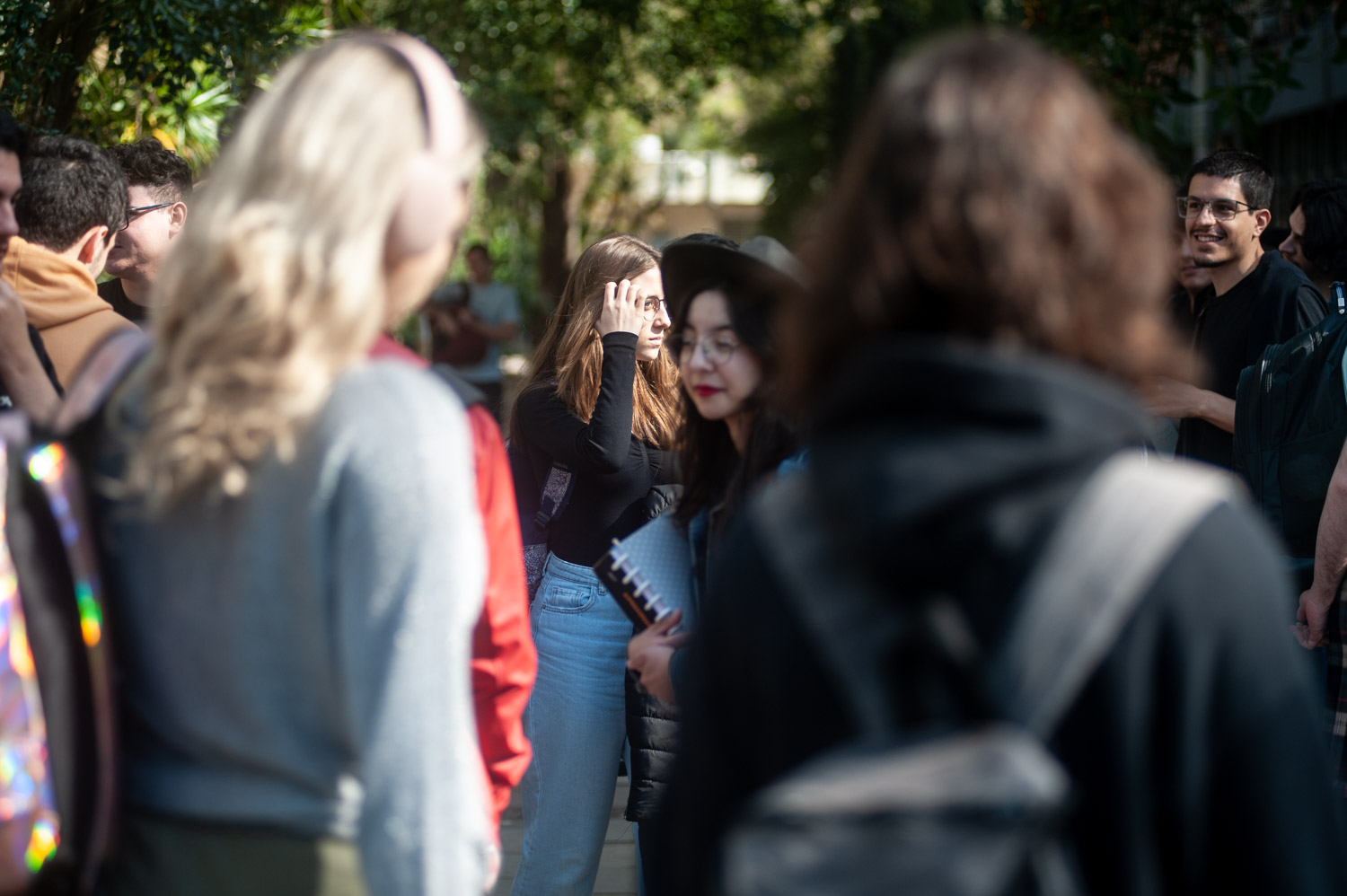
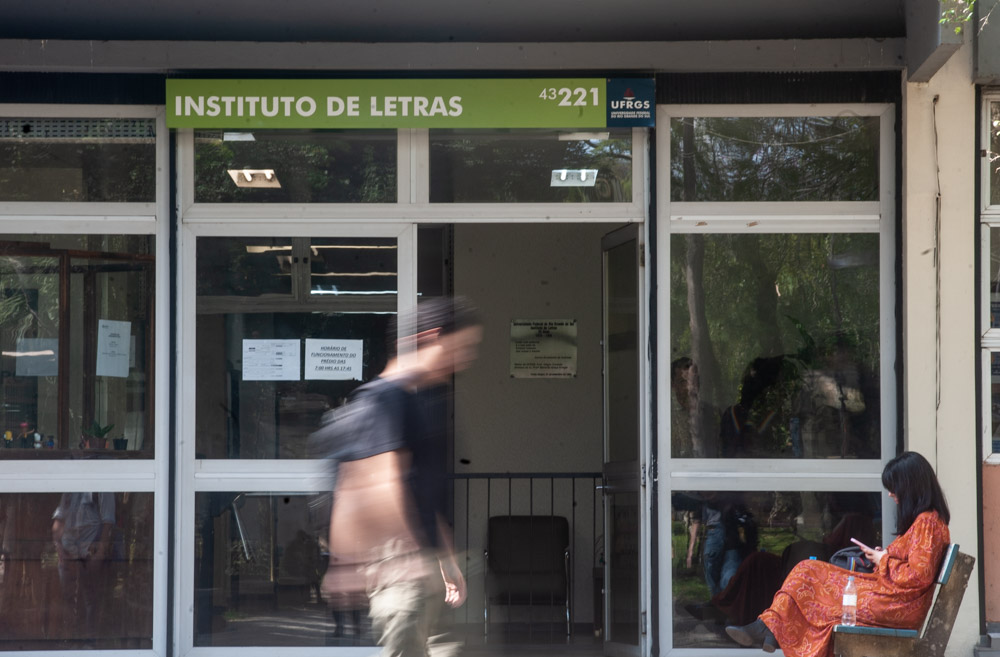
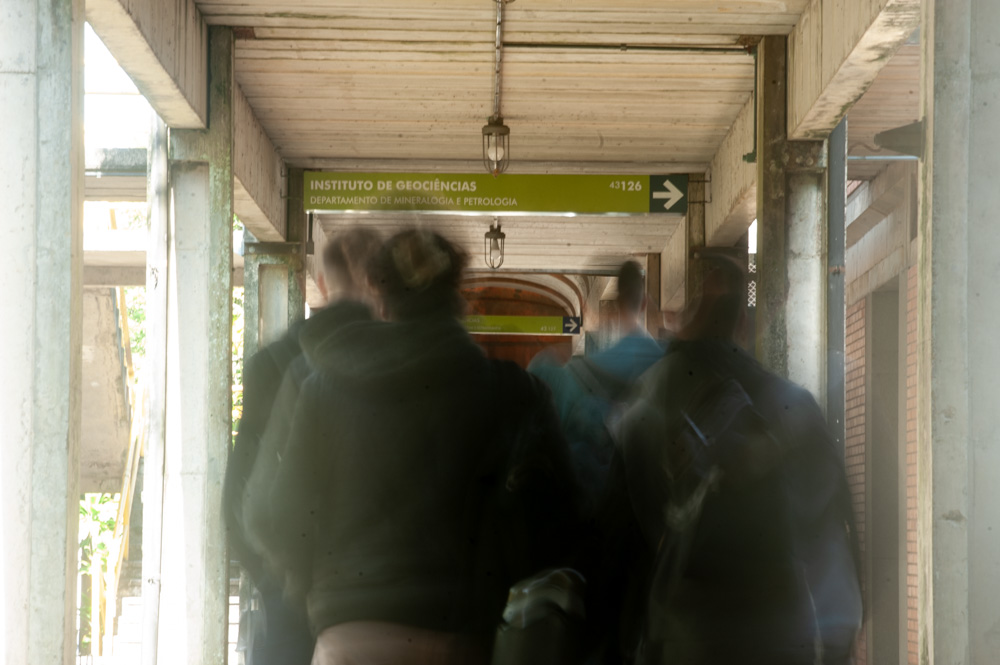
In the images, UFRGS students on a break between morning classes at the Vale Campus (Photos: Flávio Dutra/JU)
Future outlook for education and profession
A course called “Introduction to Physics” has been created for the Undergraduate Program in Physics Education. The aim is for students to understand the practical application of subjects offered outside the Institute of Physics, as well as to introduce some of the contents that will be covered in depth later on. Active teaching methodologies are used, which make the student think and debate critically with other colleagues, to encourage them to talk to each other. Heidemann gives as an example a method where students, upon encountering a problem, must convince others with reasons that justify the answer they have given.
The Institute of Mathematics and Statistics (IME) offers the course “Profession of the Statistician” to students of the Bachelor’s in Statistics, aiming to present perspectives for the future professional. One of the activities involves discussions with graduates currently employed in the job market. “Pre-Mathematics” is also held at the IME for Mathematics both undergraduate and graduate students. Freshmen are invited to take part in workshops to consolidate knowledge on basic mathematical contents. These workshops are held about a week before classes start, providing a moment of integration between the newcomers.

Mentoring and tutoring as a means of permanence
Beyond introducing students to their course and showing them possible prospects for the future, it’s important to help them through their journey. The exchange between senior students and newcomers can be a welcoming, counseling and learning tool.
The Mentoring Program for International Relations Students (PROMERI) is among the initiatives that encourages student mentoring. PROMERI is designed for students recently got entrance to the International Relations Program through the Affirmative Action Program, who are mentored by graduate students. The program is not restricted to students in their first semester: quotas law students in International Relations can take part in the actions offered in any semester of their undergrad studies.
According to the project’s coordinator, Tatiana Vargas Maia, some of the difficulties that arise are not knowing how to prepare for an assessment or to organize for their studies and the university routine, not understanding how a particular assessment works and not knowing the opportunities within UFRGS. The purpose of the program is to alleviate these difficulties through mentoring. Workshops are also held for all the students taking part in the project, based on the demands they present.
In the Physics Education Program, the mentoring format is different, being organized by seniors who are willing to help freshmen in their academic routines. One of the organizers of this initiative, student Ingrid Weber, says that these mentorships work like sponsorship, which has been happening for some time, but some seniors were more involved than others, and the contact with the freshmen was often lost.
As a result, a study was carried out in partnership with the Center for Studies and Actions for Student Persistence (NEAPE) and sponsorship on the course was restructured with better defined roles and objectives. At the beginning of the semester, freshmen and seniors answer a form and, after the answers are compared, sponsor and sponsee/sponsored with similar characteristics and interests are selected. Throughout the semester, the senior student acts as a reference for the freshman to ask questions about classes and other aspects of the university.
The Institute of Mathematics and Statistics has monitors to perform similar duties. The Student Monitoring Project has three monitors who are at a more advanced stage of the course and who help younger students with advice, organization, and issues about the course.

Other programs and actions at UFRGS
The School of Administration (EA) and the Institute of Chemistry (IQ) are working on a Student Support Protocol. In each faculty, the protocol has its own particularities and is at different stages of implementation, but it is a joint proposal by both departments, implemented by the undergraduate committees in partnership with the student affairs technicians. The protocol stipulates that students at risk of dropping out are identified and monitored by checking their performance via SISGRAD and by contacting teachers. Students are offered individual assistance with registration and study organization, as well as a time to be listened to and share experiences.
On a more general level at the university, the Director for Student Affairs (PRAE) offers pedagogical and social support to students who are members of the PRAE Benefits Program, with the objective of listening to and advising them on matters of experience and pedagogy, and collaborating to create strategies for better learning. PRAE also runs the “Learning to Learn” project, which has had two editions so far, in which workshops are offered to help students who want to improve their academic performance.
Addressing the challenge of combating dropout rates involves collecting and analyzing data on the subject. In this sense, the #ACOMPANHA! Program, which is managed by PROGRAD, aims to expand student monitoring by grouping data about students and making it available in a centralized way. UFRGS program managers can access the “Pedagogical Management” tab in the manager’s panel and check data reports on their respective students, to find out the ones who are at risk of dropping out. PROGRAD also monitors the data and contacts the COMGRADS so that they can offer greater support to these students at risk.
According to the Executive Vice-President for Undergraduate Studies, Leandro Raizer, one of the highest dropout rates at UFRGS is caused by the fact that students stop enrolling. He stresses the importance of, when necessary, suspending enrollment rather than not enrolling at all; in this way, the link with UFRGS is maintained.
Entering higher education can be a less challenging experience when actions aimed at the pedagogical well-being of students are carried out. Making students feel part of the place where they live and understand where they can get to with the training they are doing can be, in most cases, fundamental for them to stay.

Translated into English by Rafaela Alexandre de Oliveira, undergraduate student enrolled in the course “Supervised Translation Training II (English)” of the Undergraduate Program in Language and Literature, under the supervision and translation revision of Professor Elizamari R. Becker (P.h.D.) – IL/UFRGS.
:: Read in portuguese
Projetos buscam incentivar a permanência estudantil na graduação