
Innovation | Combining collagen extracted from fish and a synthetic polymer, this new material can be an efficient and low-cost alternative in the treatment of vascular diseases
*By Geovana Benites
*First published December 8, 2022
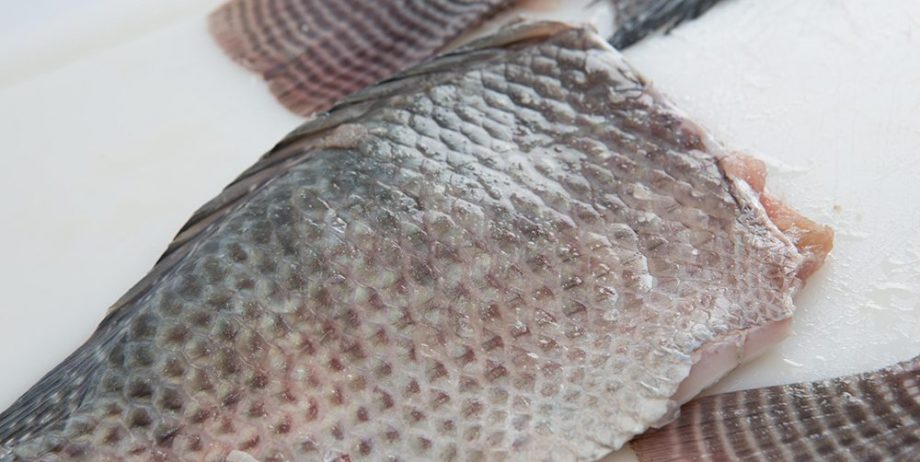
*Photo: Tomas May/Embrapa – In addition to being used in the treatment of burns,
tilapia skin has been widely studied within tissue engineering as an alternative and low-cost biological material
Vascular arterial diseases represent one of the main causes of mortality in the world, contributing to the increase in vascular transplants, which aim to ensure a healthy amount of transport of blood. Synthetic grafts are one of the options for treating patients who need to rebuild or replace damaged blood vessels. Knowing this and seeking to develop more efficient alternatives, a master’s thesis defended in the Graduate Program in Biological Sciences: Physiology at UFRGS developed a biomaterial that uses collagen extracted from tilapia skin for the treatment of vascular diseases.
Carried out by researcher Bruna Borstmann Jardim Leal, under the supervision of Professor Patricia Pranke, this work aims to contribute to the future development of smaller synthetic vascular grafts. The currently available materials have a high failure rate in small diameter blood vessels due to the formation of thrombi (clots that hinder blood circulation).
Bruna had already started working with the development of vascular biomaterials for undergrad final paper research in Biomedicine at the University of Vale do Rio dos Sinos (UNISINOS), when she joined the laboratory team coordinated by Patricia. It was during Bruna’s master’s training that, together, they began the study the use of tilapia skin, with collagen extracted by partner researchers of the Drug Research and Development Center of the Federal University of Ceará (UFC).
The study was carried out from tissue engineering, an area of regenerative medicine that combines engineering and biology, providing better alternatives for tissue development in order to replace those with a high rate of immune rejection. In this way, vascular tissue engineering seeks solutions to regenerate possible damaged tissues or replace them with materials compatible to blood vessel structures.
The main objective of the work, according to Bruna, was to create a synthetic vascular graft for application in small blood vessels, expanding the options already available in the market. “This is the main point of my work: we wanted to develop a synthetic vascular graft for application in small vessels, which would be smaller than 6mm”.
Combination of natural and synthetic polymers
Natural and/or synthetic polymers can be used to develop biomaterials, and the combination of the two allows the development of a material with biological and mechanical properties suitable for use as a vascular graft. Natural polymers, such as collagen, have properties comparable to those of natural extracellular matrix proteins, allowing cells to better connect with the biomaterial used. However, these polymers have less suitable mechanical properties. “For a blood vessel”, Bruna explains, “we need to have excellent mechanical function because the blood will go through a high flow pressure and the vessel needs to be resistant”.
Synthetic polymers, such as polycaprolactone (PCL) – used in the biomaterial developed in Bruna’s work – have a good mechanical function and are more stable than natural polymers. In this way, the combination of the two types can form more efficient biomaterials. “One would be complementary to the other, so it is very interesting to make a biomaterial associating these two types of polymers. In the case of my work, in the part of natural polymers, we associate [PCL] with the collagen of tilapia skin”.
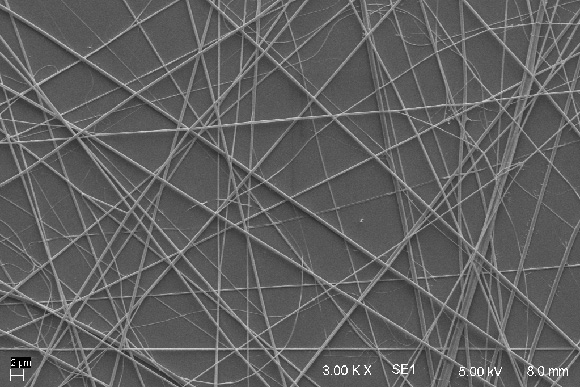
From the electrospinning technique (production of fibers with diameters on a nanometric scale), the study presented different types of biomaterials: one only with synthetic PCL polymer and two with PCL associated (i.e. mixed in the same solution) with tilapia skin collagen (in proportions of 50/50 and 25/75).
In addition, the researcher tested a collagen-functionalized PCL biomaterial, that is, initially made with PCL and to which, later, collagen was added. Bruna explains “By adding collagen in a functionalized way to this PCL-only biomaterial, it would have greater biological properties to help cells adhere and proliferate on the biomaterial, and that’s what happened”.
The analysis demonstrated that the biomaterials produced from the combination of synthetic and natural polymers present functional groups of PCL and collagen. These results are considered suitable for application in vascular tissue engineering, due to the diameter being comparable to that of the fibers of the natural extracellular matrix.
Resistant and rich in collagen
In addition to being used in the treatment of burns, tilapia skin has been extensively studied within tissue engineering as an alternative and low-cost biological material.
Similar to human skin, tilapia skin has good tensile strength, and the collagen in this material stimulates the growth of fibroblasts (cells involved in healing) that lead to angiogenesis (the process of forming blood vessels from pre-existing vessels) – important features for vascular grafts.
“Tilapia skin is usually discarded [by the food industry]. So, we use a material that would end up going to waste, taking advantage of it and extracting the collagen. That’s a very interesting part of the job as well.”
Bruna Borstmann Jardim Leal
According to Bruna, the research is a first step – before it can effectively reach the market, more tests are needed. “In the study we developed, tests were done only on cells, so the next step would be to test on animals and finally on humans,” she explains.
Translated into English by Alex Porto Teixeira, undergraduate student enrolled in the course “Supervised Translation Training II (English)” of the Undergraduate Program in Language and Literature, under the supervision and translation revision of Professor Elizamari R. Becker (P.h.D.) – IL/UFRGS.
:: Read in Portuguese
Pesquisa desenvolve biomaterial a partir de pele de tilápia para utilização como enxerto vascular