
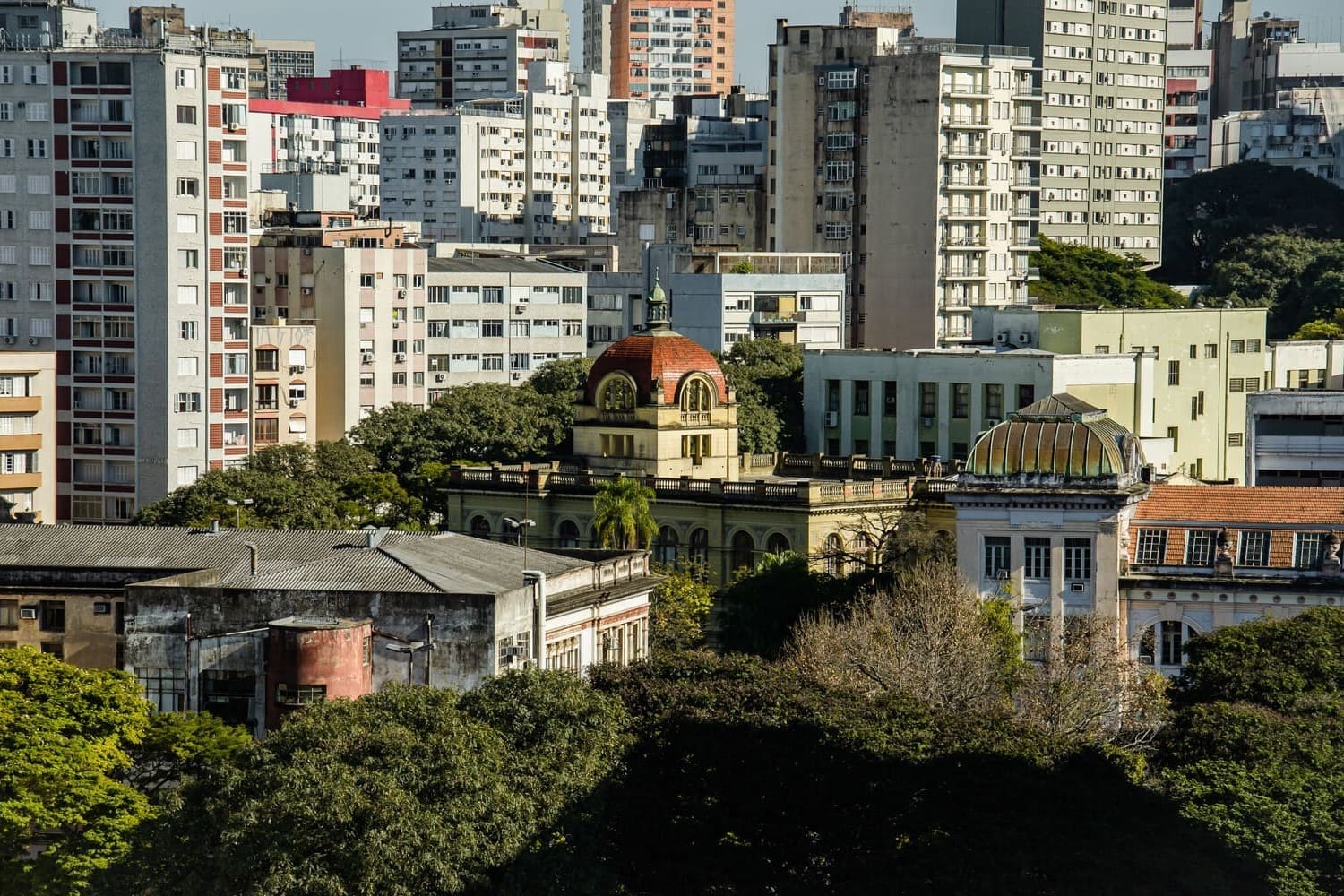
Innovation | Using concepts and tools from the area, the doctoral dissertation investigates how design can engage with urban planning to make cities more efficient, safe and attractive
*By Thiago Rodrigues Müller
*First published September 6th, 2023
*Photo: Marcelo Pires/JU
Innovative solutions in the field of revitalization of public spaces can promote quality of life and make the city more efficient, safe, attractive, and desirable. Design, understood as a tool for innovation in the city revitalization process, requires, however, a multidisciplinary knowledge, in addition to specifically tailored techniques and methods, connection between the public and private sectors, as well as a solid connection to urban planning. With all of this in mind, a doctoral dissertation from the Postgraduate Program in Design at UFRGS introduced a model for using design tools for the development of an urban revitalization project.
To get to the model, the author, Claudia Nichetti, carried out a bibliographic and documentary survey about the use of design in city revitalization processes. It was identified, however, that what exists about these processes comes from urban planning or architecture, and not from design.
After that, a case study was selected based on the Pacto Alegre project, which is a project of the Alliance for Innovation, a joint effort between UFRGS, PUCRS, UNISINOS and Porto Alegre City Hall. In the analysis, Claudia found that, in the few situations in which design was inserted, this occurred intuitively and the knowledge in the area was used in a purely stylistic way.
In that sense, the researcher realigned the objective of the dissertation to understand the perception of designers, architects, and professionals in related areas about the role of design and how they approached it, in practice, in projects for city revitalization. In this study, through questionnaires and semi-structured interviews, the findings indicate that, even though design has tools to solve problems, there is still a lack of connection between the area and urbanism. Based on these perceptions, Claudia built a model for the insertion of design in the city revitalization process.
Innovation-Driven Model
According to the dissertation, for this insertion to happen, macro-actions promoted by public policies are recommended. The recommendations are justified by the observation from data obtained from interviews with the actors that validate the projects, as they deal with interferences in cities and would be crossed by public authorities at various levels. Furthermore, according to the study, public authorities have knowledge of the real design problems of cities, but not the tools to solve them.
In this way, design would be a solution, but there would be a lack of connection between the area and urbanism. The challenge would therefore be to cross these areas of knowledge.

The model proposes an approximation between public authorities and universities, the valorization of design with public managers and interested parties, and the inclusion, in the curriculum, of Design programs, with courses that address this area and urban planning as tools to improve cities.
The first step of the model is precisely to develop urban planning skills among design professionals. This would take place in five spheres: attitude, which would be a way of thinking in an integrative, analytical, and critical way; experience, by acquiring familiarity by designing and implementing projects; design knowledge for problem solving; capabilities related to creativity, intuition, and problem-solving mindset; and, finally, skills necessary to execute an action or process and apply design methods.
In the second stage of the model, techniques are used to understand the problems of a city, analyzing the feasibility and functionality of the proposed intervention, including the user of the environment in this process and evaluating the physical, cultural and behavioral characteristics of the place. Using this information, it is possible to decide which process will guide the revitalization through innovation: 1) invest in the relationship between design, identity, and territory; 2) placemaking; 3) place branding; or 4) smart city proposals.
Claudia explains each of these possible processes. The first of these, the strategic relationship between the concepts of design, identity, and territory, strengthens the image of a place by implementing innovative projects for product design, and for process and service improvement. According to the research, the role of design, in this case, would be to manage the complexity of the relationship between company – a term applied, in this case, to the city –, market, product, consumption and culture. “It’s as if you’re thinking about a place to be associated with wine and Italian culture and you remember Serra Gaúcha,” explains the researcher.
The second, placemaking, would be a process of planning, creating and managing public spaces with a focus on people, that is, giving meaning to places that promote interaction between them. This can bring improvements to the local economy, increase the quality of life, develop the potential for tourism industry and generate jobs.
Place branding, on the other hand, deals with both the physical change of places and transformations guided by graphic and communication representations. According to the study, it is the displacement of an already existing concept in the field of products and services, in which the city uses branding, making branding part of the culture and influencing people’s lives, applied as an instrument for building the city’s brand.
The last term, smart city, refers to the design of efficient cities, with conscious use of natural and technological resources for the benefit of society. However, there is still no consensus in the literature regarding the term. The researcher highlights: “People always understand [a smart city] as being associated with technology, and in fact it can be in several aspects”. We can talk about a smart city in the field of technology as well as in those of human resources, governance, or in a combination of these concepts, for example.
Claudia further explains that this model emerged from the identification of design knowledge that already exists but has been barely used to solve real problems related to the revitalization of cities. “Everything proposed in my dissertation I compiled from the literature and cross-referenced with what professionals use in real life,” she reiterates. “My model is not for designers to work with, exclusively – it is for anyone who is going to develop a project,” she adds.
Translated into English by Ádrian Ferreira Oliveira, undergraduate student enrolled in the course “Supervised Translation Training II (English)” of the Undergraduate Program in Language and Literature, under the supervision and translation revision of Professor Elizamari R. Becker (P.h.D.) – IL/UFRGS.
:: Read in portuguese
Pesquisa propõe modelo para inserir o design no processo de revitalização de cidades