
Inclusion | Despite still facing academic challenges, university students who experience motherhood find refuge in spaces within UFRGS
*By Ana Gonzalez
*First published March 21, 2024
*Photo: Marcelo Pires/JU
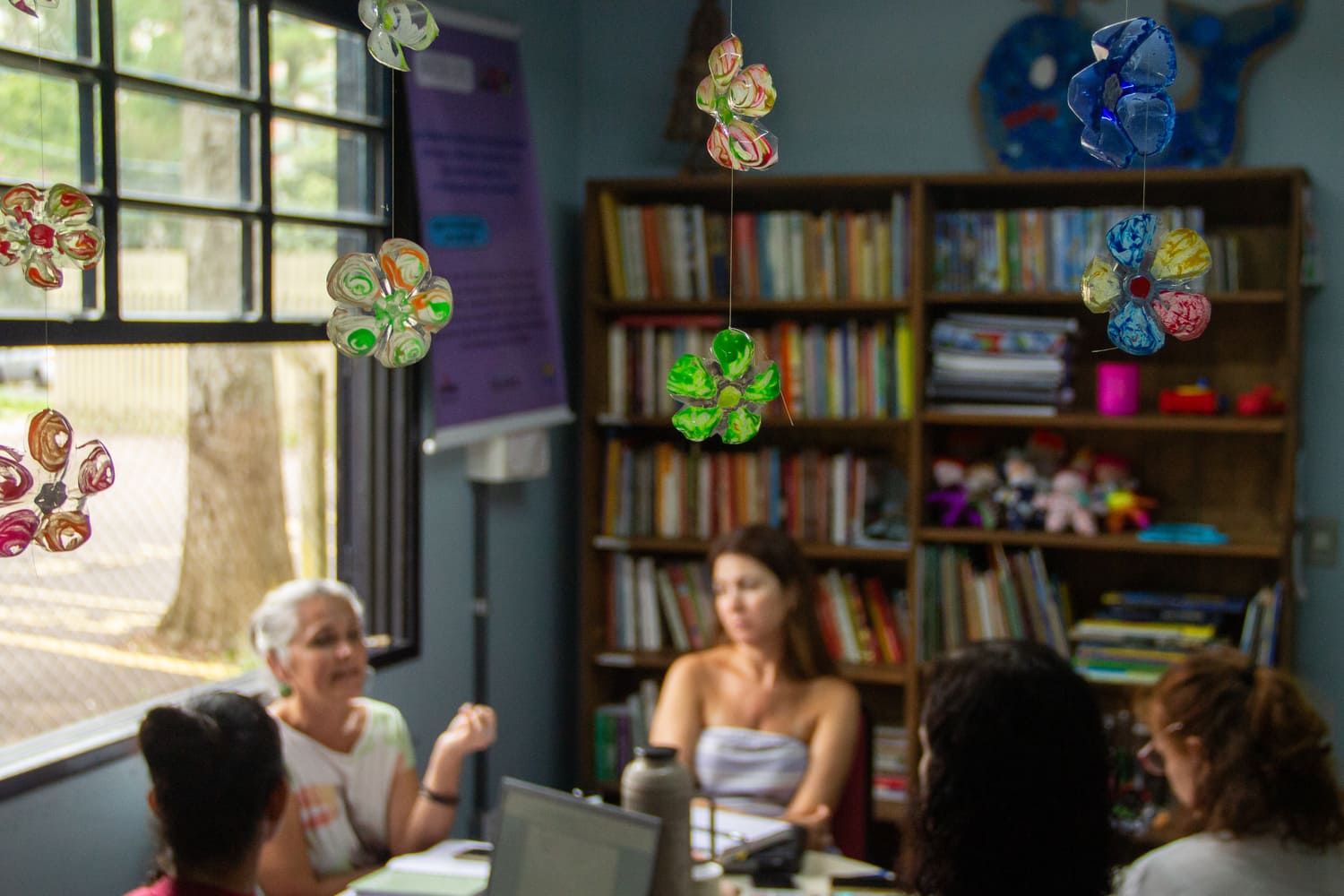
Almost hidden among the trees of the School of Physical Education, Physical Therapy, and Dance (ESEFID) at UFRGS, there is a pink-painted house. As you approach it, the sounds of childhood can be heard — from building imaginary worlds to discussing the rules of tag. When you step inside, you are reached by the smell of fresh coffee and cake just out of the oven and invited by a small library with both children’s and academic books, a generous collection of toys, a study room, and quiet corners to rest. The Casa Acolhe, as the name suggests, is one of the spaces created by students, faculty, and staff at UFRGS to support and welcome mothers, fathers, caregivers, and children within the university walls.
Affectionately known as the Casa Rosa (Pink House) by its visitors, it has been open to all university students since May 2022. The space was conceived after observing the growing debate on the topic of motherhood within the university environment, its challenges, and needs, by students and staff at ESEFID, many of whom are also mothers. “This perspective is emerging to ensure that mother students do not abandon their undergraduate and graduate programs just because they are mothers,” explains Lisandra Oliveira, a faculty member in Physical Education and one of the creators of the space.
“Motherhood cannot be an obstacle for women to study, work, and live.”
— Lisandra Oliveira
Closely tied to the Mães na UFRGS collective, the Casa Rosa offers not only a refuge for mothers, fathers, and caregivers but also a space adapted to childhood within an environment that is often hostile to children and the specific needs of this life stage. Still considered a taboo, motherhood and childhood are often invisible and seldom discussed within academic walls. “When I arrived at the university, I had the feeling that mothers were being silenced. I didn’t know who was a mother and who wasn’t,” says Laís Cabral, a Pedagogy undergrad and mother of Elisa, 6 years old. Meeting other mothers and starting to frequent spaces like Casa Acolhe was essential to making her experience as a mother and a university student less lonely.
Jennifer Araújo, a Pedagogy student and mother of 8-year-old Davi, recalls numerous situations where she felt insecure when she had to bring her child into the classroom due to lack of other options. “We don’t know how each professor will react,” she explains. “A mother doesn’t bring her child to class because she wants to. Either I bring him, or I don’t attend class.” Spaces dedicated to supporting and positively discussing motherhood and childhood within the university reduce the sense of inadequacy that many mother students face during their academic journeys.
Caroline Tasso, a Dance undergraduate and mother of 3-year-old Aurora and 5-year-old Maria Alice, shares that learning about movements like Mães na UFRGS and spaces like Casa Acolhe was crucial in her decision to return to studies after becoming a mother. “I’ve always wanted to pursue a degree in Dance, but I wasn’t confident I could stay at the university because of being a mother and having all these motherhood demands,” she explains. “Just knowing that this group exists – that there are more people to listen to me and support me – was very important.”


Contributions from the community
Since 2022, with the return to in-person classes after the COVID-19 pandemic, similar initiatives to Casa Acolhe have emerged in other parts of the university, fueled by the Mães na UFRGS collective and by the growth in discussions about motherhood and childhood in academia. Most of these places, which used to be multi-purpose rooms, storage areas, or undefined spaces, have been created through dialogue with each department’s administration and donations from the community surrounding the topic.
The IMEzinho, located at the Institute of Mathematics and Statistics (IME) at the Vale Campus, where there used to be underused meeting and study room was created after the pandemic based on the same welcoming ideas of Casa Acolhe. According to IME professor Miriam Telichevesky, the contribution from the UFRGS mother community was essential for the success of IMEzinho. “It was all the community’s action,” she emphasizes. “The nursing chair, the toys, everything was donated. Now, the librarian is helping us set up a children’s library.”
The same can be said for the breastfeeding room established at the Faculty of Medicine on the Health Campus. Created in a room that had previously housed a secretary’s office, which was turned online after the pandemic, the space was designed by Nutrition professor Vera Bosa, who emphasizes its importance, especially due to the short duration of maternity leave for university students — another issue that hinders mothers from staying at the university. Today, the Brazilian law offers only four months of maternity leave to mothers enrolled in higher education institutions, starting from the eighth month of pregnancy. “It was created with the university’s responsibility in mind, to encourage mothers to continue breastfeeding after this period,” she says.
Just like Miriam, Vera also highlights that community support was crucial for the success and continuation of the idea. With the help of other mothers, the room now includes a nursing chair and a crib.
“Mothers are often forgotten, and when something benefits us, everyone gets involved and wants to contribute and be part of it.”
— Vera Bosa
Initiatives are still questioned
Despite the strengthening of these movements since 2022, the need for spaces supporting motherhood in the university environment has been present long before. On the Health Campus of UFRGS, Dafinho, an extension of the Academic Directory of the Faculty of Pharmacy (DAFF), aimed at providing a rest, privacy, and support space for mothers and children, was won through student activism back in 2019. Once used as a storage room, the space was converted into a playroom and now has toys, a nursing chair, and a changing table — all materials are also donated by members of DAFF and the university’s mother community. “DAFF fought for that space,” says Kariane Borges, a mother, Pharmacy student, and former member of DAFF when Dafinho was founded. “The space has to be there. It needs to exist and it needs to resist.”
However, the space constantly faces questions about its necessity, which needs to be defended by the students who use it with their children. “Some colleagues used that space before it became Dafinho and think they can still use it to rest,” explains Julia Tavares, a Pharmacy student and mother of two children. According to her, the limited use of the space by mothers is used as an excuse to argue against its existence. The same environment that alienates mothers and children uses their absence to further render them invisible and exclude them.
“Now, more than ever, we need spaces like Dafinho. Even if not many people use it, it has to be there so mothers feel welcomed and have somewhere to go when they are with their babies.”
— Julia Tavares
Spaces in development
There are also projects for spaces that have not yet materialized. Along with other mothers involved in the Pedagogy course, Laís and Jennifer plan to create a similar space to Dafinho and IMEzinho in the Faculty of Education building (Faced) at the Central Campus, which currently lacks such an initiative. “We already have the space, but it still needs to be furnished,” explains Jennifer, emphasizing that community support is also essential for the project’s implementation, which they’ve named Facedinha. Information on how to make donations can be obtained by calling (51) 3308.3266.
Despite the avoidable obstacles imposed by the academic community as a whole on mother students, the existing spaces and those planned for the near future show a small but significant improvement in the overall situation for this group of students. However, other demands continue to exist and be voiced. For example, the “almoçaços” (large lunches) organized by the Mães na UFRGS collective aim to raise awareness about the need to increase the maximum age for children to access UFRGS’s university restaurants, which is currently limited to 6 years.
“We’ve been thinking about how to raise awareness in the academic community that mothers exist in this space and are important.”
— Miriam Telichevesky
Between the progress represented by these welcoming spaces and the hostility mother students often encounter in other parts of the university, for Professor Lisandra, the visibility of the maternal student movement, in whatever form it takes, remains the best strategy for raising awareness. “We are bothering the academic community that says our place is not here — we are saying that it is here, yes. Here and wherever we want.”

Translated into English by Lucas Eduardo Camargo, undergraduate student enrolled in the course “Supervised Translation Training II (English)” of the Undergraduate Program in Language and Literature, under the supervision and translation revision of Professor Elizamari R. Becker (P.h.D.) – IL/UFRGS.