

Health | Differences in color perception are often noticed in childhood during school activities. Federal University of Rio Grande do Sul (UFRGS) research develops assistive technologies for the condition, which can be congenital or acquired
*By Mírian Barradas
*First published June 7, 2023
*Photo: Nelson Riccordi noticed since his childhood his difficulty in dealing with colors; the diagnosis of color blindness, however, only came later, at the age of 55, when he needed to undergo medical tests (Flávio Dutra / JU)
A person goes to the supermarket to buy fruits and is not able to tell whether they are ripe or not. Or, on the first day of a new job, someone asks this person to organize folders by color and this person cannot quite distinguish between green and red. Situations like these are common in the daily lives of people with color blindness, a visual disorder that interferes with color perception.
Color blindness is an “umbrella” term that covers different visual changes that make it difficult to see colors. The most common cause is a recessive genetic change in the X chromosome that affects the photoreceptors, cells located within the retina responsible for capturing different light frequencies. Daniel Lavinsky, M.D., ophthalmologist and professor at UFRGS, explains this condition. “We have three photoreceptors that capture different light frequencies, one closer to red, another closer to green, and yet another closer to blue.” When there is specific damage to these photoreceptors, there is difficulty in the visualization of colors.
This explains why there are distinct types of color blindness. People may have partial or complete deficiencies in red, green, or blue-sensitive photoreceptors. There are also the so-called monochromats, who have a total deficiency in two or three of these photoreceptors. These people see in shades of gray. In addition to congenital cases, in which people are born with this condition, color blindness may be caused by a disease that affects the photoreceptors.
To paint the sun lime green and the Brazilian flag brown
Difficulties usually appear in childhood, in the first years of school, when children begin to learn colors. That is what happened to insurance broker Mr. Nelson Ricordi. “I went to a small school in the rural area, and in the first years there were those assignments that required colored pencils and I already had difficulty, but at that time, I thought it was laziness or lack of attention”.
Mr. Thiovane Pereira, publicist and Master’s student in Design at UFRGS recalls: “I was aware that I was painting wrong because sometimes I would paint the trunk of a tree green, the leaves brown, the sun lime green, but at that moment I just thought I didn’t know the colors”. This “not knowing” – which is a difficulty in seeing colors – ends up being confused with laziness or inattention. Mr. Pereira tells the case of an acquaintance who, at school, painted the Brazilian flag brown instead of green and was accused of “disrespect for the flag.” Years later, he discovered he was colorblind.
It was also during early childhood education that pedagogue Mrs. Luciana Marcarini began to suspect that her son Joaquim, now eleven years old, had difficulty with colors. “I started to notice that it was taking him a while to learn the basic colors, but I didn’t want to force it too much.” There used to be episodes like the time when, in a bakery, Joaquim went to choose a product from the store window and said he wanted the candy in a certain color. “And I said: ‘But there’s nothing like that here’. And he: ‘This one, look’, he pointed to a sweet and it wasn’t the color he said it was”, she recalls.
With the help of a brother-in-law who also has color blindness, Mrs. Marcarini started taking tests available on the internet and noticed the difficulties that her son had with colors. She recalls other episodes: “We arrived at a clothing store, where they put the clothes tone by tone, increasing the color shades – I think because they are very close tones, he mixes everything up.” Joaquim does not yet have an official diagnosis, but he lists some colors that he “sees differently”: “A very dark yellow, a very light green”. “It has a shade of blue and gray that you see as pink, right?”, adds Mrs. Marcarini.
The tests available on the internet also made Mr. Pereira realize that his difficulty perceiving colors was, in fact, color blindness. When he was thirteen, he came across a Facebook post featuring the Ishihara Test – which consists of a series of dotted cards in several different shades – and realized he couldn’t see the numbers inside the cards. “It was at that moment that I started to consider color blindness,” he said.
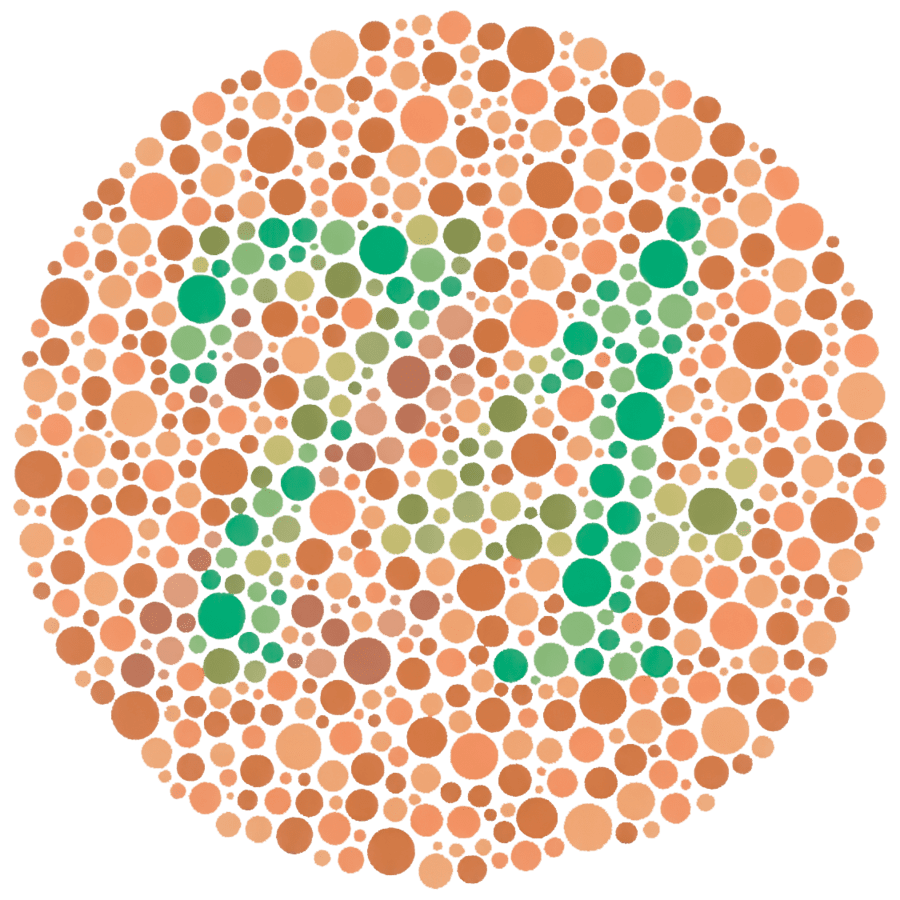
According to Mr. Lavinsky, there are more elaborate tests that can differentiate slight changes in color tones, but the Ishihara is recognized as the main screening test for color vision. “It has a good response in terms of accuracy for these not so discreet, more obvious cases,” he highlights.
Diagnosis can be difficult, but it is essential
The difficulty in reaching an official and accurate diagnosis is common among people with color blindness. Mrs. Marcarini says that, in the city where she and Joaquim live, it is not possible to reach the diagnosis, which needs to be done in a neighboring city. Therefore, Joaquim still does not have an official diagnosis of color blindness.
Mr. Pereira further explains: “What I think I have is deuteranopia [total green deficiency] and protanomaly [partial red deficiency] ”. The “I think”, he explains, is due to the lack of a precise diagnosis. When he was nineteen years old, he reported to an ophthalmologist his difficulty in perceiving colors, and the doctor performed the Ishihara Test.
“But it was a diagnosis I consider not accurate because the appropriate thing is for you to buy the Ishihara and have the physical test, printed, with the appropriate calibration. However, several
Thiovane Pereiraophthalmologists print it and make it into a booklet, which can cause differences [in the colors] due to printing. Then the doctor just told me: ‘You’re green and red colorblind.’”
When he was 55 years old, Mr. Ricordi underwent a psychotechnical test in which one of the steps involved distinguishing colored lights that changed position. “I needed to say [the colors] in order and I got all mixed up because there was green, yellow, and red,” he said. When the examiner asked if he had difficulty with the colors, Mr. Ricordi reported that he did, but that he was also going through a stressful period. The examiner then suggested repeating the test another day.
In the meantime, Mr. Ricordi had made an appointment with an ophthalmologist for another reason and told him about his condition. The doctor then opened a manual and started asking about colors. Halfway through the test, it became clear that he was colorblind – but, as with Mr. Pereira, the doctor did not specify the type of colorblindness.
And then, how to pass the psychotechnical exam? “My wife even bought me colored pencils – imagine, I’m 55 years old – so I could practice, but there’s no point in training, you know? Then I went back there to take the exam. I don’t know if the guy turned a blind eye or I got it right by chance, but he approved me,” Mr. Ricordi recalls.
Professor Lavinsky emphasizes that, when noticing any difficulty in perceiving colors, it is important to consult an ophthalmologist and report the situation. This is to investigate whether the condition is genetic or related to another disease, as color blindness can be acquired throughout life. “The more serious cases may be related to diseases such as cone dystrophy – a retinal dystrophy that evolves over time”, he explains. With an accurate diagnosis, the ophthalmologist can also evaluate the use of optical equipment and instruments that help improve color vision. “There are special glasses with filters that can improve the detailed frequencies the patient discerns. With these lenses, the colorblind person can better distinguish colors,” he adds. However, the use of these glasses, as well as others, must be prescribed by an ophthalmologist.

Difficulties, strategies, and support networks
To overcome everyday difficulties, people with color blindness develop strategies from an early age. Mr. Pereira reports that, in the art classes at school, he always asked to “make surrealist drawings and explore colors and shapes”. “So, I painted freely, without the obligation that the colors corresponded to what other people saw”, he adds. Mr. Ricordi had an ally in his early school years: a cousin, a classmate, who gave him the right colored pencils.
Reports from people with color blindness show similarities in the difficulties faced by colorblind people in simple situations, such as shopping or eating. Joaquim remembers the day he took a bite of a banana and only then realized it was still not good to eat – it was too green. Mr. Pereira recounts the time he almost ate a piece of moldy bread because he could not distinguish the mold. And Mr. Ricordi explains that, when he goes to a store to buy gifts, he needs to ask the sellers for help to find a certain color.
Professionally, color blindness can also present a challenge. For Mr. Ricordi, a remarkable episode happened at the age of eighteen, on his first day of work at a bank. He was asked to organize folders in a certain order by color. “That was a punishment for me, I didn’t know anyone, so I called a guy who was also new there and asked for help”, he says, emphasizing the embarrassment the situation caused.
Mr. Pereira chose a profession in which the use of color is fundamental: advertising. At first, he found it quite difficult to use graphic design software because not all of them specify the color name or code when selecting shades. Over time, the master’s student discovered tools to help him work autonomously, such as an “encyclopedia” of colors, which helps him choose the best shades and combinations.
But a colorblind person may also have difficulty decoding charts or maps, for example, where the use of color itself conveys a message. “In January, on a TV news program, they showed a map to explain which spots were suitable for swimming, and which were not, and they only used color [to convey the information]. I couldn’t tell the difference,” Mr. Pereira said.
In this case, he explains, it is important to use another tool besides color, such as symbols, textures, or numbers. Recommendations such as these are summarized in a guide to good practices on color blindness for professionals in the creative industry, developed by Mr. Pereira as a final project for his Advertising and Marketing course at the Federal University of Santa Maria (UFSM).
“You ask yourself: why am I going to use this color? To classify, to gather information? Do all people see this color? Not that color can’t be there – it should be – but it’s important to always add an alternative.”
Thiovane Pereira
In addition to the guide, Mr.Pereira’s research resulted in the creation of a group in a messaging application (WhatsApp) where people with color blindness share information and experiences. After the end of the paper, the participants wanted to continue this exchange, so another group was created. “People felt welcomed to talk about colors in a way that others could understand, and it’s very popular. I ended up having contact with other barriers that I had never imagined existed. It’s very interesting in terms of having a support network”, says the master’s student. On his Instagram profile, the publicist also shares information about his daily life with color blindness.
Assistive technologies
There are many tools available to help people with color blindness in their daily lives, such as apps that identify colors using the cell phone’s camera. There are also apps that allow people with trichomatism (i.e. normal color vision) to simulate how people with color blindness see images.
At UFRGS, researchers from the Institute of Informatics have been working to develop modern technologies for people with color blindness. The most recent research, from 2022, was Mrs. Violato’s final project. The student created a plugin that can be used in any video game to recolor images according to the colorblind player’s needs.
In games, colors are often used to convey certain information – for example, green and red can indicate a character’s health – and the colorblind player may be at a disadvantage, missing opportunities or taking longer to complete a task. With the recoloring done by the plugin, the disadvantage of the colorblind player is reduced.
Mrs. Violato’s advisor, Professor Manuel Oliveira of the Institute of Informatics, explains that the tool works independently of the game’s source code. The plugin recolors the game content in video memory, and the computer displays the modified image to the player. Furthermore, the solution can be quickly activated and deactivated with a keyboard command, allowing the player to choose when they want to use it or not.
The researchers applied the plugin to eighteen games, confirming that a single solution can be used successfully to different games. Tests were also conducted with nine people with color blindness, who preferred the recolored images to the original in many situations. For researchers, this demonstrates the importance of being able to quickly activate and deactivate the plugin during the game depending on the player’s preference.
Mr. Oliveria says that he began working on this topic when an undergraduate student reported in class that he had difficulty understanding certain content because he was colorblind. The professor began researching options and found them to be inadequate. “If they didn’t solve certain problems, they were very slow. In other words, you could only solve or improve the problem in static images, but with my training in Computer Graphics and my interest in interactive apps, I started looking for mechanisms and developing alternatives to fill this gap”, he stated.
The first papers dealt with image recoloring methods and color blindness simulation models. This “is the first model in the literature that explains in a unified way how normal trichomats, anomalous trichomats, and dichromats see. It was a dive into the literature: we read about electrophysiology, physiology, and so on. We took elements from different areas and built this computational model,” Mr. Oliveira points out.
The model also generated an extension that can be applied to the Mozilla Firefox browser. With the extension enabled, the user has three options: “Simulate”, which simulates the color information that a person with color blindness receives; “Daltonize”, which alters colors so that colorblind people more easily distinguish tones; and “Simulate Daltonize”, which simulates the experience of a colorblind person with the “Daltonize” function enabled.
Mr. Oliveira says he wants to continue working on the topic.
“It would be very interesting if this technology could be ported to cell phones
Manuel Oliveirabecause the reach is enormous, a large number of people play on cell phones.”
However, this requires postgraduate fellows dedicated exclusively to research. “This is a much bigger business, but I would like to continue because it is a subject for which I deeply care,” he concludes.
Translated into English by Luana Selau Machado, undergraduate student enrolled in the course “Supervised Translation Training I (English)” of the Undergraduate Program in Language and Literature, under the supervision and translation revision of Professor Márcia Montenegro Velho (M.A.) – IL/UFRGS.
:: Leia mais
Viver com daltonismo requer estratégias para driblar as dificuldades do dia a dia