
Botany | From data analysis of genomes, scientists develop a new theory about the evolution of iron absorption mechanisms in plants and algae
*By Alexandre Briozo Gomes Filho, Gabhriel Giordani
*First published Mar 30, 2023
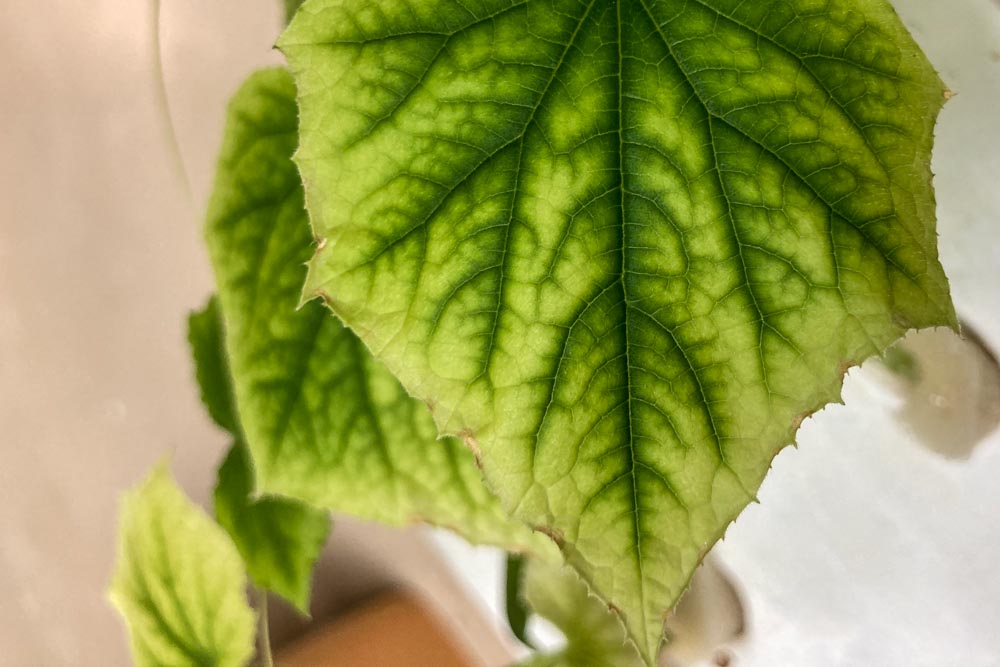
*Photo: Felipe Ricachenevsky/Personal Archive – Leaves of an iron-deficient cucumber plant
In the field of Botany, a paradigm has prevailed for a long time – that which believed that a single type of transporter, established at the beginning of plant lineage, was responsible for the absorption of iron from soil and water. This paradigm was constructed from a study that, using an alga of the genus Chlamydomonas as a basis, found that it used a transporter much similar to that of the so-called superior plants (monocotyledonous and dicotyledonous classes), reasoning which led researchers to believe that it was a matter of an ancestral characteristic of these classes. Research carried out at the Graduate Program in Cellular and Molecular Biology at the Federal University of Rio Grande do Sul (UFRGS) in partnership with the Institute of Biological Sciences at the Federal University of Minas Gerais (UFMG) showed that the transporters that algae and more recent plants use do share characteristics in common, but do not go closer than that.
“This is much more an evolutionary convergence than an ancestral trait in evolution”, says Felipe Ricachenevsky, professor at the Graduate Program in Cellular and Molecular Biology at UFRGS and one of the authors of the study. The results proved that – contrary to what was taken for granted – plants have different types of transporters to absorb iron from water and soil. “Plants may have changed which transporter they use, or maybe they use others that we have no knowledge of. We should be a little more open-minded about how think the plant acquires this extremely important ion,” says the professor.
Contextualizing this evolutionary scenario, Felipe goes back in time and explains that life on Earth began on a planet made of iron. Before the appearance of oxygen, existing living beings depended on iron to exchange electrons. After the Earth underwent a major oxidation event, photosynthesis emerged and began to produce oxygen, which over time drastically increased its concentration in the atmosphere, annihilating organisms that did not use this element. This major oxidation event resulted in the unavailability of iron, which is necessary for all organisms. And even today iron is a difficult element to obtain.
A reflection of the difficulty in obtaining iron is in the diet of the world’s population. According to Felipe, around two billion people in the world are unable to supplement their nutrition with iron due to the consumption of foods with low concentrations of this transition metal. He explains that the estimate in Brazil is that one in three children has an iron deficiency in their diet. The researchers’ goal is to find a solution to this problem.
“Our aim is to understand how plants absorb iron so we can take more of it to what we eat. This is our final goal.”
Felipe Ricachenevsky
A conversation in the car results in a scientific discovery
On their way to a doctoral panel at UFRGS, Felipe Ricachenevsky and Eduardo Del-Bem, one of the UFMG researchers involved in the study, once discussed the properties of iron absorption mechanisms in plants with the excitement that belongs to the spirit of someone who has possibly bumped into a questioning capable of altering previously obtained knowledge. Once they found the question that had not been answered or that everyone believed they knew the answer to, gathering a group of researchers and elaborating the defense of the proposition through evidence was the next task.
Performed strictly in digital form, using exclusively in silico data — an expression that indicates that a work was carried out through computer simulation —, the research made use of public databases that stored information on various genomes of plants and other organisms. The adopted method essentially consisted of comparing sequences: after aligning the sequences of gene families, the scientists analyzed whether there was a common origin for iron absorption, establishing a kind of tree diagram, just like Darwin’s, in which he shows the common origin of all organisms and how they spread.
In addition to the conclusions already presented, Felipe explains the research had no cost because open data were used. On the other hand, having formed and put people in contact with an interest in the subject is something of great value. “You manage to do work that has impact, relevance, using public data”, he comments.
Behind the publication in an international journal, there are always some adversities. In the case of this research, this journey began when the group sent the work to a lesser-known but high-quality journal, which rejected the study. “After that, we decided to send it to an even better magazine,” says Felipe. The journal in question is New Phytologist, from the United Kingdom, in which the research was accepted and published.
Keeping an eye in the sustainable agriculture
Because of the war in Ukraine, a crisis related to the price of fertilizers was installed in agriculture, since Russia is the world’s largest producer of these products. In addition, fertilizers are the highest cost in the agricultural sector – and the plants only absorb about 20% to 30% of what is added, the rest is lost, according to Professor Felipe. This non-absorbed percentage impacts the environment: part of the nitrogen in fertilizers goes to groundwater or bodies of water, where it causes the proliferation of algae and can alter the ecological balance.
Felipe’s goal now is to find smart ways to move towards long-term sustainable agriculture, and he hopes to start exploring other botanical groups that might have different and useful iron uptake systems in the area. To find ways to do rational fertilization, you need to find out exactly how plants absorb what is given to them. “If the plant is not getting enough iron, such scarcity affects the absorption of other nutrients,” he concludes.
Translated into English by Luana Santos, undergraduate student enrolled in the course “Supervised Translation Training I (English)” of the Undergraduate Program in Language and Literature, under the supervision and translation revision of Professor Elizamari R. Becker (P.h.D.) – IL/UFRGS.
:: Read in Portuguese:
Estudo mostra que plantas e algas possuem diferentes transportadores para absorção de ferro