
Community Outreach | UFRGS rondonistas share experiences and stories from their participation in the Mangabeiras Operation in São Francisco (SE)
*By: Pedro Henrique Tubiana Pereira
*First published March 21, 2024
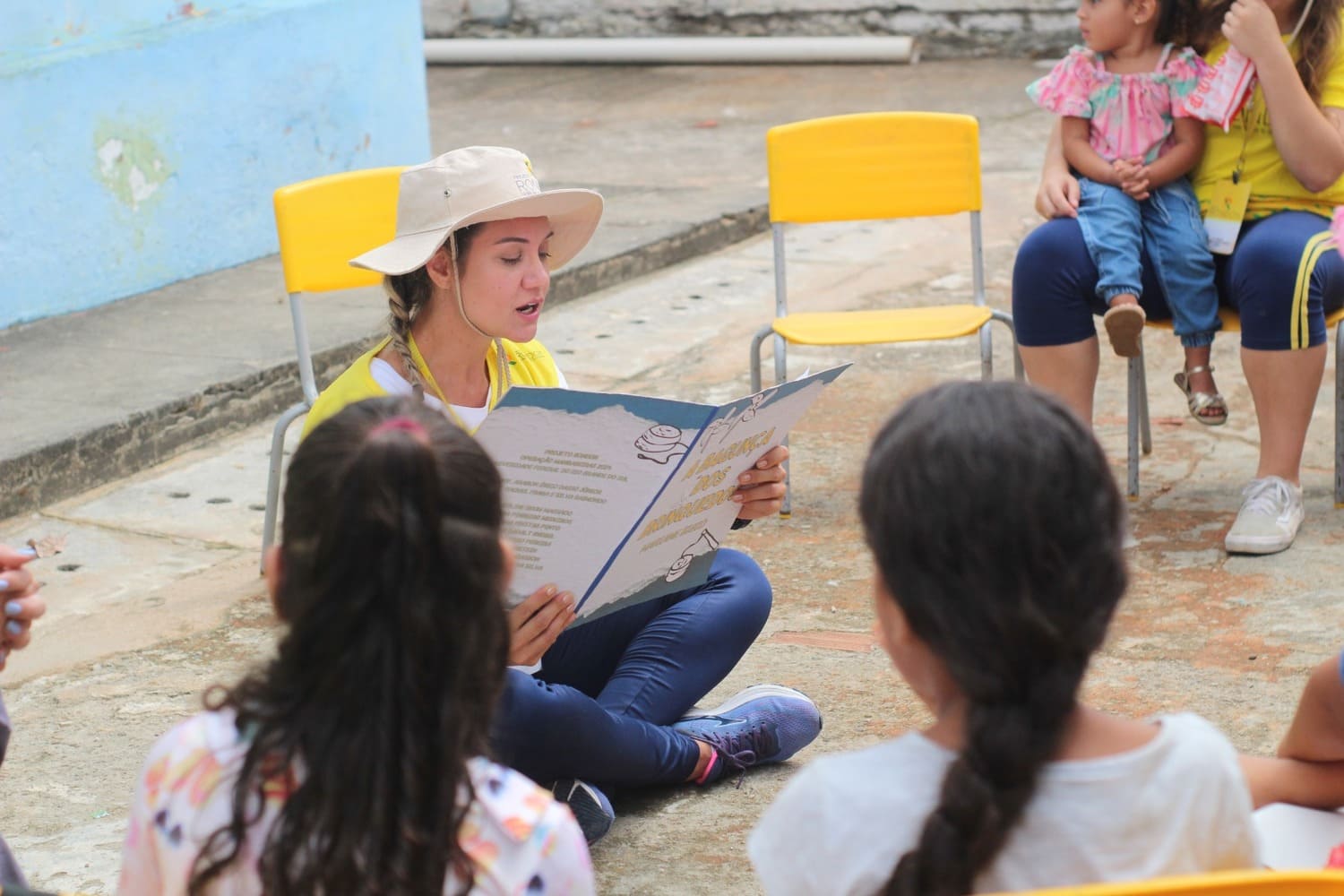
*Photo: Raquel Wainstein, a Nutrition student, reads a book to children in a circle (Credit: Luciana Pinheiro)
During two weeks of intense heat and hard work, Mariana Freitas, a Nursing student from UFRGS, noticed that many people struggled to identify as Black in a city with a significant Black population – the city is São Francisco, located in the interior of Sergipe. With a population of just over 3,000, São Francisco was one of the settings for “Operação Mangabeiras 2024,” which took place from January 19 to February 4, organized by the Ministry of Defense through the Rondon Project, aimed at promoting citizenship. UFRGS presented an intervention and workshop plan and was one of the selected institutions to participate.
All activities are planned before the trip, based on intensive research and investigation into the local problems and needs. One of the planned activities was the workshop on Education for Ethnic-Racial Relations, to be given by Mariana on January 30, near the end of the operation.
In the days leading up to the workshop, the Nursing student conducted home visits, administering a questionnaire to residents, one of which asked about ethnic-racial self-declaration. Many residents did not know how to answer. Mariana used herself as an example: “I am a Black woman. My skin tone is dark.” The locals immediately responded, “What do you mean?! You’re not Black, you’re moreninha (brown), don’t say that about yourself.”
Even so, the answers Mariana received regarding ethnic-racial self-declaration were shocking to her and made the planned workshop even more relevant.
“I started to realize that the population didn’t even have basic racial literacy, even though most of the population is Black.”
Mariana Freitas

The Girl with Curly Hair
During the operation, the rondonistas—participants of the Rondon Project—maintained close contact with the inhabitants of São Francisco. One of the children, a Black girl with curly hair, was described as aggressive, which caught the rondonistas’ attention.
Mariana comments on her: “She was deeply captivated by the light-eyed white girls in our team. She kept saying how beautiful the girls were and how ugly she was, even though (wow!) the child was beautiful. She said she hated her hair and how people bad-mouthed her. The little girl was suffering from racism, and the way she found to avoid being affected was by being aggressive.”
The rondonistas responded to her aggression with affection, daily reminding the child of her beauty. After some time, the girl’s mother shared how her daughter’s behavior had changed during the days the rondonistas were in the city.
Aunt Mel
“Aunt Mel! Aunt Mel!” the children called out on the Sunday evening of January 28. This is how they referred to Melissa Knebel, a Dentistry student at UFRGS. They had gathered for “Cine Rondon,” an event where a film was projected on the wall of one of the houses in São Francisco. They called for Melissa to show that they had used the toothbrush and toothpaste kits distributed in the oral hygiene workshop conducted by her.
For Melissa, the Rondon Project experience was revitalizing: “I came back with a lot of energy to dedicate myself to the things I truly care about. Seeing how I got involved and how it worked out made me appreciate more the things I have here. It made me want to work in the SUS (Unified Health System), at a health post, as I originally planned.”
Melissa’s extroversion not only captivated the children of São Francisco but also made her the perfect choice to host a talent show organized by the group on the Saturday evening of January 27.

A Talented City
For Raquel Wainstein, a Nutrition student at UFRGS, the talent show, organized in collaboration with the rondonistas from the Federal Institute of Southeast Minas Gerais (IF Sudeste MG), was one of the striking moments of the trip: “I highlight it as one of the most memorable days. It was one of those days when everything could have gone wrong, but it went right. Suddenly, we look at the town square, and there are 120 chairs, people having fun, lighting up their phones and making lights.”
One of the goals of UFRGS participants was to stimulate the local economy, which the talent show helped achieve as vendors gathered in the square to sell their products while the event took place.
That night, the harmony between the two rondonist institutions operating in São Francisco was undeniable. A beautifully decorated stage was set up in the town square, and while some people worked on calling the population, others gathered sign-ups. Others still searched for background music, as most performances would consist of singing songs. But there was mote: one of the elderly women presented embroidery, and a child drew during a set time slot.
The City’s Greatest Problem
Even though the talent show was recreational, it was intended to integrate the rondonistas with the community. Caroline Brum Machado, a Museology student at UFRGS, recalls an encounter at the end of the activity: “A social assistance worker said that several autistic children performed that night, something she would never have imagined.”
“I know how to draw sneakers; that’s my talent,” said one of the autistic children when signing up for the event. “The moment we received feedback from the community, saying that children who went on stage were very shy and didn’t socialize, and that we were facilitating their socialization, was very moving. At that moment, I held back tears,” Caroline concludes.
It was during a popular participation workshop, led by Victoria Mendonça, a UFRGS Administration student, that the community identified the lack of knowledge on how to deal with autistic children as the most urgent issue to resolve in the city.
“We had already thought about addressing this, but the teachers [who guided and supported the rondonistas] thought the locals wouldn’t identify it as a problem, that it would be difficult for us. But, actually, it was very easy for them to discuss it.”
Caroline Brum Machado
Much More than Nostalgia
At the last minute, Caroline was invited by Victoria to join the popular participation workshop. For the Museology student, it was a happy surprise: “I really want to work with museum education for children and museological theory. When I arrived there, I realized I really want to pursue a master’s degree in Design, focusing on the inclusion of neurodivergent people in museums.”
It’s unanimous. After returning to Porto Alegre, the nostalgia from the experience is shared by all the rondonistas. But beyond the nostalgia, the impacts of “Operação Mangabeiras 2024” remain in both São Francisco and the hearts of the young women who crossed the country.
Victoria Mendonça was the creator of the “rondonista future” workshop, which aims to plant the seed of the Rondon Project among the youth of the community, stimulating the exercise of citizenship. Raquel comments that all the young locals echoed the same sentiment: “I hate this town; there’s nothing to do here. There’s no future!” And she adds, highlighting the importance of the work created by her colleague: “We realized that all they needed was encouragement. To show them that they have enormous potential, and the town does too. They just need to unite.”

Translated into English by Lucas Eduardo Camargo, undergraduate student enrolled in the course “Supervised Translation Training II (English)” of the Undergraduate Program in Language and Literature, under the supervision and translation revision of Professor Elizamari R. Becker (P.h.D.) – IL/UFRGS.